Christmas Controversies 3.1

A commentary on political correctness.

Every Christmas since blogging, I’ve written about Christmas controversies and every year I keep reading about a “War on Christmas.”  It appears there are people who believe the Christian festival of Christmas is under attack. Personally, I have never witnessed it nor have I talked to people who feel this way.  People who believe there is a war on Christmas take all-encompassing phrases like “Happy Holidays” as insults to Christianity. They make holiday greetings and decorations into hypothetically divisive political issues.

I find it intriguing to discover, according to the Washington Post’s article, Poll: Conservatives most likely to be offended by holiday greetings, that,

“the demographic groups most offended by “Happy Holidays” include strong conservatives (21 percent) …Trump supporters (18 percent) and all men (18 percent). These are the same groups of people that tend to say there is too much political correctness in society, yielding a paradox: The folks who complain the most about political correctness are the ones who are the most offended by what they see as “incorrect” speech.

To frame it another way, conservatives [traditionalists] often caricature liberals [according to Dictionary.com, those who are open-minded or tolerant, especially free of or not bound by traditional or conventional ideas, values, etc.] as too quick to take offense over politically incorrect speech. But in the [Public Policy Polling] PPP poll, people who described themselves as “very conservative” were more than twice as likely to be offended by “Happy Holidays” (21 percent) as “very liberal” respondents were to be offended by “Merry Christmas” (10 percent).”

As I talked about in my last blog post, Christmas Controversies 3.0, Trump wholeheartedly jump on the “Christmas is under attack” bandwagon when he told a rally of his devotees in Grand Rapids, Michigan “We’re going to start saying ‘Merry Christmas’ again.”

Mostly of what I’ve read, this so-called war seems to be an American phenomenon, but unfortunately it is overflowing into Canada.  It appears that some Canadians, or at least some of our politicians in the province of Alberta, are claiming that Christmas is under attack. Newly elected United Conservative Party (UPC) leader Jason Kenney has turned the holiday celebrating Jesus’ birth into a political issue.

Global News’ article, Twitter mocks Jason Kenney for suggesting the left thinks ‘saying Merry Christmas is hateful’, reports that Kenney was quoted as saying in a column posted by the Calgary Sun,  “The problem is people on the left [those labelled liberal thinking] think saying ‘Merry Christmas’ is hateful,” and that  “Those voices of crazed political correctness will not govern what is allowed.”

What I found even more captivating is Kenney reacted to the Twitter backlash of his comment by tweeting on December 21st, “It was a *joke* about the excesses of political correctness.” Most confusing to me was he said in the tweet, “But not too far off the mark at a time when songs like Jingle Bells & White Christmas are generating controversy.”

I had never heard of the classic songs of Jingle Bells and White Christmas being scandalous. What is so controversial about one of the best-known and commonly sung songs in the world?  Even more surprising was to learn that the 1942, “White Christmas,” made famous by Bing Crosby; a song reminiscing about an old-fashioned Christmas scenery, that is, a snowy Christmas. What could be contentious about that? I wanted to know, so I did some research.

According to the Guardian, in the article, Is Jingle Bells racist? Despite backlash from the right, it’s not black and white, a Fox News host told viewers that the “Newest Christmas controversy has social justice warriors claiming this classic holiday carol is racist,” warning that Kyna Hamill was urging people to “shun the jaunty tune.”

Kyna Hamill is a university lecturer who probed the origins of the popular carol, and published her findings, perceiving that during the past 160 years the song had become an example of music whose “blackface and racist origins have been subtly and systematically removed from its history”. Hamill did say much reporting of her research was incorrect and laden with “all sorts of absolutely absurd” accusations.

It seems that there are those that think the popular Christmas song, ‘White Christmas’, is a racist song as well.  This controversy originated, according to Opposing Views, when country music star Darius Rucker,  an African American singer and songwriter, who was asked to perform at the annual Christmas tree lighting ceremony at the Rockefeller Center. When Rucker began singing ‘White Christmas,’ people protesting the death of Eric Garner, a black man who was killed by a white police officer in Staten Island, flooded the Rockefeller Center and the surrounding area. The public turned to Twitter to voice their objections. “The irony of watching Darius Rucker singing ‘White Christmas’ around the corner from the Eric Garner protest is mind-blowing,” tweeted a law student based in Cincinnati, Ohio.

Critics of the singing of White Christmas, believe that the reference to the colour “white” by a black singer during a time of racial tensions was offensive and suggested a contempt for the feelings of other black people. Now I can only speak for myself, but that seems to be a stretch for me. Some individuals appear to look for any opportunity to create a political issue. I am still trying to wrap my head around as to why they feel the need to do so.

My conclusions: There is NO “War on Christmas.” Christmas is not being attacked. There are those that want us to believe it is, but all evidence that I’ve found says this ‘war’ is a myth being perpetrated by some for political gain.

I really like what Christopher Stuart Taylor, a Diversity and Inclusion Professional, says in his Huffpost article, If We Can’t Say ‘Merry Christmas’ in Canada, Multiculturalism Failed. Mr. Taylor wrote:

“As I returned the greeting I wondered: since when did “Merry Christmas” become a political statement especially in multicultural Canada? … Multiculturalism is a complete and utter failure in Canada when it is politically incorrect to say ‘Merry Christmas.’ …. When was the last time you told someone you didn’t know ‘Merry Christmas’ without pausing and wondering if they may or may not be offended?”

For those that do not know, multiculturalism is official policy in Canada, as it should be. The Act says, it is hereby declared to be the policy of the Government of Canada to recognize and promote the understanding that multiculturalism reflects the cultural and racial diversity of Canadian society and acknowledges the freedom of all members of Canadian society to preserve, enhance and share their cultural heritage.

That tells me there is no need to stop wishing people ‘Merry Christmas’.  As I said in my last post, it is really about common-sense etiquette. If you know someone is a Christian who is celebrating Christmas wish them ‘Merry Christmas.’ Likewise, say ‘Happy Hanukkah’ to those you know to be Jewish.  To your Hindu friends say happy Diwali when they celebrate. During Ramadan, say “Ramadan Mubarak” which means “Happy Ramadan”. If you don’t know a person’s faith, don’t worry about political correctness. Just say what feels right. When in primarily a Christian country, no one should be offended when greeted with a ‘Merry Christmas.’. If I were in Israel, I would not be offended if someone wished me a “Happy Hanukkah.” Most non-Christians would not be offended when wished a Merry Christmas in a Christian country?

The statistics appear to agree. According to the Washington Post’s article I sited earlier, “only 3 percent of respondents said they’d be personally offended if somebody said “Merry Christmas” to them. But 13 percent said “Happy Holidays” would be offensive to them. So, individuals who opt for the more inclusive, nondenominational “Happy Holidays” may end up offending more people than if they’d just said “Merry Christmas” in the first place.”

Christmas Controversies 3.0

A commentary on the Christmas controversies of 2017

I realize it has been a while since I’ve published a post and I’ll tell you more about that in another post, but the Christmas season is fast approaching so it seems only appropriate that this post be about Christmas. Every year at this time of year, I am curious about what controversies will erupt regarding Christmas. I’ve learned this year, like previous years, there are many.

In October, while speaking at the Values Voter Summit in Washington, D.C., Donald Trump claimed that political correctness has gotten in the way of celebrating the holiday. He told the crowd that “we’re saying Merry Christmas again” now that he’s president. At the Christian public policy conference, he said “We’re getting near that beautiful Christmas season that people don’t talk about anymore. They don’t use the word Christmas because it’s not politically correct.”  (see Trump: ‘We’re saying merry Christmas again’). I can’t say as I’ve experienced that as most people still say “Merry Christmas” in my community.

Every year we hear about this storm.  Essentially, the issue is about political correctness and whether people should say to one another Happy Holidays or Merry Christmas. To me there is nothing to debate. Just let common sense prevail, but it seems common sense is not so common. It is really about basic etiquette. If you know someone is a Christian who is celebrating Christmas you should say to them ‘Merry Christmas.’ Likewise, say ‘Happy Hanukkah’ to a person you know is Jewish. Similarly, say a happy Diwali to your Hindu friends. Diwali is the autumn Hindu festival of lights celebrated every year.  During the month of Ramadan, Islam’s holiest month, say “Ramadan Mubarak” which means “Happy Ramadan”. If you don’t know a person’s faith, say what feels right; either Happy Holidays or Merry Christmas. Being that Canada (and the U.S.) is primarily a Christian country, no one should be offended. If I were in Israel, I would not be offended if someone wished me a “Happy Hanukkah”. Why would a non-Christian be offended when being wished a Merry Christmas in a Christian country?

In fact, The Guardian’s article, Don’t cancel Christmas on behalf of Muslims like me – I love it by Remona Aly, a Muslim, says, “Trying to avoid offending the sensibilities of other religions by watering down Christmas traditions merely fuels the myths of Islamic intolerance.”  The article also says, “there are non-Christians who won’t feel comfortable with saying, “Happy Christmas”, or with being in a nativity play, and that’s totally fair enough and up to them. They shouldn’t be treated like weirdos, nor should they be labelled with that grating word, “intolerant”. So there you have it. I doubt a non-Christian would be offended in a Christian country that celebrates Christian festivals. Why would they?

ABC News article, Upside down Christmas tree trend sparks controversy online, describes a trend whereby Christmas trees are literally turned upside down and decorated. So why would this be controversial? It seems some on social media say this fad is disrespectful to Christmas traditions. Well, traditions can and do change. Now, to be honest, I don’t believe this fad will catch on, but if someone thinks it is cool, then why knock it. Everyone is free to celebrate how they wish so long as it is not injuring someone else.

I’m curious. Where did this idea of decorating a tree for Christmas come from? No one can say for certain, but Country Living’s article, Where Did the Tradition of the Christmas Tree Come From?, says in 1771 “while Christmas trees were appearing in Germany years earlier, the trend really caught on after writer Johann Wolfgang von Goethe visited Strasbourg, near the German border, and included the concept in his novel, The Sorrows of Young Werther”. That same article says that the 1820s was the first record of German settlers in Pennsylvania decorating evergreen trees in America.  It is interesting to note that as late as the 1840s Christmas trees were seen as pagan symbols and not accepted by most Americans.

According to History.com,

“The early 20th century saw Americans decorating their trees mainly with homemade ornaments, while the German-American sect continued to use apples, nuts, and marzipan cookies. Popcorn joined in after being dyed bright colours and interlaced with berries and nuts. Electricity brought about Christmas lights, making it possible for Christmas trees to glow for days on end. With this, Christmas trees began to appear in town squares across the country and having a Christmas tree in the home became an American tradition”.

Now I say to you, traditions regarding the decorating of the Christmas tree have evolved over the years, and they continue to today. No reason to get offended, folks!

Now for the final controversy that I’ll address. It seems for three years in a row now, Starbucks has been immersed in a Christmas controversy over its Holiday cups. This year is no different. According to the New York Times article, Starbucks Is Criticized for Its Holiday Cups. Yes, Again, some people feel that Starbucks is promoting homosexuality.  The interlinked hands on the 2017 Starbucks holiday cups have some suggesting a “gay agenda.” Are people just looking for something to attack Starbucks about?

On November 1st the Holiday cup was introduced with an online video. It featured a diverse cast of Starbucks customers, including a pair of cartoon women who were shown holding hands. The nature of cartoon women’s relationship was not specified, but some viewers saw them as a sign of inclusion of gay and transgender customers. My reaction to that is gay and transgender customers should be included. Why would a business exclude a potential customer? More importantly, I would like to remind people what Christmas is about.

I think the late Dale Evans. an actress and singer, said it best when she said, “Christmas, my child, is love in action” or the late Bob Hope, an actor, comedian and singer, who said, “My idea of Christmas, whether old-fashioned or modern, is very simple: loving others”.  Christmas is the time Christians celebrate the birth of Jesus. This is the same child that grew up to give a new commandment, according to Christian scripture. In the Book of John, chapter 15, verse 12, Jesus says, “I give you a new commandment, that you love one another. Just as I have loved you, you also should love one another”. He didn’t say love only those you approve of. In fact, in Luke 6.27 Jesus says, “But I say to you, Love your enemies, do good to those who hate you.” Jesus’ message was to love everyone. No exceptions!

Since Christmas is a Christian holiday, I’ll define love using Christian scripture. In 1 Corinthians 13:4-8, it says, “Love is patient; love is kind; love is not envious or boastful or arrogant or rude. It does not insist on its own way; it is not irritable or resentful; it does not rejoice in wrongdoing, but rejoices in the truth. It bears all things, believes all things, hopes all things, endures all things”. This says love is kind and love does not insist on its own way. It seems to me excluding gay and transgender people stems from arrogance and insisting on its own way.  This is not love; in essence, going against the spirit of Christmas.

Dr, Elisabeth Kübler-Ross, a Swiss-American psychiatrist, once said,

“There are only two emotions: love and fear. All positive emotions come from love, all negative emotions from fear. From love flows happiness, contentment, peace, and joy. From fear comes anger, hate, anxiety and guilt…”

If this is true, why do people fear the LTGB community? It is time to stop fearing one another and get back to the true meaning of Christmas; a message of love, acceptance, and inclusion. Perhaps this is what Starbucks is endeavouring to tell the world; that Christmas is about loving and accepting one another.

Do Good Samaritans Exist?

A commentary about the goodness of people.

Helen Keller, an American author, political activist, and lecturer, once said, “Science may have found a cure for most evils; but it has found no remedy for the worst of them all – the apathy of human beings.”  The Free Dictionary defines apathy as a ‘lack of interest or concern or as indifference.  George Carlin, an American comedian poked fun at this quote when he said, “Scientists announced today that they have discovered a cure for apathy. However, they claim no one has shown the slightest interest in it.” Leo Buscaglia, an American motivational speaker and writer is quoted as saying, “I have a very strong feeling that the opposite of love is not hate –it’s apathy. It’s not giving a damn.”

So why am I bringing up the subject of apathy? I have to admit that sometimes I can be cynical. By that I mean I believed that people are motivated chiefly by selfish concerns. So where does that cynicism come from? I’ve determined that its from the news media. For example, here are two recent news headlines: Indian guru jailed 20 years for raping 2 followers and killer costs family $45K fighting estate. When you hear stories like these, you begin to believe  that people are selfish, uncaring and apathetic.

Of course, there are people in the world that are selfish, uncaring and apathetic, but are these people commonplace? The Guardian has an article called,  We’re not as selfish as we think we are. Here’s the proof says, “The media worships wealth and power, and sometimes launches furious attacks on people who behave altruistically.” Altruism is unselfish concern for the welfare of others.  So is this true? The article sites a study by the Common Cause Foundation which reveals two findings:

The first is that a large majority of the 1,000 people they surveyed – 74% – identifies more strongly with unselfish values than with selfish values. This means that they are more interested in helpfulness, honesty, forgiveness and justice than in money, fame, status and power. The second is that a similar majority – 78% – believes others to be more selfish than they really are.

I recently had a stark reminder that my belief that humanity tends to be selfish, uncaring and apathetic simply isn’t true.  A few weeks ago, my wife and I were on our way to a lake with our fifth wheel when we encountered four Good Samaritans. The Free Dictionary defines a Good Samaritan as ‘a compassionate person who unselfishly helps others, especially strangers.

In case you are not familiar with the Good Samaritan story, I’ll give you the Wikipedia summary version. It comes from the Christian biblical story found in the book of Luke, chapter 10, verses 25–37 where Jesus tells a parable which is a simple story with a moral or a story told to teach a lesson. This story is about a Jewish traveler who is stripped of clothing, beaten, and left half dead alongside the road. First a priest and then a Levite comes by, but both avoid the man. Finally, a Samaritan happens upon the traveler. What makes this story so powerful, is that in biblical times Samaritans and Jews  despised each other, but strangely it is the Samaritan who helps the injured man.

So, back to my story. About five minutes into our trek we encounter our first good Samaritan. A vehicle pulls alongside of us (we were on a four-lane highway) and using hand gestures signals us to pull over. Heeding his signals, we pull off to the side of the busy highway as did the Good Samaritan. Not knowing why he signalled us to pull over, we get out to talk to this man who thankfully told us that he saw rubber flying from our trailer. It turned out that we had blown a trailer tire. We were very grateful to this kind man who took time out of his drive to inform us of the unfortunate incident.

from winjana5thwheelers.com.au/

After taking in what happened, we notice another fifth wheel parked just ahead of us. A lady comes walking towards our truck and fifth wheel to talk to us. This is when we encounter our next three Good Samaritans. This wonderful lady tells us that they had just blown a tire on their RV and her husband and son had just finished changing it. She asked us if we would like them to change our tire since her husband was a retired trucker and had lots of experience, as well as the equipment to do so. She assured us that is was not a problem or an inposition for them. How could we refuse an offer like that, so we accepted their gracious offer. After the tire was changed, we both drove to a tire shop in the community where we came from. The young man even volunteered to carry our blown tire into the shop for us. Who says Good Samaritans don’t exist. We encountered four of them in a few minutes.

Curious, I searched to see how common Good Samaritans are. Global News has a page with links to several Good Samaritan stories. One the stories is about a Teen Hero, a story about a 13-year-old North Vancouver teen when he heard a woman screaming at a strip mall in July of this year. When he saw was a man carrying a bag and running away from an SUV with a smashed window, so the teen chased down the man and tackled him wrestling the bag out of his hands. This does not sound like someone who is selfish, uncaring and apathetic to me.

An even more heroic story, Mother of 5 loses both legs, describes an incident that happened in April of this year, when a mother of five from Florida had to have both of her legs amputated after helping a car crash victim. Dani Hagmann was driving home on a highway when she noticed another car on the road had lost control and crashed. She stopped, got out to assist the driver, called 911, and waited with the injured woman until first responders arrived. Wanting to keep the injured person comfortable, she went to get a blanket when another vehicle crashed and pinned Hagmann in-between the two cars. She certainly wasn’t selfish, uncaring and apathetic. There were many more stories on the site and there are other sites.

Now I’ve always known that the world was full of ‘good’ people, but sometimes we humans can get sucked into rhetoric and the sensationalized, ‘bad’ news stories reported by the media. I know I did. Don’t believe everything you see and hear in the news. It is misleading and can give you a false sensation that people are selfish, uncaring and apathetic. There truly are more ‘good’ people on this planet than there are ‘bad’ people. When I think about my life experience so far, I can think of countless acts of kindness shown to me and my family by random strangers. That is what I want to focus on and not what I hear on the news. You should too!

We Are Not All the Same

A commentary on stereotyping

I recently saw on Facebook a video called, All That We Share. It is a video that was created in Denmark and provides a powerful message about stereotyping. To be clear on what stereotyping is, Simply Psychology defines a stereotype as “a fixed, over generalized belief about a particular group or class of people.”  If you haven’t seen the video, here it is.

The video discusses many stereotypes, but let’s focus on some of the common ones. First, let’s look at a big one, perpetrated by rhetoric by populist movements about immigration. A common stereotype that I’ve personally heard many times is that ‘immigrants are taking our jobs’. The reality is immigrants are usually filling job vacancies.  A country that is short of skilled workers will fill them with skilled migrants. Immigrants also will take jobs that most others are not prepared to do such as housecleaning. The fact is, migrants are not taking jobs away, rather they are filling a void.

Other stereotypes I’ve heard are; Immigrants don’t contribute to society’, ‘They are costing the country money’ and ‘They send money out of the country’. Like all of us, foreign workers pay taxes, pay rent, and spend money in our local economies on supplies such as clothes and food.  Even if they send some money to their home country, they are still helping out our local economies.

Another stereotype is; ‘Immigrants put pressure on the health care and education system’. It is true that helping newly arrived children with their English does add extra stress on the education system, but children from other countries have helped to save some schools from closure and expose children to cultural diversity which in turn builds tolerance. Let’s be honest; health care services could not function without the many doctors, nurses and supplementary staff from other countries. That is especially true for rural areas. I live in a rural area and all of our doctors are immigrants.

According to Migration Policy Debates (May 2014) using new and internationally comparative evidence on the fiscal impact of migration for all European OECD countries, as well as Australia, Canada and the United States:

Immigrants are thus neither a burden to the public purse nor are they a panacea [cure all] for addressing fiscal challenges. In most countries, except in those with a large share of older migrants, migrants contribute more in taxes and social contributions than they receive in individual benefits. This means that they contribute to the financing of public infrastructure, although admittedly to a lesser extent than the native-born.

Now there are other stereotypes regarding immigrants, but those are the ones I personally have had people say to me. Stereotypical remarks are not only made about immigrants, but also about aboriginals.  One stereotype I often heard in my youth was the stereotype of the “drunken Indian”. It was assumed by some that if you were of aboriginal ancestry you had a drinking problem.

According to a CBC News article, employers felt justified in refusing employment to aboriginal people based on this stereotype. Landlords would not rent to aboriginal people. Some establishments, bars mostly, refused to let aboriginal people enter. Taxi drivers drove past aboriginal people on the street. The daily humiliations added up to real social and economic barriers.

Not all aboriginal people have a drinking problem. That is a fact! I can personally attest to this as I have had the privilege of working with First Nations peoples over the years. Having said that, aboriginal communities have high rates of alcohol and drug use and consequently high rates of Fetal Alcohol Syndrome among their children. The reasons why aboriginal people have struggled with addictions have been studied for years. The root causes are pretty well documented. It all connects to residential schools, the Indian Act, child welfare issues, Indian agents, geographic isolation, racism, intergenerational trauma and so on. I like the way the CBC article ends.

Let’s spend our energy in supporting the healing, rather than propping up a label that only makes the healing process that much harder.

Now let’s address the most common typecasting that is occurring in our society today; the stereotyping of Muslims.  According to the Huffington Post, there are five common stereotypes.

One such stereotype that I have heard is, “Muslims hate Jews and Christians’. This is simply wrong.  There are multiple chapters in the Quran that mention non-Muslims. Now the Quran, like the Christian bible is subject to interpretation and there are plenty of verses that could be interpreted as Muslims are called to reject non-Muslims.  However, there are verses in the Quran stressing that justice be given to even those who show hostility and hate to Muslims.  Qur’an 5:8 says; “Do not let the hatred and animosity of other people prevent you from being just. Be just! That is nearer to righteousness”. That does not sound like a hatred to me.

Another stereotype is, ‘Muslims don’t believe in Jesus Christ’. What does that mean exactly? Does that mean that Muslims do not believe that Jesus existed. What people don’t know is Jesus is actually mentioned more times in the Quran than Muhammad is. Muslims believe that Jesus is an important prophet, but they do not recognize Jesus is the son of God as the Christians do. Nor do Muslims believe that Jesus died on the cross. They believe Jesus escaped crucifixion somehow. Muslims do believe in God, but call God “Allah”, the Arabic word for God.

C8TAPN Headlines Concept – Terrorism

The most common stereotype I hear is; “Muslims are terrorists” or ‘Islam promotes groups like Al Qaeda and ISIS’. This is not so. The Huffington Post rationalizes it this way.

ISIS most closely follows the ideals of Wahhabism and Salafism, which are extremist and radical branches of Islam. By best estimates, 87-90 percent of Muslims are Sunni and 10-13 percent are Shi’a, with small numbers belonging to other sects. If we go with these statistics, it’s safe to assume that Salafism and Wahhabism are less than five percent of the global Muslim population, and most likely does not represent the beliefs, thoughts, opinions, or actions of other Muslims. Additionally, Islam was not meant to have sects. However, Islam does not promote, nor does it encourage, joining radical groups. If you see stories of how people get radicalized, it’s usually through ISIS members themselves on radical jihadist forums.

In June, a Muslim “peace march” against Islamic terrorism was held in the German city of Cologne. (see Muslim Peace March).  Hundreds of marchers held banners including one that said: “Love for all, hatred for none,” and “A Muslim protects lives and does not take them”. This clearly refutes the stereotype that Muslims are terrorists. Clearly there are some who are not.

To have “a fixed, over generalized belief about a particular group or class of people.” is simply ridiculous. To declare that all world leaders are ‘idiots’ based on the reported idiotic behaviour of one or two world leaders (no names mentioned) is flawed logic. There always have been some ‘idiot’ leaders and some fantastic leaders. It is wrong to lump a group of people together and think that they all act the same. Not all Christians act the same. Not all Caucasians act the same. Why would we think all immigrants, indigenous people and Muslims act the same? Ridiculous.

The Pope, a TED Talk Celebrity

A commentary on the importance of community.

A few days ago, I went to the CBC news website to see if anything significant was happening in the world. This is something I do frequently. I was surprised to see an article called, Pope urges powerful to put people ahead of products in surprise TED Talk. My first reaction was, “the Pope gave a TED talk? How cool is that. When I read the article, and watched the talk, I was taken with his message as it made me think. Now I don’t always agree with the pope, but in regards to this talk, I think his message is one that the world needs to hear. It was a message about how influential people are failing to help those in need, and what the pope refers to as a “culture of waste”, a culture that puts products ahead of people. If you haven’t seen the talk, here it is.

The first thing that struck me in the Pope’s TED talk were his words:

People’s paths are riddled with suffering, as everything is centred around money, and things, instead of people. And often there is this habit, by people who call themselves “respectable,” of not taking care of the others, thus leaving behind thousands of human beings, or entire populations, on the side of the road. Fortunately, there are also those who are creating a new world by taking care of the other, even out of their own pockets. Mother Teresa actually said: “One cannot love, unless it is at their own expense.”

The pope is absolutely right. Our society is centred around money. Our society tends to put money and possessions before people. According to Wikipedia, a 2012 study for the years 2002–2008 found that about 25% of all senior citizens living in the United States declared bankruptcy due to medical expenses, and 43% were forced to mortgage or sell their primary residence. A 2004 Organization for Economic Co-operation and Development (OECD)  report said: “With the exception of Mexico, Turkey, and the United States, all OECD countries had achieved universal or near-universal (at least 98.4% insured) coverage of their populations by 1990.” I will always be grateful that Canada has a universal health care system. Private, for profit health care is but one example where money and possessions are prioritized before people.

We are all familiar with those stories where people are treated as outcasts. The Syrian refugees would be one such group, but I would rather focus on the second part of the statement, that is, “creating a new world by taking care of the other.” One such example of this is Ontario’s basic income pilot project (see basic income). Basic income is when payments are provided to eligible families or individuals that ensures a minimum level of income. Ontario’s plan is to implement a pilot program. Supporters of the basic income say it could eliminate poverty and streamline government bureaucracies because a basic income would replace many other benefits, potentially including welfare, unemployment insurance, Old Age Security as well as others. Glasgow in the United Kingdom is considering such a project as well (see BBC). Sweden and Switzerland are also considering Basic Income programs (see Huffpost). The way I see it, basic income programs are merely a way of “taking care of the other”.

It’s interesting that research is indicating that “taking care of the other” is what happens in nature. Science Daily reports in their article, Species Take Care Of Each Other In Ecological Communities, that a University of Alberta study has determined that there are rules of existence in tropical rain forests. One species will not take up too much space so as to not squeeze out other species. Researchers say this is a way that ecological communities regulate themselves. Really, it is just “taking care of the other”.

Another message the pope had that caught my attention were his words,

Please, allow me to say it loud and clear: the more powerful you are, the more your actions will have an impact on people, the more responsible you are to act humbly. If you don’t, your power will ruin you, and you will ruin the other. There is a saying in Argentina: “Power is like drinking gin on an empty stomach.” You feel dizzy, you get drunk, you lose your balance, and you will end up hurting yourself and those around you, if you don’t connect your power with humility and tenderness. Through humility and concrete love, on the other hand, power – the highest, the strongest one – becomes a service, a force for good.

“With Great Power Comes Great Responsibility” This is a quote by Benjamin Parker (Uncle Ben) in the Marvel comic series “Spider-Man”.  Those in positions of power have a responsibility to do what is best for all the people they have influence over. Political leaders must, as Pope Francis says, be willing serve others as a force of good. It was Mahatma Gandhi who said,

“The day the power of love overrules the love of power, the world will know peace.” This is so true and this is really one of Pope Francis’ key messages in the TED talk. Or, to put it in the pope’s own words:

But the future is, most of all, in the hands of those people who recognize the other as a “you” and themselves as part of an “us.” We all need each other.

The blog called Tiny Buddha, gives six reasons for why we need one another in a post called The Power of Community,. They are:

  1. Collective wisdom. No one person ever has all of the answers. This makes sense since the more ideas there are, the more likely a solution to a problem can be found.
  2. Pushing our limits. When a person is alone, it’s easy to give up when things get tough. When you’re with others you’ll have people to motivate, and push you to do things you likely wouldn’t do otherwise.
  3. Support. On those days when you most want to give up or just can’t seem to move forward, you need to lean on your community for support to get you through.
  4. New ideas.  In a diverse world, there are many views. That is a good thing as it provides many approaches to a problem since everyone sees things differently.
  5. Motivation.  Sometimes all we need to do is look around our community to be inspired.
  6. Accountability.  When you’re accountable to others you are more likely to “step up to the plate” and accomplish something.

There is no doubt, in my view, that we need community; that we need one another simply because we cannot do it alone. The poet, John Donne, says it best when he said, “No man is an island, entire of itself; every man is a piece of the continent.” We need one another therefore we have a duty to take care of one another. There is an idiom that says, “I am not my brother’s keeper”, but I say we are our brother’s keeper. That is what Pope Francis is saying. If humanity is to survive, we must take care of one another. I would add we also need to take care of our home, the planet earth, as well because I know the pope would agree with that as well.

Malala Yousafzai: One of Today’s Heros

A commentary on the impact of Malala Yousafzai

On April 12, Malala Yousafzai became a honourary Canadian in a ceremony in our parliament in Ottawa.  That is when Canadian citizenship is bestowed upon a foreigner for extraordinary distinction. It is purely a symbolic honour as recipients do not take the Oath of Citizenship or receive rights, privileges, or duties typically held by a Canadian citizen. Only five other foreigners have received honorary Canadian citizenship before Malala. Two notables are Nelson Mandela and Tenzin Gyatso. In 2001, Nelson Mandela, an anti-apartheid activist, former President of South Africa, and recipient of the 1993 Nobel Peace Prize became a honourary Canadian citizen. In 2006, Tenzin Gyatso, the 14th Dalai Lama and recipient of the 1989 Nobel Peace Prize also became a honourary Canadian citizen. Malala Yousafzai became the sixth person in history to receive such an honour.

Ms. Yousafzai is a Pakistani student and education activist who was born July 12, 1997, making her a mere 19 years old. She is known for her crusade for girls’ and women’s rights, most especially for a girl’s right to go to school. Sadly, she was a victim of a gunshot attack in October 9, 2012, when she was shot by the Taliban. The Taliban are a radically militant Islamic group that controlled some 90% of Afghanistan between 1996 and 2000. They set out to create the world’s most pure Islamic rule by introducing a disturbing and deeply revolutionary form of Muslim culture. Under the Taliban, women were forbidden to work outside the home, were forced to wear a head-to-toe covering known as a burka, and could not leave the home without a male guardian. The Taliban also prevented women from having access to health and education. After the assassination attempt, Malala was given emergency treatment in Pakistan and then moved to Great Britain for more medical treatment.

Malala Yousafzai is one impressive young lady. For a person who has only lived 19 years, she has had an enormous impact on this planet. At age 11, she became known because of a weblog published by BBC News. The BBC issued translated writings about her life under Taliban rule. In October 2013, a book about her life I am Malala: The Girl Who Stood Up for Education and Was Shot by the Taliban was published, with her help. This is a very educational and inspiring book, so I would encourage you to read it. Yousafzai was chosen by TIME magazine as a candidate for 2013’s Person of the Year. She was nominated for the World’s Children’s Prize for the Rights of the Child in 2014. Also in 2014, Yousafzai has won a Nobel Peace Prize, the youngest person ever to do so. She will also be given a Doctor of Civil Law degree by the University of King’s College located in Halifax, Nova Scotia. I’m sure her list of accomplishments will grow. This is a person I have grown to admire and in fact consider a hero. If you haven’t heard the speech she delivered on April 12, here it is.

I happened to be waiting for our SUV to be serviced in a waiting room in the car dealership with the TV on. At that moment, a news channel was broadcasting Malala’s speech. Two parts of her speech caught my attention. The first was:

The man who attacked Parliament Hill called himself a Muslim — but he did not share my faith. He did not share the faith of one and a half billion Muslims, living in peace around the world. He did not share our Islam — a religion of learning, compassion and mercy.

I am a Muslim and I believe that when you pick up a gun in the name of Islam and kill innocent people, you are not a Muslim anymore.

He did not share my faith. Instead, he shared the hatred of the man who attacked the Quebec City mosque in January, killing six people while they were at prayer.

The same hatred as the man who killed civilians and a police officer in London three weeks ago.

The same hatred as the men who killed 132 schoolchildren at Pakistan’s Army Public School in Peshawar.

The same hatred as the man who shot me.

Malala is confirming what I have stated before in posts such as; Are All Muslims Extremists? Contrary to the rhetoric we’ve heard south of the border, all Muslims are NOT terrorists. Most Muslims are peaceful, law-abiding individuals. As Malala says, “when you pick up a gun in the name of Islam and kill innocent people, you are not a Muslim”.  The same holds true for Christians as well. When a person picks up a gun in the name of Christianity and kills an innocent person(s), you are not a Christian. In fact, the same is true for any world religion as when you get down to the core beliefs or practices of any world religion, they all advocate for peaceful coexistence. It is when people start interpreting religious sacred scripture in ignorance that the true teachings of the religion become warped.

The other portion of Malala’s speech that caught my attention is:

I have travelled the world and met people in many countries. I’ve seen firsthand many of the problems we are facing today — war, economic instability, climate change and health crises. And I can tell you that the answer is girls.

Secondary education for girls can transform communities, countries and our world. Here’s what the statistics say:

  • If all girls went to school for 12 years, low and middle income countries could add 92 billion dollars per year to their economies.
  • Educated girls are less likely to marry young or contract HIV — and more likely to have healthy, educated children.
  • The Brookings Institution calls secondary schooling for girls the most cost-effective and best investment against climate change.
  • When a country gives all its children secondary education, they cut their risk of war in half.

Education is vital for security around the world … because extremism grows alongside inequality — in places where people feel they have no opportunity, no voice, no hope.

When women are educated, there are more jobs for everyone. When mothers can keep their children alive and send them to school, there is hope.

But around the world, 130 million girls are out of school today. They may not have read the studies and they may not know the statistics — but they understand that education is their only path to a brighter future. And they are fighting to go to school.

Now as an educator for 35 years, I know this to be true. Secondary education, not just for girls, but for all people can transform communities, countries and our world. I especially was struck by her statement, “When a country gives all its children secondary education, they cut their risk of war in half”.  It seems to me that the cure for violence and conflict is education. This makes sense to me as through education we can teach tolerance and understanding. It is ignorance, and especially fear, that breeds tensions and conflict. It is education that will decrease a fear of Muslims. It is education that will prove to sexists and misogynist that the sexes are equals. Science has unequivocally proved this. To quote Nelson Mandela, “Education is the most powerful weapon which you can use to change the world”. So as Malala says, “Education is vital for security around the world”.

The Hideous Consequences of Political Rhetoric

A commentary on the increase in “hate crimes” due to political rhetoric.

rhetI am deeply disturbed by some of the events occurring in my beloved country of Canada. I have always been proud of the fact that Canada celebrates cultural diversity. Multiculturalism in Canada is the sense of an equal celebration of racial, religious and cultural backgrounds.  The Canadian federal government, under then Prime Minister Pierre Elliott Trudeau, put forth the ideology of multiculturalism which places emphasis on the social importance of immigration. The Canadian Multiculturalism Act is a law that was passed in 1988 and it aims to preserve and enhance multiculturalism in Canada. When I taught high school social studies I always proudly emphasized this fact to my students. So, when I learn of islamophobia, anti-Semitism, and anti-immigration views expressed in my country, I am alarmed and angered. These are some of the things that have happened in Canada.

In early March, Montreal police arrested a 47-year-old man hours after a bomb threat targeting Muslim students forced the evacuation of three buildings at Concordia University’s downtown campus. Apparently, several media outlets in Montreal received a bomb threat claiming to be from the “Council of Concerned Citizens of Canada,” a white supremacist organization also known as C4, which claimed that “small […] amateur explosive devices” had been placed in two buildings on the University. The email stated that C4’s goal was to injure Muslim students. The email also began by citing the election of U.S. President Donald Trump as inspiration for the group’s violent agenda (see CBC News).

Also in early March, a late-night fire at an Islamic information centre and mosque is being investigated by Toronto police. A police spokesperson said the fire is considered “suspicious” and being investigated as arson. It was not ruled as a hate crime then, but it certainly “smells” like a hate crime (see CBC News).

The Globe and Mail is reporting that police are investigating the discovery of swastikas inside an Ontario university classroom this week which left some students feeling distraught; the school calling the symbols “hate graffiti”. The news report says the police are treating the incident as a case of mischief at the time of the article. Marc Newburgh, CEO of Hillel Ontario told reporters, “This incident is an unfortunate reminder that anti-Semitism continues to persist even in a society as welcoming as Canada and a city as diverse as Toronto.” Hillel Ontario is an organization that strives to enrich the lives of Jewish students attending Ontario’s colleges and universities (see Globe & Mail). Sure seems like a hate crime to me.

Far right groups opposed to a federal government motion condemning Islamophobia took to the streets of Montreal in early March. On the opposing side were around 100 representatives of anti-fascist groups, carrying signs saying “Make racists afraid again” and chanting “Immigrants in, fascists out.” Tensions between the groups quickly flared despite a police presence (see CBC News).

Then there was the Quebec City Mosque attack that occurred on January 29th. Alexandre Bissonnette, only 27, was charged with six counts of first-degree murder and five counts of attempted murder while using a restricted firearm. During that attack, six men died in the shooting while evening prayers were underway at the Centre Culturel Islamique de Québec (Islamic cultural centre of Quebec) [see CBC News].

A Winnipeg business owner who identifies herself as a witch says her store has been repeatedly vandalized over the past six years and she wants police to investigate the incidents as hate crimes. Dominique Smith owns Elemental Book & Curiosity Shop Inc. Smith sells alternative spirituality products such as herbs, crystals, incense, books and tarot cards. She also teaches classes out of the business and occasionally has gatherings for worship and rituals. She says her shop’s window has been broken three times. She has had people come into the store harassing her and her staff, telling them that we were evil and needed to repent. Ms. Smith says she’s had to clean spit and urine off of her door and windows countless times over the past few years (see CBC News).

Now I ask the question: what has happened to “tolerance and understanding”? Why does it appear to be disappearing? Don’t get me wrong. I’m not that naive. Canada has always had its share of racists and bigots, but for the most part my country is seen as a tolerant, multicultural society. In fact, analysts at the London-based think tank, the Legatum Institute, ranks 142 countries based on their economy, entrepreneurship and opportunity, governance, education, health, safety and security, personal freedom and social capital.  In 2015, the Institute ranked Canada as number one for being the “freest country in the world” with its tolerance of immigrants, minorities, freedom of expression and beliefs. In fact, an overwhelming percentage of Canadians (92 %) agreed that their country is a good place for immigrants. The United States was ranked 15th for personal freedom (see CTV News).  In 2016, Canada dropped to second place and the United States dropped to position 26 in terms of personal freedom. (see Legatum 2016).

mother-teresa-beautiful-words-love-thy-neighbor-quotes-if-you-judge-people-have-not-time-acknowledge-them-caring-givingCanada is predominantly a Christian country. In the 2011 National Household Survey, two-thirds of Canada’s population reported affiliation with a Christian religion. Christianity is a religion that follows the teachings of Jesus whose teachings focus on the themes of love of God and love of neighbour. In fact, Matthew 22:36 – 40 in the Christian scriptures says, ‘Teacher [Jesus], which commandment in the law is the greatest?’ He [Jesus] said to him,” You shall love the Lord your God with all your heart, and with all your soul, and with all your mind.” This is the greatest and first commandment. And a second is like it: “You shall love your neighbour as yourself.” On these two commandments hang all the law and the prophets.’ If Christians believe this, then I do not understand why Canadians (at least some of them) are becoming (maybe they’ve always been so) increasingly intolerant and bigoted. At least this is what the various news articles are suggesting is the trend. It just doesn’t fit with the teachings of Jesus.

Sadly, this trend seems to have begun when the US presidential campaign began and much anti-immigration, anti-Muslim and anti-Mexico rhetoric began filtering into Canada’s news. Middle East Eye, an online news organization that provides news from a Middle Eastern perspective, reports that Donald Trump’s election victory is causing a ‘spill-over effect’ in Canada, where hate-motivated incidents have seen a recent spike (see MEE). Even some of our Canadian politicians are now spewing toxic, divisive rhetoric. I truly thought Canadians were different; that Canadians were more tolerant because of our multicultural diversity.  In fact, our Prime Minister, Justin Trudeau, during an address in London, United Kingdom, in November of 2015 said, “Diversity is our strength.” Now I always thought so, but perhaps I’m just naive.  It was Pierre Bayle, a French philosopher, who once said, “It is thus tolerance that is the source of peace, and intolerance that is the source of disorder and squabbling”. He is so right! I still choose to believe that the majority of Canadians are tolerant and welcoming people no matter what race, religion and belief a person may have. The individuals carrying out these despicable hate crimes act out of fear perpetrated by rhetoric. Publius Cornelius Tacitus, a senator and an historian of the Roman Empire, once said, “Fear is not in the habit of speaking truth.” People are acting out of fear and thus executing heinous, hateful, acts because of lies spread by toxic political rhetoric. This has to stop!

Why is the Vatican Still Stonewalling Pope Francis?

A commentary on the sexual abuse scandal in religious institutions

Pope_Francis_Korea_Haemi_Castle_19_(cropped)CBC recently had a story that caught my attention. The story was called, Leading member of pope’s sex abuse panel quits, says Vatican is stonewalling. I haven’t heard much about the sexual abuse scandal in a long time, so I naturally assumed that the church had dealt with the issue. It seems I was wrong.

The news article reports that Marie Collins, a member of the Pontifical Commission for the Protection of Minors, quit out of frustration because of the lack of co-operation from other Vatican offices, known as the Curia. Ms. Collins claims there is “cultural resistance” at the Vatican that include some officials refusing the pope’s instructions to reply to all correspondence from abuse survivors. Collins wondered if the continuing reluctance to address the problem is “driven by internal politics, fear of change, clericalism which instills a belief that ‘they know best’ or a closed mindset which sees abuse as an inconvenience?”

clapping-hands-transparent-b-g-mdNow I applaud Pope Francis as I sincerely believe  he is trying to correct a wrong. A CBC article, Pope condemns “evil” child abuse, reports that in 2014, Pope Francis made his first public plea for forgiveness for the “evil” committed by priests who molested children. He then stated, “I feel compelled to personally take on all the evil that some priests… [committed]… to personally ask for forgiveness for the damage they have done for having sexually abused children.” He went on to say, “The Church is aware of this … personal, moral damage carried out by men of the Church, and we will not take one step backward with regards to how we will deal with this problem…” It was then that Pope Francis set up the Pontifical Commission for the Protection of Minors, a commission whose job was to propose the best initiatives for protecting minors and vulnerable adults, so that everything possible was done to ensure that no more children are abused by predator priests.

Historically, there was a systematic cover up by bishops and other Catholic hierarchy in many dioceses around the world to cover up the crimes of pedophile priests who raped children and committed other sexual abuses. This was done by moving allegedly abusive priests to other parishes, where abuse often continued. Protection of the institutional church became of all-encompassing importance to the Catholic hierarchy. Here is a brief history of the sexual abuse scandal in the Catholic church.

According to the National Catholic Reporter, reports of clergy sexually abusing children first surfaced in the mid 1980s. In the mid-1990s a number of books were published on the topic. The topic became the focus of intense scrutiny and debate after the Boston Globe published a series of articles covering cases of sexual abuse in the Boston archdiocese.

The National Catholic Reporter reports that in January of 2002, a Judge ordered Boston Cardinal Bernard Law to turn over 10,000 pages of records. The Boston Globe used this evidence to initiate an extensive series on clerical sexual abuse in the archdiocese. It was the Globe and Mail that revealed that John Geoghan, a former Boston priest, who was accused of abusing more than 130 children during his 30 years as a priest and as a result was convicted of molesting a child in 1991 and sentenced to 9-10 years in prison where he was killed by a inmate.

According to a study being conducted by John Jay College of Criminal Justice in New York, about 4% of priests committed an act of sexual abuse on a minor between 1950 and 2002. However, it should be noted that the graphs and statistics sited in the report end before the Boston scandal.

The sexual abuse of children under the age of consent by priests has been reported in the United States, Canada, Ireland, the United Kingdom, Mexico, Belgium, France, Germany and Australia as well as other nations throughout the world. Many of the cases spanned several decades and were brought forward years after the abuse occurred.

This abuse is not unique to the Catholic church. Wikipedia has a list of abuse allegations that occurred in Jewish communities, Church of Jesus Christ of Latter Day Saints (Mormons), the Anglican Church, as well as other religious institutions.

It isn’t just prevalent in religious communities. In Portland, Ore, a jury reached a $1.4 million verdict against the Boy Scouts of America in a trial that showed that since the 1920s, Scouts officials kept “perversion files” on suspected abusers but kept them secret.

The Huffington Post reports that in June 17, 2012 then Pope Benedict XVI told Irish Catholics that it is a “mystery” to him why priests and other church officials have been abusing children entrusted to their care for at least the past several decades.

Much of the abuse in the Catholic church was directed towards altar boys. I was an altar boy in the 1960s so I could have easily been one of those victims. Thankfully, I wasn’t. I can easily see how the abuse occurred. In the 1960s it was taught that the “holy fathers” (priests in other words) were directly consecrated by God.  These men believed they were Christ’s representatives on earth and were acting on Christ’s behalf.  These men were often put in charge of large numbers of children who have been taught that priests are God’s representatives and must be obeyed in all matters. You can see how easily abusing young children would have been. Talk about a “betrayal of trust.” I personally knew some of the priests who were accused of sexual abusing children.

I also personally know people who have experienced sexual abuse, none of which were by priests however. Nonetheless, I’ve seen firsthand what this abuse has did to them. People who were abused as children become damaged adults. Sexual Assault Services of Saskatchewan (SASS) is a provincial membership organization that supports agencies who offer services to survivors of sexual assault and abuse. This organization says survivors experience many of these responses after sexual assault or abuse:

  • Diminished self-esteem with frequent feelings of shame, humiliation, guilt, anger, and powerlessness
  • Negative self/body image and feelings of ugliness associated with shame and embarrassment of body
  • Physical symptoms of stress – such as headaches, stomach upsets, eating and sleeping problems, lethargy
  • Increased anxieties or tendency towards depression or depressive behaviour
  • Feelings of anger, fear, rage, couple with numbness and disconnection from shock
  • Increased isolation from others, withdrawn or difficulty trusting others
  • Erratic mood swings from hyper-alert to inconsolable grief to aggressive
  • Increased usage of alcohol or drugs to numb or cope with feelings and memories
  • Self-harm such as cutting, burning or scratching as way to numb or cope with feelings
  • Difficulty in returning to usual behaviours with inter-personal relationships
  • No or little desire for sexual intimacy
  • Increase in risky sexual behaviours
  • Flashbacks of the incident(s) and fear of being alone
  • Nightmares or other sleep disturbances
  • Loss of employment or school time due to inability to concentrate

This is why, in my view, sexual abuse by clergy is so difficult to comprehend. These men were supposed to be holy folks; people who carry out God’s work, yet they carried out heinous acts. This is why, in my view, crimes by the priesthood or a minister are so much graver and need to be taken seriously. Furthermore, those at the top of the hierarchy who knew of these scandalous acts, and yet still protected the abusers, should be even more shamefaced. I applaud Pope Francis for trying to prevent these atrocious crimes from happening again, but it seems there is still resistance within the church to deal with the issue seriously.

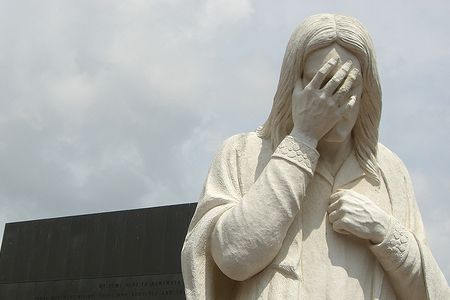
weeping-jesusThe Guardian quotes Father Thomas Doyle, a former canonical lawyer at the Vatican’s Washington embassy, as saying, “One of the massive holes in the Roman Catholic church’s approach to this issue, still today, is a failure to completely comprehend the depth of the spiritual damage that is done to the victims, to their families, especially their parents, to their friends and to the community itself.”  It is not difficult to understand why the faithful are confused when they were taught that sexual acts outside of marriage were intrinsically evil, always a mortal sin (an action that leads to a separation from God’s saving grace), and never moral, regardless of intention or circumstance. To preach one thing and act in opposition to what was taught would confuse anyone. I’m sure Jesus must be weeping.