Littering! Really?

A commentary on the disrespectful act of littering.

For the past three summers, my wife and I have camped for several weeks at a campsite near where we live. This campsite is beside a river and has a golf course where I golf at least once a day. The campsite is located in a beautifully treed area where you can truly feel connected with nature. I don’t need to write about the health benefits of being in nature as I did that in my post Nature’s Wonders in May. Spending time golfing and having campfires is what I’ve been doing for the last few weeks so in case you’ve been wondering, that is why I haven’t published anything lately.

My wife loves to walk and so I go for walks as often as I can with her. It’s good quality time together and we often have some of our best talks doing this. We either walk around the campsite visiting the occasional camper that we know or we walk down a rural road near the campground. It’s about a six kilometre (3.7 mile) walk to the location we go to and back. The road is a gravel road so sometimes we get bombarded with dust when a vehicle goes by but for the most part the road is a beautiful walk in the river valley.
litter
From Litter Heros website

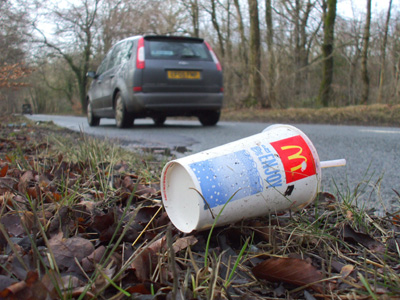
The last time I walked this route, I was alone which gave me more time to observe my surroundings. What struck me was the amount of litter I saw. I counted eight (8) soft drink or coffee cups. They were from such fast food restaurants as Dairy Queen (DQ), Tim Horton’s, and MacDonald’s.  I also saw fast food napkins, a hamburger Styrofoam box, a beer bottle and a beer can. There were also candy wrappers and a level which must have fallen off a work truck. That was what I could see just from the road. I’m sure there was much more litter as the grass was long in the ditches. What disturbs me about finding beer containers is the people who tossed them likely were drinking and driving. That to me is alarming!

Years ago our son was in 4H and every year the 4H clubs participated in the Alberta Highway cleanup where 4H members gather to clean up a section of a highway. I participated with him and what I remember most about that event was the number of cigarette packages there were. Smokers seem to be some of the worst litterers. The second most common piece of litter we picked up were fast food cups. Of course there were numerous bottles and cans and other miscellaneous items including dirty diapers. During a town cleanup last year we picked up mainly fast food cups, cigarette packages, along with other miscellaneous items and yes even dirty disposable diapers.

I’ve tried to understand why people litter and the only thing I can conclude is that people are just too lazy to find a garbage can and that people really don’t care about our environment. This inspired me to learn more about the topic.

Here are some facts from a website created by a Litter Reduction Task Force to address the litter issues within the Region of Waterloo, Ontario, Canada. This site is called, The only cure for litter is you.

  • The average distance someone will carry garbage before littering is 12 paces.
  • Most litter occurs within 5 meters of a garbage receptacle.
  • Single use food and beverage litter made up 45 per cent of litter cleaned up in the Great Canadian Shoreline Cleanup in Ontario, Canada.
  • There are 8,000 tonnes of cigarette butts dropped by Canadians each year, the majority within 10 feet of an ashtray. It takes 10 years for the filter to biodegrade.

What people need to understand is that much of this litter remains in the environment for a long time. According to this same website, it takes an aluminum can 80 to 200 years to break down naturally but if recycled, it can be reused within six weeks.  Here is some information about how long it takes other items to break down naturally.

  • Banana peel: 3 to 4 weeks
  • Paper bag: 1 month
  • Cardboard: 2 months
  • Wool sock: 1 year
  • Tin steel can: 50 years
  • Disposable diapers: 550 years
  • Plastic bags: 20 to 1000 years
  • Plastic jug: 1 million years
  • Glass: 1 to 2 million years
  • Styrofoam: 1+ million years
6_pack_duck_270x224
From humanesociety.org

It seems obvious to me that people just don’t care what they are doing to Mother Earth. So that begs the question, Why should we care about the problem of littering? According to the same website,

  • Litter is damaging to plant life. Litter can stunt plant growth.
  • Every year, millions of birds, fish and animals die from ingesting litter.
  • Litter on the ground and in our water is dangerous to humans.
  • Litter destroys the beauty of the community. Litter begets litter. One piece of litter on the ground signals others to litter.
  • Litter is a safety hazard. It is a breeding ground for rodents and bacteria.

According to the website, Conserve Energy Future (CCF),

  • Littering is expensive. Every year millions upon millions of dollars are spent cleaning up litter. This money should be going to more productive things, but instead, people don’t realize that something as small as littering done on a mass scale does indeed affect them. Taxpayers’ dollars are being spent on littering…
  • A very large majority of Americans have admitted to littering in their lifetimes. I’ll admit it. I have littered. The average American only walks a few steps before dumping their trash on the ground without even searching for a garbage can.
  • Billions of tons of litter are dumped into the ocean each year…This leads to the repeated killing of fish on a daily basis and the gradual depletion of marine life. Believe it or not, the litter we produce is causing more underwater species to become endangered.
  • Cigarette butts make up over half of our littered objects, and they take a grand total of ten years to decompose because of a cellulose acetate, contrary to the popular perception that cigarette butts decompose very quickly in only a matter of days. In reality, cigarette butts are a serious threat to the environment.

According to the article, Littering a crime of inconvenience for Canadians by Marc and Craig Kielburger, WWF Canada says Canadians are frustrated with environmental groups telling them that making small changes will have a big impact on our planet.

But Canadians are doing their part to clean up the mess we humans have created. According to the Kielburger brothers, The Great Canadian Shoreline Cleanup is one of the largest public action conservation programs in the country. Last year, more than 58,000 volunteers picked up litter along 3,000 km of shoreline and inventoried every piece. Having said that, we need to do more.

do-not-see-clipart-1It’s time we humans stop this disrespectful action of littering and start getting involved in public actions such as the Great Canadian Shoreline Cleanup, Alberta Highway Clean Up (if you live in Alberta) or in your local community spring clean-ups (see Communities celebrate spring with clean ups). It’s time to be stewards and to protect, respect and take care of our precious planet. No longer should we take our environment for granted. So do the right thing!

Climate Change Confusion

A commentary on whether humans are to blame for climate change

Carbonbrief.org, a UK-based website covering the latest developments in climate science, climate policy and energy policy, reports, Study links heatwave deaths in London and Paris to climate change. The study refers to the 2003 tragedy where more than 70 000 people across Europe died in a  heatwave. Climate Change is a reality. I don’t think anyone disputes that and the science community doesn’t either. All a person needs to do is take note of the strange weather the world has experienced in recent years. In June, we saw extremely wet weather in Europe causing flooding in Paris, France and Germany. In the United States there has been sizzling heat in the Southwest causing uncontrollable wildfires in California.  West Virginia has experienced severe flooding. In the province of Alberta, 88 000 people had to be evacuated from Fort McMurray because of wildfires. Also in June, Eastern China saw a tornado and hailstorm that killed at least 98 people when it sped over the city of Yancheng’s outskirts, destroying buildings, smashing trees and flipping vehicles on their roofs. The list of weird weather goes on and on.

There is no question that our weather is changing and becoming extreme. The ongoing debate is: Is it human activity that is causing climate change? Now I’ve taught about this topic in science for many years and there has been no doubt in my mind that it was indeed humans causing global warming which leads to climate change. I would show the graph comparing CO2 levels to average global temperatures and use it as evidence to convince my students. I would show them pictures of the shrinking polar ice cap and melting glaciers. I would show them Al Gore’s movie: Inconvenient Truth (see trailer below) and emphasize Al Gore’s argument that most of the scientists around the world agree that humans are the main reason for the global warming.

The article Scientific consensus: Earth’s climate is warming on NASA’s Global Climate Change website agrees with Al Gore’s conclusions as it says,

Multiple studies published in peer-reviewed scientific journals show that 97 percent or more of actively publishing climate scientists agree: Climate-warming trends over the past century are extremely likely due to human activities. In addition, most of the leading scientific organizations worldwide have issued public statements endorsing this position.

The Scientific America article: Is Global Warming a Myth? also agrees with Al Gore as it says,

…scientists have not been able to validate any such reasons for the current warming trend, despite exhaustive efforts. And a raft of recent peer reviewed studies—many which take advantage of new satellite data—back up the claim that it is emissions from tailpipes, smokestacks (and now factory farmed food animals, which release methane) that are causing potentially irreparable damage to the environment.

I have always believed that Al Gore must be right. But then I watched a video, on my son’s insistence, called, Climate Change: Fact or Fiction by Dr. Gary Smith (see below). Dr. Smith convincingly argues that humans are not causing global warming.

Global Research.ca, an organization that seems to me to be credible, has an article called Global Warming: Ten Facts and Ten Myths on Climate Change that seems to agree with Dr. Smith’s conclusions. This article agrees with Dr. Smith as it says,

 Climate has always changed, and it always will. The assumption that prior to the industrial revolution the Earth had a “stable” climate is simply wrong. The only sensible thing to do about climate change is to prepare for it.

The reality is that almost every aspect of climate science is the subject of vigorous debate. Further, thousands of qualified scientists worldwide have signed declarations which (i) query the evidence for hypothetical human-caused warming and (ii) support a rational scientific (not emotional) approach to its study within the context of known natural climate change.

So now I’m confused. I thought it was all clear in my mind but now I’m not so sure. The more I learn, the more confused I get. But I guess that is nothing new as Albert Einstein once said, “The more I learn, the more I realize how much I don’t know.”  Even Aristotle said, “The more you know, the more you know you don’t know.”

So now I’m not sure what to think. Am I convinced that humans are not to blame for climate change? NO I’m not. I suspect that we humans are contributing to the problem, but it could also be, at least in part, to natural changes in climate as the earth has gone through many warming and cooling periods. I suspect climate change is due to both. Having said that, I continue to believe that moving away from our addiction of fossil fuels can only help our planet. It just feels like the right thing to do. I guess we will just have to wait and see who wins the debate.

Don’t throw that away!

The CBC news article, Starbucks pledges to donate 100% of unsold food, reported that Starbucks corporation on March 23, 2016 publicized plans to eliminate food waste and donate all of its unused food items from its U.S. stores to the needy within five years. Perishable items such as breakfast sandwiches, salads, and other ready-to-eat meal packages would be donated. The company said it will add up to five million meals in its first year, and more than 50 million free meals by 2021. They plan to use an agency called Food Donation Connection (FDC) to get the items to the food banks and homeless shelters. Since 2010, Starbucks has been collecting pastries at the company’s 7,600 stores after they can no longer be sold to customers, and working with FDC to get the pastries to people who need them.

Canadian Starbucks locations will not be included in the program, but a spokesperson told CBC News that Canadian Starbucks is watching closely. Food consultancy Value Chain Management International Inc. estimates that roughly $31 billion worth of food is wasted in Canada every year. According to a Starbucks spokesperson, “In Canada we currently have measures in place to donate unused food and are working to formalize the practices so that we can maximize our efforts in this market.”

I did some research and learned that there are other companies who donate unsold food. According to an article on AME Science, Tesco is a British multinational grocery and general merchandise retailer who plans to eradicate all its food waste by 2017. They’ve started several projects to achieve this goal. It has also started selling “wonky veg” boxes, to encourage consumers to buy imperfect foods. In a 14-store pilot programme the company provided the equivalent of 50,000 meals to less fortunate people.

oranges10a
from theguardian.com

According to figures published by Tesco 55,400 tonnes of food were thrown away at its stores and distribution centres across the country in 2015. This would be the equivalent of over 125,000,000 meals, assuming all the food were edible. Even if half of it is edible, that still brings a huge amount of meals. Another article by Salon reports Tesco’s initial report found the biggest losses were in bagged salad, two-thirds of which was being discarded either in-store or by customers; it was also wasting 40 percent of apples, a quarter of grapes and a fifth of bananas.

I was curious as to why grocery stores throw out so much food although it is only 10% of the total food wasted, whereas about 14% of all household food is wasted according to davidsuzuki.org. The site says over 30 percent of fruits and vegetables in North America don’t even make it onto store shelves because they’re not pretty enough for picky consumers. According to Business Insider, the reasons why stores waste is:

  • Most grocery stores assume that customers are more likely to buy produce if it’s from a fully stocked display.
  • Customers expect perfect produce. Retailers stock their produce according to that expectation.
  • Customers don’t understand what expiration dates, sell-by dates, use-by dates, or best-by dates mean. They assume that food is no longer good after these days. Instead, sell-by dates are guidelines for sellers to indicate peak freshness. Most foods are good long after the sell-by date. Consequently, most grocery stores pull the items from the shelves several days before the sell-by date.
  • Sometimes, product packaging gets damaged during shipping, causing supermarkets to toss products even though the food hasn’t been compromised. The assumption is that no consumer is going to buy it if a faulty one is right next to it.

So why don’t all stores donate the unsold food to charities. From what I can determine, the reason is businesses fear they will be held liable should the product donated later cause harm to the recipient. It’s Interesting to note that in 1996 U.S. President Bill Clinton passed the Good Samaritan Act to encourage companies to donate healthy food that would otherwise go to the waste dump. This law protects businesses from liability when they donate to a non-profit organization. To my knowledge Canada has no such law. The province of Ontario, however has such a law called the Donation of Food Act which was passed in 1994.

clapping-hands-transparent-b-g-mdKudos to the Starbucks and Tesco corporations. I’m quite sure my research is not thorough. I’m sure there are other companies out there so I applaud any of the companies I’ve missed who donate unsold food to charities.

On August 7, 2015 I wrote a post about the France National Assembly who voted unanimously to ban supermarkets from throwing away or destroying unsold food.  According to the article, France pass new law forbidding food waste, large grocery stores must donate edible food to charities and allow inedible food to be used for animal feed or compost.

I have since learned that Italy is set to become the second European country to pass legislation that will pressure supermarkets to stop throwing out food waste, and instead give it to those in need. (See Italy’s about to pass law). The soon to be Italian law is slightly different from the French law in that Italy’s legislation rewards companies for donating by reducing their rubbish tax. The more food companies donate, the bigger savings they’ll receive in taxes.

Thumbs upThumbs up to the European countries of Italy and France who are making efforts to waste less food and support less fortunate people. Kudos to the United States and to the province of Ontario for passing laws that protect companies who choose  to donate food instead of throwing it out. It is time for other provinces or Canada as a whole to do the same.

smileyMy research also showed me that there are many food rescue (also known as food recovery or food salvage) organizations in Canada and the United States. These organizations glean edible food from places such as restaurants, grocery stores, produce markets, or dining facilities and distribute it to emergency food programs. The food would otherwise go to waste. In Canada there are organizations such as Second Harvest and Forgotten Harvest. In the US there is Feeding America, Food Forward and many more. I salute those charity organizations who do the right thing.

British novelist and author of the Chronicles of Narnia, once said, “Integrity is doing the right thing, even when no one is watching.” I am so grateful that there are people, organizations, companies and countries in this world that have integrity.

World Water Day

WaterDayTuesday, March 22, 2016 is World Water Day. I had not heard of this day until recently when reading a news article, so I decided to do some research to find out why a day deemed World Water Day was created. What surprised me is this day has been held annually since the 22nd of March 1993, which was the first World Water Day. How could there have been twenty-three World Water Days in the past and I had not heard of it before? Do I live in a bubble? I’ve always known that fresh water was, and still is, a precious resource and that it is rapidly disappearing due to pollution and melting glaciers. In fact, I taught many lessons to my students about it over the years, but when I did some research on the topic, I was surprised by what I learned.

If I am truly honest with myself, I have to admit that I’ve always taken water for granted. There has never been a water shortage where I live. There has always been plenty of fresh, clean water to drink, to have a shower, to operate the clothes washer, to run the dishwasher, and to even water the lawn occasionally. I’ve always assumed, like most people I suspect, that we would always have a supply of fresh water. After doing some research, now I’m not so sure.

The Water Project is a non-profit organization providing reliable water to communities in sub-Saharan Africa. According to the website, water Scarcity is a reality on our planet! That means there is either the lack of enough water or lack of access to safe water. This site says 1 in 9 people worldwide do not have access to safe and clean drinking water. That means over a billion people on our planet lack access to safe water. The site also says that in developing countries, as much as 80% of illnesses are linked to poor water and sanitation conditions.

The World Water Council is an international multi-stakeholder council that promotes awareness, builds political commitment and triggers action on critical water issues. According to the Council, 1.1 billion people live without clean drinking water. The daily per capita use of water in residential areas is

  • 350 litres in North America and Japan
  • 200 litres in Europe
  • 10-20 litres in sub-Saharan Africa

That means each citizen of North America uses 350 litres every day. That’s a lot of water. It begs the question, are we wasting water?

From an agricultural perspective, the Water Councils says the quantity of water needed to produce 1 kg of wheat is 1 000 litres. Rice needs 1 400 litres and beef requires 13 000 litres of water. Perhaps it’s time to eat less steak.

Water.org is an international non-profit organization that brings water and sanitation to the developing world. Here are some interesting statistics I found on their site.

  • 663 million people – 1 in 10 – lack access to safe water.
  • 4 billion people – 1 in 3 – lack access to a toilet.
  • Twice the population of the United States lives without access to safe water.
  • More people have a mobile phone than a toilet.
  • Every 90 seconds a child dies from a water-related disease
eye
From ideahack.me

The Guardian’s article, How will climate change impact fresh water security? says fresh water scarcity is best understood by contemplating the distribution of fresh water on our planet. Approximately 98% of our water is in our oceans, which consists of salt water, and only 2% is fresh water. Of that 2%, almost 70% is snow and ice (namely glaciers), 30% is groundwater, less than 0.5% is surface water (lakes, rivers, etc.) and less than 0.05% is in the atmosphere. Climate change has had enormous effects on the amounts of fresh water available to us on the planet. The primary one is that global warming causes the polar ice caps and the world’s glaciers to melt into the sea, turning it into seawater.

Does this mean we should we alarmed? Yes it does. Does it mean we should lose hope for the future? No it doesn’t. All the various organizations I mentioned above are working towards solving the water scarcity problem. Science is also working towards solutions.

According to The Guardian’s article, 8 unbelievable solutions to future water shortages, science has come up with innovative ideas such as,

  • Waterless bathing using a lotion called DryBath which is a blend of essential oils, bioflavonoids (group of plant pigments), and an odour-eliminating chemical that is said to save four litres of water ever session.
  • Ultra efficient showers that use a screw-in device that captures water at the beginning of a shower and feeds it back into the system.
  • Using lasers to induce rain at times of drought, an idea debated by the World Meteorological Organization.
  • Folding toilets that make more efficient use of water. Its inventors claim that if installed it could save 10,000 litres per person every year.
  • Using a solar-chemical purification process that involves exposing titanium dioxide and zinc oxide to ultra violet radiation from the sun to produce a photo catalytic composite that cleans water.

According to the Canada Free Press’ article, Israel holds the solution to world water crisis, Israel has many new innovative products and policies. Some of these are drip irrigation and “fertigation,” a process of injecting fertilizers, soil amendments, and other water-soluble products into an irrigation system. Israel promotes dual-flush toilets, seawater desalination, advanced wastewater treatment and reuse, free-market pricing of water, drought-resistant seeds, cutting-edge metering and leak-detection systems, conservation education and precision agriculture.

Perhaps the most alarming thing that I’ve learned was on the World Water Council website. It said,

“As the resource is becoming scarce, tensions among different users may intensify, both at the national and international level. Over 260 river basins are shared by two or more countries. In the absence of strong institutions and agreements, changes within a basin can lead to transboundary tensions. When major projects proceed without regional collaboration, they can become a point of conflicts, heightening regional instability.”

Water-Wars-Logo
Logo from touchland.com

The prospect of “water wars” has been flaunted for decades and according to the article, Global ‘water war’ threat by 2030 – US intelligence, it may become reality within a decade. The article says the Office of the Director of National Intelligence (ODNI), the organization that oversees US intelligence agencies such as the CIA and FBI, was commissioned by President Barack Obama to examine the impact of water scarcity worldwide on US security. The ODNI predicts that by 2040 water demand will outstrip current supply by 40 per cent. The organization says it could lead to outright fighting, or water could be used as a tool of political leverage, similar to how gas and oil are used today. It suggests revising international water treaties and investing in superior water purification technologies that will make the increasingly scarce resource plentiful again.

The world faces many serious problems such as global warming and water scarcity. It is time for us to get our “heads out of the sand” and educate ourselves about these issues. Even more, it is time for us to get involved, even if it is something as simple as donating to an organization that brings clean water and sanitation to the developing world, taking shorter showers, or purchasing water efficient appliances. If we all do our small part, we will make a difference.

There is Hope

Evo Morales, an Indigenous Bolivian who has served as President of Bolivia since 2006, is quoted as saying, “Sooner or later, we will have to recognize that the Earth has rights, too, to live without pollution. What mankind must know is that human beings cannot live without Mother Earth, but the planet can live without humans.”  Mr. Morales is right!  We cannot continue to abuse Mother Earth without dire consequences.

According to The Watchers, a daily news service that relays information on global events, world evolution and transformation, there are many environmental catastrophes taking place on our planet. Here are some that I noted.

A state of emergency was declared over a large natural gas leak pouring high quantities of methane and other gases into a Los Angeles neighbourhood on January 6, 2016. Numerous residents reported health issues and thousands of people have been forced to evacuate the area. The leak of natural gas was first observed October 23, 2015, and is now the largest natural gas leak ever reported.

A flow of toxic mining waste, which spilled into a main river in the city of Mariana, Brazil on November 5, 2015 has traveled at least 500 km (310 miles) through the Rio Doce since the event. The disaster has been proclaimed as the country’s worst environmental catastrophe in history. At least 11 people were confirmed dead, 15 went missing and hundreds of homes were devastated.

bellandur-new-2
Bellandur Lake, India (dogonews.com)

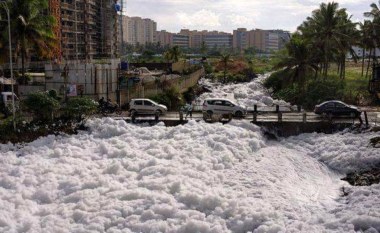
Bellandur Lake, the largest lake in the city of Bangalore, India, is extremely polluted by a high amount of ammonia and phosphate. From the air, the 36 km (22 miles) wide lake visually appears as if snow is covering a mountain. In reality what looks like snow is a large, white foam covering the water surface, an unnatural phenomenon resulting from extremely toxic, untreated, chemical accumulations. The froth has risen to a height of one meter.

A dam at a waste pond on Mount Polley Mine of British Columbia, Canada, full of toxic heavy metals burst on August 4, 2014, releasing 10 million cubic meters of wastewater and 5 million cubic meters of toxic slurry into Hazeltine Creek, Quesnel Lake and Polley Lake.  Mining experts warn that the incident is the largest mining disaster in Canadian history, possibly even globally.

There are many, many more environmental catastrophes listed on the Watchers website, and I haven’t even mentioned the biggest one facing the planet, that is, climate change. Now it would be easy to get down and discouraged when reading this kind information, but as they say, “every cloud has a silver lining”. I still believe that the human spirit is strong and that we can correct our wrongs, even when it comes to the environment. So what is the silver lining you may wonder?

The silver lining is that we now have a tremendous opportunity  to develop new technologies, which in turn would create new industries and jobs as well as benefit our planet environmentally. So what might these technologies look like? The Greenbiz website lists 9 technologies to clean up the planet.   The livescience site lists 10 emerging environmental technologies. Some that caught my attention are:

We now have technologies to prevent CO2 from entering the atmosphere. Some of these makes the CO2 into something else that can be sold as products. Skyonic Corporation is building a commercial CO2 capture plant scheduled to begin operating this year which is expected to reduce 300,000 tons of CO2 emissions per year through a combination of direct capture from a cement plant and the making of commercial products, such as baking soda. This is a technology that could help to curb global warming.

Nuclear reactors are becoming safer. The technology for nuclear power has become so efficient that they now use the byproducts of conventional nuclear power production as fuel. The travel wave reactors, backed by Bill Gates, look to use depleted uranium to generate electricity, rather than leaving it to be stored or used in other applications, such as ammunition. This technology makes nuclear power plants much safer and solves the problem of nuclear waste. This could very well be an alternative to the polluting coal burning power plants.

glaciers-melting-600x407
From the Berkeley Blog

The United Nations have predicted that water supply shortages will affect billions of people by the middle of this century. Desalination, the removing the salt and minerals out of seawater, is one way to provide potable water in parts of the world where supplies are limited but it is expensive and uses a lot of energy. Scientists are working toward better processes where inexpensive fuels can heat and evaporate the water before running it through membranes with microscopic pores to increase efficiency. That gives hope for new fresh water sources as much of our fresh water supply in the form of glaciers is melting and ending up in our oceans.

Hydrogen fuel cell usage has been touted as a pollution-free alternative to using fossil fuels. These cells make water by combining hydrogen and oxygen and in the process they generate electricity. Most recently, scientists have come up with ways to power laptops and small devices with fuel cells, and some car companies are promising that soon we’ll be seeing cars that emit nothing but clean water. That is great news for our environment.

OTEC technologies convert the thermal energy contained in the oceans and turn it into electricity by using the temperature difference between the water’s surface, which is heated, and the cold of the ocean’s bottom. This difference in temperature can operate turbines that can drive generators. This would be a clean source of electricity therefore helping to reduce climate change by eliminating coal burning power plants.

Bioremediation uses microbes and plants to clean up contamination. Examples include the cleanup of nitrates in contaminated water with the help of microbes, and using plants to uptake arsenic from contaminated soil. There is an urgent need to clean up many of the contaminated sites on our planet such as the Deloro mine, a 202-hectare site that lies 65 kilometres east of Peterborough, Ontario, Canada.

I recently watched Disney’s movie, Tomorrowland.  This movie delivers a  message of hope for humanity. It is a call to use our human mental abilities and imagination to make changes that can repair the environmental damage that we humans have created. Just reading about some of the many new technologies being developed gives me hope for our planet. We humans are masters at screwing things up, such as our environment, but we are resilient and savvy enough to fix our mistakes. It just takes public awareness through education, a political will, and economic motivation. New technologies create new industries and new jobs. We can fix our environmental problems and still have a thriving economy.  Keeping things at the status quo is not an option.

There is a Cree Prophecy that says, “When all the trees have been cut down, when all the animals have been hunted, when all the waters are polluted, when all the air is unsafe to breathe, only then will you discover you cannot eat money.” It’s time we put our health and our planet’s welfare ahead of profits. Our survival as a species depends upon it.


Bring the New Year

Here we are again saying goodbye to another year and bringing in another new year. It boggles my mind (mainly because it reminds me that I’m getting older) how fast annual events come about, whether they be birthdays, anniversaries, holidays or even the Stanley Cup playoffs. New Years is one of those annual events.

Now when you talk to people you discover that some people tend to live in fear. For example, these individuals are afraid to travel because “terrible things,” like terrorism, might (and I emphasize the word might) occur in the world. I categorize these individuals as the pessimists. Now I will admit that I sometimes can fall into this category. It’s easy to do. These are the people who always point out the negative in the world. These are the folks who say, “What kind of world will our children or grandchildren live in?” Fearful individuals seem to believe the world is “going to hell” and are anxious because 2016 will be even worse than 2015.

What I find interesting is that attitudes have not changed. My Mom talks about how her parents used to worry about the kind of world their children and grandchildren would be born into. My parents used to be concerned about the state of the world as they lived during the Cuban Missile Crisis and the Cold War. The world has always faced challenges and threats. Today is no different. The reality is the world continues to survive.

Now to be fair, there is some merit to their fear; to their pessimism.  2015 has seen many heartbreaking events. Here are some that caught my imagesattention. In October Hurricane Patricia, the most intense hurricane ever recorded in the Western Hemisphere, had winds up to 322 kilometres per hour (200 mph). November saw  multiple attacks by Islamic State of Iraq and the Levant (ISIL), the best known was the attack in Paris, France, resulting in 130 fatalities. Also in November of this year Turkey shot down a Russian fighter jet which is the first case of a NATO member destroying a Russian aircraft since the 1950s. In June of 2015, ISIL claimed responsibility for three attacks around the world during Ramadan such as the one in Kuwait City where a suicide bomber attacked a Mosque killing 27 people and injuring 227 others. Then there was the Greek government debt crisis in July when Greece became the first developed economy to miss a payment to the International Monetary Fund (IMF) in the 70-year history of the IMF.

Of course, I would be remiss if I didn’t mention the story that has been dominating the news most of the 2015 year and that is the Syrian refugee crisis; the worst refugee crisis since the Second World War.  The International Organization for Migration claims that more than one million migrants and refugees crossed into Europe in 2015. Now I could list other events, but there is no question that there have been numerous shameful events in 2015.

Thank God  (or Allah, or Yahweh, or the Universe) there are those who always see the good in the world. I categorize them as the optimists.  Optimists are filled with hope. These are folks who believe that the world can be better; that humanity is not all bad. Individuals such as these look to 2016 with an attitude of hope, hoping that things will improve.  I choose to align myself with the optimists.

There is merit to their argument. Here are some of the jovial events that caught my attention. In April, health officials declared the Americas the first region in the world to be free of the endemic rubella, or German measles, thanks to a 15-year effort to vaccinate men, women, and children everywhere in the northern hemisphere. This is great news since rubella can cause death or severe birth defects when women catch the disease during pregnancy. In July, history was made when Cuba and the United States reestablished full diplomatic relations, ending a 54-year history of GUSTAVO-CAMACHO-GONZALEZ-L1060274_(23430273715)hostility between the nations. In December, a global climate change pact was agreed upon at the COP 21 summit, where  195 countries adopted the first-ever universal, legally binding global climate deal. This is great news for the planet. Also in December of this year SpaceX, a company that hopes to revolutionize space technology, lands a Falcon 9 rocket.  This is the first reusable rocket to successfully enter the Earth’s orbit and return. This brings hope for space travel as it makes it cheaper. December also saw Indian Prime Minister Narendra Modi make a surprise visit to  Pakistan to meet his counterpart, Nawaz Sharif.  This is the first time an Indian leader has visited Pakistan in over a decade.  Relations between these two countries have been bitter ever since the violent division of British India in 1947, and the two nations have a history of  numerous military conflicts. This shows that good relations are possible between rivals. That gives hope that peace is achievable. Also in December the members of the Scottish Parliament voted unanimously in favour of a law to ban smoking in cars that are carrying children. That’s great news for kids. There are certainly more positive events of 2015 I could report, but you get the idea.

The Atlantic Monthly in December of 2015 , a magazine published in Washington, D.C,  wrote an article called 2015: The Best Year in History for the Average Human Being. The article cites numerous reasons for making this claim.  Here are a few that caught my attention.

“At the Paris climate conference in December, countries demonstrated renewed resolve to tackle global climate change together. Absent any policies enacted to slow climate change since 2010, the world might have been more than 4 degrees Celsius hotter in 2100 than pre-industrial temperatures. Existing policies to cut emissions reduced that forecast to 3.6 degrees, and the additional pledges in Paris brought it to 2.7 degrees Celsius.”
“The Global Terrorism Index says, 11,133 people died in terrorist attacks—suggesting terrorism accounted for about 1.8 percent of violent deaths worldwide. And for all that terrorism deaths have increased since 2012, they remain responsible for perhaps three hundredths of one percent of global mortality…Rabies was responsible for three times as many deaths as terrorism that year. Stomach cancer killed more people than murder, manslaughter, and wars combined…”
“Civil and political rights also continued their stuttering spread. While 2015 saw rights on the retreat in countries including Turkey and Thailand, the number of electoral democracies worldwide remains at a historic high according to Freedom House…This year, there were peaceful and democratic transitions of power in settings as diverse as Burkina Faso, Tanzania, Myanmar, and Argentina. And Saudi Arabia held local elections where, for the first time ever, women were allowed to stand as candidates and vote.”
The Atlantic Monthly focuses on the positives of 2015. What astounds me is instead of feeling good about the progress made in 2015, the pessimists choose to downplay the article. CBC did this in their article, 2015 ‘the best year in history’? Not everyone agrees. Why not be proud of what humanity has achieved in 2015? Why can’t humans celebrate the positives rather than dwell on the negatives?
When doing research for this post, I ‘googled’ predictions for 2016. What is intriguing to me is the vast majority of the predictions are ‘doom and gloom’ predictions.  One ‘hit’ was titled 2016 will be a year of living dangerously for the global economy.  The Inquisitr, an internationally recognized news website, predicts World War Three will start in 2016.  When you think about it, the third world war has already started as the war on terrorism involves much of the world community. I guess they’re right about that prediction. At least Newsweek predicts a  rise in electric cars which if it becomes true is great for the environment.  Now remember, a prediction is just a guess or a forecast.  When I ‘googled’, “How many predictions came true in 2015?” the vast majority of ‘hits’ were talking about the movie Back to the Future II. In this movie Marty McFly and Doc Brown travel to the future in their time machine, the DeLorean. The date set on the time machine was October 21, 2015.  The various websites were comparing the 2015 of today with the 2015 of the movie. I had little luck finding anything else. That leads me to believe that most of the predictions made for 2015 didn’t come true. Certainly some of the political changes that occurred in 2015 weren’t predicted.

best-year-everSo what will 2016 bring? The pessimists will likely envision , more ISIL terrorist attacks,  more anger from Mother Nature in the form of violent storms, more conflicts between nations, more economic problems, and on and on. Optimists will focus on the positives like improved political relations, the international community working together to slow climate change, improvements in human rights, improvements in health, and so on. I choose to be in the optimist camp. I choose to believe that 2016 will bring many good things. Really, the only thing we can control is the choices we make. To quote Brad Paisley, “Tomorrow is the first blank page of a 365 [366 for 2016] page book. Write a good one.” I’m choosing to make it a good one. I’m choosing to make 2016  a great year!

Interesting reads: 5 Major Trends and Make your 2016 better

Get it Right

If you follow the news at all, you know that the 2015 United Nations Climate Change Conference, also known as COP21, is presently being held in Paris, France. The talks started November 30 and will continue until December 11. The objective of the conference is to achieve a legally binding and universal agreement from all the nations of the world. The goal of the agreement is to reduce greenhouse gas emissions so as to limit the global temperature increase to 2 °C. If you are not familiar with greenhouse gasses and what is known as the greenhouse effect, here is a little science lesson.

GUSTAVO-CAMACHO-GONZALEZ-L1060274_(23430273715)It is referred to as the greenhouse effect because the earth acts just like a greenhouse does. The sun gives off electromagnetic radiation, in particular infrared radiation, visible light, and ultraviolet light. Visible light consists of short wavelengths of energy, which are able to pass through the glass or plastic of a greenhouse, and are absorbed. It is then released back as heat (thermal energy) or infrared radiation. This is what heats up the greenhouse as infrared radiation consists of long wavelengths of energy which are unable to pass through the greenhouse’s glass or plastic, thus are trapped in the greenhouse.

The earth, in essence is like a big greenhouse. The sun sends energy to the earth’s surface in the form of visible light (and other radiation), which is absorbed and then released back as heat. Our atmosphere, which contains naturally occurring greenhouse gases such as carbon dioxide, water vapour, and methane gas, absorbs the heat radiation and then slowly releases some of it into space. The earth’s atmosphere is like the glass or plastic of a greenhouse; it traps heat in. Since there is an excess amount of greenhouse gases caused by human activity, namely the burning of fossil fuels, being released into our atmosphere (See the graph on NASA’s Global Climate change website. ), plus the fact that humans are destroying forests at an alarming rate which remove CO2 , more heat radiation than normal is trapped in our atmosphere. The result is the earth is getting warmer

We refer to global warming as when excess greenhouse gases cause the Earth’s temperature to rise.  According to NASA’s Earth Observatory website, “As the Earth moved out of ice ages over the past million years, the global temperature rose a total of 4 to 7 degrees Celsius over about 5,000 years. In the past century alone, the temperature has climbed 0.7 degrees Celsius, roughly ten times faster than the average rate of ice-age-recovery warming”.

Climate change is caused by the rising temperature of the earth, which causes regional climate characteristics (temperature, humidity, rainfall, etc.) to be altered, leading to catastrophic events like melting glaciers, rising oceans, evaporating lakes, devastating hurricanes, and heavy snowfalls.

United Nations Climate Change Conferences have been tried on numerous occasions before with UN conferences on climate change occurring every year since 1995. Will this conference be different? Will the world leaders unify this time and actually produce a binding agreement to reduce greenhouse gasses and commit to it? Let’s hope so.

It doesn’t take much research to determine that our planet is in trouble. Climate change is happening whether we believe it or not. On NASA’s Global Climate change website it states, “Ninety-seven percent of climate scientists agree that climate warming trends over the past century are very likely due to human activities, and most of the leading scientific organizations worldwide have issued public statements endorsing this position.” On this website, and there are many other websites agreeing, it sites evidence such as rising sea levels, increasing ocean temperatures, the melting of polar ice caps and glaciers in Greenland. Then there are the extreme weather events that all of us have witnessed in recent years. NASA’s website also sites extreme weather events as evidence. If we are to save this planet, and ultimately ourselves as humans, we must start doing something constructive now!

Many of the world’s leaders are saying the right things. Addressing the 2015 conference in Paris, U. S president Barack Obama said on November 30 that the U.S. accepted its responsibility to help fix climate change, and that global action need not damage economic growth. “What should give us hope that this is a turning point, that this is the moment we finally determined we would save our planet.” He urged the leaders to take action even if the benefits were not evident for generations. Mr. Obama also has stated the importance for getting India and China on board to make the U.N climate summit a success, as both those countries are huge CO2 emitters. (see Citing Urgency)

Canada’s prime minister, Justin Trudeau in his address to the conference stated that, “Canada will take on a new leadership role internationally,” Mr. Trudeau was interrupted by applause when he said: “We’re here to help.”

Mr. Trudeau also goes on to say, “Indigenous peoples have known for thousands of years how to care for our planet…The rest of us have a lot to learn and no time to waste”.

Justin Trudeau also said climate change is more than a challenge, but an historic opportunity. He said climate change is “An opportunity to build a sustainable economy based on clean technology, on green infrastructure and on green jobs. We will not sacrifice growth, we will create growth,” he said. (see APTN National News)

It is true that the indigenous people have historically had a great deal of respect for “Mother Earth”, and when the Europeans came over to North America, that changed. This is something I have taught about for years. Mr. Trudeau is right! Climate change does not have to be just a challenge. It is an opportunity to develop new, clean energy technologies that will create new jobs and potentially provide huge economic growth. This is what the world needs to be focused on. It is time to discharge our addiction to fossil fuels.

There seems to be some indications that world leaders are serious about reducing greenhouse emissions. India’s prime minister, Narendra Modi has stated: “The sun is the source of all energy.”  He apparently is enthusiastic about solar energy and in January set an investment target of $100 billion in India’s solar sector by 2022. The United Kingdom has committed to phasing out coal plants entirely by 2025. In Canada the province of Alberta announced a climate change strategy that includes a carbon tax, a cap on tar sands emissions, a phasing out of coal-fired electricity, and an emphasis on wind power. These are all steps in the right direction.

On Monday, Pope Francis said it’s “now or never” for the international community to start effectively curbing climate change. He said, “Every year the problems are getting worse. We are at the limits. If I may use a strong word I would say that we are at the limits of suicide.” (see World leaders must listen to Pope Francis). I believe Pope Francis is correct. I sincerely hope that the leaders of our world are serious about curbing climate change. The planet that we leave behind for our children must be a planet that is habitable. World leaders must get it right this time or our planet will become a vastly different planet; a planet with less habitable landmass, a planet with more deserts than we can ever imagine. A planet where there is little fresh water left to be found since much of our fresh clapping-hands-transparent-b-g-mdwater supply is in the glaciers that are disappearing. That’s not mentioning the numerous plant and animal species that will likely disappear because of global warming. (see Consequences of Global Warming).  The list goes on. It is time to get serious about curbing climate change. That doesn’t have to be a negative thing. I applaud those leaders who have already committed to change.

Here is an interesting website to check out: Time to Choose

Change is inevitable!

I recently received this quote in an email and the quote got me thinking. The quote was:

Change cannot be avoided in life. So do not resist change, embrace it!

There is no doubt that life is changing all the time.  I’ll use myself as an example.  This year, 2015, has been very much a year of change for myself as well as my family. As I mentioned in some of my other posts, I retired as a classroom teacher after 35 years of teaching.  So to say that this is a huge change for me personally is an understatement.  Really, retirement is a new beginning; it is the beginning of a whole new journey.  For me, that has meant following some of my passions.  One of those passions is writing which is why I started this blog.  I needed an outlet for my writing.  I needed a place to share my stories and my opinions.  It means change because now there will be no more having to get up for work unless I decide to work somewhere.  Working is more of a choice now, rather than a necessity.  That is a good change.  I’ve heard it said, “some people work to live and others live to work”.  I was always one of those that worked to live.  I needed to work to support my family and to feel useful to society.

My wife and I have three wonderful children,  All three of our children have gone through some sort of change this year.  Our eldest daughter has moved to a new place to live after being in her previous place for five years.  That was a major change for her as she is not a person who freely embraces change.  Our youngest daughter is returning to university this year after living and working for the past year in her home town.   Our son is also off to university after spending two years at the local community college.  He is excited for this change as he has been living with us while getting his Diploma.  So as you can see, there has been much change in my family.  The only one that is remaining at her same job is my wife.  Having said that, she has taken a three-month leave of absence from her work place so that we can do some travelling this fall.  So even she has to endure some changes, although they are good changes.

If you listen to the news regularly, then you would also know that the day-to-day conditions on our planet are changing now in ways we could not have anticipated.  Climate change is one of the biggest changes our planet has had to endure.  Every year seems to be reported as the hottest on record.  Storms seem to be getting more and more frequent and progressively more violent.  According to the Union of concerned scientists, “As the Earth warms, the amount of rain or snow falling in the heaviest one percent of storms has risen nearly 20 percent on average in the United States—almost three times the rate of increase in total precipitation between 1958 and 2007.” That is definitely change, and not good change. Our planet needs help.

Changes the world will endure, according to the article, 5 ways the world will change radically, are:

  1. The world is becoming over populated.  The article states that,” India’s population will overtake China’s around 2020, and Africa’s population will overtake India’s by 2040″  That is not change to embrace since Africa is one of the world’s most poverty-stricken continents.
  2. Urbanization will rapidly increase.  The article says, “the number of people living in cities will climb from 3.5 billion today to 6.3 billion by 2050”  That means there will be much less farmland to grow food to feed the people.  That is not good change.
  3. Conflicts over water shortages will probably play out on our planet.  That is not positive change, for that means many people will die because the world is running short of fresh water.
  4. At this time in history, there isn’t enough energy being extracted from known sources of fossil fuels to sustain 10 billion people. That means humans will be forced to turn to new energy sources before the end of the century.  In my opinion this is good change as hopefully these new sources will mean less pollution.
  5. The article maintains, “biologists [not all biologists] believe that with the current rate of extinction, 75 percent of the planet’s species will disappear within the next 300 to 2,000 years”.  That is just sad as this planet has so much biodiversity.  That definitely is not good change.

So the fact of change is real!  The quote at the beginning says, So do not resist change, embrace it.”  When change happens to us individually, then yes it should be embraced.  As it has been said, “A change can be as good as a vacation.”  I think there is truth in that.  Many spiritual writers will say that when change happens to an individual, it is God’s or the universe’s way of forcing you to do what you are not choosing to do yourself, because God knows what is best. Having said that, sometimes individuals need Ostrichto resist change such as when individuals or groups of people are being forced to do something against their will. An example of this might be when groups of people are forced from their homes due to conflict like what we are witnessing in areas of the world like Africa and the Middle East.

However, when it comes to changes affecting this planet, such as climate change, or loss of biodiversity, then change needs to be resisted.  It is time for us humans to “get our heads out of the sand” and start resisting planetary changes that will only cause our planet to be less desirable to live in.