Don’t throw that away!

The CBC news article, Starbucks pledges to donate 100% of unsold food, reported that Starbucks corporation on March 23, 2016 publicized plans to eliminate food waste and donate all of its unused food items from its U.S. stores to the needy within five years. Perishable items such as breakfast sandwiches, salads, and other ready-to-eat meal packages would be donated. The company said it will add up to five million meals in its first year, and more than 50 million free meals by 2021. They plan to use an agency called Food Donation Connection (FDC) to get the items to the food banks and homeless shelters. Since 2010, Starbucks has been collecting pastries at the company’s 7,600 stores after they can no longer be sold to customers, and working with FDC to get the pastries to people who need them.

Canadian Starbucks locations will not be included in the program, but a spokesperson told CBC News that Canadian Starbucks is watching closely. Food consultancy Value Chain Management International Inc. estimates that roughly $31 billion worth of food is wasted in Canada every year. According to a Starbucks spokesperson, “In Canada we currently have measures in place to donate unused food and are working to formalize the practices so that we can maximize our efforts in this market.”

I did some research and learned that there are other companies who donate unsold food. According to an article on AME Science, Tesco is a British multinational grocery and general merchandise retailer who plans to eradicate all its food waste by 2017. They’ve started several projects to achieve this goal. It has also started selling “wonky veg” boxes, to encourage consumers to buy imperfect foods. In a 14-store pilot programme the company provided the equivalent of 50,000 meals to less fortunate people.

oranges10a
from theguardian.com

According to figures published by Tesco 55,400 tonnes of food were thrown away at its stores and distribution centres across the country in 2015. This would be the equivalent of over 125,000,000 meals, assuming all the food were edible. Even if half of it is edible, that still brings a huge amount of meals. Another article by Salon reports Tesco’s initial report found the biggest losses were in bagged salad, two-thirds of which was being discarded either in-store or by customers; it was also wasting 40 percent of apples, a quarter of grapes and a fifth of bananas.

I was curious as to why grocery stores throw out so much food although it is only 10% of the total food wasted, whereas about 14% of all household food is wasted according to davidsuzuki.org. The site says over 30 percent of fruits and vegetables in North America don’t even make it onto store shelves because they’re not pretty enough for picky consumers. According to Business Insider, the reasons why stores waste is:

  • Most grocery stores assume that customers are more likely to buy produce if it’s from a fully stocked display.
  • Customers expect perfect produce. Retailers stock their produce according to that expectation.
  • Customers don’t understand what expiration dates, sell-by dates, use-by dates, or best-by dates mean. They assume that food is no longer good after these days. Instead, sell-by dates are guidelines for sellers to indicate peak freshness. Most foods are good long after the sell-by date. Consequently, most grocery stores pull the items from the shelves several days before the sell-by date.
  • Sometimes, product packaging gets damaged during shipping, causing supermarkets to toss products even though the food hasn’t been compromised. The assumption is that no consumer is going to buy it if a faulty one is right next to it.

So why don’t all stores donate the unsold food to charities. From what I can determine, the reason is businesses fear they will be held liable should the product donated later cause harm to the recipient. It’s Interesting to note that in 1996 U.S. President Bill Clinton passed the Good Samaritan Act to encourage companies to donate healthy food that would otherwise go to the waste dump. This law protects businesses from liability when they donate to a non-profit organization. To my knowledge Canada has no such law. The province of Ontario, however has such a law called the Donation of Food Act which was passed in 1994.

clapping-hands-transparent-b-g-mdKudos to the Starbucks and Tesco corporations. I’m quite sure my research is not thorough. I’m sure there are other companies out there so I applaud any of the companies I’ve missed who donate unsold food to charities.

On August 7, 2015 I wrote a post about the France National Assembly who voted unanimously to ban supermarkets from throwing away or destroying unsold food.  According to the article, France pass new law forbidding food waste, large grocery stores must donate edible food to charities and allow inedible food to be used for animal feed or compost.

I have since learned that Italy is set to become the second European country to pass legislation that will pressure supermarkets to stop throwing out food waste, and instead give it to those in need. (See Italy’s about to pass law). The soon to be Italian law is slightly different from the French law in that Italy’s legislation rewards companies for donating by reducing their rubbish tax. The more food companies donate, the bigger savings they’ll receive in taxes.

Thumbs upThumbs up to the European countries of Italy and France who are making efforts to waste less food and support less fortunate people. Kudos to the United States and to the province of Ontario for passing laws that protect companies who choose  to donate food instead of throwing it out. It is time for other provinces or Canada as a whole to do the same.

smileyMy research also showed me that there are many food rescue (also known as food recovery or food salvage) organizations in Canada and the United States. These organizations glean edible food from places such as restaurants, grocery stores, produce markets, or dining facilities and distribute it to emergency food programs. The food would otherwise go to waste. In Canada there are organizations such as Second Harvest and Forgotten Harvest. In the US there is Feeding America, Food Forward and many more. I salute those charity organizations who do the right thing.

British novelist and author of the Chronicles of Narnia, once said, “Integrity is doing the right thing, even when no one is watching.” I am so grateful that there are people, organizations, companies and countries in this world that have integrity.

Fear or Love

BELGIUM-BLASTc2303_620_427_100
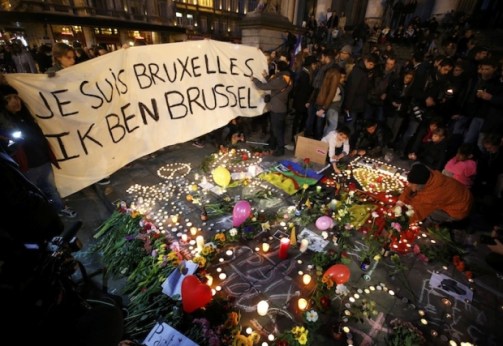
Banner reads ‘I am Brussels’ in French & Flemish – Reuters pic

One week ago on Tuesday, March 22, 2016, three coordinated bombings occurred in Brussels, Belgium’s capital. Two attacks occurred in the Brussels airport, and one at its metro station. During these attacks, 31 innocent victims were killed along with three suicide bombers. Even more disturbing is the 300 innocent people who were injured.

I feel great sadness when I hear of a terrorist attack especially when it occurs in Europe because just six months ago my wife and I were in Europe. In October of 2015, my wife and I visited Belgium. While Brussels was not one of the places we visited, we did visit several of the World War One sites in Flanders’ Fields. We also visited Paris, France on our trip so when the Paris attacks happened it deeply affected us both, as did the Brussels attack.

As I stated in my November 27, 2015  post about the Paris attacks, terrorism is something I cannot understand. I’ve tried to put myself into the shoes of a terrorist in order to comprehend how someone can cause harm and death to innocent people like the bloodshed that happened in Brussels. The news media repeatedly tells us that the people who carry out such acts of violence have been radicalized.  Merriam-Webster dictionary defines a radical as  “advocating extreme measures to retain or restore a political state of affairs”. So as I understand it, radicals are people who carrying out acts of murder for political gain.  This is what I can’t wrap my head around.  In my mind killing innocent people for political gain, or any reason, is wrong!

How can someone with any kind of conscience murder innocent people? As I mentioned in the November post, the only thing I can come up with is that these people have been brainwashed. It is the only explanation that makes sense.

What disturbs me the most is when a terrorist attack  happens on our planet panic sets in. Panic is a symptom of fear. The school that I taught in is taking a group of students to Germany this month. The Brussels event set off a wave of panic among the parents. These parents were fearful because their children were off to Europe, where terrorist attacks occur. Now I’m a parent, so I understand the need to protect your children. But when we cave in to fear, the terrorists succeed.

Perhaps it’s time to look at the issue of terrorism from a different perspective. According to many spiritual writers today, all behaviours and emotions can be put into two categories – love and fear. These writers tell us fear is the opposite of love. So what is fear? Fear results in a feeling of not being protected or feeling secure. So when it comes to terrorism, fear sets in because we feel insecure and vulnerable. In fact, that is what terrorism is all about, instilling fear. Terrorists want us to be fearful. They want to cause terror. In fact, ‘terror’ is the root word of ‘terrorist’ or ‘terrorism’.

Fear limits our minds. People who live in fear will do harmful things. They lash out at those whom they perceive to be the cause of their pain. The same could be argued for animals. When do animals attack? It is when they fear for their survival.

Now most people would argue that the opposite of love is hate but when you think about it, hate is really stemming from fear. A person might “hate” someone who has abandoned or disrespected him. Abandonment makes more sense in terms of the fear. When a person feels abandoned, their emotions are stemming from fear of being alone. Disrespect is when a person feels scorned or disregarded, so it stems from the fear a person has when they are not honoured or regarded.

In a CNN report, Republican front-runner Donald Trump is quoted as saying,

“It’s going to get worse and worse. In my opinion, this is just the beginning. It will get worse and worse because we are lax and we are foolish — we can’t allow these people, at this point we cannot allow these people to come into our country. I’m sorry…”

His remarks clearly come from fear. His and others like him lack love and compassion. Banishing others does not stem from love. It stems from fear which indicates that there is no love.

Love on the other hand doesn’t hurt. If it hurts it is fear. Love is a core emotion from which many other emotions are created. Emotions such as happiness, kindness, charity, faith, empathy, fairness and compassion all come from loving intentions. This type of love is what the Greeks called agape love. This love is selfless, sacrificial, unconditional love. It is the highest form of love there is. With this type of love there is no exclusiveness.

Fear is the opposite of love because fear is the base emotion from which hate, prejudice, greed, stress, paranoia, and many other negative emotions are based.

1 John 4:18 of the Christian scriptures tells us, “There is no fear in love, but perfect love casts out fear; for fear has to do with punishment, and whoever fears has not reached perfection in love.” It is also interesting that scripture scholars tell us the phrases “do not fear” and “do not be afraid” appears 365 times in the Christian Bible. I don’t think that is coincidence. Perhaps a basic message in the scriptures is, do not have fear because when you are fearful, you do not possess love.

The CNN report referred to above quotes Pascale Rouhier, a 38-year-old resident of Brussels, as saying, “I’m not going to change my way of living because Brussels is my city.”

The article also reports that 2,000 people gathered in front of  the Brussels stock exchange, with Belgium Prime Minister Charles Michel and other leaders who laid wreaths at Maelbeek metro station.

German Chancellor Angela Merkel said, “Our strength lies in our unity, and our free societies will prove to be stronger than terrorism.” (see article)

These are all examples of people whereby fear has not taken hold. Their reactions and comments stem from love. Love unifies while fear divides.

Perhaps former Beatle John Lennon sums it up best when he said,

“There are two basic motivating forces: fear and love. When we are afraid, we pull back from life. When we are in love, we open to all that life has to offer with passion, excitement, and acceptance. We need to learn to love ourselves first, in all our glory and our imperfections. If we cannot love ourselves, we cannot fully open to our ability to love others or our potential to create. Evolution and all hopes for a better world rest in the fearlessness and open-hearted vision of people who embrace life.”

Franklin D. Roosevelt, the 32nd President of the United States was right when he said during his inaugural address on March 4, 1933,   “Let me assert my firm belief that the only thing we have to fear is…fear itself.”  If terrorists succeed in their mission to instil fear into the world then they will create a culture of fear; a culture where there is no love; a world full of hate, prejudice, greed, stress, and paranoia. But, if we don’t allow fear to take hold then we will have a culture filled with happiness, kindness, charity,  empathy, fairness and compassion; a culture where there is love. The choice is ours.

Someone is Watching You

I regularly receive emails from various websites. Most of them are emails containing inspirational quotes or sayings; basically emails that encourage us to be better human beings. I recently received this one.

Remember that someone is looking up to you now, preparing to follow your example. Let this guide your next choice.

We often think that we are operating in a vacuum, that no one is watching us, that our actions are mostly private. Yet, what if you knew that your every thought, word, and deed today was going to be imitated by one who admires you?

I’ve been pondering on this email for a while now. Being in the teaching profession for 35 years I know unreservedly what being watched is like. Whether we teachers like it or not, we are always being watched by our students and their parents. It is a rare occurrence for me to not be seen by a former student of mine when out in public. It is not unusual to have some young person from the school I taught at in my community to yell out to me with a greeting or to wave at me when I am out and about in the community. It was also common to have a student, when I was still teaching, come up to me and tell me that they saw me in some store or walking on the street, or some such thing. As a teacher, you are always in the public eye. Now I admit, I have always had struggles with this. I sometimes avoided attending community events because of it. It has also given me a much greater compassion for our political leaders, entertainers, sports stars and other people who are even under more scrutiny by the public.

I often think of celebrities and how difficult it must be for them. Not only do random strangers notice them, but many of them are constantly followed by the Paparazzi. There is a reason that LAX is providing a new option for Hollywood celebrities looking to skirt airport paparazzi. The article states LAX is set to approve plans to convert a cargo office into a small new terminal that will allow passengers to drive into a secluded entrance, get screened by the Transportation Security Administration privately and be driven across the airfield straight to the stairs to board their flights.

In August of 2015, Buckingham Palace issued an appeal to world media not to publish unauthorized images of two-year-old Prince George, the elder child of Prince William, Duke of Cambridge, and Catherine, Duchess of Cambridge. He is third in line to succeed his paternal great-grandmother, Queen Elizabeth II, after his paternal grandfather Charles, and his father, William. (see Prince George harassed)

The palace says in recent months, photographers have done such things as used long-range lenses to photograph the Duchess of Cambridge playing with her son in private parks, have monitored the movements of Prince George and his nanny around London parks, as well as observed movements of other household staff, pursued cars leaving family homes, and used other children to draw Prince George into view around playgrounds. Whether people are a member of a Royal family, a Hollywood celebrity, or politician, these people have a right to privacy, although I am certain that they are all very aware that they are in the public eye.

dead-poets-society*580xx936-624-0-45
Scene from Dead Poet’s Society

Over the years I have become more and more aware of how much I was being examined. Sometimes when talking to former students I will ask them what they remember about my classes. I have yet to have a former student tell me it was one of those brilliant lessons (at least I thought so) I had taught. Instead their response to my question is always connected to relationship. Former students would tell me it was most often something I said to a student. I had one former student tell me that it meant the world to him when I told him in school, paraphrased “You’re a lousy student but you are a really nice guy.” He said he appreciated the fact that I still liked him even though he wasn’t the best student. Another student told me that I was one of the teachers that cared; I was one of the teachers that always listened and helped. Now I write this with the risk of sounding vain but the point I am making is that students notice. They notice when you care. They notice when you are kind. They know when you like them or not.

A person does not realize how much they have impacted a student until they receive letters from them. One student wrote, “I haven’t been in this school very long; you were one of my first teachers… During the many classes we had together you made it very enjoyable and you were very understanding when people didn’t have a clue on what you were talking about.” Another student in a “Thank You” card wrote, “Thanks for being a part of my high school career. I know we had our ups and downs, but just know you have made a difference in my life, and every one else’s”. Still another student wrote in a letter, “I would like to start this letter of appreciation to you by saying what a great teacher you are. Whenever I needed help, you would come right over and do your best to help me understand and that goes for the rest of the class too…I feel lucky to be in your classes at school.” My intent here is not to boast but to demonstrate that people notice how you treat them, what you say to them and most importantly your attitudes towards them.

In the 1980s I worked at a summer camp for three years. I was part of a team that planned, organized and implemented the programs. One of the first weeks of camp we did was what was called Counsellors Week. It was the week where we prepared the counsellors for the weeks where they would be working with the 9, 10, 11, 12 and 13 year olds. I just went about doing my duties as a team member and being me. I had no idea how much I had impacted this one counsellor until I received a letter from him a number of weeks later. In the letter he told me that he had watched me during Counsellor’s Week, that I inspired him, and that he wanted to eventually be part of the team at camp so he could emulate me. I had no idea that I had such an impact on this young man. To say that I was shocked when I got the letter is an understatement. The point is people are noticing you even when you are not aware of it.

During a parent teacher interview many years ago, I expressed concern to the parents that I had noticed a change in their child.  I was stunned to learn that the reason for this change was due to something I had said to the child; something the young person took offense to. The choices we make affect others whether we’re aware of it or not.

lg-Eyes-OjosSo always remember that someone is likely seeing you, maybe even looking up to you, and preparing to follow your example. Let this guide your next choice.

We are NOT operating in a void where no one is watching us, that our actions are mostly remote. Someone who admires you will reproduce your every thought, your every word, and your every action? Make your next choice with this in mind. Your choices could impact another person for the rest of their lives. That could be positively or negatively. If you are not sure how to be the kind of person that people look up to, check out, How to be a good person that people look up to.


Political Bullying

I have always had an interest in politics. I taught social studies in high school for years and would passionately discuss politics with my students and give projects to them when election campaigns were on. I’ve even scrutineered once.  For those of you who don’t know what a scrutineer is, in the British and Canadian systems, a scrutineer is an official examiner of votes in an election. There was even a time when I would have seriously considered running for office. I used to think politicians were honourable people and individuals to be admired for their service. Now don’t get me wrong, there are still a few honourable people who are leaders. However, as I watch the politicking of our neighbours to the south, I begin to wonder if honourable and honest people enter politics anymore.

You’re probably wondering why I say such a thing. I was recently watching some of the analysis on CNN regarding the most recent primaries that are happening in the United States. One of the commentators was discussing the insults that were exchanged between Donald Trump and Marco Rubio, two candidates running for the Republican Party nomination for president. Here is an article about what I’m talking about –Us Election 2016. There were insults traded between the two candidates about misspelled tweets, wet trousers, wearing makeup and Trump ridiculing Marco Rubio for his love of drinking water.  Apparently, in a State of the Union response speech in 2013 while on national television Mr. Rubio paused for a sip of water. But what really got me were their exchanges about sweating.

Trump
From BBC.com

According to Business Insider, the exchange apparently happened backstage when they were debating one another. Mr. Rubio insinuated that Trump possibly “wet” himself. “He called me Mr. Meltdown,” Rubio went on to say, “Let me tell you, during one of the breaks — two of the breaks — he went backstage. He was having a meltdown. First he had this little makeup thing, applying makeup around his mustache, because he had one of those sweat mustaches. Then he asked for a full-length mirror. I don’t know why, because the podium goes up to here. Maybe he was making sure his pants weren’t wet. I don’t know.

Trump countered with, “He’s with a pile of makeup putting it on his face, I said Marco, easy with the makeup, you don’t need that much. You know the story with Marco. I watched Marco with this man [Christie]. Where Marco, he was right over here I asked him I said are you okay? He looked like he just came out of a swimming pool. He was a mess.” Anyway, I’m sure you get what I’m talking about.

The first question I have is, Why are they throwing insults when I’m sure the American people want to hear about solutions to the problems the country faces? Donald Trump’s campaign slogan is, “Make America Great Again.” A great slogan I might add. But I seldom hear him telling the American people how he intends to do that. What I typically hear is insults flying and Trump being a bully. The other Republican candidates don’t seem to be a whole lot better. Are these the best candidates that America has to offer, candidates throwing insults at one another? Granted, it might be entertaining, but really it’s bullying. No wonder our society has a bullying problem. When I vote, I vote for those candidates that reflect my values, but even more because they’ve explained what they will do to make their country better.

Canada is not immune to such antics. During the last 2015 Federal Election in Canada, the then reigning Conservative government placed ads in local newspapers and flyers, questioning whether Justin Trudeau, Canada’s current Prime Minister, shares their values. The ads tried to foster fear that a Liberal government would legalize marijuana, “making access easier for kids.” The ad warns there would be legal drug-injection sites in our neighbourhoods and that prostitution would be legalized, “putting brothels in our communities.” The Conservative Party attack ad finishes with, “Those aren’t our values either. Vote for your values.”  They were twisting the truth. Mr. Trudeau did make a campaign promise to legalize marijuana, but he never explicitly said he would legalize prostitution or drug injection sites. That was only Conservative fear mongering.

TrudeauOf course there was the long running television ads attacking Mr. Trudeau’s credibility saying, “He’s just not ready” to be prime minister. The Liberal Party of Canada is also guilty of attack ads. In 2006  then Liberal Party Leader Paul Martin approved a controversial ad suggesting the Tories would post armed soldiers on the streets of Canadian cities. During the last weeks of the campaign, the Liberals resorted to negative ads directed towards the Conservative party, attempting to depict its leader Stephen Harper as an extreme right-wing politician. The most controversial ad said, “Stephen Harper actually announced he wants to increase military presence in our cities. Canadian cities. Soldiers with guns. In our cities. In Canada.”

Chretien_AdHistorically, one that stands out for me was the 1993 Progressive Conservative Party attack on then Liberal leader Jean Chretien, who was elected as Prime Minister that year. The ad showed a picture (on left) of Mr. Chretien saying,”Is this a Prime Minister?” This ad was interpreted as mocking Chretien’s slight deformity and speech impediment that were leftover from a childhood case of Bell’s Palsy.  This is a condition where paralysis of the facial nerves occur, causing muscular weakness in one side of the face. To me, that was a “low blow.” That was “hitting below the belt.”


Why does politics have to be about attacking another’s character? Most people I have talked to express how repugnant this type of politicking is. I’m grateful that Canada’s present Prime Minister, Justin Trudeau, did not run any attack ads during the 2015 election and does not resort to bullying to achieve his goals. In fact, in October of 2015 on CTV’s Canada AM Mr. Trudeau said,“I don’t believe in attack ads. I think they hurt your ability to govern and my capacity to stay positive and focused on our platform.” I say kudos to Canada’s Prime Minister. It is time to get back to what I call honourable politicking, where politicians put forth their platforms for making their country great. It’s time to bring honour and respect back to politics.  Time to give us politicians who have creative new ideas, who aren’t bullies, and who want to lead because they want to make a difference in this world. It is a sad state of affairs when the only potential leaders that step forward are bullies who attack their opponents. Enough already!

Seek Some Awe

William James, an American philosopher and psychologist, once said, “Religious awe is the same organic thrill which we feel in a forest at twilight, or in a mountain gorge.” I totally understand what Mr. James is communicating. I have had many experiences of awe when out in nature. But first, we should understand what awe is.

The Cambridge Dictionary defines awe as a feeling of great respect sometimes mixed with fear or surprise. Now that word fear usually confuses me especially when talking about awe.  We typically think of fear as being afraid of something or someone. However, Dictonary.com says in addition to being afraid, fear is reverential awe, especially toward God. The Free Dictionary describes awe as a feeling of respect or reverence mixed with dread and wonder, often inspired by something majestic or powerful.

Dacher Keltner, Professor of psychology at the University of California, defines awe as the feeling of being in the presence of something vast that transcends your understanding of the world. So the way I understand awe is that awe are those moments when we experience something majestic or powerful; when we feel wonder. They are the times when we have an encounter with the divine. They are moments when we in some way experience God or the Source of all Being or something mystical. It’s when you are touched at a soul or spiritual level; when what we are witnessing or experiencing is beyond our understanding.

The_Earth_seen_from_Apollo_17Many astronauts talk about their experiences of awe when looking at the planet earth from space. Alan Shepard, Apollo 14 astronaut said, “When I first looked back at the Earth, standing on the Moon, I cried.” Russell “Rusty” Schweikart, Apollo 9 astronaut said, “When you go around the Earth in an hour and a half, you begin to recognize that your identity is with that whole thing. That makes a change … it comes through to you so powerfully that you’re the sensing element for Man.”

One of the best known for his experience of seeing Earth from space is Apollo 14 astronaut Edgar Mitchell who said:

“That’s a powerful experience, to see Earth rise over the surface [of the Moon]. And I suddenly realized that the molecules in my body, and the molecules in the spacecraft and my partners had been prototyped, maybe even manufactured, in some ancient generation of stars. But instead of being an intellectual experience, it was a personal feeling… And that was accompanied by a sense of joy and ecstasy, which caused me to say ‘What is this?’ It was only after I came back that I did the research and found that the term in ancient Sanskrit was Samadhi.”

Oxford dictionary defines Samadhi as a state of intense concentration achieved through meditation. In Hindu yoga, this is regarded as the final stage at which union with the divine is reached. In essence what Mr. Mitchell is saying is he felt some sort of union with the divine.

Susan Santucci, a learning specialist and author says, “Watch for glimpses of the divine order.  Find those experiences, sights, and sounds, which fill you with awe.  Any experience met with awe can be spiritual:  a safari through an animal kingdom, taking in a sunset, a hike to an awesome mountaintop.”

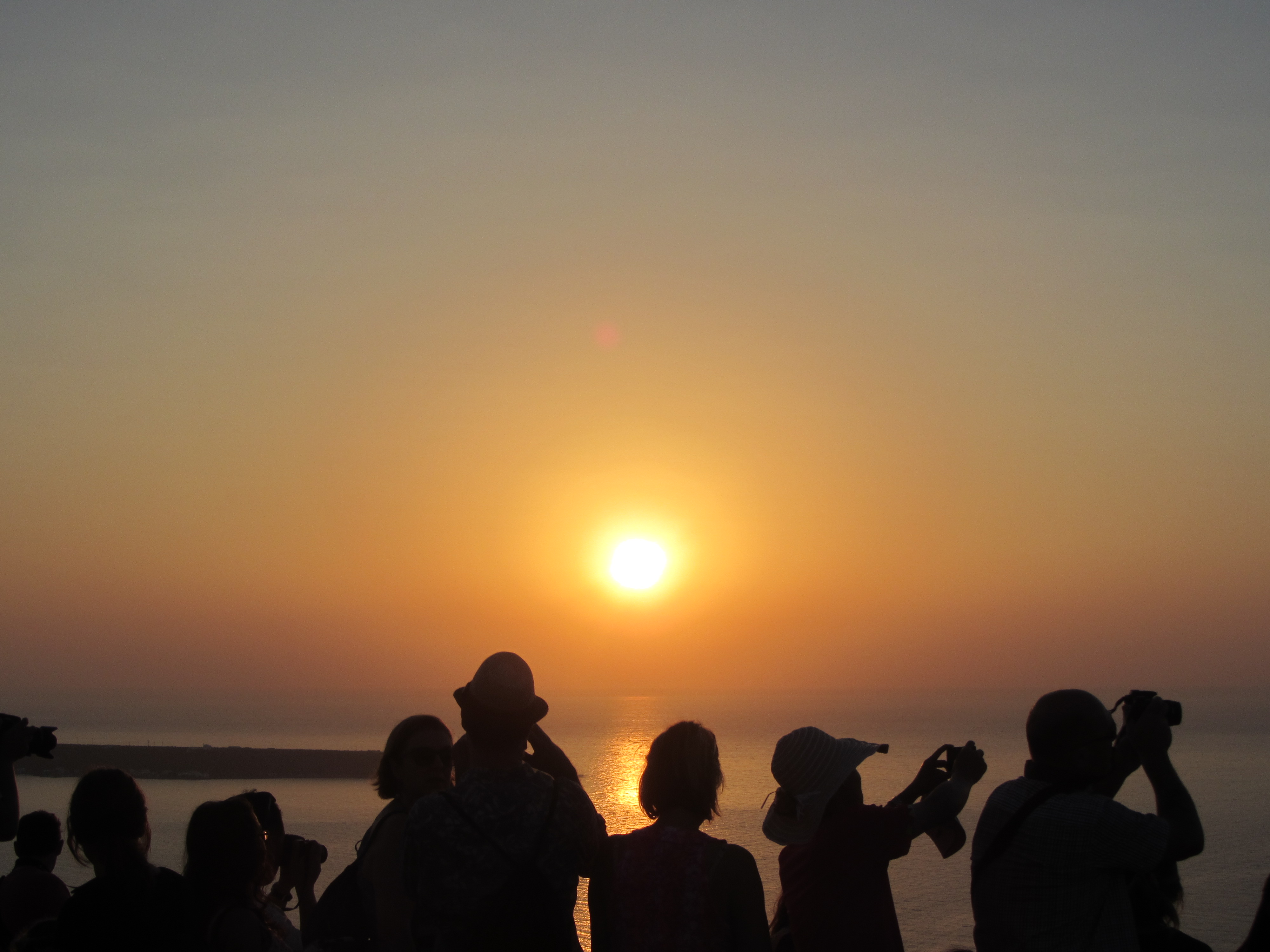
P1030507editedI have hiked in the mountains with my son and friends and family for many years. I have to agree with Susan Santucci as every time I stand on top of a mountain, I feel that sense of awe. For me, it is a spiritual experience. It is an experience where I am overtaken with the beauty of the mountain landscape. I have this same experience when I am at the ocean. Standing on an ocean beach, looking at the vast amount of water in front of me sets me into a state of awe. Sunsets do the same. When my wife and I were in Europe a few months ago, we were blessed to see numerous sunsets and even sunrises. It never ceases to amaze me how beautiful those magnificent colourful skies can be. Each sunrise we beheld on our trip was uniquely beautiful. I have a sense of awe or wonder every time I am lucky enough to see the northern lights or the aurora borealis. For me, each of these experiences were, as Dacher Keltner put it, a feeling of being in the presence of something vast that transcends ones understanding of the world.

Greece

Yes, I understand some of the science behind how mountains are built with colliding tectonic plates. I comprehend that when the Sun appears lower and lower on the horizon, its light needs to pass through more of the atmosphere to reach our eyes, so as the sun drops towards the horizon, it progressively loses violets and blues, then greens and yellows, and finally even the oranges, leaving only the reds behind. It is mind-boggling to comprehend that 70% of the Earth’s surface is covered by ocean, and the deepest known area measures 11 kilometres (6 miles) deep.  I understand that the aurora borealis occurs when collisions between electrically charged particles from the sun enter the earth’s atmosphere and collide with its gases. As amazing as the science is, when I experience the above-mentioned things I experience something beyond my science understanding. My experience is met with awe and wonder. When I am experiencing these things I touch the divine.

I had another one of these experiences when my daughter showed me a video of Jeffrey Li, a 10-year-old boy from Canada, and Celine Tam, a 7-year-old girl from Hong Kong, performing a duet of the song “You Raise Me Up”. I was blown away. These two singers literally took my breath away. What I heard from these two young people touched me at a soul or spiritual level. It made me ask, “How can a seven and ten year old have singing voices like this?” The singing voice of these two “kids” was beyond my understanding. If you haven’t seen the video, check it out below.

http://www.youtube.com/watch?v=XIucRL4iQTI

Maybe it is time to seek out more of those awe experiences, whatever they may be for you. In fact, doing so just may make the world a better place. Articles such as High on Wonder: People Who Experience More Awe Are Nicer, Better People, and The Key to Fulfillment claim science is providing empirical evidence that awe is the emotion that motivates people to do things that enhance the greater good. If we choose to get rid of the some of the distractions like cell phones and watching television in our lives and seek to put ourselves in new situations such as going to new places, and meeting new people, this may increase our chances of encountering awe. If it is true what the studies are saying, experiencing awe will make us better people. I implore you to seek out some awe and wonderment in your lives. You will be better for it!

Judge Not!

Now that I have some time, I spend some time perusing the internet reading interesting articles.  I recently read an article titled, We’re all the Same.  Basically, the article says we as humans are quick to judge others.  It makes bold statements like:

  • Let’s face it. We all do it. We judge.
  • We like to label others and shove them into this box.
  • We don’t like ”undefined” people.
  • We assume we know who someone is based on our interactions and observations.
  • Judging makes us feel safe and comfortable.
  • It gives us a sense of control.
  • But despite our best efforts to judge, we all know deep down inside, we can’t and shouldn’t really judge another person.

Now my initial reaction was, “Not me!  I don’t judge people.”  But who am I kidding?  So I thought about it.  Do I judge others or not?  If I am honest with myself, the answer of course is “Yes”.

The year 2015 was a year of change for my wife and I.  I retired from teaching.  My eldest daughter moved to a different apartment which is closer to her work.  My youngest daughter returned to university, so she is moved back to the city after living in the rural community she grew up in.  And my son, who has been going to the local college, is moved to the city to continue his education at university.  My wife is the only stable one (in more ways than one) as she is continuing with the same job.

JudgeSo a few months ago, my wife and I were helping our eldest daughter find furniture for her new apartment.  She had been getting some used stuff off of Kijji, an online garage sale site.  She had looked at a media unit with an electric fire-place and decided to purchase it.  She gave the young man $40 to hold it, and arranged to pick it up when I could bring up the truck. On a Saturday morning we arrived at this person’s apartment complex at the agreed upon time only to find that he was not there.  My daughter texted him and called him only to discover his voice mail box was full. Being the Dad that I am, I immediately jumped to conclusions. As far as I was concerned this guy had ripped off my daughter.  My daughter and wife, on the other hand, kept reminding me that maybe he had a family emergency or something.  I, on the other hand, was convinced that he had swindled my daughter out of  $40.  After an hour of waiting and me “steaming” we left and continued with our day.

Now it turns out that this fine, young man did indeed have a family emergency. His explanation to my daughter alluded to perhaps a death in the family.  This man felt very bad about the incident and returned my daughter’s $40 to her.   I had totally misjudged the situation and the young man involved.  Now I am the one feeling bad and guilty that I had so little faith in people. This was not the only time recently that I had jumped to conclusions and misjudged a situation.

As I mentioned earlier, I just retired from teaching.  The school that I worked at submits a weekly newspaper column in the local papers.  Well, at the end of June, I was all “bent out of shape” because my school (so I thought) did not even care that I was leaving after 26 years of service. They didn’t even have the decency to acknowledge my exit in the school column.  I was feeling sorry for myself.  I had convinced myself that my colleagues didn’t even care that I was leaving.

The next week the local papers arrived at our house and I my wife pointed out that I, and the other colleagues that retired with me, were acknowledged in the school column.  Lesson learned (I hope); Do not be so quick to judge people and situations. Once again, I felt bad and guilty that I  had so little faith in my colleagues. I know I could just blame it on “human nature”, but that is still not an excuse.

As a former school teacher I can recall numerous occasions where I prejudged students based on hearsay around the staffroom, only to discover that my experiences with those students were different from the prejudgements. It is so important to resist judging.

So, what is wrong with judging? I’m sure someone is wondering. The late Earl Nightingale, an American radio personality, writer, speaker and author who dealt mostly on the subjects of human character, once said, “When you judge others, you do not define them, you define yourself.” That is so true! Judging others is about our need to feel safe and comfortable. When we judge others we feel better about ourselves because judging others occurs when we believe we are better than the people we’ve judged. Really, we have no right to judge anyone unless we know everything about that person, which is impossible. There is a native American proverb that says, Don’t judge any man until you have walked two moons in his moccasins.” As I learned from my experience with the young man who I believed conned by daughter out of $40, you never really know what is going on in that person’s life, so as in my case, most often our judgements are based on ignorance or misinformation.

So remember, things are not always what you perceive them to be or believe them to be.  Don’t be so quick to judge a situation. Michael J. Fox, best known for his role as Marty McFly in the Back to the Future movie trilogy, once said,  The least amount of judging we can do, the better off we are.” He is right! I am going to try to follow Fox’s advice from now on, or at least that is the goal.

Namaste, a Reverent Gesture

A_yoga_namaste_Hindu_culture_religion_rites_rituals_sights.jpgOver the years I have been periodically greeted with a greeting known as “Namaste”. This is a gesture that entails a slight bow made with hands pressed together, palms touching and fingers pointed upwards in front of the chest. I have witnessed speakers and performers greet their audiences with this sign. Many years ago our school hosted an exchange student from Thailand who when she first arrived would greet her teachers and fellow students with the Namaste gesture. Some of my yoga instructors concluded every practice by uttering “Namaste” while bowing with hands pressed together. Even in Taekwondo we bowed to our opponents although not with our hands together. A bow in Taekwondo was a sign of respect which is its meaning in all martial arts. We even bowed when we entered the dojang or gym as a sign of respect for it.

Whenever someone greets me with the Namaste gesture, and especially when saying the word “Namaste”, I feel very honoured. I feel respected and accepted. It truly is a wonderful feeling when acknowledged with a gesture of Namaste. So what does this form of salutation mean? Where does it come from as it is not a common form of greeting in my part of the world?

In my part of the world, the handshake is the popular form of greeting. A handshake is a ritual in which two people grasp one of each other’s like hands and give a brief up and down movement of the grasped hands. The origins of the handshake are unknown as historians say that the handshake predates written history, and therefore is somewhat difficult to track down. What I find fascinating is there are some historians who claim the ritual dates to the Romans who would approach each other and grab the forearm to make sure the other man was not carrying a weapon. If that is true, then the handshake has a very different connotation than Namaste does.

The  Namaste gesture is widely used throughout India, Nepal, and parts of Asia.  Namaste or namaskar is used as a respectful form of greeting, acknowledging and welcoming a relative, guest or stranger as well as with goodbyes. It is also used when a person expresses gratitude for assistance offered or given, and to thank the other person for his or her benevolence.

The gesture (or mudra) of Namaste is a simple act made by bringing together both palms of the hands before the heart (sometimes the forehead), and lightly bowing the head. In the simplest of terms it is accepted as a humble greeting straight from the heart and reciprocated accordingly. But does it have a deeper meaning? Being a teacher who taught Religious Education, I knew it did. So here is a lesson.

From the great religion of Hinduism, the sign of Namaste is an ancient Sanskrit greeting still in everyday use in India and especially on the trail in the Nepal Himalaya. Translated roughly, it means, “I bow to the God within you,” or “The Spirit within me salutes the Spirit in you,” a Hindu knowing that we are all made from the same One Divine Consciousness. More specifically, nama means bow, as means I, and te means you. Therefore, Namaste literally means, “bow me you” or “I bow to you.”

Now this can be thought of in many ways. These are some of the ways the meaning of Namaste has been explained to me.

  • The Divine light in me acknowledges the Divine light in you.
  • The God in me greets the God in you.
  • I honor the spirit in you that is also in me.
  • The Divine wisdom in me recognizes and acknowledges the Divine wisdom in you.

Hinduism Today says the Namaste gesture

“bespeaks our inner valuing of the sacredness of 216px-An_Oberoi_Hotel_employee_doing_Namaste,_New_Delhiall. It betokens our intuition that all souls are divine. It reminds us in quite a graphic manner, and with insistent repetition, that we can see God everywhere and in every human being we meet. It is saying, silently, ‘I see the Deity in us both, and bow before It. I acknowledge the holiness of even this mundane meeting. I cannot separate that which is spiritual in us from that which is human and ordinary.’”

One practicing Hindu put it this way.

“I’ve heard it means, ‘I salute God within you.’ The true Namaste gesture is accompanied by bowing the head and shoulders slightly. This is a gesture that lessens our sense of ego and self-centeredness, requiring some humility to do it well–whereas shaking hands can be quite an arrogant event.”

According to Buddha Weekly, it is not just a salutation. For Buddhists the gesture is called Anjali and it serves many purposes. In spiritual activities, the mudra Anjali (offering with both hands), indicates we are making a “divine offering.” In a Buddhist context, it is the “cure” for pride, one of the great obstacles in their practice. In day-to-day life it indicates respect, literally meaning “I bow to you.”  Also, in acupuncture terms, the tips of the fingers activate certain energies.

Now I was raised a Christian, so how might this fit into a Christian context. In 1 Corinthians 3:16 it says, “Do you not know that you are God’s temple and that God’s Spirit dwells in you?” (NRSV) To me that aligns with the Hindu claim that the divine is within us. Christians just call it the Holy Spirit. I was taught that at baptism or confirmation, depending on the religious tradition, that the Holy Spirit entered and from then on resided in us.

In Galatians 5:22-23 it is written, “By contrast, the fruit of the Spirit is love, joy, peace, patience, kindness, generosity, faithfulness, gentleness, and self-control. There is no law against such things.” (NRSV) So Christians believe that if a person allows the spirit to be active in them, then that person should express love, joy, peace, and so on. Wouldn’t it be wonderful if Christians supported this belief with the Namaste gesture, a slight bow made with hands pressed together.

namaste-2No matter how Namaste is interpreted, it invokes a sense of sharing a spiritual connection and creates a sense and feeling of oneness. It is a way to feel connected. It conjures up feelings of respect. It is a sign of universal oneness. Maybe this world would be in a better place if all humans practiced this simple gesture. As the Buddhists believe, it just may be a “remedy” for pride that is the cause of many problems. I’m convinced this simple gesture brings about more feelings of reverence and honour for others. Mohandas K. Gandhi allegedly said once, “Namaste. I honor the place in you where the entire universe resides. A place of light, of love, of truth, of peace, of wisdom. I honor the place in you where when you are in that place, and I am in that place, there is only one of us.” Such a simple sign, a bow with hands together, with the intended meaning as Gandhi explained, just might make all the difference in this world.

A New Beginning!

As a now retired school teacher who taught high school social studies, I have taught about the indigenous (First Nations or aboriginal) people for about 30 years. I have always been drawn to the indigenous people especially to their spirituality and their tremendous respect for Mother Earth before contact with the European explorers. For several years I had the privilege of working with aboriginal people when I taught courses to adults a few weekends during the year. I have always been sympathetic to the plight of the aboriginal people in North America. From the moment the Europeans landed on this continent to the present day, aboriginal people have been exploited and treated unjustly, so when I read about improved relations between our leaders and indigenous people, I cheer.

According to a CBC article, Aboriginal’s top newsmakers of 2015, it was an exceptional year for indigenous people in Canada, a year that included truth and reconciliation, a year when ten indigenous Members of Parliament (MPs) were elected to Canada’s parliament and the year the long-awaited inquiry into missing and murdered indigenous women and girls was announced.

In case you are not familiar with the Truth and Reconciliation Commission (TRC), here is a little history lesson. The Commission’s five-year mandate was to inform all Canadians about what happened in Indian Residential Schools (IRS).  The TRC hopes to guide and inspire Aboriginal people and Canadians in a process of reconciliation and renewed relationships that are based on mutual understanding and respect.  After travelling about the country for six years, the committee collected 6,740 statements from survivors of the Residential Schools and recorded 1,355 hours of testimony.  The Commission completed its task on June 2, 2015.

The Truth and Reconciliation Commission report makes 94 recommendations for change in policies, programs and the “way we talk to, and about, each other.” These recommendations include the creation of a National Centre and Council for Truth and Reconciliation and the drafting of new and revised legislation for education, child welfare, aboriginal languages, and the implementation of the United Nations Declaration on Indigenous Peoples.

ch-3-p40-41-old-sun-classroom-p7538-1005If you don’t know much about the legacies of Residential Schools, here is another lesson. (It’s the teacher in me. I just have to teach). After the closing of the schools, which operated from the 1870s to 1996, and held some 150,000 aboriginal children over the decades, many former students made allegations of physical, psychological, and sexual abuse, plus accusations of neglect. The sole aim of residential schools was to assimilate First Nations children into the European culture. There were also student deaths at these institutions as well as burials of numerous deceased students in unmarked graves without the notification or consent of the parents. I personally have heard residential school survivors tell their stories and break down weeping when doing so. It is a very painful topic for many of them. This is not a part of our history that I am proud of. I have also taught about the atrocities that have occurred in these schools and witnessed students distraught because of it. Students instinctively know, as all of us do, that the way the indigenous people were treated was unjust.

CBC reports that on December 14,2015, the completed Truth and Reconciliation report was released in an emotional ceremony that had commission chair Justice Murray Sinclair choked with emotion and newly elected Prime Minister Justin Trudeau wiping away tears. Kudos to our leaders who recognize the wrongs done to the aboriginal people.

missing-and-murdered-aboriginal-womenThen there is the missing and murdered aboriginal women in Canada, an issue that First Nations people have been lobbying our government to conduct an inquiry on for at least a decade. The following statistics are from the Native Women’s Association of Canada (NWAC) fact sheet based on March 2010 statistics. The association gathered information on about 582 cases of missing and murdered Aboriginal women and girls. Of these:

  • 67% are murder cases (death as the result of homicide or negligence);

  • 20% are cases of missing women or girls;

  • 4% are cases of suspicious death—deaths regarded as natural or accidental by police, but considered suspicious by family or community members; and

  • 9% are cases where the nature of the case is unknown—it is unclear whether the woman was murdered, is missing or died in suspicious circumstances.

The number of missing and murdered Aboriginal women and girls in Canada is disproportionately high. NWAC’s research indicates that, between 2000 and 2008, Aboriginal women and girls represented approximately 10% of all female homicides in Canada. However, Aboriginal women make up only 3% of the female population. What is interesting is the NWAC has found that only 53% of murder cases involving Aboriginal women and girls have led to charges of homicide. This is dramatically different from other homicide cases in Canada, which was last reported as 84% solved cases according to Statistics Canada.

On December 8th, 2015, Canada’s new Liberal government announced that the first phase of an inquiry into missing and murdered indigenous women and girls would begin. This is great news for those grieving families who lost their children. They have a right to know what happened to their loved ones.

liberal-cabinet-20151104The October 2015 federal election saw  54 indigenous candidates enter the race, and a groundbreaking push to have First Nation, Inuit and Métis people head to the polls. When it was over, ten indigenous MPs were elected to Canada’s House of Commons; the most ever. Newly elected Prime Minister Justin Trudeau told the Assembly of First Nations, “It is time for a renewed, nation-to-nation relationship with First Nations people. One that understands that the constitutionally guaranteed rights of First Nations in Canada are not an inconvenience but rather a sacred obligation.”  This is great news for Canada. I cannot say it any better than Assembly of First Nations Chief Perry Bellegarde who said, “It sends a powerful statement about inclusion and it sends a powerful statement about the reconciliation that is going to be required in rebuilding a new relationship between Canada and Indigenous Peoples.” A new kind of relationship with our First Nations people has been long overdue. Kudos to Canada’s new PM for initiating a new kind of relationship; a relationship that can only make this a better country.

Now I know many people do not feel the same as I do about these events. There has been, and still is, much racism between our people. Having said that, racism stems from ignorance, and so much of that racism is due to misinformation and misunderstanding between aboriginal and non-aboriginal people. I am hopeful that the TRC and the National Inquiry will educate and eradicate that ignorance, bringing about a new relationship. They were the first people on this continent and rightfully deserve to be treated with the same respect and privileges as non-aboriginal Canadians. It has been a long time coming! 

Interesting reads: 

Source: The Two-Sentence View of History                                                                  SourceDEAR MEDIA, I AM MORE THAN JUST VIOLENCE