Dance Could Change the World Too

A commentary on the value of dancing.

A few weeks ago I wrote a post entitled, Music can change the world suggesting that music is a way to unite the world. I personally believe this to be true. A few days ago a link to the following video landed in my inbox.

Dance has always been a part of my world. I grew up in a small town where there were dances, often wedding dances, many weekends of the year. It was at those small town dances that I learned to dance. When I was in college and university I joined the dance club where we learned to do such dances as the Rumba, Samba, the Foxtrot, old-time waltz, swing and even square dance. My wife tells me that one of the things that attracted her to me was the fact that I could dance. She also tells me that now I don’t dance with her enough. Our daughters danced for years with the local dance association doing Hip Hop, Ballet, Modern, Jazz and Lyrical dance. My wife and I also volunteered when our club held their dance festivals. So when I watched this video I was immediately enlivened and inspired. What a great video! Watching it put a smile on my face. The video raises one’s spirits. Dance, even just watching it, has the ability to put us in a better mood.

I wanted to learn more about what kind of person would make such a video and why they would make it, so, like I typically do, I did some research.   Can dancing unite the world? is an article I found on the Pocket Cultures site, a website which aims to increase connections, awareness and understanding between different cultures.  According the article, the video was created by Matt Harding who became an Internet celebrity by creating a series of videos of himself doing silly dances in numerous countries around the world. The video above is his latest and was made in 2012. If you go to Mr. Harding’s website, where the heck is Matt, you will find other videos he has created. Matt says he started dancing with locals because he thought it looked like fun but some people have argued that he is actually improving world relations by connecting people around the world. clapping-hands-transparent-b-g-mdI applaud Mr. Harding for his diplomatic projects and for showing us that everyone in this world just wants to dance and enjoy life.

Dancing is a great way to connect people around the world, just as music is. Really, when you think about it, the two are connected. You can’t have dance without music and probably visa versa. It’s difficult to dance without music and I suspect music is what inspired dancing to arise in the first place. So I wondered, are there organizations or movements that share this vision of connecting through dance to unite the world? Using Google, this is what I discovered. United Dance is an organization with the purpose to unite and train dancers all over the world. They desire to show the heart of God in unity through creative expressions of worship and dance to the world. Another is Movement Exchange, a community of dance diplomats, who aim to unite the world through dance and service. This movement believes that sharing movement creates more joy in our world. That is so true! If you watch the above video carefully, you will notice that no matter what country Matt is in, the people dancing with him are smiling and joyful. I’m sure there are other movements as well.

Even the United Nations acknowledges dance music as a positive global force. According to this article, United Nations Secretary General Bam Ki-Moon praised Belgium’s Tomorrowland music festival, one of the most noteworthy global music festivals; a festival that began in 2005.

The Secretary General commented on the true power of global dance music, and its positioning within a wider cultural dialogue; one meant for a world of togetherness and universal acceptance. Now even though the festival isn’t specifically a dance festival, you can bet that the “dance music” had people dancing. In my view, dance and music go hand in hand.

Not only does music and dance unite people of different races and cultures, but dance is good for you.  According to the Better Health Channel’s article, Dance-Health Benefits, the health benefits of dancing are:

  • improved condition of your heart and lungs
  • increased muscular strength, endurance and motor fitness
  • increased aerobic fitness
  • improved muscle tone and strength
  • weight management
  • stronger bones and reduced risk of osteoporosis
  • better coordination, agility and flexibility
  • improved balance and spatial awareness
  • increased physical confidence
  • improved mental functioning
  • improved general and psychological well being
  • greater self-confidence and self-esteem
  • better social skills.

Time’s article, The Hidden Health Benefits of Dance, says:

“People who took dance class improved their fitness three times more than non-dancers”.

The Toronto Star reports in the article, Toronto researchers test benefits of dance for dementia patients, that a few studies suggest dancing programs in care homes appear to decrease problematic behaviour and increase social interaction and enjoyment.

Psychology Today’s article, Why Should We Dance?  says,

Studies have shown that dance, in particular, can decrease anxiety and boost mood more than other physical outlets

So the bottom line is dance has value in this world. We live in a world that needs unity. All one has to do is watch the news to come to that conclusion. So the more ways there are to unite the world, the better this world will be. I think dance, like music, is another way to do this. So, I encourage you to celebrate the different forms of dance in the world. I especially enjoy watching people from Africa dance. The African people know how to move and express themselves.

dancingSo let loose and dance. To quote Satchel Paige, an African-American Major League Baseball pitcher,

“Dance like nobody’s watching.”

It’s a good way to get fit. It makes you feel better. It unites the world because every country has their own unique dance forms. What more can I say?

So now I’m curious. Tell me what you think?

Bears Have Rights Too

tentI mentioned in a previous blog post, The Encounter, that my son and I do annual hiking trips in the Canadian Rocky Mountains. This past weekend we did a trip to Jasper National Park hiking up the Sunwapta Peak trail.  This was our 14th trip together. We stayed in a campground called, Wabasso, near the town of Jasper. When we were registering at the campground, we were warned that a black bear had been in the campsite the previous night. While eating our supper that evening, the people at the tent next to us started yelling, “there’s a bear!” They made a bunch of noise to scare the bear away. We never did get a glimpse of the wild animal but nonetheless, the possibility of a bear nearby always makes a person a bit anxious.

Now in the 14 years of doing this, we have only encountered a bear once (if you can call it that).  It was five years ago and the black bear was on the trail in Jasper National Park some 500 or more metres ahead of us.  When we yelled and my brother-in-law set off a “bear banger” (that is a device that makes a very loud bang) the bear took off. Bears are always on your mind when hiking in the mountainous wilderness so we’ve always taken precautions. All of us carry bear spray, a type of pepper spray or capsicum deterrent that is used to deter aggressive bears. Thankfully, we’ve never had to use it although we have talked to hikers who have. When we hike we travel in groups and make lots of noise so that if there is a bear nearby, it knows humans are nearby as Parks Canada advises. (see Safe Travel in Bear Country). We also make sure our food is stored in vehicles, lockers or on bear poles. Bear poles are tall metal poles with hooks so that hikers can hoist their bags (food especially) up to the hooks for safekeeping overnight.

black-bear-blogHaving freshly done a mountain hike in bear country, I began to have some questions about bears so I did some research. The first question I wondered: Just how common are bear attacks? According to the article, Behaviour, by the Get Bear Smart Society,

Bears are NOT mean or malicious. Bears are normally shy, retiring animals that have very little desire to interact with humans. Unless they are forced to be around humans to be near a food source, they usually choose to avoid us.

That leads to my second question: Just how common are bear attacks? According to the article, A few surprises in decades-long black bear study, in the  Globe and Mail,

“Fatal black bear attacks were rare from 1900 to 2009 but they disproportionately occurred in Canada, according to an analysis published in the Journal of Wildlife Management. Of the 63 people who died in 59 incidents, 44 victims were mauled in Canada. It’s not known why, but periodic food shortages due to shorter growing seasons could be a factor.”

That means there were only 44 Canadian victims in 109 year span. The article also reports,

Researchers found that the vast majority of the confrontations weren’t the result of chance meetings in the woods, but the outcome of predatory behaviour, nearly always by lone male black bears. Surprisingly, only 8 per cent of the deadly attacks were attributed to mother bears.

So that made me wonder: Why are there bear attacks?  According to the Globe and Mail article,

Bear-caused fatalities have increased largely in lockstep with the continent’s human population growth and subsequent rise of recreational activities. Most of the deadly encounters with bears – 86 per cent – were recorded since 1960. Nine out of 10 times, the victim was alone or with only one other person. Improperly stored food and garbage was a likely attractant in 38 per cent of the incidents… In all cases, researchers found that bear pepper spray was not deployed as a measure of defence.

Another question: How do conservationists respond to bear habituation? Habituation is when a bear has constant, repeated exposure to people. When this happens bears can become increasingly bold and less afraid of people. These bears run the risk of becoming “problem” bears that enter townsites and campgrounds, places they are more likely to be illegally fed or rewarded with improperly stored garbage or pet food. Parks Canada’s wildlife specialists do their best to reverse this behaviour, but if a bear can’t be rehabilitated they are destroyed because they became too much of a risk to public safety. In areas outside the national parks, bears are often destroyed once they’ve been habituated. In Revelstoke, British Columbia, nine bears were destroyed in one week. (see the CBC article,  9 Bears Killed in one Week).

Recently Josh Bowmar, an American and a former javelin athlete, posted a video of himself killing a black bear in Alberta with a spear. That video caused sharp criticism on social media and from the provincial government. In the video, a black bear can be seen circling and then approaching the area that had been baited where Bowmar stands nearby before he impels the spear into the bear’s stomach.  The bear ran off, likely suffering for many hours and was found dead the next day. Alberta’s government have since announced it will introduce a ban on spear hunting this fall as part of those updated regulations. (see Alberta Government orders Investigation). If you haven’t seen the video, here it is.

I was surprised that spear hunting was even legal in Alberta. I was even more surprised to learn that baiting bears and other animals was also legal. Personally, I’ve never understood the appeal of hunting. When I was a teen I once shoot a sparrow with my pellet gun and killed the bird. I felt so incredibly guilty when the bird died that I’ve never intentional killed an animal since except for mosquitos, flies and spiders when my wife forces me to. Typically, I rescue the spiders and put them outside.

The bottom line is we humans have an obligation to learn how to live in harmony with wildlife. All living creatures have a right to exist. In fact, UNESCO, an agency of the United Nations, issued a Declaration for All Life on Earth which declared, we shall create a world based on love and harmony in which all forms of life are respected. Organizations such as, World Wildlife Federation (WWF) states their mission to stop the degradation of the planet’s natural environment and to build a future in which humans live in harmony with nature. I believe this is possible and education is the key. Dr. Jane Goodall, an animal rights activist and best known for dwelling with Tanzanian chimps to observe their behaviour, said it best when she said, “Only if we understand, will we care. Only if we care, will we help. Only if we help shall all be saved.”  If you are going to be in bear country, it is imperative that you get educated.  A good place to start is to read the Dispelling Myths article by the Get Bear Smart Society. To quote Nelson Mandela, “Education is the most powerful weapon which you can use to change the world”. 

Music Can Change the World

A commentary on the benefits of music.

IMG_0252
Randy Bachman

This past weekend, my wife and I, along with four other friends, attended a Rock Festival in a nearby city. There is nothing I love to do more than to sit outside on a sunny, hot day and listen to the rock music I grew up on. This festival had rock icons like Randy Bachman, the cofounder of two great Canadian rock bands, The Guess Who and Bachman-Turner Overdrive (BTO). I could have listened to Bachman for several more hours. There were others like Lou Gramm, lead singer for the 70’s and 80’s band Foreigner. It is always fun to sing along with the many hits he sang such as, “Cold as Ice” and “Hot Blooded”.  A surprise to me was the band 54-40, a Canadian alternative rock group from Vancouver, British Columbia, who took their name from the slogan Fifty-Four Forty or Fight!, a slogan coined during a contested U.S.-Canada border dispute. Even though I wasn’t familiar with their music, I enjoyed every one of their songs. I have since purchased some of their music. All in all, it was a great weekend of music. My wife and I have attended rock festivals in the past as well as attended the local music festival at a nearby ski hill. My son sometimes attends the annual Country Music Festival. We go to these events whenever we can. Why? Music feeds the soul. It touches people at a spiritual level. At least that is true for me. Martin Luther, a German professor of theology, composer, priest, monk and best known for his role in the Protestant Reformation once said,

“Next to the Word of God, the noble art of music is the greatest treasure in the world”.

I believe Martin Luther was correct. Music is a treasure. It is something that needs to be promoted and valued. Music has the ability to unite people, put people in a happy state, has a calming effect on people and generally makes the world a better place to be in. Paul David Hewson, better known by his stage name Bono, the lead vocalist of the rock band U2, is quoted as saying,

“Music can change the world because it can change people”.

Bono is right! Music can change the world and change it for the better. The article, 11 Powerful Images That Prove How Music Really Can Change the World, reports eleven events that used music to bring change in our world. One particular event that caught my eye was the 600 guitarists who fought the rape culture in India by paying tribute to a 23-year-old who died after being gang raped on a bus. This action triggered other protests in the country.

One music project that is trying to change the world was initiated from the belief that music has the power to break down boundaries and overcome distances between people. The project is called, Playing For Change.  This movement is trying to inspire and connect the world through music. They’ve created many music videos by traveling the world and uniting musicians to create, Songs Around the World. Here is one of my favourites, “Stand by Me”.

Not only can music bring about positive change, it has health benefits. According to a Hufflington Post article, 5 Ways Music Improves our Health, Neuroscientists have discovered that listening to music heightens positive emotion through the reward centres of our brain, by stimulating dopamine, a neurotransmitter that typically makes us feel good or even elated. The article reports listening to music stimulates other areas of the brain suggesting more widespread effects and potential uses for music. This article resolves that music reduces stress and anxiety, that music decreases pain, that music may improve immune functioning, that music may aid memory, and that music helps people exercise.

According to the McGill University Newsroom article, Major health benefits of music uncovered, a large-scale review of 400 research papers in the neurochemistry of music was carried out by the McGill University’s Psychology Department.  It discovered that playing and listening to music has clear benefits for both mental and physical health. The article says music was found both to improve the body’s immune system function and to reduce levels of stress. It even suggests listening to music was found to be more effective than prescription drugs in reducing anxiety prior to surgery.

In another article by the New York Times, Is Music the Key to Success? the article claims, multiple studies link music study to academic achievement.

The National Institutes of Health (NIH) News in Health’s article, Music Matters for Body and Mind, says:

Several well-controlled studies have found that listening to music can alleviate pain or reduce the need for pain medications. Other research suggests that music can benefit heart disease patients by reducing their blood pressure, heart rate and anxiety. Music therapy has also been shown to lift the spirits of patients with depression. Making music yourself, either playing instruments or singing, can have therapeutic effects as well.

Over the past decade, new brain imaging techniques have shown that music activates many unexpected brain regions. It can turn on areas involved in emotion and memory. It can also activate the brain’s motor regions, which prepare for and coordinate physical movement.

The sentence,“It can turn on areas involved in emotion and memory” is very true. How often has a song come on the radio that immediately brings you back to a time in your past? It happens to me all the time and most often it is a happy time in my life.

Clearly scientific research is showing that music has health benefits. I’ve just quoted from four of the thousands of articles related to the benefits of music. The articles I drew upon were ones that caught my attention. There is no doubt in my mind that music is beneficial. I don’t need research to convince me. Just being at a music event such at the Rock Festival proves that for me. The people at these events are happy, having fun and very friendly. It can only be the music that does that. So, I encourage you to listen to music, no matter what style of music you like, as much as you can and if you are able to go to music festivals. Why? It’s good for you.

Littering! Really?

A commentary on the disrespectful act of littering.

For the past three summers, my wife and I have camped for several weeks at a campsite near where we live. This campsite is beside a river and has a golf course where I golf at least once a day. The campsite is located in a beautifully treed area where you can truly feel connected with nature. I don’t need to write about the health benefits of being in nature as I did that in my post Nature’s Wonders in May. Spending time golfing and having campfires is what I’ve been doing for the last few weeks so in case you’ve been wondering, that is why I haven’t published anything lately.

My wife loves to walk and so I go for walks as often as I can with her. It’s good quality time together and we often have some of our best talks doing this. We either walk around the campsite visiting the occasional camper that we know or we walk down a rural road near the campground. It’s about a six kilometre (3.7 mile) walk to the location we go to and back. The road is a gravel road so sometimes we get bombarded with dust when a vehicle goes by but for the most part the road is a beautiful walk in the river valley.

litter
From Litter Heros website

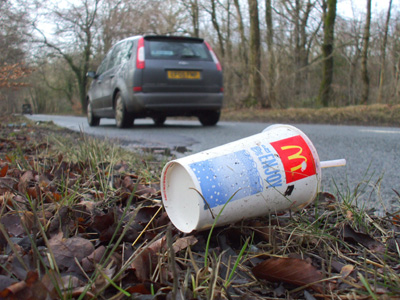
The last time I walked this route, I was alone which gave me more time to observe my surroundings. What struck me was the amount of litter I saw. I counted eight (8) soft drink or coffee cups. They were from such fast food restaurants as Dairy Queen (DQ), Tim Horton’s, and MacDonald’s.  I also saw fast food napkins, a hamburger Styrofoam box, a beer bottle and a beer can. There were also candy wrappers and a level which must have fallen off a work truck. That was what I could see just from the road. I’m sure there was much more litter as the grass was long in the ditches. What disturbs me about finding beer containers is the people who tossed them likely were drinking and driving. That to me is alarming!

Years ago our son was in 4H and every year the 4H clubs participated in the Alberta Highway cleanup where 4H members gather to clean up a section of a highway. I participated with him and what I remember most about that event was the number of cigarette packages there were. Smokers seem to be some of the worst litterers. The second most common piece of litter we picked up were fast food cups. Of course there were numerous bottles and cans and other miscellaneous items including dirty diapers. During a town cleanup last year we picked up mainly fast food cups, cigarette packages, along with other miscellaneous items and yes even dirty disposable diapers.

I’ve tried to understand why people litter and the only thing I can conclude is that people are just too lazy to find a garbage can and that people really don’t care about our environment. This inspired me to learn more about the topic.

Here are some facts from a website created by a Litter Reduction Task Force to address the litter issues within the Region of Waterloo, Ontario, Canada. This site is called, The only cure for litter is you.

  • The average distance someone will carry garbage before littering is 12 paces.
  • Most litter occurs within 5 meters of a garbage receptacle.
  • Single use food and beverage litter made up 45 per cent of litter cleaned up in the Great Canadian Shoreline Cleanup in Ontario, Canada.
  • There are 8,000 tonnes of cigarette butts dropped by Canadians each year, the majority within 10 feet of an ashtray. It takes 10 years for the filter to biodegrade.

What people need to understand is that much of this litter remains in the environment for a long time. According to this same website, it takes an aluminum can 80 to 200 years to break down naturally but if recycled, it can be reused within six weeks.  Here is some information about how long it takes other items to break down naturally.

  • Banana peel: 3 to 4 weeks
  • Paper bag: 1 month
  • Cardboard: 2 months
  • Wool sock: 1 year
  • Tin steel can: 50 years
  • Disposable diapers: 550 years
  • Plastic bags: 20 to 1000 years
  • Plastic jug: 1 million years
  • Glass: 1 to 2 million years
  • Styrofoam: 1+ million years
6_pack_duck_270x224
From humanesociety.org

It seems obvious to me that people just don’t care what they are doing to Mother Earth. So that begs the question, Why should we care about the problem of littering? According to the same website,

  • Litter is damaging to plant life. Litter can stunt plant growth.
  • Every year, millions of birds, fish and animals die from ingesting litter.
  • Litter on the ground and in our water is dangerous to humans.
  • Litter destroys the beauty of the community. Litter begets litter. One piece of litter on the ground signals others to litter.
  • Litter is a safety hazard. It is a breeding ground for rodents and bacteria.

According to the website, Conserve Energy Future (CCF),

  • Littering is expensive. Every year millions upon millions of dollars are spent cleaning up litter. This money should be going to more productive things, but instead, people don’t realize that something as small as littering done on a mass scale does indeed affect them. Taxpayers’ dollars are being spent on littering…
  • A very large majority of Americans have admitted to littering in their lifetimes. I’ll admit it. I have littered. The average American only walks a few steps before dumping their trash on the ground without even searching for a garbage can.
  • Billions of tons of litter are dumped into the ocean each year…This leads to the repeated killing of fish on a daily basis and the gradual depletion of marine life. Believe it or not, the litter we produce is causing more underwater species to become endangered.
  • Cigarette butts make up over half of our littered objects, and they take a grand total of ten years to decompose because of a cellulose acetate, contrary to the popular perception that cigarette butts decompose very quickly in only a matter of days. In reality, cigarette butts are a serious threat to the environment.

According to the article, Littering a crime of inconvenience for Canadians by Marc and Craig Kielburger, WWF Canada says Canadians are frustrated with environmental groups telling them that making small changes will have a big impact on our planet.

But Canadians are doing their part to clean up the mess we humans have created. According to the Kielburger brothers, The Great Canadian Shoreline Cleanup is one of the largest public action conservation programs in the country. Last year, more than 58,000 volunteers picked up litter along 3,000 km of shoreline and inventoried every piece. Having said that, we need to do more.

do-not-see-clipart-1It’s time we humans stop this disrespectful action of littering and start getting involved in public actions such as the Great Canadian Shoreline Cleanup, Alberta Highway Clean Up (if you live in Alberta) or in your local community spring clean-ups (see Communities celebrate spring with clean ups). It’s time to be stewards and to protect, respect and take care of our precious planet. No longer should we take our environment for granted. So do the right thing!

Climate Change Confusion

A commentary on whether humans are to blame for climate change

Carbonbrief.org, a UK-based website covering the latest developments in climate science, climate policy and energy policy, reports, Study links heatwave deaths in London and Paris to climate change. The study refers to the 2003 tragedy where more than 70 000 people across Europe died in a  heatwave. Climate Change is a reality. I don’t think anyone disputes that and the science community doesn’t either. All a person needs to do is take note of the strange weather the world has experienced in recent years. In June, we saw extremely wet weather in Europe causing flooding in Paris, France and Germany. In the United States there has been sizzling heat in the Southwest causing uncontrollable wildfires in California.  West Virginia has experienced severe flooding. In the province of Alberta, 88 000 people had to be evacuated from Fort McMurray because of wildfires. Also in June, Eastern China saw a tornado and hailstorm that killed at least 98 people when it sped over the city of Yancheng’s outskirts, destroying buildings, smashing trees and flipping vehicles on their roofs. The list of weird weather goes on and on.

There is no question that our weather is changing and becoming extreme. The ongoing debate is: Is it human activity that is causing climate change? Now I’ve taught about this topic in science for many years and there has been no doubt in my mind that it was indeed humans causing global warming which leads to climate change. I would show the graph comparing CO2 levels to average global temperatures and use it as evidence to convince my students. I would show them pictures of the shrinking polar ice cap and melting glaciers. I would show them Al Gore’s movie: Inconvenient Truth (see trailer below) and emphasize Al Gore’s argument that most of the scientists around the world agree that humans are the main reason for the global warming.

The article Scientific consensus: Earth’s climate is warming on NASA’s Global Climate Change website agrees with Al Gore’s conclusions as it says,

Multiple studies published in peer-reviewed scientific journals show that 97 percent or more of actively publishing climate scientists agree: Climate-warming trends over the past century are extremely likely due to human activities. In addition, most of the leading scientific organizations worldwide have issued public statements endorsing this position.

The Scientific America article: Is Global Warming a Myth? also agrees with Al Gore as it says,

…scientists have not been able to validate any such reasons for the current warming trend, despite exhaustive efforts. And a raft of recent peer reviewed studies—many which take advantage of new satellite data—back up the claim that it is emissions from tailpipes, smokestacks (and now factory farmed food animals, which release methane) that are causing potentially irreparable damage to the environment.

I have always believed that Al Gore must be right. But then I watched a video, on my son’s insistence, called, Climate Change: Fact or Fiction by Dr. Gary Smith (see below). Dr. Smith convincingly argues that humans are not causing global warming.

Global Research.ca, an organization that seems to me to be credible, has an article called Global Warming: Ten Facts and Ten Myths on Climate Change that seems to agree with Dr. Smith’s conclusions. This article agrees with Dr. Smith as it says,

 Climate has always changed, and it always will. The assumption that prior to the industrial revolution the Earth had a “stable” climate is simply wrong. The only sensible thing to do about climate change is to prepare for it.

The reality is that almost every aspect of climate science is the subject of vigorous debate. Further, thousands of qualified scientists worldwide have signed declarations which (i) query the evidence for hypothetical human-caused warming and (ii) support a rational scientific (not emotional) approach to its study within the context of known natural climate change.

So now I’m confused. I thought it was all clear in my mind but now I’m not so sure. The more I learn, the more confused I get. But I guess that is nothing new as Albert Einstein once said, “The more I learn, the more I realize how much I don’t know.”  Even Aristotle said, “The more you know, the more you know you don’t know.”

So now I’m not sure what to think. Am I convinced that humans are not to blame for climate change? NO I’m not. I suspect that we humans are contributing to the problem, but it could also be, at least in part, to natural changes in climate as the earth has gone through many warming and cooling periods. I suspect climate change is due to both. Having said that, I continue to believe that moving away from our addiction of fossil fuels can only help our planet. It just feels like the right thing to do. I guess we will just have to wait and see who wins the debate.

Are All Muslims Extremists?

A commentary on “Islamic or Muslim Extremists”.

On June 21, CBC.ca reported that a Muslim woman was attacked in a shopping mall. The article says a Muslim woman shopping with her four-month-old son was attacked in a London, Ontario supermarket and according to police the fourth reported event against visible minorities in the city in the past eight months. The day before, CBC reported A pig’s head left outside a Quebec City mosque was the latest in a string of incidents pointing to a rising tide of Islamophobia across Quebec. This is just days after the horrific attack in Orlando, Florida when a gunman massacred 49 people in a nightclub.

On June 12, the night of the attack, Donald. Trump, GOP presidential nominee tweeted: What has happened in Orlando is just the beginning. Our leadership is weak and ineffective. I called rtx1gzco (1)it and asked for the ban. Must be tough. In other words, his view is to ban all Muslims from entering the USA, a position he put forth during the primaries.

On June 13 Donald Trump gave an address on terrorism, immigration and nation security. During that address he said;

The immigration laws of the United States give the President the power to suspend entry into the country of any class of persons that the President deems detrimental to the interests or security of the United States, as he deems appropriate. I will use this power to protect the American people. When I am elected, I will suspend immigration from areas of the world when there is a proven history of terrorism against the United States, Europe or our allies, until we understand how to end these threats.

It’s no secret that Mr. Trump plans to ban Muslims from entering the United States. So what is happening? Is Mr. Trump, along with many other individuals, stereotyping Muslims, that is, categorizing them as potential “radical Islamists”? So I have to ask the questions: Is it fair to lump all Muslims together and label them potential “radical Islamists”? Should we fear Muslims because they might be terrorists? To answer these questions I did some research.

Globalresearch.ca is a Centre for Research on Globalization (CRG). It is an independent research and media organization based in Montreal, Quebec, Canada. Since the CRG is a registered non-profit organization and was created to do research on global issues, I would then conclude that it is a credible source. This organization has concluded that non-Muslims carried out more than 90% of all terrorist attacks in the United States. (see Non-Muslims…) The article cites a graph that provides statistics from 1980 to 2005 from the FBI Database. According to this data, there were more Jewish acts of terrorism (7%) within the United States than Islamic (6%).  The article also says the U.S. News and World Report noted in February 2013: Of the more than 300 American deaths from political violence and mass shootings since 9/11, only 33 have come at the hands of Muslim-Americans, according to the Triangle Center on Terrorism and Homeland Security. 

The Economist’s article, The plague of global terrorism reports:

Last year (2014) 32,700 people were killed in attacks worldwide, nearly twice as many as in 2013… Most of the deaths last year (and every year) are in the Middle East and Africa, not the West. Iraq, Nigeria, Syria, Pakistan and Afghanistan together account for three-quarters of the global total. Western countries suffered under 3% of all deaths in the past 15 years…The Paris attacks and the downing of a Russian airliner in Egypt killed more than 100 people each. Such lethal attacks are rare but are increasing. Last year, there were 26 compared with a handful in 2013. Most were carried out by ISIS, and most occurred in Iraq. And terrorism is spreading. 67 countries saw at least one death last year compared with 59 the year before.

So according to the Economist, less than 3% of all deaths in the West in the past 15 years were due to terrorist attacks. According to globalresearch.ca article, The Terrorism Statistics Every American Needs to Hear, the leading cause of deaths for Americans traveling abroad is not terrorism or murder or even a crime of any sort; it’s car crashes. With the exception of the Philippines, more Americans died from road crashes in all of the 160 countries surveyed than from homicides. The article also claims, you are 35,079 times more likely to die from heart disease than from a terrorist attack It too says you are 33,842 times more likely to die from cancer than from a terrorist attack.

The World Post has an article titled, Muslims Are Not Terrorists: A Factual Look at Terrorism and Islam, which makes some interesting points. One of their points is: Even if all terrorist attacks were carried out by Muslims, you still could not associate terrorism with Islam. It supports that statement with the fact that there have been 140,000 terror attacks committed worldwide since 1970. Even if Muslims carried out all of these attacks, those terrorists would represent less than 0.00009 percent of all Muslims. To put things into perspective, this means that you are more likely to be struck by lightning in your lifetime than a Muslim is likely to commit a terrorist attack during that same time span.

This article also says that if you’re going to claim that all Muslims are terrorists, then  you must also claim all Muslims are peacemakers. The article says that the same statistical assumptions being used to falsely portray Muslims as violent people can be used more accurately to portray Muslims as peaceful people. If all Muslims are terrorists because a single digit percentage of terrorists happen to be Muslim, then all Muslims are peacemakers because 5 out of the past 12 Nobel Peace Prize winners (42%) have been Muslims.

So what are my conclusions? My take on things is that the media has perpetrated the belief that most or even all terrorism is due to “Muslim extremists”. I say this because as typical of the news media, terrorist attacks, especially those carried out by “Muslim extremists”, get sensationalized in the media.. This myth perpetrated by the media is contrary to the evidence I sited earlier. It is blatantly unethical to group all believers of Islam as potential terrorists. That is why Donald Trump’s call for the Untied States to ban all Muslims for entering the States is unmerited and is based on misconceptions. Besides, banning Muslim immigrants does not guarantee a nation’s safety from terrorism since the latest incident in Orlando, Florida was carried out by an American born, non-practicing Muslim. I do not believe all Muslims are potential terrorists. I believe that most Muslims are peaceful, law-abiding people. Mr. Trump has used the phrase “Islamic Extremists” numerous times as have others. To think there is only extremism in Islam is naïve. The Christian religion has had its share as well. One of the latest, according to Wikipedia, was in November of 2015 when Robert Lewis Dear killed three and injured nine at the Planned Parenthood clinic in Colorado Springs, Colorado. The Christian terrorist voiced on several occasions his support for radical Christian views and interpretations of the Bible, and praised people who attacked abortion providers, saying they were doing “God’s work.” It’s interesting to note that this incident was not talked about for numerous days afterward.

Is our world less safe than it once was because of extremism? Yes it is. But should we be fearful of Muslims and Islamic terrorists? No. If we become a culture of fear then terrorists groups, such as ISIS, have succeeded in their mission which is to instill terror. Besides you’re more likely to be killed in a vehicle accident than in a terror attack.

Many Islamic leaders have condemned attacks carried out by “Muslim extremists”. I believe they will continue to do so and I have heard of many Muslims working to change the image people have of their religion. An ad campaign was launched in the United Kingdom to improve the image of Muslims. (see U.K. ad campaign). To quote the late Muhammad Ali, Terrorists are not following Islam. Killing people and blowing up people and dropping bombs in places and all this is not the way to spread the word of Islam. So people realize now that all Muslims are not terrorists. I say it is time to stop the senseless attacks on Muslims. Not all Muslims are a threat!actions do

Orlando: Hate or Terrorism?

A commentary regarding the massacre that occurred in Orlando, Florida on Sunday, June 12.

us-today-7591
USA Today headlines June 13, 2016

I was horrified to learn that on Sunday, June 12, 2016, a gunman pledging allegiance to the Islamic State opened fire inside a crowded gay bar and dance club in Orlando, Florida, leaving 49 people dead and 53 injured. This sickening event is being called the deadliest mass shooting in the history of United States.

President Obama, once again commenting on a mass shooting, said it was “an act of terror and an act of hate.” So that begs the question: Was the Orlando massacre an act of terrorism or was it a hate crime? Dictionary.com defines a hate crime as a crime, usually violent, motivated by prejudice or intolerance toward an individual’s national origin, ethnicity, colour, religion, gender, gender identity, sexual orientation, or disability. Vocabulary.com defines an act of terrorism as the calculated use of violence against civilians in order to attain goals that are political or religious or ideological in nature. Now if we consider the two definitions, the answer to the question would be it is both an act of terror and a hate crime. Violence in the form of gun shooting was carried out against civilians, specifically the LGBT community, and was motivated or at least inspired by the terrorist group known as ISIS so it is an act of terror. Even more, it was a hate crime. It was a hate crime clearly directed towards the LGBT community. Omar Mateen, a man previously investigated by the FBI, was allegedly motivated when he witnessed two men kissing. Seeing the two men together apparently angered him enough to commit this horrendous act.

To me, this is much more a hate crime as opposed to an act of terrorism. There is no evidence that ISIS or any other terrorist organization directed Mateen to act. I was moved by the words of Tom Walters from Canada’s CTV news station. On the night of the shooting, Tom Walters closed the newscast with these words. I wish I could say these are my words because Mr. Walters captures the essence of the problem so brilliantly.

“In simple terms, the motive for the Orlando massacre is not mystery, it was hate. And finding out what kind will explain little because every reason to hate a stranger is just as senseless. Colour, religion, sexual orientation, these are mere fragments of a human being, not the summation of who a person is or the basis to judge what a person is worth. Consigning people to categories denies them their individuality and robs them of their humanity. This is what makes hate possible…only a handful [of individuals] could do this. Now in the aftermath, some would still put individuals into categories and ask us to fear and reject whole groups. Society will never be perfectly safe from the deranged few, but when they are fed the rhetoric of hate and have access to the tools of murder, common sense would say we are less safe. Now facing the monstrous evil of terrorism, a future with less hate may seem distant…and if hate itself is the poison, that future is out of reach until people everywhere reject the ideas that diminish the individual and enable hate. That could include any doctrine that says I belong here more than you or that my love for someone is more valid than yours or I am among the chosen and you are not…but in a world of individuals we can each make a choice to reject those ideas that would add another drop of poison to the common cup.”

As Tom Walters says, “consigning people to categories denies them their individuality…and makes hate possible”. The Orlando mass shooting is clearly an act of hate directed towards the LGBT community; a community who just want to be treated as equals and live their lives happily.

The mass shooting in Orlando is but a familiar story in the United States. It was the third mass shooting in 2016 that left at least three victims dead, following shootings in Hesston, Kansas. and Kalamazoo, Michigan in February. Six months earlier 14 people were killed in a rage in San Bernardino, California. Time magazine has complied a list of mass shooting since 1984. (see 34 years of mass shootings). Wikipedia lists the United States’ firearm-related death rate as 10.44 per 100,000 people per year. Canada’s firearm-related death rate is 1.97 per 100,000 people per year. That is a significant difference. The article Gun violence by the numbers by Global News lists the USA as having 90 firearms per 100 people whereas Canada’s rate is 30 firearms per 100 people. The American Medical Association called gun violence a “public health crisis” on June 14th and urged Congress to fund research into the problem.The association pleaded that a long-standing ban on federal government research into gun violence must be lifted to better understand and tackle the problem. It astounds me that researching the gun problem is forbidden. Does that make sense?

Now this information raises a second question: Why haven’t Americans realized that there is a connection between mass shootings and the amount of guns. Canada has always had tighter controls on guns. I am convinced that is why Canada’s firearm-related death rate is much lower than USA’s. The Global News article sited earlier says you’re more likely to be shot to death in the United States than you are to die in a car accident in Canada. It seems obvious to me that the more guns a society has the more gun related deaths there will be. Americans always cite the second amendment to the United States Constitution, adopted on December 15, 1791, as a defence to owning guns. This amendment protects the right of the people to keep and bear arms.  An amendment is a change or addition to a legal or statutory document so if Americans wanted to change their relationship with guns they could change (amend) their Constitution.

Donald Trump, GOP presidential nominee tweeted on the night of the shooting, “Appreciate the congrats for being right on radical Islamic terrorism, I don’t want congrats, I want toughness & vigilance. We must be smart!” He later tweeted, “What has happened in Orlando is just the beginning. Our leadership is weak and ineffective. I called it and asked for the ban. Must be tough.” In other words, his view is that radical Islamic terrorists are to blame and so his answer is to ban all Muslims from entering the USA. Now that leads to a third question: Should we fear all Muslims because they might be terrorists? My answer to that is a resounding NO. To use the words of Tom Walters, what Mr. Trump is doing is putting “individuals into categories and ask[ing] us to fear and reject” Muslims.

Slate, an online magazine, has an article called, The Truth About Islam. The article says Muslim societies are among the least violent in the world. It goes on to say,

The reality is that Islam—like Christianity, Judaism, Hinduism, and other major world religions—is neither inherently violent nor inherently peaceful. Like every other great religion, the history of Islam is darkened by periods of violent bloodletting. And the holy texts of all religions can be mined for quotes to legitimize terrorism—or indeed principled nonviolence.

The Christian and Jewish religions have had their share of “darkened periods of violent bloodletting”. In 1095 the Christian crusades began. This was when armies responded to Pope Urban II’s plea to go to war against Muslim forces in the Holy Land. The inquisition was the Catholic churches attempt to remove heresy. Both were filled with bloodletting. Judaism has a history of radical Zionism, a movement for the re-establishment of a Jewish nation. Zionism promoted aggressive war justified with biblical texts.

To categorize all Muslims as terrorists is stereotyping and that makes it wrong. There are many peaceful Muslims just as there are Christians and Jews. The Islamic Society of Wichita condemned the attack, as did many Islamic leaders. The group issued the following statement Sunday.

“Along with our fellow Americans, the Islamic Society of Wichita condemns the hateful act of violence in Orlando, Florida. In this holy month of Ramadan, we will be offering special prayers for the victims and their families. As people of faith, we stand unified against acts of terrorism and violence and will continue our work to defend all people against hatred and brutality. We urge local Muslims…to donate blood for the victims of this heinous act.” 

I would like to reiterate Tom Walters’ words to reject “any doctrine that says I belong here more than you or that my love for someone is more valid than yours or I am among the chosen and you are not.” Mr. Trump is saying that Muslims do not belong in America because they are potential terrorists. Trump is stereotyping. That is why he is calling for a ban on Muslims entering the United States. “Consigning people to categories” such as all Muslims are potential terrorists, “is what makes hate possible”. It is time to stop the labelling of groups because it “makes hate possible”. Not all Muslims are radical Islamic terrorists! The lifestyle of the LGBT community is not sinful!  Is a heterosexual’s love for another more valid than homosexual’s love? Who are we to judge? Guns kill when they fall into the hands of people who stereotype and hate. America, it’s time to decrease gun availability so they don’t fall into the hands of those who hate. After all, authorities tell us that the Orlando killer purchased guns a few days before he went on his rampage. So long as a person doesn’t have a criminal record or has no history of mental illness they can purchase a gun. Guns were created for one purpose only and that is to kill. Guns are just too plentiful and much too easy to obtain in the USA.

Nature’s Wonders

IMG_4412
Lake Louise

It astonishes me the number of beautiful places this planet has to offer for us humans to appreciate. I consider myself blessed because my wife and I have seen a handful of them. When I look at websites advocating must see places to visit in the world, I am surprised at how many I have seen. These sites often mention places such as Santorini in Greece, Venice in Italy, Paris in France, Rome in Italy, Stonehenge at Amesbury, England, Glacier National Park in Montana, USA all of which I have visited. With the exception of Glacier Park, these places all involve flights over oceans but we don’t have to travel across oceans to see beautiful places. There are so many places right here in our own country. The Internet has many lists of must see places on it and many of these lists include places in the Canadian Rocky Mountains; places like Banff National Park, Lake Louise, Jasper National Park, and Maligne Lake in Jasper National Park.

The Reader’s Digest’s article, 10 Places In Canada Every Canadian Needs To Visit includes Banff National Park and Lake Louise on its list. CNN’s article, 20 of the most beautiful places in Canada includes Jasper National Park and Lake Louise on it. When you search the Internet for must see places in Canada, the Canadian Rockies, Banff National Park, Jasper National Park or Lake Louise will almost inevitably show up on the list.

The Canadian Rockies are an assemblage of mountains that extend to  parts of British Columbia and Alberta. They were formed about 55 to 80 million years ago in what is called the Cretaceous era. These mountains are made up of layered sedimentary rocks and when you take the time to look you can see the layers. Their peaks are sharp and pointy because of glaciers on it.

2016-05-16 15.17.13
Bighorn sheep

There are five national parks that are part of the Canadian Rockies; these are Yoho, Jasper, Kootenay, Banff and Waterton. Banff National Park was the first to be formed. The UNESCO World Heritage Site is made up of four Canadian Rocky Mountain national parks and has a total protected area of over 20,000 square kilometres. If you are lucky enough you might see animals such as grizzly or black bears, deer, elk, moose, cougars and bighorn sheep. My wife and I caught a glimpse of a black bear and numerous bighorn sheep. We also saw some moose. The Canadian Rockies have been likened to the 2016-05-15 15.33.08African Serengeti in terms of the abundance of wildlife. When you drive in Banff National Park you’ll notice places where wildlife can cross the Trans-Canada Highway on specially built over and under passes, designed to reduce collisions with the animals.

My wife and I just recently spent a week in the Canadian Rocky Mountains. We visited three of the five national parks; Banff, Jasper and Kootenay. Even though I’ve been to the Rockies many times, I still find the beauty of these majestic mountains to be breathtaking. When I’m among these gigantic, unique pieces of rock I feel a closeness to our creator God especially when we are walking on one of the numerous beautiful hiking trails. My wife and I spent three days in Jasper National Park where we went to Maligne Lake for the first time. It was truly one of the most beautiful places I have ever seen.

Maligne Lake, Jasper

Another thing that always amazes me, or both of us really, is the number of people from all over the world you meet or the variety of languages you hear. We heard languages in French, German, Chinese, Japanese and some we didn’t recognize. We met people from France, China, United States, and Germany. It truly is a global village. All of these people were doing the same thing as we were. They were taking in the beauty of the Canadian Rockies.

It astounds me the number of people I know who live in the province of Alberta, Canada, that have never been to the Canadian Rockies. We live on the east side of the province of Alberta, probably one of the farthest points from the Rockies yet both my wife and I have been there too many times to count. It takes us six hours to drive to the Jasper town site. Yet, so many people who live even closer to the west side of the province where the Rockies are located have never taken the time to visit those majestic sites.

There are so many wonderful places to see in our world, many of them in our own back yard. Life is too short to procrastinate seeing them. Now I know it is human nature to make excuses for not doing it; excuses like it costs too much, not enough time or work is just too important to miss. I just think it is sad that people don’t take the time to see such wonderful formations of nature. It is so important to spend time seeing what nature has created and just being in nature. It doesn’t have to be the Rocky Mountains although if you haven’t seen them you definitely should. There are so many benefits to being in nature. According to the article, Get Outside! 7 Scientifically-Backed Health Benefits of Being in Nature, spending time in nature improves attention spans, boosts serotonin (the feel good neurotransmitter) levels and shows increased activity in the parts of the brain responsible for empathy, emotional stability, and love.  Some research suggests urban environments do the same for fear and anxiety. Being in nature is good for your health. Take the time to experience a bit of heaven on earth. It is worth the effort. Or as the French author, Jules Renard says,  On earth there is no heaven, but there are pieces of it.