
I have always had an interest in politics. I taught social studies in high school for years and would passionately discuss politics with my students and give projects to them when election campaigns were on. I’ve even scrutineered once. For those of you who don’t know what a scrutineer is, in the British and Canadian systems, a scrutineer is an official examiner of votes in an election. There was even a time when I would have seriously considered running for office. I used to think politicians were honourable people and individuals to be admired for their service. Now don’t get me wrong, there are still a few honourable people who are leaders. However, as I watch the politicking of our neighbours to the south, I begin to wonder if honourable and honest people enter politics anymore.
You’re probably wondering why I say such a thing. I was recently watching some of the analysis on CNN regarding the most recent primaries that are happening in the United States. One of the commentators was discussing the insults that were exchanged between Donald Trump and Marco Rubio, two candidates running for the Republican Party nomination for president. Here is an article about what I’m talking about –Us Election 2016. There were insults traded between the two candidates about misspelled tweets, wet trousers, wearing makeup and Trump ridiculing Marco Rubio for his love of drinking water. Apparently, in a State of the Union response speech in 2013 while on national television Mr. Rubio paused for a sip of water. But what really got me were their exchanges about sweating.

According to Business Insider, the exchange apparently happened backstage when they were debating one another. Mr. Rubio insinuated that Trump possibly “wet” himself. “He called me Mr. Meltdown,” Rubio went on to say, “Let me tell you, during one of the breaks — two of the breaks — he went backstage. He was having a meltdown. First he had this little makeup thing, applying makeup around his mustache, because he had one of those sweat mustaches. Then he asked for a full-length mirror. I don’t know why, because the podium goes up to here. Maybe he was making sure his pants weren’t wet. I don’t know.
Trump countered with, “He’s with a pile of makeup putting it on his face, I said Marco, easy with the makeup, you don’t need that much. You know the story with Marco. I watched Marco with this man [Christie]. Where Marco, he was right over here I asked him I said are you okay? He looked like he just came out of a swimming pool. He was a mess.” Anyway, I’m sure you get what I’m talking about.
The first question I have is, Why are they throwing insults when I’m sure the American people want to hear about solutions to the problems the country faces? Donald Trump’s campaign slogan is, “Make America Great Again.” A great slogan I might add. But I seldom hear him telling the American people how he intends to do that. What I typically hear is insults flying and Trump being a bully. The other Republican candidates don’t seem to be a whole lot better. Are these the best candidates that America has to offer, candidates throwing insults at one another? Granted, it might be entertaining, but really it’s bullying. No wonder our society has a bullying problem. When I vote, I vote for those candidates that reflect my values, but even more because they’ve explained what they will do to make their country better.
Canada is not immune to such antics. During the last 2015 Federal Election in Canada, the then reigning Conservative government placed ads in local newspapers and flyers, questioning whether Justin Trudeau, Canada’s current Prime Minister, shares their values. The ads tried to foster fear that a Liberal government would legalize marijuana, “making access easier for kids.” The ad warns there would be legal drug-injection sites in our neighbourhoods and that prostitution would be legalized, “putting brothels in our communities.” The Conservative Party attack ad finishes with, “Those aren’t our values either. Vote for your values.” They were twisting the truth. Mr. Trudeau did make a campaign promise to legalize marijuana, but he never explicitly said he would legalize prostitution or drug injection sites. That was only Conservative fear mongering.
 Of course there was the long running television ads attacking Mr. Trudeau’s credibility saying, “He’s just not ready” to be prime minister. The Liberal Party of Canada is also guilty of attack ads. In 2006 then Liberal Party Leader Paul Martin approved a controversial ad suggesting the Tories would post armed soldiers on the streets of Canadian cities. During the last weeks of the campaign, the Liberals resorted to negative ads directed towards the Conservative party, attempting to depict its leader Stephen Harper as an extreme right-wing politician. The most controversial ad said, “Stephen Harper actually announced he wants to increase military presence in our cities. Canadian cities. Soldiers with guns. In our cities. In Canada.”
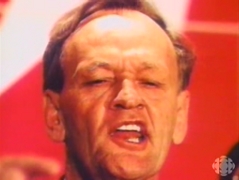 Historically, one that stands out for me was the 1993 Progressive Conservative Party attack on then Liberal leader Jean Chretien, who was elected as Prime Minister that year. The ad showed a picture (on left) of Mr. Chretien saying,”Is this a Prime Minister?” This ad was interpreted as mocking Chretien’s slight deformity and speech impediment that were leftover from a childhood case of Bell’s Palsy. This is a condition where paralysis of the facial nerves occur, causing muscular weakness in one side of the face. To me, that was a “low blow.” That was “hitting below the belt.”
Why does politics have to be about attacking another’s character? Most people I have talked to express how repugnant this type of politicking is. I’m grateful that Canada’s present Prime Minister, Justin Trudeau, did not run any attack ads during the 2015 election and does not resort to bullying to achieve his goals. In fact, in October of 2015 on CTV’s Canada AM Mr. Trudeau said,“I don’t believe in attack ads. I think they hurt your ability to govern and my capacity to stay positive and focused on our platform.” I say kudos to Canada’s Prime Minister. It is time to get back to what I call honourable politicking, where politicians put forth their platforms for making their country great. It’s time to bring honour and respect back to politics. Time to give us politicians who have creative new ideas, who aren’t bullies, and who want to lead because they want to make a difference in this world. It is a sad state of affairs when the only potential leaders that step forward are bullies who attack their opponents. Enough already!


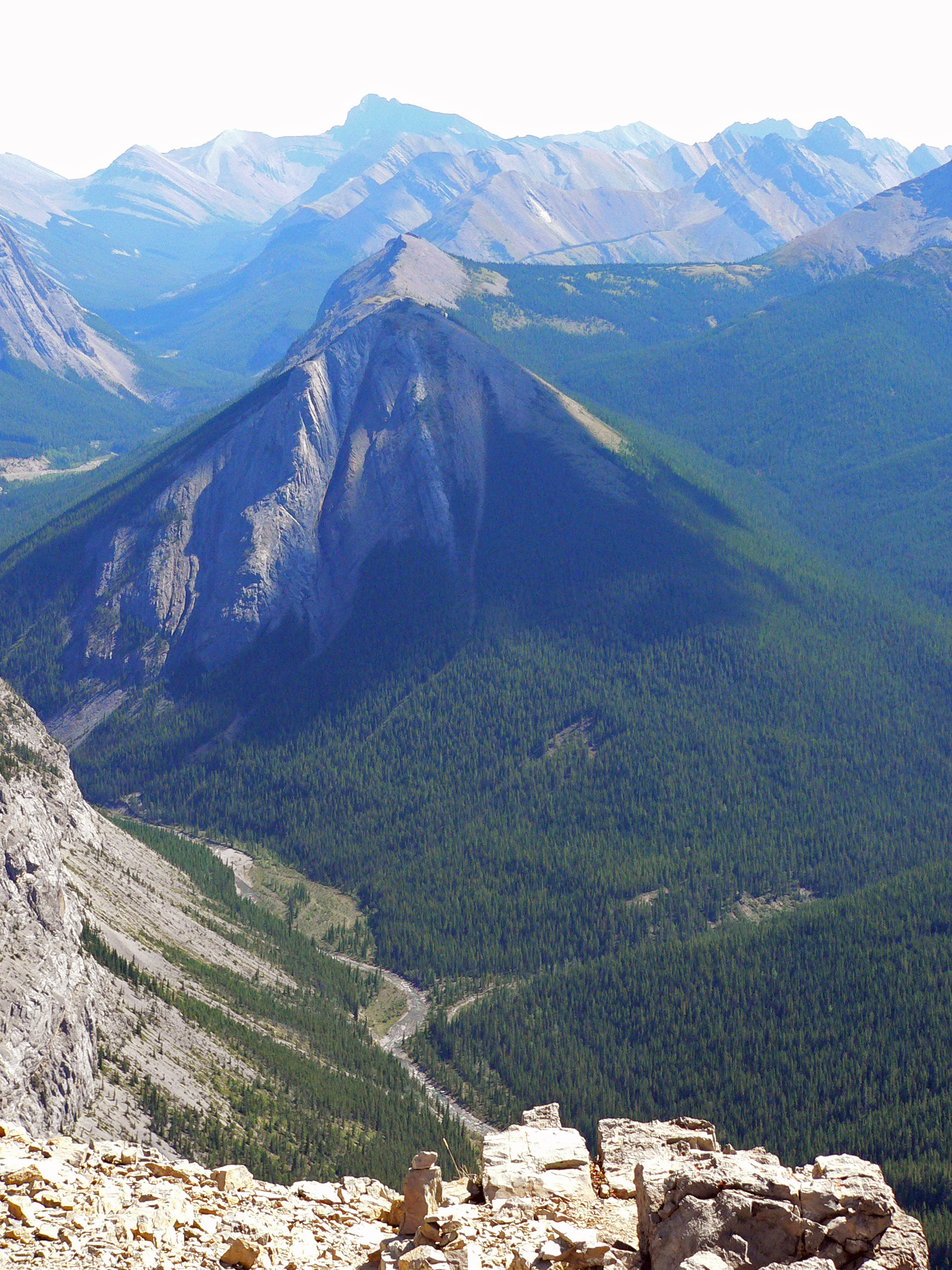
 Now I have been asked over the years why I would go into the back country where there is no contact with the outside world; where there are bears and cougars and it can sometimes get to below freezing at nights. Those are good questions. My first response to those questions is always that it is quality time with my son. But it is more than that. I do it for the adventures. There is nothing like being in nature and the experience of standing on top of mountain with the wind blowing through your hair. The beauty that Mother Nature has to offer is far-fetched until you see it, and even then it can be surreal. For me, being in the wilderness is a chance to touch the divine. It is during those times that I feel closest to God or the Universe.



 Over the years I have been periodically greeted with a greeting known as “Namaste”. This is a gesture that entails a slight bow made with hands pressed together, palms touching and fingers pointed upwards in front of the chest. I have witnessed speakers and performers greet their audiences with this sign. Many years ago our school hosted an exchange student from Thailand who when she first arrived would greet her teachers and fellow students with the Namaste gesture. Some of my yoga instructors concluded every practice by uttering “Namaste” while bowing with hands pressed together. Even in Taekwondo we bowed to our opponents although not with our hands together. A bow in Taekwondo was a sign of respect which is its meaning in all martial arts. We even bowed when we entered the dojang or gym as a sign of respect for it.
 all. It betokens our intuition that all souls are divine. It reminds us in quite a graphic manner, and with insistent repetition, that we can see God everywhere and in every human being we meet. It is saying, silently, ‘I see the Deity in us both, and bow before It. I acknowledge the holiness of even this mundane meeting. I cannot separate that which is spiritual in us from that which is human and ordinary.’”
 No matter how Namaste is interpreted, it invokes a sense of sharing a spiritual connection and creates a sense and feeling of oneness. It is a way to feel connected. It conjures up feelings of respect. It is a sign of universal oneness. Maybe this world would be in a better place if all humans practiced this simple gesture. As the Buddhists believe, it just may be a “remedy” for pride that is the cause of many problems. I’m convinced this simple gesture brings about more feelings of reverence and honour for others. Mohandas K. Gandhi allegedly said once, “Namaste. I honor the place in you where the entire universe resides. A place of light, of love, of truth, of peace, of wisdom. I honor the place in you where when you are in that place, and I am in that place, there is only one of us.” Such a simple sign, a bow with hands together, with the intended meaning as Gandhi explained, just might make all the difference in this world.
 I recently read a book titled, Inconvenient Indian by Thomas King. What surprised me, was that Mr. King claims that the massacre that allegedly occurred at the Alamo was a fabrication, a story created over the years. But that is not what history says.
 If you don’t know much about the legacies of Residential Schools, here is another lesson. (It’s the teacher in me. I just have to teach). After the closing of the schools, which operated from the 1870s to 1996, and held some 150,000 aboriginal children over the decades, many former students made allegations of physical, psychological, and sexual abuse, plus accusations of neglect. The sole aim of residential schools was to assimilate First Nations children into the European culture. There were also student deaths at these institutions as well as burials of numerous deceased students in unmarked graves without the notification or consent of the parents. I personally have heard residential school survivors tell their stories and break down weeping when doing so. It is a very painful topic for many of them. This is not a part of our history that I am proud of. I have also taught about the atrocities that have occurred in these schools and witnessed students distraught because of it. Students instinctively know, as all of us do, that the way the indigenous people were treated was unjust.
  Then there is the missing and murdered aboriginal women in Canada, an issue that First Nations people have been lobbying our government to conduct an inquiry on for at least a decade. The following statistics are from the
  The October 2015 federal election saw
  Sommer Season all year