
For the past three summers, my wife and I have camped for several weeks at a campsite near where we live. This campsite is beside a river and has a golf course where I golf at least once a day. The campsite is located in a beautifully treed area where you can truly feel connected with nature. I don’t need to write about the health benefits of being in nature as I did that in my post Nature’s Wonders in May. Spending time golfing and having campfires is what I’ve been doing for the last few weeks so in case you’ve been wondering, that is why I haven’t published anything lately.
My wife loves to walk and so I go for walks as often as I can with her. It’s good quality time together and we often have some of our best talks doing this. We either walk around the campsite visiting the occasional camper that we know or we walk down a rural road near the campground. It’s about a six kilometre (3.7 mile) walk to the location we go to and back. The road is a gravel road so sometimes we get bombarded with dust when a vehicle goes by but for the most part the road is a beautiful walk in the river valley.
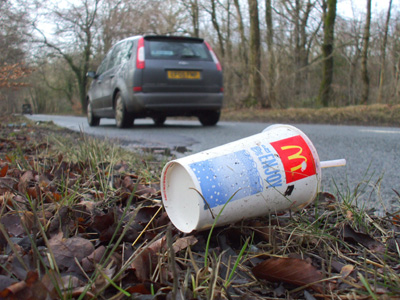
The last time I walked this route, I was alone which gave me more time to observe my surroundings. What struck me was the amount of litter I saw. I counted eight (8) soft drink or coffee cups. They were from such fast food restaurants as Dairy Queen (DQ), Tim Horton’s, and MacDonald’s. I also saw fast food napkins, a hamburger Styrofoam box, a beer bottle and a beer can. There were also candy wrappers and a level which must have fallen off a work truck. That was what I could see just from the road. I’m sure there was much more litter as the grass was long in the ditches. What disturbs me about finding beer containers is the people who tossed them likely were drinking and driving. That to me is alarming!
Years ago our son was in 4H and every year the 4H clubs participated in the Alberta Highway cleanup where 4H members gather to clean up a section of a highway. I participated with him and what I remember most about that event was the number of cigarette packages there were. Smokers seem to be some of the worst litterers. The second most common piece of litter we picked up were fast food cups. Of course there were numerous bottles and cans and other miscellaneous items including dirty diapers. During a town cleanup last year we picked up mainly fast food cups, cigarette packages, along with other miscellaneous items and yes even dirty disposable diapers.
I’ve tried to understand why people litter and the only thing I can conclude is that people are just too lazy to find a garbage can and that people really don’t care about our environment. This inspired me to learn more about the topic.
Here are some facts from a website created by a Litter Reduction Task Force to address the litter issues within the Region of Waterloo, Ontario, Canada. This site is called, The only cure for litter is you.
- The average distance someone will carry garbage before littering is 12 paces.
- Most litter occurs within 5 meters of a garbage receptacle.
- Single use food and beverage litter made up 45 per cent of litter cleaned up in the Great Canadian Shoreline Cleanup in Ontario, Canada.
- There are 8,000 tonnes of cigarette butts dropped by Canadians each year, the majority within 10 feet of an ashtray. It takes 10 years for the filter to biodegrade.
What people need to understand is that much of this litter remains in the environment for a long time. According to this same website, it takes an aluminum can 80 to 200 years to break down naturally but if recycled, it can be reused within six weeks. Here is some information about how long it takes other items to break down naturally.
- Banana peel: 3 to 4 weeks
- Paper bag: 1 month
- Cardboard: 2 months
- Wool sock: 1 year
- Tin steel can: 50 years
- Disposable diapers: 550 years
- Plastic bags: 20 to 1000 years
- Plastic jug: 1 million years
- Glass: 1 to 2 million years
- Styrofoam: 1+ million years

It seems obvious to me that people just don’t care what they are doing to Mother Earth. So that begs the question, Why should we care about the problem of littering? According to the same website,
- Litter is damaging to plant life. Litter can stunt plant growth.
- Every year, millions of birds, fish and animals die from ingesting litter.
- Litter on the ground and in our water is dangerous to humans.
- Litter destroys the beauty of the community. Litter begets litter. One piece of litter on the ground signals others to litter.
- Litter is a safety hazard. It is a breeding ground for rodents and bacteria.
According to the website, Conserve Energy Future (CCF),
- Littering is expensive. Every year millions upon millions of dollars are spent cleaning up litter. This money should be going to more productive things, but instead, people don’t realize that something as small as littering done on a mass scale does indeed affect them. Taxpayers’ dollars are being spent on littering…
- A very large majority of Americans have admitted to littering in their lifetimes. I’ll admit it. I have littered. The average American only walks a few steps before dumping their trash on the ground without even searching for a garbage can.
- Billions of tons of litter are dumped into the ocean each year…This leads to the repeated killing of fish on a daily basis and the gradual depletion of marine life. Believe it or not, the litter we produce is causing more underwater species to become endangered.
- Cigarette butts make up over half of our littered objects, and they take a grand total of ten years to decompose because of a cellulose acetate, contrary to the popular perception that cigarette butts decompose very quickly in only a matter of days. In reality, cigarette butts are a serious threat to the environment.
According to the article, Littering a crime of inconvenience for Canadians by Marc and Craig Kielburger, WWF Canada says Canadians are frustrated with environmental groups telling them that making small changes will have a big impact on our planet.
But Canadians are doing their part to clean up the mess we humans have created. According to the Kielburger brothers, The Great Canadian Shoreline Cleanup is one of the largest public action conservation programs in the country. Last year, more than 58,000 volunteers picked up litter along 3,000 km of shoreline and inventoried every piece. Having said that, we need to do more.
 It’s time we humans stop this disrespectful action of littering and start getting involved in public actions such as the Great Canadian Shoreline Cleanup, Alberta Highway Clean Up (if you live in Alberta) or in your local community spring clean-ups (see Communities celebrate spring with clean ups). It’s time to be stewards and to protect, respect and take care of our precious planet. No longer should we take our environment for granted. So do the right thing!
 it and asked for the ban. Must be tough. In other words, his view is to ban all Muslims from entering the USA, a position he put forth during the primaries.

 presidential candidate. “Look at that face. Would anybody vote for that? Can you imagine that, the face of our next president? ! I mean, she’s a woman, and I’m not s’posedta say bad things, but really, folks, come on. Are we serious? ” Now Dictionary.com defines sexism as, The belief that one gender is superior to the other, especially that men are superior to women. Trump’s words, “she’a a woman” sounds to me that he thinks women are lesser than men. That sounds like sexism to me. In fact, the Telegraph has a
  On a CNN program, speaking with Jake Tapper, Mr. Trump specifically attacked the “Mexican heritage” of the judge. Mr. Curiel is a man who was born in Indiana, who battled Mexican drug cartels as a federal prosecutor and was appointed to the bench by a Republican. “This judge is of Mexican heritage,” Trump said in the interview. He went on to say, “I’m building a wall, OK? I’m building a wall. … He’s a member of a society where, you know, very pro-Mexico. And that’s fine. But I think he should recuse himself.” When asked on CBS’ “Face the Nation” if a Muslim judge would treat him unfairly because he has vowed to ban Muslims from entering America, the potential president said: “It’s possible, yes. That would be possible, absolutely.” (see


 I’ve always been intrigued with Buddhism. The founder of Buddhism is said to have declared, “What we think, we become.” What does this really mean? I have been pondering that question for some time now. Others have said something similar. Ralph Waldo Emerson, an American essayist, lecturer, and poet, once said, “We become what we think about all day long.” Henry Ford, the founder of the Ford Motor Company, once said, “Whether you think you can or can’t, you’re right.” That is just a sampling of like-minded thinkers. So that begs the question, what do these quotes really mean?


 Sommer Season all year