Christmas Controversies

Every year as the Christmas season approaches controversies erupt around political correctness and tolerance. This year there was the Starbucks controversy (see Red Cup Controversy) , which monopolized imageheadlines in November. The company typically has its red holiday cups decorated with snowflakes, Christmas ornaments or reindeer, but chose for a minimalist design this year with cups that are red with nothing but its green logo. Starbucks executives said they wanted to embrace “simplicity and quietness.” However some Christian conservatives saw these new cups as an attempt to diminish the importance of Christmas.


Screen Shot 2015-12-15 at 10.50.33 AMAnother controversy occurred in Oakville, Washington, a town of 700 people who typically celebrates Christmas without controversy (see Christmas Message Sparks Controversy).  This year volunteer firefighters at Grays Harbor Fire District No.1 put a biblical message on their sign. The sign outside the fire station read, “Unto us a savior is born. Merry Christmas.” So when someone complained the fire commissioner ordered the sign to come down and their Christmas tree turned off.

I understand some of the thinking around these controversies. After all we live in a multicultural country and it is important to be sensitive to the different cultures around us. In fact, Canada celebrates multiculturalism and has officially made multiculturalism it’s policy. In 1971, then Prime Minister Pierre Trudeau, the father of Canada’s present prime minister, Justin Trudeau, acknowledged its commitment to the principle of multiculturalism and formalized a policy to protect and promote diversity. Canada was the first country in the world to adopt multiculturalism as an official policy. This policy affirmed the value and dignity of all Canadian citizens regardless of their racial or ethnic origins, their language, or their religious affiliation.

In 1988, the Canadian Multiculturalism Act was enacted by then Prime Minister Brian Mulroney. This Act has two fundamental principles:

  1. All citizens are equal and have the freedom to preserve, enhance and share their cultural heritage.
  2. Multiculturalism promotes the full and equitable participation of individuals and communities of all origins in all aspects of Canadian society.

The United States does not have any kind of act recognizing its multicultural diversity that I am aware of, but nonetheless, like Canada, it is a country made up of immigrants and therefore it’s society encompasses many cultures.

So I get it (I think). I understand the need to be sensitive to other religious traditions and cultures. After all, the Canadian Multiculturalism Act states, “Citizens…have the freedom to preserve, enhance and share their cultural heritage.” So the way I see it, Christmas is a time for Christians to share their religious heritage.

Christmas is celebrated on December 25th and is the day when Christians celebrate the birth of Yeshua or Jesus of Nazareth. Jesus is regarded by most Christians as the Son of God and the savior of humanity. It seems every year there are some people who take offense to Christians expressing this belief.  Christians should not feel stifled in any way when celebrating one of their biggest festivals!

250px-Menorah_0307The Jewish tradition celebrates Hanukkah or the “Feast of Dedication,” also known as the “Festival of Lights”.  This festival is celebrated on the 8th day of December and it is a time when Jewish people recall a miracle in the Jerusalem temple during a war fought by the Maccabees for the cause of religious freedom. Temple candles only had enough oil to burn for a single day. Yet they burned for eight days. Jews light candles on a menorah, two on the first day, three on the second, to nine on the eighth day. Jews should not feel restricted in any way when celebrating Hanukkah. In fact, this celebration should be encouraged. Perhaps in addition to Starbucks having cups with Christmas decorations on it, the company should also include cups with the menorah on it.

Also on December 8th, or on the Sunday immediately preceding it, the Buddhists celebrate Bodhi Day. This day recalls the day in 596 BCE, when Siddhartha Gautama, also known as the Buddha (meaning enlightened one) sat beneath a Bodhi tree and is believed to have achieved enlightenment, thus escaping the repeating cycle of reincarnation: involving birth, life, death and rebirth. Being this is an important day for the Buddhists, why not have some Starbucks cups with Bodhi trees on them in December as well. This would be a great way to educate people about the various religious traditions among us and maybe even build religious tolerance, which is so badly needed in our world.

For Muslims, Eid al-Adha is a significant annual Islamic observance for many Muslims around the world. It is also known as the Feast of Sacrifice or Festival of Sacrifice or Day of Sacrifice as it commemorates Ibrahim’s (Abraham) willingness to sacrifice his son to God. Eid al-Adha is a happy occasion that many Muslims celebrate. It is around the 10th to the 13th days of the Islamic month of Dhu al-Hijjah (or Dhul Hijja). This is the twelfth and final month in the Islamic calendar. It is a very sacred month in the Islamic calendar, one in which Hajj (pilgrimage to Mecca) takes place. It is a time marked by special prayers and many Muslims gather for special prayer services. Many people also visit family and friends, exchange greetings and gifts, and make donations to the poor. It is also a time for forgiveness and compassion. Doesn’t that sound a lot like Christians at Christmas? At Christmas don’t people gather for special prayer services, visit family and friends, and exchange greetings and gifts?

In 2006, 2007, and 2008, Eid al-Adha was celebrated in December. These holy days have left December, but will return in about three decades. Why not have some Starbucks cups commemorating this Islamic festival during the month when it is celebrated. This would be a great way to educate people about Islam especially during a time in history when Islamophobia is rampant. Why not?

We can get so caught up in political correctness or the mentality that we might offend non-Christians if we celebrate Christmas publicly. These festivals should be celebrated publicly and acclaimed with pride. I am not referring to just the Christian festivals but all religious festivals. Instead of being afraid to offend someone, companies such as Starbucks, should be willing to acknowledge these festivals when they occur and their cups should acknowledge the festival of whichever religious celebration is occurring. Maybe I’m being naive, I don’t know. Maybe this is easier said than done, but it seems to me that this would be a way to educate people about the various religions of the world and a way to build religious tolerance rather than contributing to fear and resentment of other religious traditions.

Europe Then and Now

Since returning from our trip abroad, my wife and I have been asked numerous times what we found different in Europe compared to our first time over there which was 26 years ago. Our gut response is always to say, “It pretty much looks the same as it did last time we were there.”  Now that is the truth.  It still looks pretty much as it did in the 1980s.  Most of the buildings still look very old and the majority of the streets are still very narrow. However, if there is one thing that was noticeably different was the amount of English around.

When I taught Social Studies, we used to discuss the  question, Is English becoming a universal language? when teaching about how globalization is changing the world.  For me, it was interesting to see if what I taught was indeed truth.  According to the article, 10 Reasons why English is the World’s Language, some of  the reasons why English is considered by some to be, or at least on its way to being, a universal language are:

  1. English is the language of business & finance
  2. Hollywood is the capital of film-making and many foreign actors have had to learn to speak English to work in Hollywood.
  3. If you want to make in the international music arena, you must be able to sing in English.
  4. English is the language of travel. English is the language used when the local hotel, restaurant or retail staff members communicate with foreigners and visitors.
  5. English is the unofficial language of the internet. There are billions upon billions of websites on the Internet nowadays, and it’s estimated that more than half of the entire online material is published in English.
  6. The influence of the United States and the United Kingdom, two very influential English-speaking world players.

Kevin & Marilyn - 1557 of 2668Now this all makes sense to me, but I know when I was teaching this stuff I wondered if it really was that way.  Well I can tell you after returning from Europe, I have to say that I believe there is truth in these arguments.  Allow me to share some of my observations.  When we were in the airports and train stations I noticed the signage would have the language of the country we were in written first, with English written underneath. We were in airports in Athens (Greece), Rome (Italy), Paris (France) Istanbul (Turkey) and Warsaw (Poland).  This was the case in every one of those airports.  I don’t recall that being the case 26 years ago.  Announcements in the airports were also in both the language of the country and in English.  This was also the case for most train stations and we were in many, many train stations throughout Italy and France.

Before leaving for Europe, we prepared by downloading a translator app, and then we inputted and saved numerous phrases that we thought would be necessary when over in Italy, France and Greece.  We did not need to use this app once when talking to people.  Almost everyone we talked to in France, Italy, the Turkish airport, the Polish airport and in Greece spoke fluent English, although with an accent. We were most surprised when we found an English speaking waitress in the Warsaw airport.The only time we used the translator app was when looking at ingredients in a supermarket.

IMG_2491As for the restaurants, no matter what country we were in, most of the staff spoke English.  Not only that, almost every restaurant we ate at had menus in English.  Often they would have the Greek or Italian or French first with the English written underneath.

My wife and I drove in northern France. One day we decided to see what was on the radio, so we turned on the radio only to be pleasantly surprised to hear a song we recognized; a pop song in English.  As soon as the song was finished, we were astonished to hear the disk jockey speak in French.  It struck me as odd; as “out of sink”; as not fitting.  This certainly does suggest that much of the world’s popular music is indeed sung in English.

IMG_2857Another noticeable difference from the 1980s was the number of signs you see in English.  In all three of the countries we visited; France, Italy and Greece, you would see store or company signage in both the language of the country we were in and in English. Often it would be Greek (or Italian or French) on some businesses and English on others. Many of the directions for toilets, exits, or tourist sites would also have English on them.

Another topic I often discussed with my students was; Was the world  becoming more homogenized  (more the same) because of globalization?  I certainly saw evidence of this as well.  The youth in Europe for the most part wore blue jeans just as the youth in North America do.  This was not only true of the youth. The hair styles of the youth were the same styles you would see on North American youth. Then there is the cell phones.  Everyone appears to have one and be on it just like in North America. Whether we were on the Metro, on a bus, in a museum or walking down a street, you would see people texting or talking on their cell phones.This certainly suggests homogenization to me.

It was not unusual to see stores or products from the same corporations in European cities that you would see in North American cities.  I noticed many MacDonald’s restaurants, Burger King, Shell gas stations, Esso gas stations, and clothing stores such as Abercrombie & Fitch and the Gap.  I also noticed Apple Stores, Starbucks coffee, and Disneyland Paris.  There were Coca Cola and/or Pepsi signs every where. I’m sure I missed a few companies that operate in the European Union. This also advocates for the homogenization argument.  We went into one store in Greece only to discover that much of clothing they sold had American cities written on them or some  saying written in English.

IMG_3061I have mixed feelings about these changes that I’ve observed.  Regarding English as perhaps a universal language, that is great for those of us that English is our first language, or in my case the only language.  I guess I should be grateful that the language I was born into is being spoken in most parts of the world. After all, it makes travelling much less stressful.  What bothers me is the possibility that the world is becoming more and more the same culturally.  This saddens me because the point of travel for me at least is to experience the cultural diversity in the world.  I fear that as globalization continues to take hold, diversity will be lost.  The fact that youth in Europe and North America dress the same is evidence of this.  The truth that you see many of the same companies in the European Union as you do in North America suggests the world is indeed becoming more and more alike.  Like anything else there are always pros and cons.  I do hope that the various cultures of the world will be able to resist globalization enough so that they will continue to exist as a unique culture of the world. Variety makes the world more interesting.  If all countries of the world become more and more alike, then won’t that make for a boring world?

Get it Right

If you follow the news at all, you know that the 2015 United Nations Climate Change Conference, also known as COP21, is presently being held in Paris, France. The talks started November 30 and will continue until December 11. The objective of the conference is to achieve a legally binding and universal agreement from all the nations of the world. The goal of the agreement is to reduce greenhouse gas emissions so as to limit the global temperature increase to 2 °C. If you are not familiar with greenhouse gasses and what is known as the greenhouse effect, here is a little science lesson.

GUSTAVO-CAMACHO-GONZALEZ-L1060274_(23430273715)It is referred to as the greenhouse effect because the earth acts just like a greenhouse does. The sun gives off electromagnetic radiation, in particular infrared radiation, visible light, and ultraviolet light. Visible light consists of short wavelengths of energy, which are able to pass through the glass or plastic of a greenhouse, and are absorbed. It is then released back as heat (thermal energy) or infrared radiation. This is what heats up the greenhouse as infrared radiation consists of long wavelengths of energy which are unable to pass through the greenhouse’s glass or plastic, thus are trapped in the greenhouse.

The earth, in essence is like a big greenhouse. The sun sends energy to the earth’s surface in the form of visible light (and other radiation), which is absorbed and then released back as heat. Our atmosphere, which contains naturally occurring greenhouse gases such as carbon dioxide, water vapour, and methane gas, absorbs the heat radiation and then slowly releases some of it into space. The earth’s atmosphere is like the glass or plastic of a greenhouse; it traps heat in. Since there is an excess amount of greenhouse gases caused by human activity, namely the burning of fossil fuels, being released into our atmosphere (See the graph on NASA’s Global Climate change website. ), plus the fact that humans are destroying forests at an alarming rate which remove CO2 , more heat radiation than normal is trapped in our atmosphere. The result is the earth is getting warmer

We refer to global warming as when excess greenhouse gases cause the Earth’s temperature to rise.  According to NASA’s Earth Observatory website, “As the Earth moved out of ice ages over the past million years, the global temperature rose a total of 4 to 7 degrees Celsius over about 5,000 years. In the past century alone, the temperature has climbed 0.7 degrees Celsius, roughly ten times faster than the average rate of ice-age-recovery warming”.

Climate change is caused by the rising temperature of the earth, which causes regional climate characteristics (temperature, humidity, rainfall, etc.) to be altered, leading to catastrophic events like melting glaciers, rising oceans, evaporating lakes, devastating hurricanes, and heavy snowfalls.

United Nations Climate Change Conferences have been tried on numerous occasions before with UN conferences on climate change occurring every year since 1995. Will this conference be different? Will the world leaders unify this time and actually produce a binding agreement to reduce greenhouse gasses and commit to it? Let’s hope so.

It doesn’t take much research to determine that our planet is in trouble. Climate change is happening whether we believe it or not. On NASA’s Global Climate change website it states, “Ninety-seven percent of climate scientists agree that climate warming trends over the past century are very likely due to human activities, and most of the leading scientific organizations worldwide have issued public statements endorsing this position.” On this website, and there are many other websites agreeing, it sites evidence such as rising sea levels, increasing ocean temperatures, the melting of polar ice caps and glaciers in Greenland. Then there are the extreme weather events that all of us have witnessed in recent years. NASA’s website also sites extreme weather events as evidence. If we are to save this planet, and ultimately ourselves as humans, we must start doing something constructive now!

Many of the world’s leaders are saying the right things. Addressing the 2015 conference in Paris, U. S president Barack Obama said on November 30 that the U.S. accepted its responsibility to help fix climate change, and that global action need not damage economic growth. “What should give us hope that this is a turning point, that this is the moment we finally determined we would save our planet.” He urged the leaders to take action even if the benefits were not evident for generations. Mr. Obama also has stated the importance for getting India and China on board to make the U.N climate summit a success, as both those countries are huge CO2 emitters. (see Citing Urgency)

Canada’s prime minister, Justin Trudeau in his address to the conference stated that, “Canada will take on a new leadership role internationally,” Mr. Trudeau was interrupted by applause when he said: “We’re here to help.”

Mr. Trudeau also goes on to say, “Indigenous peoples have known for thousands of years how to care for our planet…The rest of us have a lot to learn and no time to waste”.

Justin Trudeau also said climate change is more than a challenge, but an historic opportunity. He said climate change is “An opportunity to build a sustainable economy based on clean technology, on green infrastructure and on green jobs. We will not sacrifice growth, we will create growth,” he said. (see APTN National News)

It is true that the indigenous people have historically had a great deal of respect for “Mother Earth”, and when the Europeans came over to North America, that changed. This is something I have taught about for years. Mr. Trudeau is right! Climate change does not have to be just a challenge. It is an opportunity to develop new, clean energy technologies that will create new jobs and potentially provide huge economic growth. This is what the world needs to be focused on. It is time to discharge our addiction to fossil fuels.

There seems to be some indications that world leaders are serious about reducing greenhouse emissions. India’s prime minister, Narendra Modi has stated: “The sun is the source of all energy.”  He apparently is enthusiastic about solar energy and in January set an investment target of $100 billion in India’s solar sector by 2022. The United Kingdom has committed to phasing out coal plants entirely by 2025. In Canada the province of Alberta announced a climate change strategy that includes a carbon tax, a cap on tar sands emissions, a phasing out of coal-fired electricity, and an emphasis on wind power. These are all steps in the right direction.

On Monday, Pope Francis said it’s “now or never” for the international community to start effectively curbing climate change. He said, “Every year the problems are getting worse. We are at the limits. If I may use a strong word I would say that we are at the limits of suicide.” (see World leaders must listen to Pope Francis). I believe Pope Francis is correct. I sincerely hope that the leaders of our world are serious about curbing climate change. The planet that we leave behind for our children must be a planet that is habitable. World leaders must get it right this time or our planet will become a vastly different planet; a planet with less habitable landmass, a planet with more deserts than we can ever imagine. A planet where there is little fresh water left to be found since much of our fresh clapping-hands-transparent-b-g-mdwater supply is in the glaciers that are disappearing. That’s not mentioning the numerous plant and animal species that will likely disappear because of global warming. (see Consequences of Global Warming).  The list goes on. It is time to get serious about curbing climate change. That doesn’t have to be a negative thing. I applaud those leaders who have already committed to change.
Here is an interesting website to check out: Time to Choose

Culture of Fear or Compassion ?

ct-photos-eiffel-tower-in-the-french-flag-s-co-006Since my wife and I had just been in Paris, France a month ago, I  was filled with great sadness when I heard about the terrorist attacks that occurred in Paris on Friday, November 13, 2015.  Terrorism is something I have a difficult time wrapping my head around. I cannot for the life of me understand how someone can cause harm and death to innocent people such as the carnage we saw in Paris. The news media has repeatedly said that the people who carry out such acts of violence have been radicalized, that is, have become more radical. Merriam-Webster dictionary defines a radical as  “advocating extreme measures to retain or restore a political state of affairs”.  I guess for radicals that means carrying out acts of murder.  This is what I can’t get my head around.  How can someone with any kind of conscience murder innocent people? The only explanation I can come up with is these people have been brainwashed. The MacMillan Dictionary defines brainwash as “to force someone to accept a particular set of beliefs by repeating the same idea many times so that the person cannot think in an independent way”.  How exactly terrorist groups such as Al-Qaeda or ISIL (Islamic State of Iraq and the Levant) are able to do this using the internet is a mystery to me, but this  must be what is happening.

IMG_1182What concerns me the most is that many people are becoming fearful. On November 23rd, the American Government issued a world wide travel alert cautioning Americans to possible risks of travel due to increased terrorist threats. This obviously means that Americans are becoming fearful. Don’t get me wrong, caution when traveling is always a good thing.  Travellers should always use caution when travelling outside of their country whether terrorism threats are around or not. That is just common sense.  Moreover, we are beginning to see a rise in Islamophobia (or anti-Muslim sentiment). That is when there is prejudice against, hatred towards, or fear of the religion of Islam or Muslims. U. S. Republican presidential candidates Donald Trump and Ben Carson have been advocating for more surveillance of Muslims. (see Muslim-Americans fear ‘ugly rhetoric’) Mr. Trump says, “we’re being foolish, we’re kidding ourselves” if law enforcement doesn’t keep close surveillance on mosques, and he expressed support for the idea of a database for tracking Muslims in the United States. Some have even resorted to using religion to justify Islamophobia or fear of Muslims. During a November 15 sermon at First Baptist Church in Dallas, pastor Robert Jeffress told his congregation that the Paris terrorists were “acting according to the teaching of Islam,” and said “it is time” to call out Islam as “a false religion … inspired by Satan himself”.  (see Theological Studies Director calls out) This is wrong, pure and simple. It simply is not fair to put all adherents to Islam in the same category.  In fact, the majority of Muslims around the world have condemned the Paris attacks and other acts of terrorism carried out by Muslim extremists. Even more, most if not all non-extremist Muslims categorically say that these extremists are not true Muslims. (see Muslims Around World Speak Out)  The bottom line is we must not let the terrorists achieve their goal. The root word of terrorism is terror which Dictionary.com defines as “an instance or cause of intense fear or anxiety”.  The very goal of terrorism is to instil fear in society so that our leaders cave into their demands. 

IMG_1239This fear, caused by the Paris terrorists and other terror attacks, has changed the debate over refugees.  Since returning home from Europe a few weeks ago I have been asked many times if we were affected by the refugees that had been dominating the news media before the Paris incident. Of course we were not.  My wife and I even had a conversation with another couple recently at an airport where this couple expressed real concern over Canada accepting refugees from Syria. They told us that they heard one of the Paris extremists was a refugee. Once again their concerns were stemming from fear.

There seems to be two camps in this debate; Do we allow the Syrian refugees into our country or do we keep them out as there might be an extremist among them? Canada’s new prime minister,  Justin Trudeau has promised to bring 25 000 Syrian refugees to Canada. (see Trudeau…) The debate in Canada and United States over the refugees is heated.  Several of Canada’s premiers have spoken out on the issue, both for and against. Petitions against bringing in the Syrian refugees have been popping up online. (see Should Canada stop).  Quebec’s premier Philip Couillard said it well when he said, “We must keep our arms open to refugees. They have fled their villages, they have seen their parents murdered and sometimes in front of their eyes. They come here in search of peace and freedom. Always remember that the Syrian refugees that will come to Quebec are themselves the first victims of terror.” (see We must keep our arms open)   The Free Dictionary defines a refugee as “one who flees, especially to another country, seeking refuge from war, political oppression, religious persecution, or a natural disaster”.  These people fear for their lives. They have witnessed horrible things. As Mr. Couillard stated, they are victims themselves. Alberta’s new premier,  Rachel Notley said it even better when she delivered an impassioned speech on the need to keep our doors open to Syrian refugees in the wake of the Paris attack, to not treat them as if they are terrorists about to launch a jihad in Edmonton or Calgary.  (see Graham Thomson) Here are some of Premier Notley’s words from Monday, November 16 speech; “…The refugees are themselves fleeing exactly the kind of terror that we were all shocked to observe and watch unfold this weekend. And that’s why we need to be reaching out to them…” The Premier later told reporters: “We cannot have our decisions being driven by fear.” The premiers of Quebec and Alberta are right! We must not be driven by fear.  My fear is that my country is buying into a culture of fear and as a result becoming less compassionate. I have always believed and been proud of the fact that Canadians are a compassionate people. Now is the time to show compassion for the Syrian refugees and NOT fear them. Now is the time to show the extremists that we will NOT be dictated by fear, that we will continue to travel abroad, and that we will NOT live our lives in fear.  President Franklin D. Roosevelt, the 32nd president of the United State said  in his 1933 Inaugural Address, “The only thing we have to fear is fear itself”. Roosevelt is right! My fear is that fear will take hold in our free society thereby making us prisoners of fear.

We Shall Never Forget!

As I’ve mentioned in my first Remembrance Day post, November 11th is an important day to observe as it marks the anniversary of the official ending of World War I. That war ended on the 11th hour of the 11th day of the 11th month thus explaining why Remembrance day is November 11th.  When in France recently, my wife and I visited the Normandy D-Day beaches. In case you don’t know the significance of those beaches, here is a history lesson.

On D-Day, June 6, 1944, “Operation Overlord”, the allied invasion of Nazi-occupied Europe started at 06:30. The target was an 80 kilometre (50-mile) stretch of the Normandy coast, which was divided into five sectors: Utah, Omaha, Gold, Juno and Sword Beach. The Utah and Omaha sectors would be assaulted by the American Army, Gold and Sword beaches by the British troops and Juno beach by the Canadians. We visited the British, Canadian and American beaches. The success of Operation Overlord was a turning point in World War II and led to the liberation of Europe and the defeat of Nazi Germany.

IMG_3091In regards to the Canadian mission, fourteen thousand young Canadians stormed Juno Beach on D-Day. The landings initially encountered heavy resistance from the German Division as well as Canadian soldiers faced mined beach obstacles. They also discovered upon their landing on the beach that the preliminary bombardment proved less effective than had been hoped, and rough weather forced the first wave to be delayed until 07:35. The Canadians took heavy casualties in the opening minutes of the first wave. Since they had strength of numbers, as well as fire support from artillery and armoured squadrons, the Canadian forces cleared most of the coastal defenses within two hours of landing.

IMG_3155The fighting they endured was fierce and frightening. The price the Canadians paid was high. The battles to take control of the beachhead cost 340 lives and another 574 wounded. John Keegan, distinguished British historian who wrote Six Armies in Normandy, stated the following concerning the Canadian 3rd Division on D-Day: “The opposition the Canadians faced was stronger than that of any other beach save Omaha. That was an accomplishment in which the whole nation could take considerable pride.”

It was very surreal to stand on Juno beach, knowing what happened on that beach 71 years ago. I knelt on the sand, ran the sand through my fingers as I thought about the D-Day invasion and what our troops endured that day. I toured the Nazi bunkers that are still there and envisioned how the Nazis would have operated. One of the most emotional moments at Juno Beach was during the video the museum showed at the end; a video titled, “They walk with us”.  It consisted of newsreel footage of the D-Day assault and ends with a father and mother walking down present day Juno beach discussing what happened there with their two children. I’ll say no more other than it affected both my wife and I deeply.

My wife and I also visited Pointe du Hoc located in between the two American beaches of Utah and Omaha. To understand the significance of this place, here is a history lesson.

IMG_3294
Pointe du Hoc lies 6.4 kilometres (4 miles) west of the center of Omaha Beach. As part of the Atlantic Wall fortifications, the prominent cliff top location was the most fortified part of the beaches by the Germans.

The American assault force was carried in ten landing craft with another two carrying supplies. One landing craft carrying troops sank and all but one of its occupants drowned, another was swamped. One supply craft sank and the other put the stores overboard to stay afloat. Once within  1.6 kilometres (a mile) of the shore, German mortars and machine guns fired on the craft. These initial setbacks resulted in a 40-minute delay in landing at the base of the cliffs, but British landing craft carrying the Rangers finally reached the base of the cliffs at 7:10 am with approximately half the force it started out with. The landing craft were fitted with rocket launchers to fire grapnels (a device with hooks) so ladders and ropes could be attached to the cliffs. The cliffs proved to be higher than the ladders could reach. As the Rangers (a U.S. WWII soldier specially trained for making surprise raids and attacks in small groups) scaled the cliffs, the Allied destroyers provided them with fire support and ensured that the German defenders above could not fire down on the assaulting troops.

IMG_3298The Rangers successfully scaled the 30 metre (100 foot) cliff only to find that their radios were ineffective. Those Rangers that reached the fortifications learned for the first time that the main objective of the assault, the artillery battery, had been removed. The Rangers regrouped at the top of the cliffs, and a small patrol went off in search of the guns. Two different patrols found five of the six guns nearby (the sixth was being fixed elsewhere) and destroyed their firing mechanisms. At the end of the two-day action, the initial Ranger landing force of over 225 was reduced to about 90 fighting men.

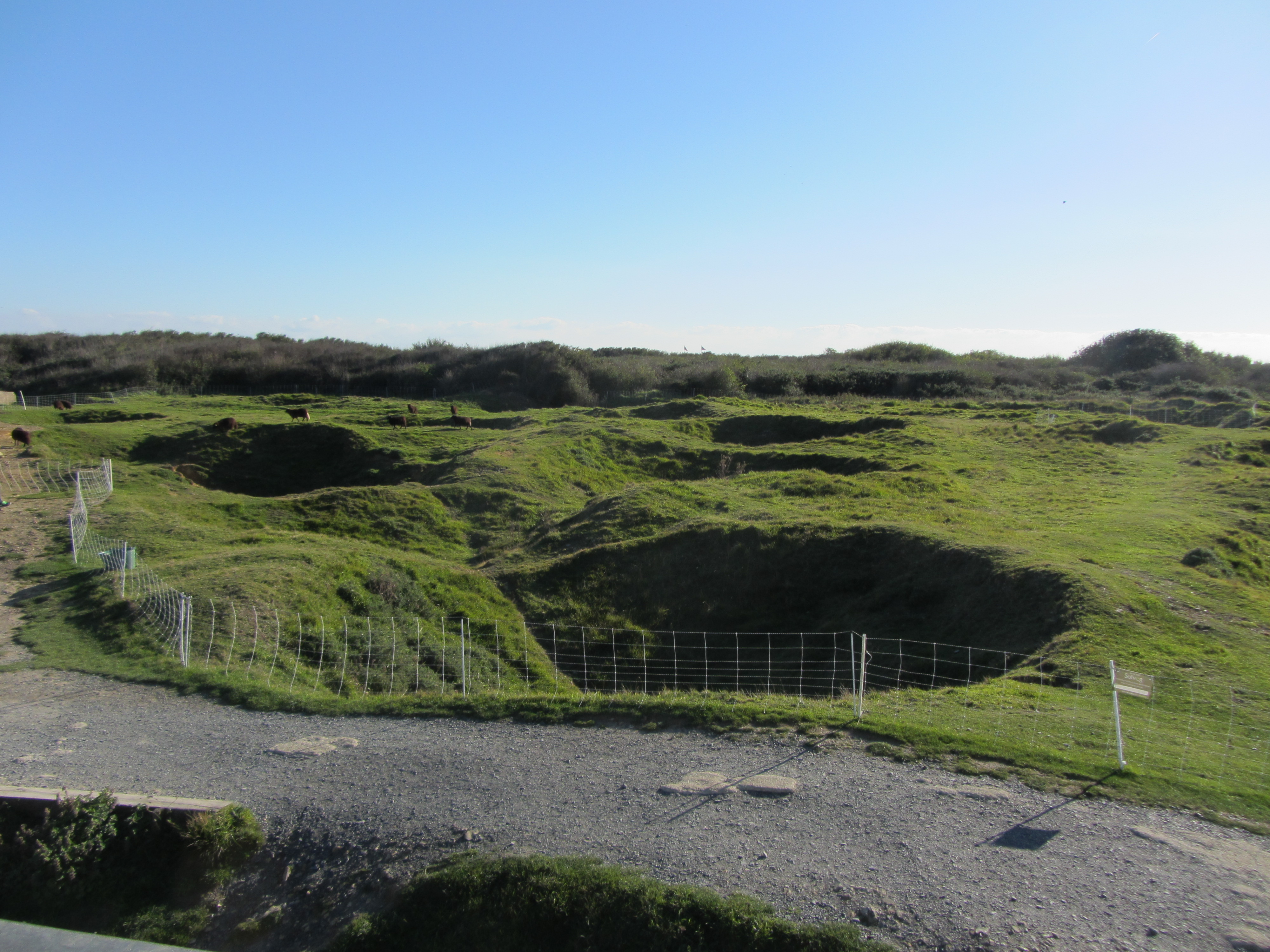
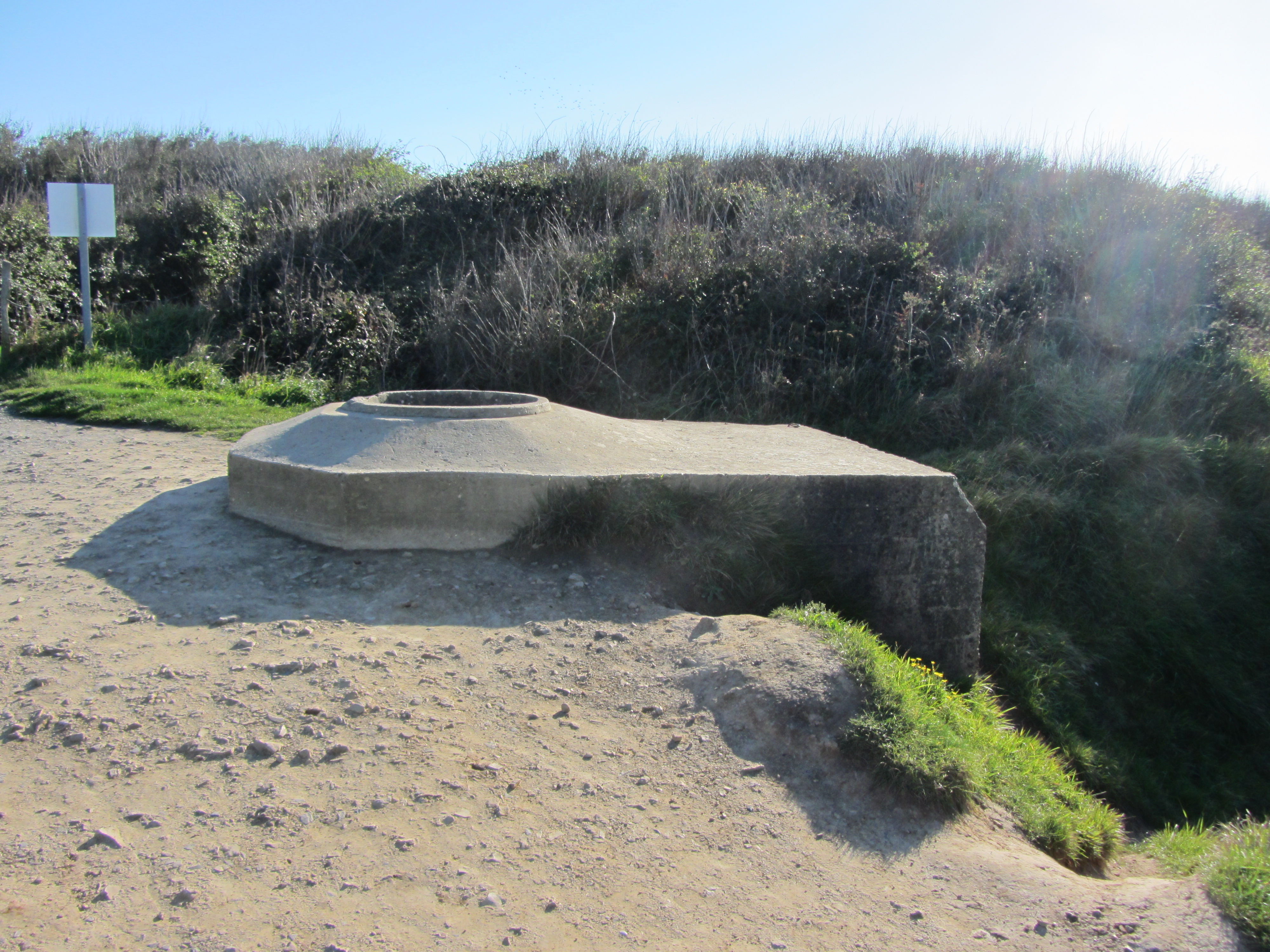
As it was in Juno beach, it was very surreal to be there, knowing what happened on that point 71 years ago. There are still some bunkers intact but the most noticeable markings of the event were the numerous craters caused by the air and naval bombardments. Some of the bunkers were in pieces. Some of the circular gun pits, which housed the 155mm guns, are still there. As we walked about the site I tried to envision what the American Rangers had to endure to succeed at their mission.

2015-10-08 17.16.25We also made a brief stop at Arromanches, located on the British Gold beach, where one of the two portable temporary Mulberry harbours is located that were built and operational within three days of the invasion. Mulberry A was for the Americans at Omaha Beach and Mulberry B was serving the British and Canadians at Arromanches. A heavy storm destroyed the American harbor on June 19, but Mulberry B remained in use for eight months. Block ships were sunk off the Normandy coast to create protection from the open sea. These ships are still there and my wife and I marveled at the ingenuity of the Allied planners. In the first 100 days following D-Day, the harbor landed over 2.5 million men, 500,000 vehicles and 4 million tons of supplies for the Battle of Normandy; successfully contributing to the liberation of Europe and the defeat of Nazi Germany.

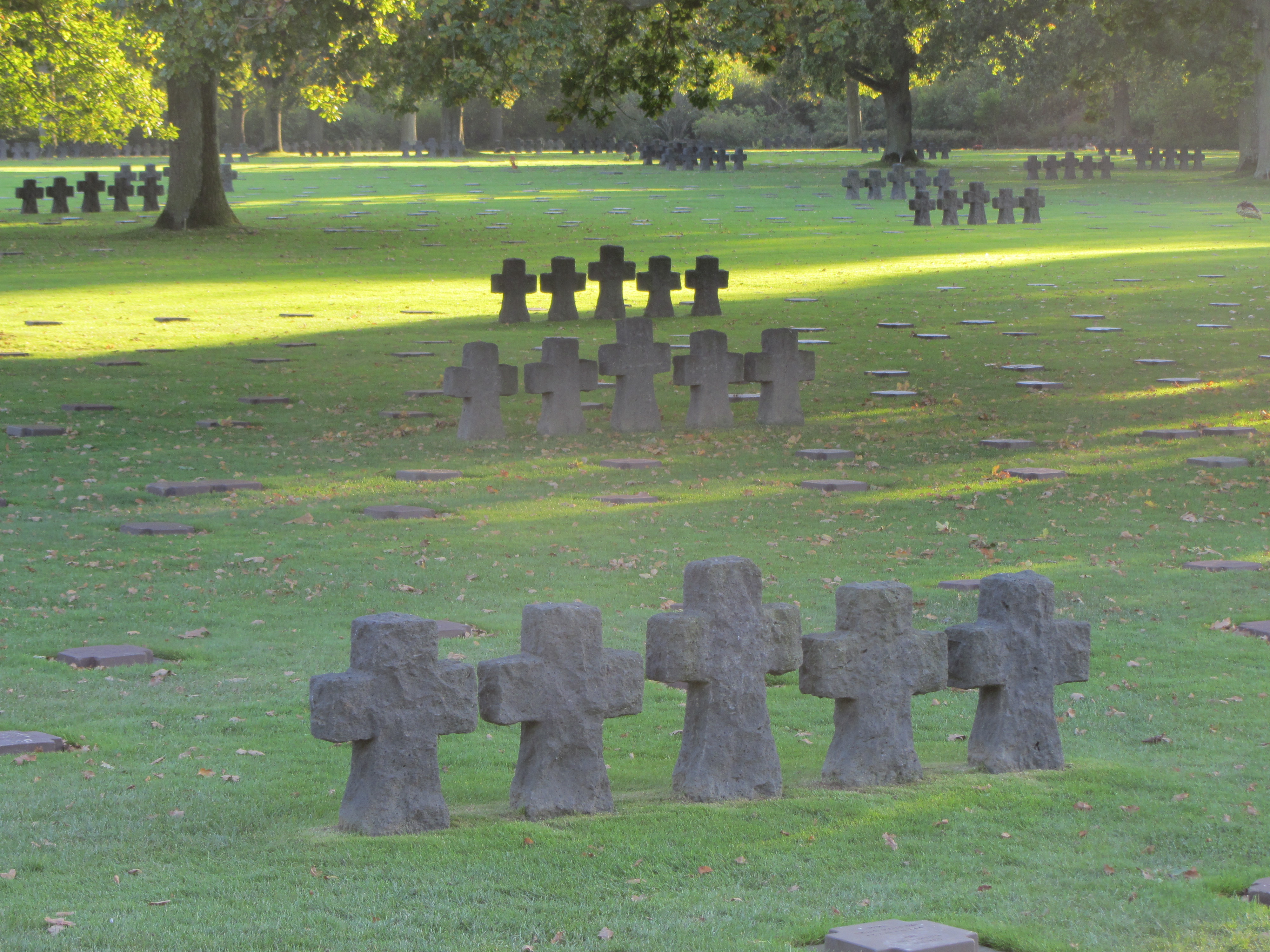
2015-10-08 16.16.41We also visited two of WWII cemeteries; the Canadian cemetery and the German cemetery. Again we were in admiration at how well-kept these cemeteries were, regardless of nationality. We were also saddened when looking at the various head stones when we learned many, many of these soldiers who died ranged between ages of 17 to 23. It was especially heart retching for my wife and I since our son is presently aged 21. Another very stirring moment for us was when we read the sign at the entrance of the German cemetery. The sign read, “Until 1947, this was an American cemetery. The remains were exhumed and shipped to the United States. It has been German since 1948, and contains over 21 000 graves. With its melancholy rigour, it is a graveyard for soldiers not all who had chosen either the cause or the fight. They too have found rest in our soil of France.” As I’ve stated IMG_3333before, this speaks of the nature of the French nation. They have a great respect for the dignity of all fallen soldiers. The French value and honor all soldiers, no matter what side of the war they fought for.

As we did for the WWI soldiers, my wife and I now have a whole new appreciation for the WWII soldiers and the sacrifice they made to liberate France and other European countries from Nazi oppression. I will attend the Remembrance Day ceremonies this year with much more gratitude and appreciation of all soldiers, especially knowing what the soldiers of WWII had to sacrifice to  achieve their assigned goals.

We Shall Remember!

November 11th is an important day to observe as it marks the anniversary of the official ending of World War I. That war ended on the 11th hour of the 11th day of the 11th month thus explaining why Remembrance day is November 11th. In Canada Remembrance Day is a national holiday and all Commonwealth Nations observe this day as a day to remember the members of their armed forces who have died in the line of duty. For those that don’t know, the Commonwealth is an organization of 53 member states that were mostly territories of the former British Empire, which includes the United Kingdom. The United States has a day of remembrance called Veterans Day, which is an official federal holiday that is observed annually on November 11. Its purpose is to honor people who have served in the U.S. Armed Forces, that is, its veterans. Armistice Day remains the name of the holiday in France and Belgium.

Now I’ve always felt that Remembrance Day was an important day to remember our fallen soldiers and I have often attended ceremonies, but since visiting the World War I and II sites in France, I have a whole new appreciation for this day. In this post, I will share my experiences visiting the WWI sites and cemeteries in France and Belgium. Experiences of my visits to WWII sites will be in another post.

2015-10-11 14.29.38The first site I visited was the Canadian National Vimy Memorial which has always been on my “bucket list” to visit. The memorial towers over the scene of Canada’s most recognizable First World War engagement, the Battle of Vimy Ridge, fought on  April 9 to 12, 1917. In 1922 the French Government granted land on the crest of the ridge to the Canadian nation and this piece of land is now a Canadian National Park. To help you understand the importance of this site, here is a history lesson.

The Battle of Vimy Ridge was a military operation fought primarily as part of the Battle of Arras during the First World War. The main combatants were the Canadian Corps, of four divisions, against three divisions of the German Sixth Army.

The Canadian Corps was ordered to seize the heavily German fortified Vimy Ridge in April 1917. Situated in northern France, this seven-kilometre (4 mile) ridge which held a commanding view over the Allied lines. In May 1915, the French army attempted to seize the ridge but failed with 150 000 casualties. In February 1916, the British Army attempted to take control of the ridge but the Germans were able to push them away from the ridge.

IMG_3473Attacking together for the first time, the four Canadian divisions stormed the ridge at 5:30am on 9 April 1917. More than 15,000 Canadian infantry overran the Germans all along the front. Canadians single-handedly charged machine-gun nests or forced the surrender of Germans in protective dugouts. Hill 145, the highest and most important feature of the Ridge, and where the Vimy monument now stands, was captured in a frontal bayonet charge against machine-gun positions. It was the first time all four Canadian divisions attacked together and men from all regions of Canada were present at the battle. Brigadier-General A.E. Ross declared after the war, “in those few minutes I witnessed the birth of a nation.”

IMG_3444For me, visiting Vimy Ridge was an “eye opening” experience even though I’ve taught about the Battle of Vimy Ridge for many years. The first thing you notice are the craters left behind from the three-week bombardment that preluded the attack that occurred on the 9th of April. They were everywhere you looked. Large areas are fenced off with electric fences with signs stating that there are still unexploded devices in these areas. In fact, the attendant in the information told us that recently someone brought in a what they thought was a rock only to find out it was an undetonated grenade from 98 years ago.

When visiting the preserved trenches, I was struck by how close the Allied and German trenches were to each other. We were told that the trenches were 25 metres apart in places. In the area between the opposing trenches, known as “no man’s land” are several huge craters. We were told that these craters were from Allied soldiers tunneling under “no man’s land” and detonating explosives. My wife and I learned about the conditions of the trenches. Soldiers would spend months in these trenches often standing in ankle to knee-deep mud and water which caused many soldiers to acquire infections in their feet known as “trench foot”. The soldiers also had to contend with rats and head lice in epidemic proportions. The food was usually canned food and not much variety either. Many soldiers perished not because of battle but because of the horrific conditions of the trenches.

The park also does a tour of the tunnels. The tunnels at Vimy Ridge were part of a 20 kilometre (12 mile) network of tunnels stemming from the city of Arras. The soldiers would exit these tunnels to go onto the battle field. While soldiers were in the tunnels awaiting battle, they had to be perfectly quiet as they could be heard in the nearby German tunnels. The lighting in the tunnels was minimal so when our guide demonstrated what it would be like in there in 1917, it was almost pitch black. The temperature in the tunnels is a constant 10 degree Celsius (50 degrees Fahrenheit).

IMG_3726In the nearby city of Arras, my wife and I visited the Wellington Quarry (la Carrière Wellington) a museum that opened in 2008. The museum is a section of the many kilometres of tunnels dug by the British Army in WWI. Here is another history lesson.

From the Middle Ages through to the 19th century, the chalk beds underneath Arras were extensively quarried to supply stone for the town’s buildings. In 1916, during the First World War, the British forces decided to re-use the underground quarries to aid in a planned offensive against the Germans. The quarries were to be linked up so that they could be used both as shelters from the continual German shelling and as a means of conveying troops to the front in secrecy and safety, so 500 miners from the New Zealand Tunnelling Company, were brought in to dig 20 kilometres (12 miles) of tunnels. They worked alongside the British coal miners. Many were soldiers of below average height who had been rejected from regular units because they did not meet the height requirements.

The tunnel system could accommodate up to 20,000 men and these tunnels were outfitted with running water, electric lights, kitchens, latrines, a light rail system and a fully equipped hospital. Thousands of soldiers were billeted in the tunnels for eight days prior to the start of the Arras offensive on 9 April 1917. At 05:30 that morning, exits were dynamited to enable the troops to storm the German trenches. The Germans were taken by surprise and were pushed back 11 km (6.8 miles). However, the offensive soon bogged down and it was eventually called off after casualties reached 4,000 a day.

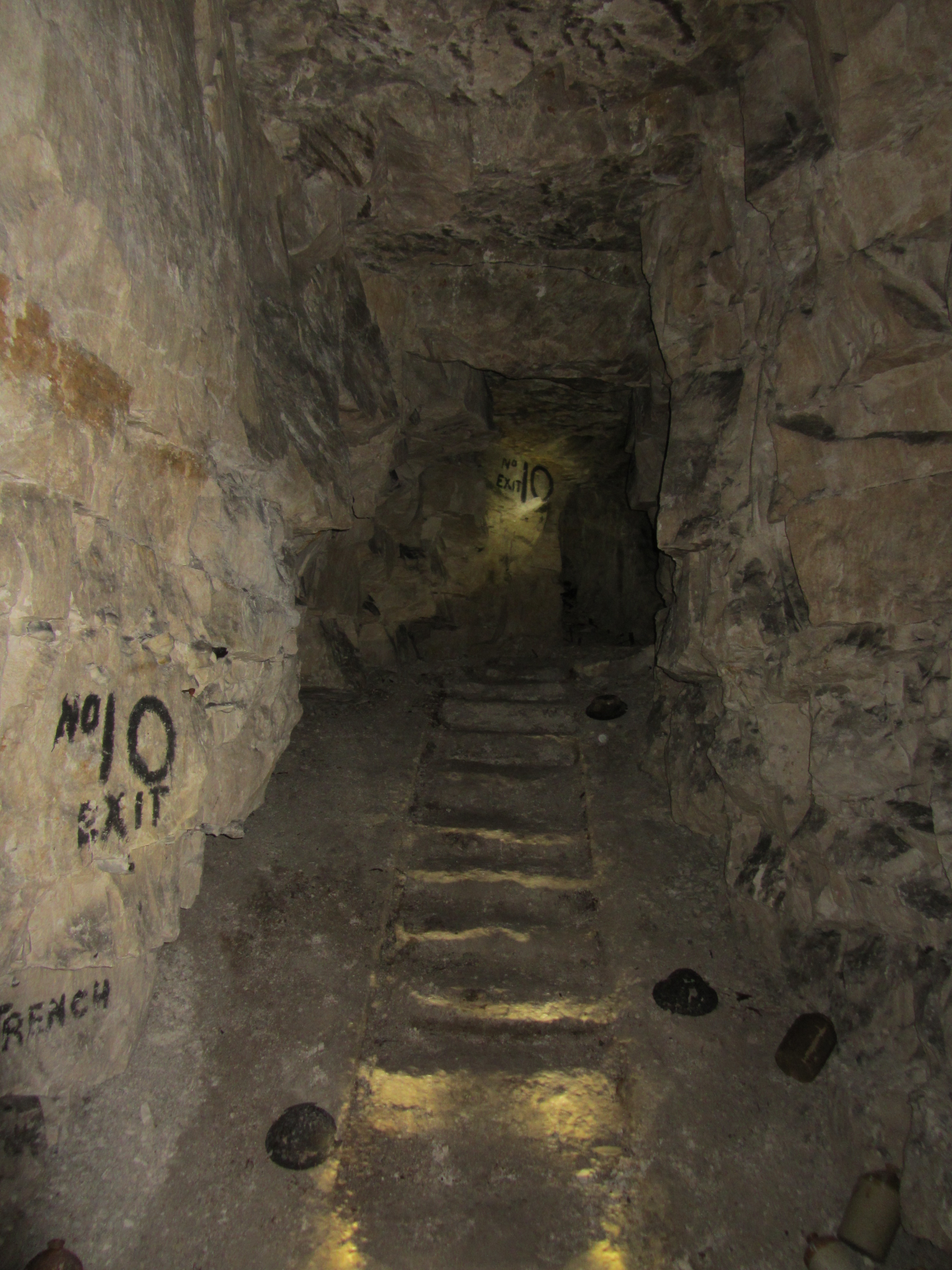
When you visit the quarry which lies 20 metres (65 feet) below the surface you are immediately struck by the numerous tunnels down there. A guide takes you through showing the many bottles, cans, shoes, and other WWI artifacts that are still there. You are also shown the graffiti on the walls left by the soldiers as well as one of the exits that led to the battlefield. It was truly one of the most moving and spiritual experiences I have ever had.

IMG_3434My wife and I also visited the many, many WWI military cemeteries in the area. We were actually overwhelmed by the sheer number of them. We visited three or four commonwealth cemeteries, which lay many Canadians. We visited a German cemetery and a French cemetery. What was astonishing to us was the number of unknown soldiers in these cemeteries. One of the cemeteries we visited had over half of the graves as unknown soldiers. Another surprising observation we made was how well-kept these cemeteries were. There were flowers growing between every headstone, the grass was always well-groomed  and monuments were found in every cemetery. I IMG_3518think this speaks of the character of the French people and nation. It says they have great respect for the dignity of all fallen soldiers. The French value and honor all soldiers, no matter what side of the war they fought for. I was also struck by the sense of peace in these cemeteries. It was truly a humbling and touching experience to visit these resting places of WWI soldiers.

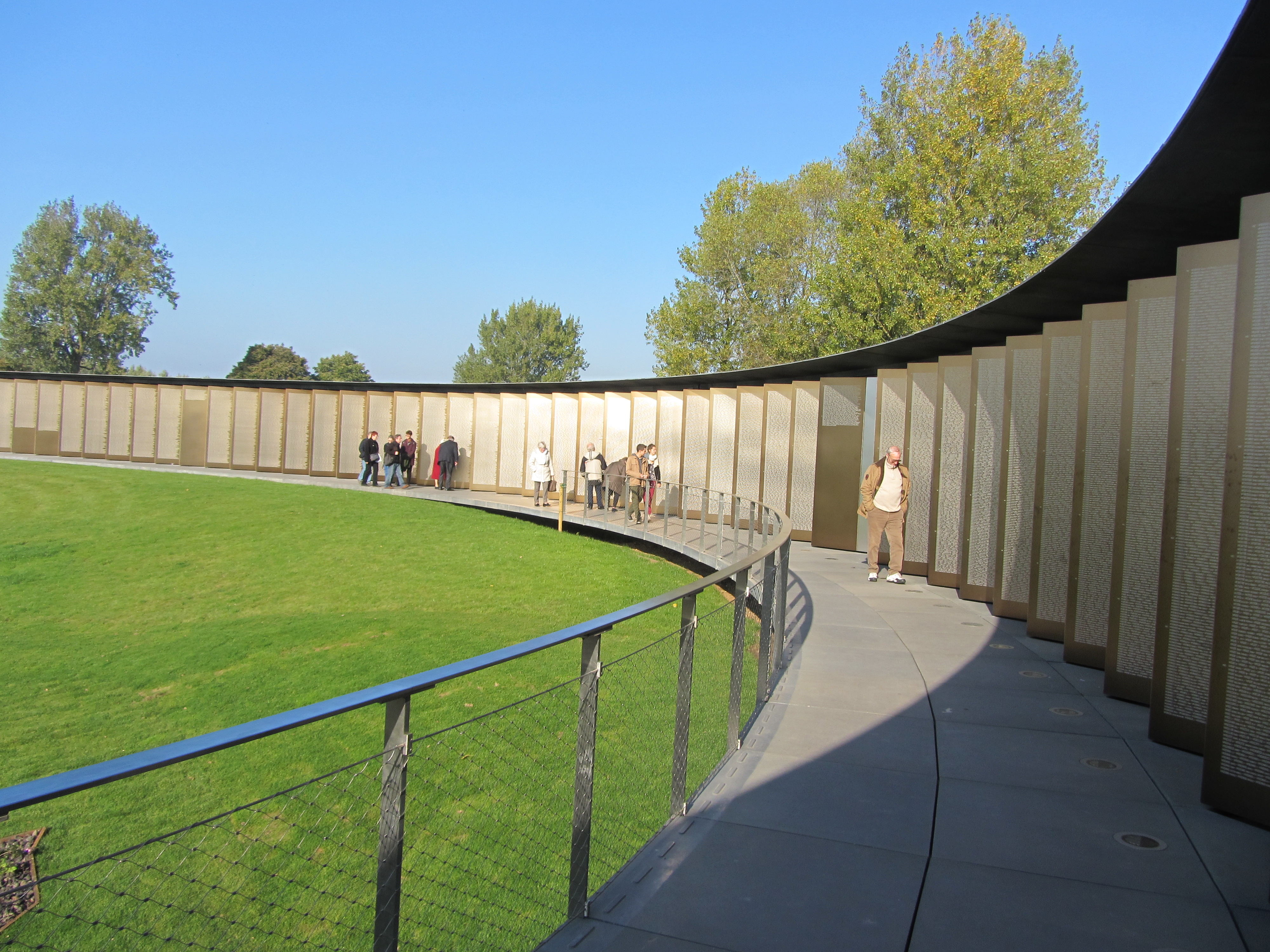
Notre Dame de Lorette is the world’s largest French military cemetery. Beside this cemetery is the Remembrance Ring  (Anneau de la Mémoire) officially known as Mémorial International Notre-Dame-de-Lorette.  This new memorial was inaugurated on November 11, 2014 and takes the form of a 328-metre ring of concrete with 500 sheets of bronzed stainless steel inside listing 579,606 German, IMG_3528French and British names. Now that is a lot of fallen soldiers and that does not include the many unknown soldiers whose names are not part of this memorial. What was so unusual to me was the fact that the French Government collected as many names as they could obtain of soldiers who perished in WWI regardless of their nationality; regardless of which side of the war they fought on. Once again this speaks of the character of the French nation. My wife and I wandered around in awe of this memorial finding our family names. It is very powerful and humbling experience to stare at 113 people with the same surname as me who fought with the Germans, the enemy of the day. As you might have gathered, my ancestry is German.

My wife and I now have a whole new appreciation for all soldiers and the sacrifice they made to maintain freedoms. Even though WWI was such an unnecessary war and a world war caused by the big egos of the leaders of the day, it was still necessary for soldiers to keep France and Belgium from being occupied and controlled by a foreign empire. I will attend the Remembrance Day ceremonies this year with much more gratitude and appreciation of all soldiers, especially knowing what the soldiers of WWI had to endure.

Those Crazy European Drivers

On our flight over to Europe, I watched the recently released movie called Spy whereby the main character, Susan Cooper, played by Melissa McCarthy. is a desk bound CIA analyst who volunteers to go undercover to infiltrate the world of a deadly arms dealer, and prevent a global disaster. The movie has a very funny driving scene where an Italian agent named Bradley Fine, played by Jude Law, picks Cooper up and drives her to her hotel. During that scene the Italian agent, driving a sporty convertible speeds through the narrow streets of Rome, paying more attention to the girls he is passing by than to his driving. The scene is very funny and typifies the way Europeans drive. Anytime I’ve watched scenes like this, I’ve always thought that the movies must be majorly exaggerating drivers in Europe. After returning home, I no longer think that.

IMG_1172Based on our experiences in Europe, it would seem that the stereotype, perpetrated by Hollywood movies,  that European drivers are crazy is true. Have you ever seen an intersection packed with cars at all different angles, none of them moving, many of them tooting angrily like it will possibly help? Well, we did in Paris when our shuttle driver entered the very large round about that encircles the Arc of Triumph (Arc de Triomphe).  There were no clear lanes and cars were everywhere and numerous horns were tooting. This is just one of the many driving experiences my wife and I, along with our friends, experienced when we visited Continental Europe. Even though I was aware of the stereotype, I was still “shell shocked when witnessing it”.

Our first taxi ride was on the island of Santorini, one of the Greek islands.  After a nice dinner at our hotel, we decided to visit the nearby village of Kamair, so we had the hotel call a taxi for us.  When the taxi arrived, My wife and our friends got in the back seat, and I got into the front with the driver.  No word of a lie, the driver put the “petal to the metal” and the car accelerated quickly.  Now in Greece, there are no side walks so pedestrians walk on the narrow roads.  There was a group walking down the road as the taxi driver sped toward them, showing no signs of slowing down.  The pedestrians scattered very quickly, as you might imagine.  The village was two kilometres from our hotel. and our taxi driver speeded the entire way there.  Thank God, we made it to the village alive.  We all were so shocked that all we could do was laugh. I would label this taxi driver as one of those stereotypical crazy European drivers.

IMG_1166Like the driver in Santorini, the taxi driver who took us to the airport in Athens “floored it” at every opportunity.  At one point he narrowly missed a car door that was opening. What made the situation even more humorous was the fact that just before the taxi arrived, a huge thundercloud moved over the city and a torrential rainstorm occurred as we were driving off.  Now as in many cities, Athens does not have the infrastructure to handle torrential downpours, so needless to say the streets of Athens were semi flooding, or in some case fully flooded.  That didn’t slow down our taxi driver.  He just sped through the water sending water everywhere.  Now we were nervous to say the least and I suspect our driver must have sensed that since he put in a CD of Greek music and “cranked” it up.  It worked, as we did relax and started swaying to the music. This driver fit the stereotype.

IMG_1738Being a pedestrian in Europe is truly an adventure.  Really you take your own life into your hands every time you step out onto the street as there was no other choice since sidewalks are rare in Europe.  There were many, many times when our friends and us would be walking in what we assumed was a pedestrian zone only to be shocked when a vehicle would drive through scattering all the pedestrians.  That happened in Florence and Sorrento in Italy, Mykonos town in Greece, and Bayeux in France, to name some places we experienced this.  In fact, at our vacation rental in Sorrento, the gate opened right onto the road, and I’m not kidding when I say the vehicles did not slow down on that road.  Numerous times we literally ran to cross the road for fear of getting hit by a car.  It was most entertaining when you watched some else doing so.

In places like Rome, Paris and Athens it is common to see the narrow streets jammed with unruly drivers, streetcars, buses, mopeds, and double-parked trucks.  It is also common in these cities to see massive horn-honking traffic jams.  The mopeds and motorbikes were plentiful on the streets and would weave in and out of the vehicles, and often would drive between two vehicles to get ahead.  There didn’t seem to be any sense of abiding by rules and such.

IMG_2752Then there is the parking.  In Rome and Paris, for example, you would see vehicles parked in every which direction.  There would be trucks parked in lanes with their flashers on.  We saw this often in Paris on the shuttle.   Vehicles would be parked up on sidewalks, if there was one, and it was not uncommon to see cars double parked.  Vehicles would just park beside other parked vehicles and turn on their flashers.  It just seemed liked chaos to me.

Now I realize that the reason drivers are so aggressive in Europe and why people park in any available space they can find in cities is because Europe does not have the space that North America has. Most of the cities in Europe are ancient.  To give you some perspective, parts of Rome are truly ancient.  If you look at the famous Roman Colosseum and inquire when it was built you would learn that it was commissioned around A.D. (CE) 70-72 by Emperor Vespasian. Paris existed long before Notre Dame Cathedral was built and the cathedral began its construction  in 1163 AD (CE). The site of Athens has been inhabited since before 3000 BC (BCE). The earliest buildings date from the late Bronze Age, about 1200 BC (BCE), when part of the town spread to the south of the citadel on the Acropolis. The Acropolis is an ancient citadel (fortress) located on a high rocky outcrop above the city of Athens and contains the remains of several ancient Greek Temples.  So as you can see, these cities are truly ancient thus explaining why the city streets are narrow.  They were built in times before vehicles were around.  These cities were never intended to have modern vehicles on them.  In fact, many of these streets are still cobblestone. Space is at a premium over in Europe.

Then there is the population factor. Italy, for example, has 60,808,000 inhabitants and is 33 times smaller than Canada and the United States. Canada’s population is about 35 million and the population of the United States is approximately 319 million. Now that doesn’t mean much until you compare the number of people to the land area, otherwise known as their population density.  According to the World Bank Data Website Italy has a population density of 209 people per sq. kilometre (km) of land area.  Canada, on the other hand, has a density of 4 people per sq. km of land area and the United States has 35 people per sq. km of land area.  So as you can see, Italy is much more densely populated than either Canada or the United States. In light of these statistics, it is easy to understand that Italy has much less space to handle its vehicles and pedestrians.

After returning home, I have come to appreciate  the amount of space we have in North America.  Our wide streets, our sidewalks for pedestrians our large, straight highways, our open space in rural areas  are so refreshing after being in Europe.  All the while we were in Europe we heard about the refugee crisis.  It was on the news.  It was in their news papers.  We even witnessed a demonstration in support of the Syrian refugees in Athens. North America has so much more space and fewer people when compared to the European nations, therefore we should not be afraid to take in more of the Syrian refugees, especially in light of the fact that Europe is experiencing a refuge crisis right now. North America can easily encompass more inhabitants.  We have the space!

What is with the Stereotypes?

Well, I’m back from my European adventure and I have many stories to share with you in this and future blogs.  This is the third time I’ve been over to Europe and every time I come back amazed by the ancient historical buildings there and how different the culture is from North America.  I can never get enough of that wonderful continent.

A common stereotype of the French people is they’re rude and snobby.  Articles such as Common French Stereotypes and French Stereotypes allude to this stereotype, I would like to share some of my thoughts on France.  I have just visited this country for the third time and I cannot say enough good about this beautiful country and its citizens.

Over the years, and not long before leaving on this trip, I had many people tell me how rude they found the French people, especially the Parisians.  People often would tell me to expect the French people, especially in Paris, to be rude and snobby.  Well, I can tell you in all honesty that I have never experienced this during any of my three visits to France, and yes I was in Paris all three times.  In fact, I found French people to be most kind, welcoming, and always helpful.  Let me give you some examples from our most recent trip.

IMG_1207While still trying to “get our bearings” on the first day in Paris, we stopped in a wine shop to ask for some directions to the Metro.  Since neither my wife or myself speak the French language, the first words we would articulate would be, “Parlez-vous anglais?” that is, do you speak English?  Almost everyone we asked this question, replied, “Qui”, and then proceeded to speak to us in English.  We were always very grateful for this.  Anyway, this particularly kind man in the wine shop told us where to find the Metro, how to use the Metro, and where to purchase tickets.  Now that doesn’t fit the stereotype.

On another occasion, while making our way to the Palace of Versailles, we were helped by a very nice young man.  To get to Versailles you take the RER, which are the Paris commuter trains as the palace is about 28 kilometres away. Commuter trains are like the Metros in the sense that they make numerous stops along the way. Anyway, the stop to get off at is a stop called Versailles Rive Gauche, Chateau de Versailles. Knowing that the stop was Rive Gauche, when we arrived at the Viroflay Rive Gauche stop,  we panicked and got off;  two stops too soon.  Standing there wondering if we were at the right place, likely looking like confused tourists, a very nice young man came up to us and asked us something in French.  My wife responds with, “Parlez-vous anglais?” and the nice young man responds in English, “Can I help you?”  We explained our dilemma and he quickly got us straightened out.  We got on the next train, and were in Versailles in no time. This young French citizen didn’t fit the French stereotype.

The previous evening, while in the Paris Metro, my wife and I were discussing how to get to the Palace of Versailles. My wife is very meticulous and has a need to know exactly where she is going before embarking on an adventure.  While we were standing there, looking at a Metro map on the wall, some random older lady walks up to us and says something in French.  We gave our usual response and then speaking in English she explained to us how to get to the palace.  Keep in mind that her actions were of concern for us as we did not ask for help.  She explained to us to take line C of the RER to Versailles, and to get off at Rive Gauche.  We thanked her and started walking to our exit.  A minute later this kind lady comes running up to us and asked us if we wanted to go to the castle or the city of Versailles.  We clarified and she explained that she wanted to make sure she gave us the right stop.  This Parisian lady took time out of her I’m sure busy day to run and catch us so that we would not get lost the next day.  That was an action of kindness, not snobbishness.  We were very thankful for this lady did not fit the Parisian stereotype.

Outside of Paris was no different.  We were always greeted with kindness and friendliness.  Allow me to share some examples, again from our recent trip. When we arrived in Bayeux, France, a city near the Normandy D-Day Beaches, we were tired and hungry. We ventured out on foot to find a restaurant.  Using a map to navigate to the city centre, as was often the case we got confused and therefore lost.  A man, obviously a local, along with his daughter and dog were walking towards us.  We stopped him and asked if he spoke English.  Thankfully, he did and he directed us in the right direction.  He was most kind and most friendly.  He didn’t fit the stereotype.

IMG_3359While driving from Bayeux to Lievin, France, we stopped in the French village of Aumale as  my wife liked the town.  We parked and walked toward the huge church, which every village has.  As we turned the corner around the church, we discovered a market.  Walking about the market we came across a table with croissants on it so my wife asked if she could have one.  The lady at the table spoke no English, but understanding what my wife was asking, answered, “Oui”.  Then the lady points to the coffee urn, says something in French,  and looks at me.  Understanding that she was offering me coffee I said, “Oui”. This pleasant, friendly lady then pours my wife a juice.  The people of Aumale were most gracious and hospitable to us, the strangers in town.  The people of this French village certainly did not fit the French stereotype.

Just before arriving in the wonderful village of Aumale, we were stopped at an intersection.  Drivers around us were pointing at our vehicle and we immediately presumed that we had done something illegal or that something was wrong with our vehicle.  Then one man gets out of his car, comes running up to our vehicle and says something in French, while pointing down by the car door.  My wife, driving at the time, rolls down the window and looks out the window and to her horror discovers that her coat was hanging out the car door. This kind man had made the effort to alert us to our carelessness.  We were truly thankful for this man who was not stereotypically French.

While coming into Lievin, France, where our Bed and Breakfast (B&B) was located we drove to where our GPS said was our B&B, yet we couldn’t see it.  We walked down to the intersection and spotted a lady working in her yard.  Unfortunately, she didn’t speak English but we showed her the address and she pointed us in the right direction which was up the street.  It turned out that we had not walked far enough up the street.  She didn’t hesitate to help us lost tourists.

Our B&B lady was most welcoming and helpful.  She did speak English although with a strong French accent.  In fact, she kept apologizing for her accent.  We assured her that we could understand her.  She went out of her way to make us feel welcome and to help us plan our days.  She would even put addresses into our GPS of sites she recommended we see, such as the Canadian National Vimy Memorial.  Any time we tried to put in an address, our GPS could not find it.  It seems there is a certain way to put in French addresses. This lady was a fantastic hostess; not stereotypical at all.

IMG_3744While walking to a recommended restaurant our B&B person told us about, our GPS took us to a residential area.  The GPS said we were there, but there was nothing that looked anything like a food establishment. So we started walking back.  We first asked a random stranger standing at a street corner who also could not speak English where the restaurant was, and using gestures he pointed us down the street.  We kept walking, unsure of where we were going.  Seeing a lady in her yard, we asked her if she spoke our native tongue.  She did not so we showed her the name of the food place.  She rambled on in French and pointed us down the street.  We walked further down the road and lo and behold, there it was.  Those kind, non stereotypical people helped us move in the right direction.

Now I could go on and on with many more stories of experiences with friendly, kind and hospitable French citizens, but I’m sure you get the picture. The bottom line is the French people we encountered definitely did not fit the stereotypical mould of being rude and snobby.  Quite the opposite really. Ed Koch, an American lawyer, politician, political commentator, movie critic and reality television arbitrator once said, Stereotypes lose their power when the world is found to be more complex than the stereotype would suggest. When we learn that individuals do not fit the group stereotype, then it begins to fall apart”. That is so true. When you’ve been to France and see that their population is so diverse, you realize that not all citizens of France fit the stereotypical mould, although I’m sure they have some that do.

It just isn’t right to stereotype all French people as being rude and snobby, just as it isn’t right to stereotype all Americans as being arrogant and boastful, even though we did meet a couple of Americans who were.  Having said that, we met far more Americans who did not fit that stereotype. It’s equally as wrong to stereotype all Canadians as being extremely polite.  I have met my fair share of Canadians who are not stereotypically polite.