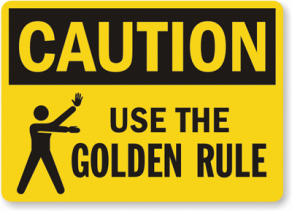
What happened to the Golden Rule?

the-golden-rule.gifGrowing up I was always reminded of the Golden Rule, both at school and by my parents. Being raised in a Christian community this rule was always emphasized. It wasn’t always stated as “treat others the way you wish to be treated” but often in other ways such as, “show respect to your elders” and “always respect your teachers.” I have always believed that if all people could bring themselves to live by this ethic, humankind would be in a much better place.

The Ethic of Reciprocity, or what is better known as the Golden Rule, simply states that we are to treat other people the same way we would wish to be treated. It can be worded in various forms. Wikipedia describes this rule in three forms:

  1. Positive or directive form: One should treat others as one would like others to treat oneself.
  2. Negative or prohibitive form: One should not treat others in ways that one would not like to be treated.
  3. Empathic or responsive form: What you wish upon others, you wish upon yourself.

No matter how the rule is stated, it boils down to the word respect. Merriam Webster dictionary defines respect as “a feeling of admiring someone or something that is good, valuable, important, etc” or 
as “a feeling or understanding that someone or something is important, serious, etc., and should be treated in an appropriate way.” So when a person shows respect for another then they treat that person the way they would wish to be treated.

What always astounded me about the Golden Rule is that all organized religions have this ethic.

  • In Christianity it is found in Matthew 7:12 (NRSV) of the Christian bible where it is written, ‘in everything do to others as you would have them do to you; for this is the law and the prophets.”
  • In the Buddhist tradition it is found in a collection of verses known as the Udanavarga. In chapter 5, verse 18 of the Udanavarga it says, Hurt not others in ways that you yourself would find hurtful.”
  • In Hinduism, it is found in their sacred scriptures Mahabharata 5:1517 where it is written, this is the sum of duty: do not do to others what would cause pain if done to you.
  • Judaism has it in two places, the Talmud and Book of Tobit. The first book of the Talmud is about Shabbat, the Jewish day of rest. In Shabbat 31a. It states, “What is hateful to you, do not do to your fellow man. This is the law: all the rest is commentary.” In the Jewish scriptures, specifically the book of Tobit, it says, “And what you hate, do not do to any one.” (4:15)
  • In Islam, it can be found in a compilation of forty hadiths by Imam al-Nawawi, an influential Sunni hadith scholar. A hadith is one of various reports describing the words, actions, or habits of the Islamic prophet Muhammad. Number 13 of Imam Al-Nawawi’s Forty Hadiths, it says, “None of you [truly] believes until he wishes for his brother what he wishes for himself.”

The Golden Rule is such a simple thing and makes a lot of sense. It begs the question, why is it so important to live by the Golden Rule. The answer to that question has to do with the idiom, “What goes around comes around” or stated another way, “as you sow, so shall you reap”. These are simply reminding us that when people do bad things to other people, bad things will happen to them. This is what the expression, “you’ve made your bed, now lie in it,” refers to as well. An individual must accept the unpleasant results of something they have done. Really all of these expressions could be understood as karma, the law of cause and effect. Karma is a Sanskrit term that literally means “action” or “doing”. In the Buddhist tradition, karma refers to action driven by intention, which leads to future consequences. Good intent contributes to good karma and happiness in the future, while bad intent contribute to bad karma and suffering in the future.

The Huffington Post article on Karma puts it this way:

“Everything we say and do determines what’s going to happen to us in the future. Whether we act honestly, dishonestly, help or hurt others, it all gets recorded and manifests as a karmic reaction either in this life or a future life…There is no exact formula that is provided for how and when karmic reactions will appear in our lives, but one can be sure they will appear in some form or other. One may be able to get away with a crime they committed, or avoid paying taxes, but according to karma, no one gets away with anything for long.”

What I find even more thought provoking is that science supports this idea of “cause and effect”.  Science, specifically Quantum Physics, is providing evidence that the mind can affect matter. There is a theory known as quantum entanglement. According to Space.com, the theory states when changing one particle it changes the other even if they are on opposite sides of the galaxy, 100,000 light-years apart. In other words, they behave like one object even though they are physically apart. Einstein called this idea “spooky action at a distance”.

Quantum Entanglement: What It Is And Why It’s Relevant says,

“Quantum entanglement means that every action, thought, feeling and emotion is connected and can affect the whole in one manner or another. We are all made up of atoms, photons and electrons. We are all in a constant state of vibration. Our emotions, feelings, hearts and minds have the ability to affect what frequency our molecular structure vibrates at. Quantum entanglement is observed at a physical level, meaning what we do to one particle at one location, happens for another particle at the a different location.”

So even science reinforces the idea that every single thing that a person does, thinks, etc. has an affect. Now I know from experience that when I said something hurtful to a student or to a family member there was an effect. The impact was typically in the form of parental wrath or an angry family member.

9-11We’ve all felt the impact of the actions of an individual or group of people. There are many examples of this in history, such as the terrorist attacks in Paris in 2015. The affect of this event has made many people fearful and afraid to travel. We still feel the effects of the 9/11 attack in New York City as flight travel is much more cumbersome with all the extra security. Terrorism initiated by ISIL or ISIS caused much of world community to participate in a bombing campaign, bombing areas where the terrorists were located. What goes around comes around.

It’s fair to say that one person can impact the world. We just need to look at the legacies of Mahatma Gandhi and Martin Luther King Junior to see this. Mahatma Gandhi once said, “In a gentle way, you can shake the world.”

So remember every action you take, every word you say to someone, or even every action you don’t take has an impact on your community, on your planet or maybe even the universe. It seems to me that in this time of Islamophobia, fear of terrorists, and anti-immigration, the Golden Rule is very much needed. Perhaps people (no names mentioned) who spout anti-Muslim, anti-immigration, and racist rhetoric ought to remember, “What goes around comes around”.

Is Science Fiction Really Fiction?

I used to think Star Trek was just fantasy, but is it?

STC_Enterprise-tI am a Star Trek addict. I admit it. There are many of us out there. I have watched Star Trek since my college days when most of the dorm community would watch the original Star Trek series before going for our evening meal. Ever since, I have continued to watch the various series such as Star Trek: The Next Generation, Voyager, Star Trek: Enterprise and even Deep Space Nine. I anxiously await the new series premiering in 2017. What attracted me to Star Trek, even though I understood that it is science fiction, is the technologies used on the voyages and ideas put forth by the various episodes seem possible. I have always been intrigued by such ideas as transporters, which convert a person or object into an energy pattern and then “beams” it to a target, where it is reconverted into matter. Especially intriguing to me are the concepts of time travel, the space-time continuum, and the idea that multiple dimensions or universes exist. What I find especially fascinating is that science, especially quantum physics, is now providing credible evidence that notions such as time travel and multiple universes may actually exist.

In the Star Trek: The Next Generation series there is an episode called Parallels where the Enterprise returns to the location of the fissure, attempting to return Worf to his original universe. A Bajoran ship, which causes the fissure to destabilize and the various realities to merge, then attacks the Enterprise resulting in over 285,000 Enterprises appearing in the same area of space. The android, Data determines that the way to restore the realities is to send Worf by shuttlecraft to the Enterprise of his universe, passing through the fissure and using the shuttlecraft’s engines to close it. Worf safely passes through the fissure, finding himself back in normality with a single Enterprise in front of him. After boarding, Worf finds that no time has passed since he initially entered the fissure. When he returns to his room expecting a surprise party, he finds only Troi, the ships counsellor, waiting with the knowing that the two are married in many alternate universes.

According to the article, Will we ever have a Theory of Everything, on bbc.com’s Earth page, our universe is one of many. This huge collection of universes is referred to as the “multiverse”. The article describes it this way.

“At the beginning of time, the multiverse was like ‘a great foam of bubbles’, all slightly different shapes and sizes. Each bubble then expanded into its own universe. We’re in just one of those bubbles,” says Barrow of the University of Cambridge in the UK. As the bubbles expand, other bubbles can arise inside them, each one a new universe. “It’s making the geography of the universe really complicated.” Within each bubble universe, the same physical laws will apply. That’s why everything in our universe seems to behave the same. But the rules will be different in other universes. “The laws we see in our universe are just like bylaws,” says Barrow. “They govern our bit, but not all of the universes”…There are trillions of other universes, each one unique.

It seems that many theorize that multiple universes or dimensions, like the one put forth in the Star Trek episode, Parallels, may indeed be reality. Who knew?

Without getting into the detailed plots, there are two Star Trek movies built on the theme of time travel. The first is the movie Star Trek IV, the crew of the Enterprise must travel back in time to get whales in order to save the future of Earth. In the movie Star Trek: First Contact, the Borg make a second attempt to conquer the Federation. Captain Picard and the crew of the USS Enterprise follow the Borg three hundred years into the past when Zefram Cochrane is preparing to launch Humanity’s first warp-capable engine.

What is fascinating is the world of quantum physics, specifically the Quantum Entanglement theory, strongly proposes that time is an illusion; that time does not exist. Time in reality is a human creation. Experiments have been done where two particles (photons or electrons) A and B are paired, then separated, and placed in different locations. When particle A is stimulated, particle B reacts without any time delay. That means that both particles act at the same moment in time regardless of distance. This provides evidence that time does not exist, at the fundamental level. Our concept of time as a linear passage of events is perhaps wrong. All there is, is now. Everything exists in an ever-present moment.

Albert Einstein, known for his brilliant mind in science, wrote a letter to his close friend’s family, that is, Michele Besso’s family, saying that although Besso had preceded him in death it was of no consequence, “…for us physicists believe the separation between past, present, and future is only an illusion, although a convincing one.” Even Stephen Hawking, one of the most brilliant minds alive today, is now saying time travel is possible. In a lecture titled, Space and Time Warps, he says, “The conclusion of this lecture is that rapid space-travel, or travel back in time, can’t be ruled out, according to our present understanding.” So it seems that science is suggesting that time travel may be possible.

star-trek-1966-01-gEven transporters may be possible, according to Quantum Physics. In May of 2014, The New York Times reported that scientists have achieved Quantum teleportation. This involves transferring so-called quantum information, or what is known as the spin state of an electron, from one place to another without moving the physical matter to which the information is attached.

Now this is a long way from transport machines on star ships, but it does lend itself to the possibility that it may one day be reality. There is no question that some of the things quantum physics are doing is mind blowing. In fact Niels Bohr who received the Nobel Prize in Physics in 1922 once said, “If quantum mechanics hasn’t profoundly shocked you, you haven’t understood it yet. Everything we call real is made of things that cannot be regarded as real.” I must say some of the things that are being discovered in quantum physics does shock me, and I don’t pretend to fully understand it.

So what is my point? What science seems to be telling us is that our world and our universe is much more complicated than what we’ve been taught. We humans like to get comfortable in our “little boxes” where we’ve been programmed to believe that things are a certain way. We resist any ideas or thoughts that oppose our conceptions of reality. We humans even go to great extremes to defend our beliefs about reality. It amazes me that there are still people who believe and set out to prove that the earth is flat. If you don’t believe, check out the Flat Earth Society website.

Maybe it’s time to open up our minds to the possibility that things may not be the way we think. One thing I’ve learned in my many years of life is that things are never as they seem. Actually, the poet W. H. Auden, says it better. “There’s always another story. There’s more than meets the eye.” There is always much more going on than we like to admit or even desire to know. Maybe science fiction is not so fiction after all.

2/3 Wildlife to Disappear by 2020. That’s Disturbing!

A commentary on climate change and endangered species.

A few weeks ago, an article on CBC.ca caused me some distress. The article is called; Two-thirds of wildlife will disappear by 2020, WWF. The news report says that according to the WWF conservation group, “worldwide populations of mammals, birds, fish, amphibians and reptiles have plunged by almost 60% since 1970.” It then goes on to say, “the decline is yet another sign that people have become the driving force for change on Earth”. Specifically, according to the article, this change is due to “the rising human population…threatening wildlife by clearing land for farms and cities”. It also lists other causes as “pollution, invasive species, hunting and climate change”. Think about that for a second. The year 2020 is only three years from now and according to the WWF 2/3 or 67%; more than half of the worlds wildlife will be extinct. I grew up seeing many of these animals in the wild or in zoos. To think my grandchildren will only be able to see pictures or videos of these animals is upsetting.

I went on to research this topic further. Another CBC report; A third of birds in North America threatened with extinction, states that “the first State of North America’s Birds report finds that of 1,154 bird species that live in and migrate among Canada, the U.S. and Mexico, 432 are of ‘high concern’ due to low or declining populations, shrinking ranges and threats such as human-caused habitat loss, invasive predators and climate change”. Still another CBC report, Hundreds of animals, plants locally extinct due to climate change, reveals that a “new study found local extinctions (this is when a species can no longer be found at a location where it once lived) related to global warming have occurred in half of species studied”. But the article that alarmed me the most was CBC’s, Giraffes threatened by extinction, put on watch list. Giraffes! Really! The article blamed shrinking living space as the main cause. It says the giraffe situation is worsened by poaching and disease. There seems to be a common theme here, that is, that we humans are the problem. Another common theme is climate change.

Now I understand that climate change is not the sole cause for the loss of wildlife but I’ve read enough articles to come to the conclusion that it is definitely a big part of the problem. We’ve all heard the stories about polar bears. The chief threat to the polar bear is the loss of its sea ice habitat due to global warming. The National Wildlife Federation’s article; Effects on Wildlife and Habitat,  goes into detail of how climate change is affecting wildlife.

There are still people who have “their head in the sand”. There is still debate about the cause of climate change. Is it due to human activities or is it a natural phenomenon? There is no doubt that climate change is happening as the CBC news article, ‘It’s a little scary’: On Lennox Island, no one debates whether climate change is real, says. If you are at all skeptical watch the documentary Chasing Ice. It’s a 2012 documentary film about the efforts of nature photographer James Balog and his Extreme Ice Survey to inform the public to the effects of climate change. My wife and I, on recommendation of my sister, recently watched it on Netflix. If you haven’t seen it, I would strongly encourage you to. In case you haven’t, here it is.

According to Wikipedia, a 2013 paper in Environmental Research Letters (a scientific journal) reviewed 11,944 abstracts of scientific papers matching “global warming” or “global climate change”. They found 4,014 which discussed the cause of recent global warming, and of these 97.1% endorsed the consensus position that humans are causing global warming. To me that says that the vast majority of environmental scientists agree that climate change is due to human influence.

global_warming_0It concerns me when the president-elect in the United States tweeted in November of 2012 “The concept of global warming was created by and for the Chinese in order to make U.S. manufacturing non-competitive” and who promised during his campaign to roll back President Obama’s efforts to combat climate change. According to CNBC, a business news site, “president-elect Donald Trump’s Energy Department transition team sent the agency a memo this week asking for the names of people who have worked on climate change…alarming employees and advisors”. The fear is that Trump is preparing a political enemies list. At least I can proudly say that the Canadian government is working on implementing a national climate change plan (see Manitoba will not sign).

Historically, the European immigrants came to North America with their Eurocentric world view; a view that tended to interpret the world in terms of European values and experiences; a view that saw European values as better than Aboriginal values.  In reality, the aboriginal people had the right values as they had the far superior values. Before European influence, many First Nation communities believed everything was connected. The spirit world was connected to the earthly world; the sea was connected to the land and that the sky was connected to the land. Consequently, humans co-existed with animals and plants, with equal rights to life. In this belief lies commitment to respect all living things. George Blondin, a highly respected Dene Elder who was born in the Northwest Territories, put it this way.

“We are people of the land; we see ourselves as no different than the trees, the caribou, and the raven, except we are more complicated.”

First Nations people were very religious and respectful of the Great Spirit, and other spirits that they believe inhabited the land and animals all around them. These people were taught from a very young age to respect and give thanks to the animals, birds, plants, land and water which gave them everything they needed to stay alive.

Maybe it is time to take a serious look at aboriginal spirituality. These people once had a sacred relationship with Mother Earth and had a reverent respect for the plants and animals.  The reality is if we don’t, we may end up living on a planet with 2/3 less plant and animal species or worse. That would be shameful and a complete lack of respect for our future ancestors. But then again, maybe, just maybe, science can come to the rescue. CBC has a news article called, Reviving extinct species within reach, which quotes Hendrik Poinar, a scientist at McMaster University’s Ancient DNA Centre, who says, “The revival of an extinct species is in reach.” He is referring to a new field of science called ‘de-extinction’.

Clairvoyants. Are they for Real?

A commentary on the power of thoughts.

If you watch America’s Got Talent then you’ve likely heard of the Clairvoyants consisting of a mentalist duo, Thommy Ten and Amelie van Tass. To watch them in action is “mind blowing” and captivating to say the least. It makes you ask, is this for real? Can this person really read minds? If you’ve never seen the Clairvoyants, then have a look at this video.

Now one thing I’ve discovered is no matter what you read, especially on the Internet, there are people out there who feel it is their sole purpose in life to debunk things. That is why conspiracy theories about the Kennedy assassination and the moon landing exist. The Clairvoyants are no different. There are lots of sites on the Internet putting forth explanations on how these two individuals do what they do. One of the common theories is that someone is communicating with the performers feeding them information. They suggest gadgets like a $200 device from a magic supplier called a thumper, are being used. This technology transmits Morse code via vibrations. (see Clairvoyants revealed). In my mind it would take a great deal of concentration while performing on stage to decipher the Morse code. Furthermore, if you watch the video above you will notice that neither Thommy Ten nor Amelie van Tass see the dice toss. So what message was sent? A guess perhaps?

So is this for real? A Clairvoyant is defined as having or exhibiting an ability to perceive events in the future or beyond normal sensory contact. So is beyond normal sensory contact possible? The Telegraph article, Why mind-reading is a science, not a magic trick, certainly suggests we humans have such an ability. It says “electrical activity within the brain means that our thoughts can be read and understood”. Another site, Live Science, is a site which delivers news about the natural and technological world. It’s article, Scientists Say Everyone Can Read Minds, says,

“Empathy allows us to feel the emotions of others, to identify and understand their feelings and motives and see things from their perspective. How we generate empathy remains a subject of intense debate in cognitive science…Some scientists now believe they may have finally discovered its root. We’re all essentially mind readers.”

So I say maybe Amelie van Tass can read minds. Just because we may have been taught that it is not possible doesn’t mean that that is the truth. “Yeah, right” you might say. “There is no way the mind is that powerful”. Check out these videos.

Japanese Dr. Masaru Emoto was one of the first to do experiments like these. Now if our thoughts can do this to water just imagine what our thoughts are doing to our bodies, which are made up of 50 – 65% water. The mind and body are not separate. Our thoughts have remarkable control over our bodies. I can personally attest to that. Many times I have told myself that I couldn’t do something and guess what? I couldn’t do it. Now I find myself wondering what would have happened had I repeatedly told myself that I could do it.

The Huffington Post published an article called; Can Our Brain Waves Affect Our Physical Reality? The article explains things this way.

Not only your brain, but your entire body has an electric field. Anywhere there’s a nerve cell, there’s electricity. It’s just concentrated the greatest around your head because that’s where the bulk of your nerve cells are.

Your thoughts are formed in this electric field. The measurable perturbations and disturbances in the brain’s overall electric field are your actual thoughts racing through your mind. As you read this article, the thoughts you are thinking of, the words your mind is processing, are all electrical impulses that can be measured if you had a few wires hooked up between your head and a machine. So thoughts are energy, the same as everything else.

The article goes on to explain how those thoughts (pieces of energy) influence the quantum field around us. In quantum physics they would say we are entangled with our environment so we can affect that environment and influence the randomness of it, just as it can influence us. Simply put, our thoughts can influence the environment around us, which is an environment consisting of energy. Albert Eienstein said,

“Everything is energy and that’s all there is to it. Match the frequency of the reality you want and you cannot help but get that reality. It can be no other way. This is not philosophy. This is physics.”

So if thoughts are merely pieces of energy, then wouldn’t it be possible for another person to pick up that energy and “read” it. It seems possible to me. To once again quote Albert Einstein , “The more I learn, the more I realize how much I don’t know.” So I say, it is time we open up our minds, release some of the old beliefs systems and start to broaden our minds. I’m coming to believe that possibilities are limitless. Who living in the 1980s would have thought that computers could do what they do today? Jamie Paolinetti says, “Limitations live only in our minds. But if we use our imaginations, our possibilities become limitless.” I’m beginning to realize he is right. If only I had learned this years ago. The only limits are those we place on ourselves. We believe it is not possible for one person to read another person’s thoughts, so we rationalize that it is a trick. What is a belief anyway? The late Wayne Dyer says, “a belief system is nothing more than a thought you’ve thought over and over again.” If only I had told myself over and over in my youth that I had a brilliant mind, then maybe I could read people’s minds. But then again, would I want to?

All that Waste. Shame! Shame!

Another rant on the shameful waste of food ensuing our planet.

The other day I saw a disturbing headline on the CBC website. The headline was, Walmart insider says ‘heartbreaking’ amount of food dumped in trash. The article reports that a former worker at almost a dozen Walmart stores in the Vancouver area claims he saw loads of what appeared to be perfectly good food dumped in the trash, even though Walmart says it only discards inedible food.  The article also states that CBC Marketplace investigated this issue with the episode airing Friday, October 28, in which their investigation exposed that in the Toronto area, investigators repeatedly found outdoor garbage bins piled high with everything from produce to baked goods, frozen foods, meat and dairy products.

just-eat-it-a-documentary-about-food-waste
From Just Eat It documentary

Now this is an issue that I’ve twice before written posts about. Those posts were Don’t throw that away and Vive La France. I just can’t wrap my head around why this occurs. Is it that corporations, like Walmart, just can’t be bothered? Do they not care? According to the article, the large retailer is committed to reducing food waste. The Walmart spokesperson says the company has teamed up with many organizations such as food banks to donate unsold food. The company also claims food is only discarded when it’s deemed unsafe to eat. If that is true, why did Marketplace discover all the food waste? The spokesperson could not address all the reports from Walmart insiders who told CBC they were instructed to throw away food if it looked imperfect or was close to an expired best-before date, or if shelf space was needed.

So what are these “best before dates” about?  Another CBC report titled, Best before dates and expiry dates: 5 things you may not know, explains it this way.

The best before date has nothing to do with the safety of the food. It has to do with the taste of the food. Best before dates guarantee freshness. Now expiration dates are different.  The Canadian Food Inspection Agency dictates that only five types of products need to be labelled with an expiration date. These include, baby formula and other human milk substitutes, nutritional supplements, meal replacements, pharmacist-sold foods for very low-energy diets, and formulated liquid diets. So the reality is you don’t have to discard a food item when the best before date is reached. Generally, if the food changes colour, or develops a bad smell, it is no longer safe to eat. Dented, leaking or bulging cans should be discarded. When in doubt throw it out is a good rule of thumb to follow.

apple-v2
From USA Today

Thankfully, there is some good news. Some corporations are truly trying to reduce waste. The CBC article, Selling unwanted food at a discount, says the Loblaws grocery chain recently expanded its Naturally Imperfect line. Loblaws is a supermarket chain with over 2000 stores in Canada. Those are stores such as Loblaws, No Frills, Value-mart, Superstore, Real Canadian Superstore, and numerous others. Its Naturally Imperfect line is where it offers up to a 30 per cent discount for blemished and deformed produce. The program began in Ontario and has now spread to select Loblaws grocery stores across the country.

IGA in Quebec is now selling imperfect produce. (see ugly produce). IGA is part of Sobeys which is the second largest food retailer in Canada. My question is why aren’t they selling imperfect produce in all provinces? Furthermore, why aren’t all grocery chains selling imperfect produce? It’s time we consumers start demanding all stores stock imperfect produce. It decreases food waste and saves us money.

Save-On Foods, a chain of supermarkets across western Canada, announced in September  that they were placing “Misfit” produce in all their stores (see Misfit produce). Thumbs upI give a thumbs up to Loblaws, IGA and Save-On Foods for taking positive steps towards reducing waste.

Furthermore, we need to pressure grocery chains to donate to food charities and pressure governments to enforce it like France and Italy have done. I recently read in a local daily newspaper that the city of Calgary, located in Alberta, Canada, saves nearly a tonne of food a week from the landfill. Using volunteers, Lourdes Juan, founder of non-profit LeftOvers Calgary, picks up leftover food destined for the landfill and delivers it to hungry Calgarians.  (see Calgary Herald article for more). The Globe and Mail did a story called, Charity makes the most out of other people’s leftovers, where the paper reports on organizations who are helping people in need and reducing waste. Kudos to those organizations!

I’ve always been told that the reason grocery chains and food establishments don’t donate their leftover food or the food deemed unsellable is because of liability issues. In other words, if they donated food and someone acquires food poisoning as a result, they could be sued. After I wrote my post, Don’t throw that away, I contacted the provincial government to ask why companies are not protected when they donate food. It turns out they are. Alberta has a law called, The Charitable Donation of Food Act, which protects companies who donate food. According to the website, Imagine Canada, most other provinces do as well. So liability is not the issue. I suspect it is a matter of convenience. When volunteer organizations come to collect the “unsellable food” companies willingly donate it. It seems companies such as Walmart just can’t be bothered to take the “unsellable food” to the charitable organizations. At least that’s my take.

The reality is food waste is an astronomical problem. The CBC article, Selling unwanted food at a discount, that I referred to earlier says that roughly 1/3 of the food produced in the world for human consumption is wasted. It also reports that Canadians waste more that $31 billion, yes billion, in food each year. Another statistic reported in the article is that 45% of all fruit and vegetables produced globally are wasted. That is almost half! Much of this produce was wasted because it was deemed imperfect. This is emphatically wrong! This much food wasted is simply ethically and morally wrong when there are so many starving people on this planet. It’s time we are part of the solution rather than part of the problem, even if that is purchasing “imperfect produce” creating a demand for the product and thereby reducing waste. To quote Eldridge Cleaver, an American writer and political activist, “There is no more neutrality in the world. You either have to be part of the solution, or you’re going to be part of the problem.” Please, do your part to reduce the corrupt waste of food. Be part of the solution!

Can Cars Really Run on Water?

An exploration to determine if water-fuelled vehicles are for real.

Star.com has an article, Above the Arctic Circle, climate change closes in, that says researchers predict that by mid-century Barrow, Alaska and its eight surrounding villages will be underwater despite decades of erecting barriers, dredging soil and building raised banks to hold back the water. Whatever the cause, climate change is a fact.

global_warming_0When I was an active teacher I taught science as well as other subjects. In many of those classes we used to discuss climate change, specifically the greenhouse effect, the buildup of greenhouse gases trapping heat in the atmosphere raising our planet’s temperatures. Often during class discussions, we would talk about solutions. That is when I would show them this Fox News video about the inventor, Dennis Klein.

This video would spark some interesting conversation. As you would expect some students would get excited about the solution given in the video. Others would be skeptics. Nonetheless, it made the class interesting. Over the years I often wondered about Mr. Klein’s invention.  I’ve guessed why I’ve never heard about this technology since the early 2000’s. What happened to this technology? My mind would try to explain possible responses. My mind sometimes went to conspiracy, that is, the idea that such a technology might have been discredited or maybe somehow made to disappear by the large oil conglomerates.  So I set out to find some answers.

Now whenever someone does research on the internet, one can get overwhelmed. There’s all sorts of information on the web and much of it  is conspiracy theories claiming that the technology is a scam. I always taught my students to be careful when using the Internet as there are many unreliable websites on the web. I used to tell my students “not to believe everything you read on the Internet as any ‘Joe Blow” can put up a website”. As far as that goes, don’t believe everything you read anywhere as not everything written is true, even when it comes from textbooks. I found many errors and some misinformation in school textbooks over my 35 years of teaching. So when I use the Internet I cross check information. If several websites are making the same claim; it is likely true. If only one site is making a claim, the information is likely not true.

Another thing to remember when researching on the Internet is to use only credible websites. These would be websites like universities, government sites, reputable organizations and so on. The University of Toronto  has a good article, Research Using the Internet, that explains the “ins and outs” of internet research.  So when I do my research, this is what I do.

So what did I learn? It seems the more I read, the more I don’t know. First of all, there are many sites, typically discussion sites, where people are putting forth all sorts of conspiracy theories. I like to stay away from these sites.

Wikipedia, a fairly reliable site, says in 2002, the firm Hydrogen Technology Applications patented an electrolyzer (a process of decomposing a molecule) design and trademarked the term “Aquygen” (changing the H2O to HHO, a new form of water) to refer to the hydrogen oxygen gas mixture produced by the device. The company claimed to be able to run a vehicle exclusively on water, via the production of “Aquygen”, and invoked an unproven state of matter called “magnegases” and a discredited theory about magnecules  to explain their results. Company founder Dennis Klein claimed to be in negotiations with a major US auto manufacturer and that the US government wanted to produce Hummers that used his technology. The company no longer claims it can run a car exclusively on water, and is instead marketing “Aquygen” production as a technique to increase fuel efficiency, thus making it Hydrogen fuel enhancement rather than a water-fueled car. Mr. Klein died in 2013.

So, can vehicles really run on water? The science magazine Scientific American says, Water won’t aid fuel economy in today’s cars, but it may help power the hydrogen cars of tomorrow. The Popular Mechanic’s article, the Truth about Water Powered Cars, says

There is energy in water. Chemically, it’s locked up in the atomic bonds between the hydrogen and oxygen atoms. When the hydrogen and oxygen combine…there’s energy left over in the form of heat or electrons. That’s converted to mechanical energy by the pistons and crankshaft or electrical motors to move the vehicle. Problem: It takes exactly the same amount of energy to pry those hydrogen and oxygen atoms apart inside the electrolysis cell as you get back when they recombine inside the fuel cell…Subtract the losses to heat in the engine…and you’re losing energy, not gaining it.

The Huffington Post’s article, Water-Powered Cars: Possible or Impossible? explains it this way.

Everybody knows it [water] contains hydrogen, and that hydrogen can be burned or used to generate electricity in fuel cells. But what few people seem to realize is that hydrogen is not an energy source …we have to break up water molecules via electrolysis, a process that uses more energy as input than you can then get out of the hydrogen as output.

2008-6-19-car01-copy
From philippinetop10.blogspot.ca

We Are Change is a nonpartisan, independent media organization composed of individuals and groups working to expose corruption worldwide. Seems like a reputable organization to me. Their article, The Suppression of Water Powered Cars, argues that water-fuelled cars is being suppressed from the public, namely by big oil companies. The article goes on to say, should inexpensive water-power exist; these oil companies would be set to lose billions.

So what is my conclusion? If you look at the science, then the claim that water can be used as a viable fuel source is false. To use a proverb, If it’s too good to be true, then it probably is. Having said that, the idea that the truth is being kept from us is always a possibility. Conspiracy theorists certainly would claim this. It’s happened before. Global Research, an organization I’ve referred to before in other posts says in their article, Monsanto’s Sealed Documents Reveal the Truth behind Roundup’s Toxicological Dangers, a large body of independent research has accumulated and now collectively provides a sound scientific rationale to confirm that glyphosate, better known as Roundup®, is far more toxic and poses more serious health risks to animals and humans than Monsanto and the US government admit. Roundup® has always been touted by Monsanto as a safe, environmentally friendly and easy to use herbicide. Too many times we have been told that a chemical is safe only to learn later on that is was not. The pesticide DDT and the herbicide Agent Orange are two examples. I have come to believe over my many years of life that there is always more going on than we will ever know. Another way to put it is to use the idiom, there is more (happening) than meets the eye. Is the truth being kept from us? Who really knows for sure?  Or, does the government know?

Bears Have Rights Too

tentI mentioned in a previous blog post, The Encounter, that my son and I do annual hiking trips in the Canadian Rocky Mountains. This past weekend we did a trip to Jasper National Park hiking up the Sunwapta Peak trail.  This was our 14th trip together. We stayed in a campground called, Wabasso, near the town of Jasper. When we were registering at the campground, we were warned that a black bear had been in the campsite the previous night. While eating our supper that evening, the people at the tent next to us started yelling, “there’s a bear!” They made a bunch of noise to scare the bear away. We never did get a glimpse of the wild animal but nonetheless, the possibility of a bear nearby always makes a person a bit anxious.

Now in the 14 years of doing this, we have only encountered a bear once (if you can call it that).  It was five years ago and the black bear was on the trail in Jasper National Park some 500 or more metres ahead of us.  When we yelled and my brother-in-law set off a “bear banger” (that is a device that makes a very loud bang) the bear took off. Bears are always on your mind when hiking in the mountainous wilderness so we’ve always taken precautions. All of us carry bear spray, a type of pepper spray or capsicum deterrent that is used to deter aggressive bears. Thankfully, we’ve never had to use it although we have talked to hikers who have. When we hike we travel in groups and make lots of noise so that if there is a bear nearby, it knows humans are nearby as Parks Canada advises. (see Safe Travel in Bear Country). We also make sure our food is stored in vehicles, lockers or on bear poles. Bear poles are tall metal poles with hooks so that hikers can hoist their bags (food especially) up to the hooks for safekeeping overnight.

black-bear-blogHaving freshly done a mountain hike in bear country, I began to have some questions about bears so I did some research. The first question I wondered: Just how common are bear attacks? According to the article, Behaviour, by the Get Bear Smart Society,

Bears are NOT mean or malicious. Bears are normally shy, retiring animals that have very little desire to interact with humans. Unless they are forced to be around humans to be near a food source, they usually choose to avoid us.

That leads to my second question: Just how common are bear attacks? According to the article, A few surprises in decades-long black bear study, in the  Globe and Mail,

“Fatal black bear attacks were rare from 1900 to 2009 but they disproportionately occurred in Canada, according to an analysis published in the Journal of Wildlife Management. Of the 63 people who died in 59 incidents, 44 victims were mauled in Canada. It’s not known why, but periodic food shortages due to shorter growing seasons could be a factor.”

That means there were only 44 Canadian victims in 109 year span. The article also reports,

Researchers found that the vast majority of the confrontations weren’t the result of chance meetings in the woods, but the outcome of predatory behaviour, nearly always by lone male black bears. Surprisingly, only 8 per cent of the deadly attacks were attributed to mother bears.

So that made me wonder: Why are there bear attacks?  According to the Globe and Mail article,

Bear-caused fatalities have increased largely in lockstep with the continent’s human population growth and subsequent rise of recreational activities. Most of the deadly encounters with bears – 86 per cent – were recorded since 1960. Nine out of 10 times, the victim was alone or with only one other person. Improperly stored food and garbage was a likely attractant in 38 per cent of the incidents… In all cases, researchers found that bear pepper spray was not deployed as a measure of defence.

Another question: How do conservationists respond to bear habituation? Habituation is when a bear has constant, repeated exposure to people. When this happens bears can become increasingly bold and less afraid of people. These bears run the risk of becoming “problem” bears that enter townsites and campgrounds, places they are more likely to be illegally fed or rewarded with improperly stored garbage or pet food. Parks Canada’s wildlife specialists do their best to reverse this behaviour, but if a bear can’t be rehabilitated they are destroyed because they became too much of a risk to public safety. In areas outside the national parks, bears are often destroyed once they’ve been habituated. In Revelstoke, British Columbia, nine bears were destroyed in one week. (see the CBC article,  9 Bears Killed in one Week).

Recently Josh Bowmar, an American and a former javelin athlete, posted a video of himself killing a black bear in Alberta with a spear. That video caused sharp criticism on social media and from the provincial government. In the video, a black bear can be seen circling and then approaching the area that had been baited where Bowmar stands nearby before he impels the spear into the bear’s stomach.  The bear ran off, likely suffering for many hours and was found dead the next day. Alberta’s government have since announced it will introduce a ban on spear hunting this fall as part of those updated regulations. (see Alberta Government orders Investigation). If you haven’t seen the video, here it is.

I was surprised that spear hunting was even legal in Alberta. I was even more surprised to learn that baiting bears and other animals was also legal. Personally, I’ve never understood the appeal of hunting. When I was a teen I once shoot a sparrow with my pellet gun and killed the bird. I felt so incredibly guilty when the bird died that I’ve never intentional killed an animal since except for mosquitos, flies and spiders when my wife forces me to. Typically, I rescue the spiders and put them outside.

The bottom line is we humans have an obligation to learn how to live in harmony with wildlife. All living creatures have a right to exist. In fact, UNESCO, an agency of the United Nations, issued a Declaration for All Life on Earth which declared, we shall create a world based on love and harmony in which all forms of life are respected. Organizations such as, World Wildlife Federation (WWF) states their mission to stop the degradation of the planet’s natural environment and to build a future in which humans live in harmony with nature. I believe this is possible and education is the key. Dr. Jane Goodall, an animal rights activist and best known for dwelling with Tanzanian chimps to observe their behaviour, said it best when she said, “Only if we understand, will we care. Only if we care, will we help. Only if we help shall all be saved.”  If you are going to be in bear country, it is imperative that you get educated.  A good place to start is to read the Dispelling Myths article by the Get Bear Smart Society. To quote Nelson Mandela, “Education is the most powerful weapon which you can use to change the world”. 

Music Can Change the World

A commentary on the benefits of music.

IMG_0252
Randy Bachman

This past weekend, my wife and I, along with four other friends, attended a Rock Festival in a nearby city. There is nothing I love to do more than to sit outside on a sunny, hot day and listen to the rock music I grew up on. This festival had rock icons like Randy Bachman, the cofounder of two great Canadian rock bands, The Guess Who and Bachman-Turner Overdrive (BTO). I could have listened to Bachman for several more hours. There were others like Lou Gramm, lead singer for the 70’s and 80’s band Foreigner. It is always fun to sing along with the many hits he sang such as, “Cold as Ice” and “Hot Blooded”.  A surprise to me was the band 54-40, a Canadian alternative rock group from Vancouver, British Columbia, who took their name from the slogan Fifty-Four Forty or Fight!, a slogan coined during a contested U.S.-Canada border dispute. Even though I wasn’t familiar with their music, I enjoyed every one of their songs. I have since purchased some of their music. All in all, it was a great weekend of music. My wife and I have attended rock festivals in the past as well as attended the local music festival at a nearby ski hill. My son sometimes attends the annual Country Music Festival. We go to these events whenever we can. Why? Music feeds the soul. It touches people at a spiritual level. At least that is true for me. Martin Luther, a German professor of theology, composer, priest, monk and best known for his role in the Protestant Reformation once said,

“Next to the Word of God, the noble art of music is the greatest treasure in the world”.

I believe Martin Luther was correct. Music is a treasure. It is something that needs to be promoted and valued. Music has the ability to unite people, put people in a happy state, has a calming effect on people and generally makes the world a better place to be in. Paul David Hewson, better known by his stage name Bono, the lead vocalist of the rock band U2, is quoted as saying,

“Music can change the world because it can change people”.

Bono is right! Music can change the world and change it for the better. The article, 11 Powerful Images That Prove How Music Really Can Change the World, reports eleven events that used music to bring change in our world. One particular event that caught my eye was the 600 guitarists who fought the rape culture in India by paying tribute to a 23-year-old who died after being gang raped on a bus. This action triggered other protests in the country.

One music project that is trying to change the world was initiated from the belief that music has the power to break down boundaries and overcome distances between people. The project is called, Playing For Change.  This movement is trying to inspire and connect the world through music. They’ve created many music videos by traveling the world and uniting musicians to create, Songs Around the World. Here is one of my favourites, “Stand by Me”.

Not only can music bring about positive change, it has health benefits. According to a Hufflington Post article, 5 Ways Music Improves our Health, Neuroscientists have discovered that listening to music heightens positive emotion through the reward centres of our brain, by stimulating dopamine, a neurotransmitter that typically makes us feel good or even elated. The article reports listening to music stimulates other areas of the brain suggesting more widespread effects and potential uses for music. This article resolves that music reduces stress and anxiety, that music decreases pain, that music may improve immune functioning, that music may aid memory, and that music helps people exercise.

According to the McGill University Newsroom article, Major health benefits of music uncovered, a large-scale review of 400 research papers in the neurochemistry of music was carried out by the McGill University’s Psychology Department.  It discovered that playing and listening to music has clear benefits for both mental and physical health. The article says music was found both to improve the body’s immune system function and to reduce levels of stress. It even suggests listening to music was found to be more effective than prescription drugs in reducing anxiety prior to surgery.

In another article by the New York Times, Is Music the Key to Success? the article claims, multiple studies link music study to academic achievement.

The National Institutes of Health (NIH) News in Health’s article, Music Matters for Body and Mind, says:

Several well-controlled studies have found that listening to music can alleviate pain or reduce the need for pain medications. Other research suggests that music can benefit heart disease patients by reducing their blood pressure, heart rate and anxiety. Music therapy has also been shown to lift the spirits of patients with depression. Making music yourself, either playing instruments or singing, can have therapeutic effects as well.

Over the past decade, new brain imaging techniques have shown that music activates many unexpected brain regions. It can turn on areas involved in emotion and memory. It can also activate the brain’s motor regions, which prepare for and coordinate physical movement.

The sentence,“It can turn on areas involved in emotion and memory” is very true. How often has a song come on the radio that immediately brings you back to a time in your past? It happens to me all the time and most often it is a happy time in my life.

Clearly scientific research is showing that music has health benefits. I’ve just quoted from four of the thousands of articles related to the benefits of music. The articles I drew upon were ones that caught my attention. There is no doubt in my mind that music is beneficial. I don’t need research to convince me. Just being at a music event such at the Rock Festival proves that for me. The people at these events are happy, having fun and very friendly. It can only be the music that does that. So, I encourage you to listen to music, no matter what style of music you like, as much as you can and if you are able to go to music festivals. Why? It’s good for you.