We Are Not All the Same

A commentary on stereotyping

I recently saw on Facebook a video called, All That We Share. It is a video that was created in Denmark and provides a powerful message about stereotyping. To be clear on what stereotyping is, Simply Psychology defines a stereotype as “a fixed, over generalized belief about a particular group or class of people.”  If you haven’t seen the video, here it is.

The video discusses many stereotypes, but let’s focus on some of the common ones. First, let’s look at a big one, perpetrated by rhetoric by populist movements about immigration. A common stereotype that I’ve personally heard many times is that ‘immigrants are taking our jobs’. The reality is immigrants are usually filling job vacancies.  A country that is short of skilled workers will fill them with skilled migrants. Immigrants also will take jobs that most others are not prepared to do such as housecleaning. The fact is, migrants are not taking jobs away, rather they are filling a void.

Other stereotypes I’ve heard are; Immigrants don’t contribute to society’, ‘They are costing the country money’ and ‘They send money out of the country’. Like all of us, foreign workers pay taxes, pay rent, and spend money in our local economies on supplies such as clothes and food.  Even if they send some money to their home country, they are still helping out our local economies.

Another stereotype is; ‘Immigrants put pressure on the health care and education system’. It is true that helping newly arrived children with their English does add extra stress on the education system, but children from other countries have helped to save some schools from closure and expose children to cultural diversity which in turn builds tolerance. Let’s be honest; health care services could not function without the many doctors, nurses and supplementary staff from other countries. That is especially true for rural areas. I live in a rural area and all of our doctors are immigrants.

According to Migration Policy Debates (May 2014) using new and internationally comparative evidence on the fiscal impact of migration for all European OECD countries, as well as Australia, Canada and the United States:

Immigrants are thus neither a burden to the public purse nor are they a panacea [cure all] for addressing fiscal challenges. In most countries, except in those with a large share of older migrants, migrants contribute more in taxes and social contributions than they receive in individual benefits. This means that they contribute to the financing of public infrastructure, although admittedly to a lesser extent than the native-born.

Now there are other stereotypes regarding immigrants, but those are the ones I personally have had people say to me. Stereotypical remarks are not only made about immigrants, but also about aboriginals.  One stereotype I often heard in my youth was the stereotype of the “drunken Indian”. It was assumed by some that if you were of aboriginal ancestry you had a drinking problem.

According to a CBC News article, employers felt justified in refusing employment to aboriginal people based on this stereotype. Landlords would not rent to aboriginal people. Some establishments, bars mostly, refused to let aboriginal people enter. Taxi drivers drove past aboriginal people on the street. The daily humiliations added up to real social and economic barriers.

Not all aboriginal people have a drinking problem. That is a fact! I can personally attest to this as I have had the privilege of working with First Nations peoples over the years. Having said that, aboriginal communities have high rates of alcohol and drug use and consequently high rates of Fetal Alcohol Syndrome among their children. The reasons why aboriginal people have struggled with addictions have been studied for years. The root causes are pretty well documented. It all connects to residential schools, the Indian Act, child welfare issues, Indian agents, geographic isolation, racism, intergenerational trauma and so on. I like the way the CBC article ends.

Let’s spend our energy in supporting the healing, rather than propping up a label that only makes the healing process that much harder.

Now let’s address the most common typecasting that is occurring in our society today; the stereotyping of Muslims.  According to the Huffington Post, there are five common stereotypes.

One such stereotype that I have heard is, “Muslims hate Jews and Christians’. This is simply wrong.  There are multiple chapters in the Quran that mention non-Muslims. Now the Quran, like the Christian bible is subject to interpretation and there are plenty of verses that could be interpreted as Muslims are called to reject non-Muslims.  However, there are verses in the Quran stressing that justice be given to even those who show hostility and hate to Muslims.  Qur’an 5:8 says; “Do not let the hatred and animosity of other people prevent you from being just. Be just! That is nearer to righteousness”. That does not sound like a hatred to me.

Another stereotype is, ‘Muslims don’t believe in Jesus Christ’. What does that mean exactly? Does that mean that Muslims do not believe that Jesus existed. What people don’t know is Jesus is actually mentioned more times in the Quran than Muhammad is. Muslims believe that Jesus is an important prophet, but they do not recognize Jesus is the son of God as the Christians do. Nor do Muslims believe that Jesus died on the cross. They believe Jesus escaped crucifixion somehow. Muslims do believe in God, but call God “Allah”, the Arabic word for God.

C8TAPN Headlines Concept – Terrorism

The most common stereotype I hear is; “Muslims are terrorists” or ‘Islam promotes groups like Al Qaeda and ISIS’. This is not so. The Huffington Post rationalizes it this way.

ISIS most closely follows the ideals of Wahhabism and Salafism, which are extremist and radical branches of Islam. By best estimates, 87-90 percent of Muslims are Sunni and 10-13 percent are Shi’a, with small numbers belonging to other sects. If we go with these statistics, it’s safe to assume that Salafism and Wahhabism are less than five percent of the global Muslim population, and most likely does not represent the beliefs, thoughts, opinions, or actions of other Muslims. Additionally, Islam was not meant to have sects. However, Islam does not promote, nor does it encourage, joining radical groups. If you see stories of how people get radicalized, it’s usually through ISIS members themselves on radical jihadist forums.

In June, a Muslim “peace march” against Islamic terrorism was held in the German city of Cologne. (see Muslim Peace March).  Hundreds of marchers held banners including one that said: “Love for all, hatred for none,” and “A Muslim protects lives and does not take them”. This clearly refutes the stereotype that Muslims are terrorists. Clearly there are some who are not.

To have “a fixed, over generalized belief about a particular group or class of people.” is simply ridiculous. To declare that all world leaders are ‘idiots’ based on the reported idiotic behaviour of one or two world leaders (no names mentioned) is flawed logic. There always have been some ‘idiot’ leaders and some fantastic leaders. It is wrong to lump a group of people together and think that they all act the same. Not all Christians act the same. Not all Caucasians act the same. Why would we think all immigrants, indigenous people and Muslims act the same? Ridiculous.

Who really discovered the Americas?

Some thoughts about history

I was taught in school that Christopher Columbus was the first person to “discover” America. I never gave that a thought until recent years after learning about the Viking settlement that archeologists discovered in Newfoundland, Canada. My wife and I are presently touring the province of Newfoundland and Labrador; a wonderful province filled with natural beauty, fine sea food, and wonderful, friendly people. We recently visited L’Anse aux Meadows where excavations of a Norse settlement occurred. This got me thinking. Who really discovered the Americas? Was it Columbus? Was it the Norse? Was it the Irish? Was it the Chinese? Or was it someone else? Truth is, no one can really answer that question with certainty. Of course, we must not forget that there were indigenous people here long before North America was “discovered”. Scientists know that First Nations people have lived in North America for at least 12,000 years because they have found bones and artifacts that go back that far.

L’Anse aux Meadows, whom the Norse explorers and traders called Vinland, is really a fascinating place. It is located on the northern tip of the Great Northern Peninsula in the province of Newfoundland in Canada. ThoughtCo is a website about learning which says in 1961, archaeologists Helge Ingstad and his wife Anne Stine discovered an irrefutably Viking settlement. Eleventh-century Norse artifacts recovered from l’Anse aux Meadows numbered in the hundreds and included a soapstone spindle whorl and a bronze-ringed pin process, as well as other iron, bronze, stone, and bone items. Carbon dating placed the occupation at the site between 990-1030 C.E.

Reconstructed Norse buildings in L’Anse aux Meadows

The site consisted of three building complexes and a bloomer, a building where they made iron products such as nails used to repair their ships, but there were no barns or stables that would be associated with farming. It is inferred that the elites, such as Leif Eriksson, resided in one end of the large hall, ordinary sailors slept in sleeping areas within the halls and servants, likely slaves, resided in the huts. L’Anse aux Meadows housed between 80 to 100 individuals, possibly up to three ship crews.

Leif Eriksson is generally credited as the first European to set foot on the shores of North America, nearly five centuries before Christopher Columbus would arrive in 1492. Most scholars agree that Eriksson was most likely a member of an early Viking voyage to North America, if not, in fact, the leader of that first expedition. Our interpreter told us that it was the Norseman who established the settlement, and not the Vikings as Vikings travelled about raiding and pillaging. Norsemen refers to explorers and traders.

So why were we taught that Christopher Columbus was the first European to set foot in North America. According to LiveScience, Columbus didn’t even set foot in America since he actually landed in the Bahamas, an island later named Hispaniola.  Today that island is split into Haiti and the Dominican Republic. On his subsequent voyages, he went farther south, to Central and South America. He never set foot in North America in what is now Canada, the United States and Mexico.

So why does the United States celebrate Columbus day? I was surprised to learn that this is because the 13 colonies (the beginnings of the United States) rebelled against and fought with England. It was John Cabot who “discovered” Newfoundland in England’s name around 1497 and paved the way for England’s colonization of most of North America. This is why the American colonialists turned to Columbus as their hero, not England’s Cabot. This is also why the U.S. capital, Washington, D.C. which stands for District of Columbia and not District of Cabot.

What about China being the first to “discover” the Americas? An amateur historian and author Gavin Menzies in his controversial book “1421: The Year China Discovered the World” (William Morrow, 2002), claimed that a Chinese fleet helmed by Admiral Zheng had sailed to the Americas in 1421 and left behind ample archaeological and genetic evidence of their journey. Menzies’ claims were roundly criticized by respected researchers and historians (see LiveScience).  Now this begs the question: Did the Chinese discover America before the Norse?  Just how credible is this hypothesis?

The article, Did China discover AMERICA? claims researchers have discovered ancient scripts that suggest Chinese explorers may have discovered America long before Europeans arrived there. They have found pictograms etched into the rocks around the United States that appear to belong of an ancient Chinese script. These pictograms could have been inscribed there alongside the carvings of Native Americans by Chinese explorers thousands of years ago. This means ancient Chinese people were possibly exploring and interacting with the Native peoples over 2,500 years ago. John Ruskamp, a retired chemist and amateur epigraph researcher from Illinois, discovered the unusual markings while walking in the Petroglyph National Monument in Albuquerque, New Mexico.

Our interpreter at L’Anse aux Meadows mentioned that St. Brenden, an Irish monk, was another European who potentially “discovered” North America. According to Heritage Newfoundland and Labrador, a case can be made for transatlantic voyages made by medieval Irish monks. During the fifth and sixth centuries CE, Irish monks ventured out into the North Atlantic in pursuit of some kind of divine mission. According to legend, Brendan was in his seventies when he and 17 other monks set out on a westward voyage in a curragh, a wood-framed boat covered in sewn ox-hides. The monks sailed about the North Atlantic for seven years, according to details set down in the Navigatio Sancti Brendani Abbatis in the tenth century.

But would a trans-Atlantic voyage have even been possible in the sixth century? According to the History Channel’s story, Did an Irish Monk “Discover” America? a modern-day adventurer, Tim Severin, attempted to answer the question. In 1976, based on the description of the curragh in the text, he crafted an identical vessel and began his voyage where St. Brendan had been entranced in prayer prior to his voyage (now named Mount Brandon in the saint’s honour). He followed the prevailing winds across the northernmost part of the Atlantic Ocean, and crossed it using landing points such as the Aran Islands, the Hebrides, the Faroe Islands, Iceland and Greenland as stepping stones before arriving in Newfoundland, proving that is was a possibility. As of yet, there is no reliable evidence to indicate that Brendan ever reached Greenland or America.

from monovisions.com

I love learning about history, but keep in mind that history is merely a person or person’s interpretation of the past. Do we really know who was first to “discover” North America? No, we don’t. We can, however, confidently say that the First Nations people have lived in North America for 12,000 years or longer. Perhaps we should be celebrating and emphasizing that fact along with our colonial roots. Canada is 150 years old as a nation this year but she has been a nation for much longer than that because of our indigenous peoples who were our nation long before the Chinese or Irish or Norse ever arrived.

Not Another Terror Attack

A commentary on the latest terror attack in England.

from Huffington Post

Yet again, the world has witnessed a horrific terror attack by a radicalized 22-year-old individual linked to ISIS. On Monday, May 22 where twenty two mostly young people were killed. In fact, 12 children under the age of 16 were injured or killed, one as young as an eight-year-old. At least 59 people were injured by the suicide bomber attack in total.  This terrible event occurred at a concert of singer Ariana Grande in Manchester, England. (see CBC’s Taken too soon).

Reflecting on this latest act of terrorism, I began to wonder: Are we presently living in more turbulent and unstable times compared to other times in history? Is there more terrorism today then before? If you listen to and believe the rhetoric coming from the American president, you would likely answer yes. I did some research to find out.

I focused on the historical time period in which I was alive. I grew up in the 1960s and 1970s, so I’ll look at each decade starting with the 1960s. Here is but a small sampling of terrorism and turmoil starting with the 1960s.

1960s

  • In Canada, Quebec separatists set off bombs and robbed armories in a bid to establish a separate French-speaking country. The Front de libération du Québec, or FLQ, (in English “Quebec Liberation Front”) was a separatist and Marxist-Leninist paramilitary group in Canada’s province of Quebec. The FLQ promised to destroy “all colonial symbols and institutions, in particular the Royal Canadian Mounted Police (RCMP) and the armed forces.
  • On August 13, 1961, the Berlin Wall was erected in the dead of night. It was a physical division between West Berlin and East Germany in order to keep East Germans from fleeing to the West.
  • The disastrous Bay of Pigs Invasion occurred. This was when a CIA financed and trained group of Cuban refugees to invade Cuba attempting to topple the communist government of Fidel Castro. The attack was an utter failure.
  • The frightening Cuban Missile Crisis befell with the confrontation between the United States and the former Soviet Union over the American deployment of missals in Italy and Turkey causing the Soviets to deploy missiles in Cuba. The confrontation is often considered the closest to a full-scale nuclear war the world has ever come.
  • On November 22, 1963, President, John F. Kennedy, was assassinated by Lee Harvey Oswald while he and Mrs. Kennedy were riding in a motorcade in Dallas, Texas.
  • On April 4, 1968, American Civil Rights leader Martin Luther King was assassinated by James Earl Ray in Memphis, Tennessee while standing on a motel balcony.
  • On June 5, 1968, Robert F. Kennedy, presidential candidate and brother of John F Kennedy, was assassinated at a campaign victory celebration in a Los Angeles hotel after primary victories.

Regarding terrorism in 1960s

  • It was in the 1960s when “The Troubles” occurred in Northern Ireland eventually ending with the Good Friday “Belfast” Agreement of 1998.This was a conflict between nationalists (self-identified as Roman Catholic) and unionists (self-identified as British or Protestant). Although the Troubles mainly took place in Northern Ireland, violent acts of terror (bombings, etc.), spilled over into parts of the Republic of Ireland, England and mainland Europe.

1970s

  • In Canada, the FLQ or October Crisis of 1970 happened. Pierre Elliott Trudeau’s federal government reacted toughly to the kidnapping of two high-ranking men and murder of Quebec Labour Minister Pierre Laporte. A state of war was declared in Quebec when the War Measures Act was instituted. Hundreds of intellectuals, political activists and trade-union leaders were imprisoned.
  • The Munich massacre takes place at the 1972 Summer Olympics Munich, Germany, where Palestinian Arab terrorists of the Black September terrorist organization kidnap and murdered eleven Israeli athletes.
  • United States President Richard Nixon resigned as President on August 9, 1974, while facing charges for impeachment for the Watergate scandal.

Regarding terrorism in 1970s

  • The use of terrorism by militant organizations across the world such as the Red Army Faction in Germany, Action Directe in France and the Red Brigades in Italy escalated in 1970s.
  • On September 6, 1970, the world witnessed the beginnings of a series of plane hijackings. It started on what is today called Skyjack Sunday. Palestinian terrorists hijacked four airliners and took over 300 people on board as hostage. The hostages were later released, but the planes were blown up.

1980s

  • The 1984 anti-Sikh riots in India took place. This was when Hindu militants rioted against Sikhs in response to the assassination of Indian Prime Minister Indira Gandhi by a Sikh militant.
  • In 1989, the Tiananmen Square protests occurred in the People’s Republic of China, in which pro-democracy protesters demanded political reform. The protests were crushed by the People’s Liberation Army.
  • Canada saw political unrest in the province of Quebec, due to the differences between the dominant francophone (French) population and the Anglophone (English) minority,  which caused the provincial government to call a public referendum on partial separation from the rest of Canada in 1980. The referendum ended with the “no” side winning majority (59.56% no, 40.44% yes).

Regarding terrorism in 1980s

  • Air India Flight 182 was destroyed on June 23, 1985, by Sikh-Canadian militants. It was the biggest mass murder involving Canadians in Canada’s history.
  • On December 21, 1988, Pan Am Flight 103 was blown up over the village of Lockerbie, Scotland, while on route from London’s Heathrow Airport to New York’s JFK. The bombing killed 270 people who were citizens of 21 nationalities. The bombing was and remains the worst terrorist attack in United Kingdom.
  • The Rome and Vienna airport attacks took place on December 27, 1985, against an Israeli airline. The attack was done by militants loyal to a militant Palestinian splinter group backed by the government of Libya.

1990s

  • The shameful Rwandan Genocide occurred between April 6, 1994 until mid-July 1994 involving mass killing of hundreds of thousands of Rwanda’s Tutsis and Hutu political moderates. Over the course of approximately 100 days, at least 500,000 people were killed. It resulted in serious criticism of the United Nations for failing to stop the genocide.
  • Oka Crisis

    In 1990, Canada had the Oka Crisis involving an armed standoff between people of the Mohawk nation (indigenous peoples in Canada), and the Canadian military over a dispute involving land held via treaty to the Mohawk people.

  • The 1995 Quebec referendum on sovereignty was held in the province of Quebec in Canada. If accepted Quebec would become an independent country with an economic association with Canada. The proposal is narrowly rejected by Quebec’s voters by 50.4% no, and 49.6% yes. 

Regarding terrorism in 1990s

  • The 1993 World Trade Centre bombing occurred when a truck bomb detonated in New York City intending to send the North Tower crashing into the South Tower potentially killing tens of thousands of people. Thankfully, it failed to do so but killed six people and injured over a thousand.
  • In 1995 was the Oklahoma City bombing when a bombing of a federal building in Oklahoma City, Oklahoma killed 168.
  • After the bombings of United States embassies in Kenya and Tanzania by Al-Qaeda militants, the United States naval forces launch cruise missile attacks against Al-Qaeda bases in Afghanistan in 1998.
  • Ironically, on 15 June 1996, the IRA set off a bomb in Manchester, England targeting the city’s infrastructure causing widespread damage in which 212 people were injured.

2000s

  • In 2001, the war on Terror was launched largely against Islamist groups such as al-Qaeda, Hezbollah and Hamas from posing a threat to the U.S. and its allies.
  • 2003–2011 was the Iraq War when the United States, the United Kingdom, Spain, Australia and Poland invaded and occupied Iraq.
  • 2001–2014 was the war in Afghanistan when the United States, the United Kingdom, Italy, Spain, Canada and Australia invaded Afghanistan seeking to oust the Taliban and find al-Qaeda mastermind Osama bin Laden.

Regarding terrorism in 2000s

  • We all remember 9/11 when on September 11, 2001, 19 militants associated with the Islamic extremist group al-Qaeda hijacked four airliners and carried out suicide attacks against targets in the United States. Two of the planes were flown into the World Trade Centre towers in New York City, a third plane hit the Pentagon just outside Washington, D.C., and the fourth plane crashed in a field in Pennsylvania.
  • On the 7th of July 2005, London experienced bombings in which a series of coordinated terrorist suicide bomb attacks targeting civilians in London’s underground public transport system during the rush hour was carried out.

Sadly, there has not been a decade in my life time where there has not been turbulence and terrorism happening on our planet. It seems we humans just can’t seem to get along with one another. Why can’t humans just be loving and get along? My answer is ego. Vocabulary.com defines the ego as an inflated feeling of pride in your superiority of others. It is ego that causes us to push our beliefs and values onto others. The Rig Veda the oldest of the Vedas, the Hindu sacred scriptures, says “Ego is the biggest enemy of humans.” I would have to agree. Dorothee Solle, a German theologian once said, “With the disappearance of God, the Ego moves forward to become the sole divinity.” Until humanity learns to control the ego, nothing will change.

Malala Yousafzai: One of Today’s Heros

A commentary on the impact of Malala Yousafzai

On April 12, Malala Yousafzai became a honourary Canadian in a ceremony in our parliament in Ottawa.  That is when Canadian citizenship is bestowed upon a foreigner for extraordinary distinction. It is purely a symbolic honour as recipients do not take the Oath of Citizenship or receive rights, privileges, or duties typically held by a Canadian citizen. Only five other foreigners have received honorary Canadian citizenship before Malala. Two notables are Nelson Mandela and Tenzin Gyatso. In 2001, Nelson Mandela, an anti-apartheid activist, former President of South Africa, and recipient of the 1993 Nobel Peace Prize became a honourary Canadian citizen. In 2006, Tenzin Gyatso, the 14th Dalai Lama and recipient of the 1989 Nobel Peace Prize also became a honourary Canadian citizen. Malala Yousafzai became the sixth person in history to receive such an honour.

Ms. Yousafzai is a Pakistani student and education activist who was born July 12, 1997, making her a mere 19 years old. She is known for her crusade for girls’ and women’s rights, most especially for a girl’s right to go to school. Sadly, she was a victim of a gunshot attack in October 9, 2012, when she was shot by the Taliban. The Taliban are a radically militant Islamic group that controlled some 90% of Afghanistan between 1996 and 2000. They set out to create the world’s most pure Islamic rule by introducing a disturbing and deeply revolutionary form of Muslim culture. Under the Taliban, women were forbidden to work outside the home, were forced to wear a head-to-toe covering known as a burka, and could not leave the home without a male guardian. The Taliban also prevented women from having access to health and education. After the assassination attempt, Malala was given emergency treatment in Pakistan and then moved to Great Britain for more medical treatment.

Malala Yousafzai is one impressive young lady. For a person who has only lived 19 years, she has had an enormous impact on this planet. At age 11, she became known because of a weblog published by BBC News. The BBC issued translated writings about her life under Taliban rule. In October 2013, a book about her life I am Malala: The Girl Who Stood Up for Education and Was Shot by the Taliban was published, with her help. This is a very educational and inspiring book, so I would encourage you to read it. Yousafzai was chosen by TIME magazine as a candidate for 2013’s Person of the Year. She was nominated for the World’s Children’s Prize for the Rights of the Child in 2014. Also in 2014, Yousafzai has won a Nobel Peace Prize, the youngest person ever to do so. She will also be given a Doctor of Civil Law degree by the University of King’s College located in Halifax, Nova Scotia. I’m sure her list of accomplishments will grow. This is a person I have grown to admire and in fact consider a hero. If you haven’t heard the speech she delivered on April 12, here it is.

I happened to be waiting for our SUV to be serviced in a waiting room in the car dealership with the TV on. At that moment, a news channel was broadcasting Malala’s speech. Two parts of her speech caught my attention. The first was:

The man who attacked Parliament Hill called himself a Muslim — but he did not share my faith. He did not share the faith of one and a half billion Muslims, living in peace around the world. He did not share our Islam — a religion of learning, compassion and mercy.

I am a Muslim and I believe that when you pick up a gun in the name of Islam and kill innocent people, you are not a Muslim anymore.

He did not share my faith. Instead, he shared the hatred of the man who attacked the Quebec City mosque in January, killing six people while they were at prayer.

The same hatred as the man who killed civilians and a police officer in London three weeks ago.

The same hatred as the men who killed 132 schoolchildren at Pakistan’s Army Public School in Peshawar.

The same hatred as the man who shot me.

Malala is confirming what I have stated before in posts such as; Are All Muslims Extremists? Contrary to the rhetoric we’ve heard south of the border, all Muslims are NOT terrorists. Most Muslims are peaceful, law-abiding individuals. As Malala says, “when you pick up a gun in the name of Islam and kill innocent people, you are not a Muslim”.  The same holds true for Christians as well. When a person picks up a gun in the name of Christianity and kills an innocent person(s), you are not a Christian. In fact, the same is true for any world religion as when you get down to the core beliefs or practices of any world religion, they all advocate for peaceful coexistence. It is when people start interpreting religious sacred scripture in ignorance that the true teachings of the religion become warped.

The other portion of Malala’s speech that caught my attention is:

I have travelled the world and met people in many countries. I’ve seen firsthand many of the problems we are facing today — war, economic instability, climate change and health crises. And I can tell you that the answer is girls.

Secondary education for girls can transform communities, countries and our world. Here’s what the statistics say:

  • If all girls went to school for 12 years, low and middle income countries could add 92 billion dollars per year to their economies.
  • Educated girls are less likely to marry young or contract HIV — and more likely to have healthy, educated children.
  • The Brookings Institution calls secondary schooling for girls the most cost-effective and best investment against climate change.
  • When a country gives all its children secondary education, they cut their risk of war in half.

Education is vital for security around the world … because extremism grows alongside inequality — in places where people feel they have no opportunity, no voice, no hope.

When women are educated, there are more jobs for everyone. When mothers can keep their children alive and send them to school, there is hope.

But around the world, 130 million girls are out of school today. They may not have read the studies and they may not know the statistics — but they understand that education is their only path to a brighter future. And they are fighting to go to school.

Now as an educator for 35 years, I know this to be true. Secondary education, not just for girls, but for all people can transform communities, countries and our world. I especially was struck by her statement, “When a country gives all its children secondary education, they cut their risk of war in half”.  It seems to me that the cure for violence and conflict is education. This makes sense to me as through education we can teach tolerance and understanding. It is ignorance, and especially fear, that breeds tensions and conflict. It is education that will decrease a fear of Muslims. It is education that will prove to sexists and misogynist that the sexes are equals. Science has unequivocally proved this. To quote Nelson Mandela, “Education is the most powerful weapon which you can use to change the world”. So as Malala says, “Education is vital for security around the world”.

“Peace Through Strength”; I Don’t Buy It!

A commentary on the belief that peace is achieved by strength.

NBC News reports that current Secretary of State, Rex Tillerson, made the comment that “all options are on the table” over derailing North Korea’s weapons program. The news article also reports that Tillerson’s bluntness was met with immediate alarm by national security analysts and academics.

The Washington Times article, Trump administration: ‘America First’ and ‘Peace Through Strength’ national security policies states that President Donald Trump and his administration face an array of security threats and challenges around the world as the new president seeks to refocus U.S. government policies on putting America first. It also says the Trump administration’s immediate priorities include revamping the military and intelligence policies toward the Islamic State terrorist group. Just on March 16, the budget released by Trump’s administration proposes a $54 billion hike in defence.

Time, the online version of Time Magazine, has a section titled, Unpredictable America. In that section it says, the world’s sole superpower was once the international trump card, imposing order to force compromise and head off conflict. Now it’s a wildcard, because instead of creating policies designed to bolster global stability, President Trump will use U.S. power overwhelmingly to advance U.S. interests, with little concern for the broader impact.

On January 14, 2017, US Senator, John McCain said,

“What we have to understand is what Vladimir Putin is and so we have to go back to the days of Ronald Reagan. Peace through strength, the only thing that Vladimir Putin understands is strength, that for his aggression the price is higher than what he might gain from it.”

Those of us who are more matured remember the Cold War. Wikipedia explains that this was a “war” of geopolitical tension between powers in the Eastern Bloc (the Soviet Union and its satellite states) and powers in the Western Bloc (the United States, its NATO allies and others). Each side had a nuclear strategy that discouraged an attack by the other side, on the basis that such an attack would lead to the total destruction of the attacker. In essence, peace through strength. “Peace through strength” is a phrase which suggests that military power can help preserve peace.

George Washington, one of the Founding Fathers of the United States, allegedly said, “To be prepared for war is one of the most effective means of preserving peace”. But it was Ronald Reagan, the 40th President of the United States, who made the phrase standard when he said, “We maintain the peace through our strength; weakness only invites aggression”. What alarms me is Mike Pence, the present vice president of the United States is quoted as saying, “I think I’ve always believed in Ronald Reagan’s adage, “Peace through Strength”.

Ironically, I received the following quote in my email inbox from NealeDonaldWalsch.com.

On this day of your life, Dear Friend,

I believe God wants you to know that peace cannot come to this world until you are convinced that violence will never produce it. Hurt does not heal hurt. Violence will not bring an end to violence. Help the world to understand this by reacting differently, responding newly, when anger and a need to hurt you is sent your way.

You will have such an opportunity in your life. And probably, more than once. Do not miss the chance to humbly send a message of love.

The words, “peace cannot come to this world until you are convinced that violence will never produce it… Help the world to understand this…” literally jumped out at me. Why I wondered? Then the answer came to me. This is truth!

It is what is said in the western religions sacred scriptures of the world. In the Hebrew scriptures it says, “Depart from evil, and do good; seek peace, and pursue it”. In the Christian scriptures it is written, in 1 Peter 3:11, “let them turn away from evil and do good; let them seek peace and pursue it”.  In Islam’s sacred scriptures, the Quran, it says in chapter 49, verse 11, “Surely all believers are brothers. So, make peace between brothers, and fear Allah that mercy may be shown to you”.

Even many of the world’s greats have said that “peace through strength” is not the way. A man who is one of my heroes, Mahatma Gandhi, the leader of the Indian independence movement in British-ruled India, famously declared, “An eye for an eye only ends up making the whole world blind”.  Martin Luther King, Jr. was an American activist for the Civil Rights Movement. He is best known for his role in the advancement of those rights using nonviolent civil disobedience based on his Christian beliefs and the influence of Gandhi. King once declared, “I refuse to accept the view that mankind is so tragically bound to the starless midnight of racism and war that the bright daybreak of peace and brotherhood can never become a reality… I believe that unarmed truth and unconditional love will have the final word”.  Even Albert Einstein, widely regarded as a genius said, “Peace cannot be kept by force; it can only be achieved by understanding”.

Bridget of Sweden, a mystic and saint, and founder of the Bridgettines nuns and monks, allegedly once said, “The world would have peace if the men of politics would only follow the Gospel”. Margaret Mead, an American anthropologist during the 1960s and 1970s, is quoted as saying, “The first step in the direction of a world rule of law is the recognition that peace no longer is an unobtainable ideal but a necessary condition of continued human existence”. With all the world’s racism, war mongering, anti-Muslim, and anti-immigration rhetoric, citizens of this planet are craving to obtain a peaceful world and Mead is right; it is necessary for human existence.

For the most part, men have been the leaders in this world and still are. UN Women Website reports that as of June 2016, only 22.8% of all national parliamentarians were women, a slow increase from 11.3% in 1995.  We continue live in a world, as it has been for most of world history, ruled by males.

BBC has an article called, What if women ruled the world?  The article quotes Janet Napolitano, United States Secretary of Homeland Security from 2009 to 2013, under President Barack Obama as saying, “I think it’s fair to say that women are a little more collaborative in their approach overall, and a little less driven to conflict as opposed to driven to working out problems.” Mary Robinson, President of Ireland from 1990 to 1997, once said, “We need to take decisions now that will make for a safer world for our grandchildren and their grandchildren, and I think women are more likely to do that when they come into positions of leadership.”

More and more I am coming to the conclusion that people like Janet Napolitano and Mary Robinson are right. Maybe the world would be a more peaceful place if more women were running things.

Alice H. Eagly did a study in 2013 at Northwestern University called Women as Leaders. In this study she looked at leadership style versus leaders’ values and attitudes. Northwestern University is a private research university based in Evanston, Illinois. Her conclusion was, “There are multiple indications that women, compared with men, enact their leader roles with a view to producing outcomes that can be described as more compassionate, benevolent, universalistic, and ethical, thus promoting the public good”.

Something has to change if peace on this planet is ever to be obtained. Women, by their very nature would understand that peace cannot come to this world until humans are persuaded that violence will never produce it.

The Hideous Consequences of Political Rhetoric

A commentary on the increase in “hate crimes” due to political rhetoric.

rhetI am deeply disturbed by some of the events occurring in my beloved country of Canada. I have always been proud of the fact that Canada celebrates cultural diversity. Multiculturalism in Canada is the sense of an equal celebration of racial, religious and cultural backgrounds.  The Canadian federal government, under then Prime Minister Pierre Elliott Trudeau, put forth the ideology of multiculturalism which places emphasis on the social importance of immigration. The Canadian Multiculturalism Act is a law that was passed in 1988 and it aims to preserve and enhance multiculturalism in Canada. When I taught high school social studies I always proudly emphasized this fact to my students. So, when I learn of islamophobia, anti-Semitism, and anti-immigration views expressed in my country, I am alarmed and angered. These are some of the things that have happened in Canada.

In early March, Montreal police arrested a 47-year-old man hours after a bomb threat targeting Muslim students forced the evacuation of three buildings at Concordia University’s downtown campus. Apparently, several media outlets in Montreal received a bomb threat claiming to be from the “Council of Concerned Citizens of Canada,” a white supremacist organization also known as C4, which claimed that “small […] amateur explosive devices” had been placed in two buildings on the University. The email stated that C4’s goal was to injure Muslim students. The email also began by citing the election of U.S. President Donald Trump as inspiration for the group’s violent agenda (see CBC News).

Also in early March, a late-night fire at an Islamic information centre and mosque is being investigated by Toronto police. A police spokesperson said the fire is considered “suspicious” and being investigated as arson. It was not ruled as a hate crime then, but it certainly “smells” like a hate crime (see CBC News).

The Globe and Mail is reporting that police are investigating the discovery of swastikas inside an Ontario university classroom this week which left some students feeling distraught; the school calling the symbols “hate graffiti”. The news report says the police are treating the incident as a case of mischief at the time of the article. Marc Newburgh, CEO of Hillel Ontario told reporters, “This incident is an unfortunate reminder that anti-Semitism continues to persist even in a society as welcoming as Canada and a city as diverse as Toronto.” Hillel Ontario is an organization that strives to enrich the lives of Jewish students attending Ontario’s colleges and universities (see Globe & Mail). Sure seems like a hate crime to me.

Far right groups opposed to a federal government motion condemning Islamophobia took to the streets of Montreal in early March. On the opposing side were around 100 representatives of anti-fascist groups, carrying signs saying “Make racists afraid again” and chanting “Immigrants in, fascists out.” Tensions between the groups quickly flared despite a police presence (see CBC News).

Then there was the Quebec City Mosque attack that occurred on January 29th. Alexandre Bissonnette, only 27, was charged with six counts of first-degree murder and five counts of attempted murder while using a restricted firearm. During that attack, six men died in the shooting while evening prayers were underway at the Centre Culturel Islamique de Québec (Islamic cultural centre of Quebec) [see CBC News].

A Winnipeg business owner who identifies herself as a witch says her store has been repeatedly vandalized over the past six years and she wants police to investigate the incidents as hate crimes. Dominique Smith owns Elemental Book & Curiosity Shop Inc. Smith sells alternative spirituality products such as herbs, crystals, incense, books and tarot cards. She also teaches classes out of the business and occasionally has gatherings for worship and rituals. She says her shop’s window has been broken three times. She has had people come into the store harassing her and her staff, telling them that we were evil and needed to repent. Ms. Smith says she’s had to clean spit and urine off of her door and windows countless times over the past few years (see CBC News).

Now I ask the question: what has happened to “tolerance and understanding”? Why does it appear to be disappearing? Don’t get me wrong. I’m not that naive. Canada has always had its share of racists and bigots, but for the most part my country is seen as a tolerant, multicultural society. In fact, analysts at the London-based think tank, the Legatum Institute, ranks 142 countries based on their economy, entrepreneurship and opportunity, governance, education, health, safety and security, personal freedom and social capital.  In 2015, the Institute ranked Canada as number one for being the “freest country in the world” with its tolerance of immigrants, minorities, freedom of expression and beliefs. In fact, an overwhelming percentage of Canadians (92 %) agreed that their country is a good place for immigrants. The United States was ranked 15th for personal freedom (see CTV News).  In 2016, Canada dropped to second place and the United States dropped to position 26 in terms of personal freedom. (see Legatum 2016).

mother-teresa-beautiful-words-love-thy-neighbor-quotes-if-you-judge-people-have-not-time-acknowledge-them-caring-givingCanada is predominantly a Christian country. In the 2011 National Household Survey, two-thirds of Canada’s population reported affiliation with a Christian religion. Christianity is a religion that follows the teachings of Jesus whose teachings focus on the themes of love of God and love of neighbour. In fact, Matthew 22:36 – 40 in the Christian scriptures says, ‘Teacher [Jesus], which commandment in the law is the greatest?’ He [Jesus] said to him,” You shall love the Lord your God with all your heart, and with all your soul, and with all your mind.” This is the greatest and first commandment. And a second is like it: “You shall love your neighbour as yourself.” On these two commandments hang all the law and the prophets.’ If Christians believe this, then I do not understand why Canadians (at least some of them) are becoming (maybe they’ve always been so) increasingly intolerant and bigoted. At least this is what the various news articles are suggesting is the trend. It just doesn’t fit with the teachings of Jesus.

Sadly, this trend seems to have begun when the US presidential campaign began and much anti-immigration, anti-Muslim and anti-Mexico rhetoric began filtering into Canada’s news. Middle East Eye, an online news organization that provides news from a Middle Eastern perspective, reports that Donald Trump’s election victory is causing a ‘spill-over effect’ in Canada, where hate-motivated incidents have seen a recent spike (see MEE). Even some of our Canadian politicians are now spewing toxic, divisive rhetoric. I truly thought Canadians were different; that Canadians were more tolerant because of our multicultural diversity.  In fact, our Prime Minister, Justin Trudeau, during an address in London, United Kingdom, in November of 2015 said, “Diversity is our strength.” Now I always thought so, but perhaps I’m just naive.  It was Pierre Bayle, a French philosopher, who once said, “It is thus tolerance that is the source of peace, and intolerance that is the source of disorder and squabbling”. He is so right! I still choose to believe that the majority of Canadians are tolerant and welcoming people no matter what race, religion and belief a person may have. The individuals carrying out these despicable hate crimes act out of fear perpetrated by rhetoric. Publius Cornelius Tacitus, a senator and an historian of the Roman Empire, once said, “Fear is not in the habit of speaking truth.” People are acting out of fear and thus executing heinous, hateful, acts because of lies spread by toxic political rhetoric. This has to stop!

Why is the Vatican Still Stonewalling Pope Francis?

A commentary on the sexual abuse scandal in religious institutions

Pope_Francis_Korea_Haemi_Castle_19_(cropped)CBC recently had a story that caught my attention. The story was called, Leading member of pope’s sex abuse panel quits, says Vatican is stonewalling. I haven’t heard much about the sexual abuse scandal in a long time, so I naturally assumed that the church had dealt with the issue. It seems I was wrong.

The news article reports that Marie Collins, a member of the Pontifical Commission for the Protection of Minors, quit out of frustration because of the lack of co-operation from other Vatican offices, known as the Curia. Ms. Collins claims there is “cultural resistance” at the Vatican that include some officials refusing the pope’s instructions to reply to all correspondence from abuse survivors. Collins wondered if the continuing reluctance to address the problem is “driven by internal politics, fear of change, clericalism which instills a belief that ‘they know best’ or a closed mindset which sees abuse as an inconvenience?”

clapping-hands-transparent-b-g-mdNow I applaud Pope Francis as I sincerely believe  he is trying to correct a wrong. A CBC article, Pope condemns “evil” child abuse, reports that in 2014, Pope Francis made his first public plea for forgiveness for the “evil” committed by priests who molested children. He then stated, “I feel compelled to personally take on all the evil that some priests… [committed]… to personally ask for forgiveness for the damage they have done for having sexually abused children.” He went on to say, “The Church is aware of this … personal, moral damage carried out by men of the Church, and we will not take one step backward with regards to how we will deal with this problem…” It was then that Pope Francis set up the Pontifical Commission for the Protection of Minors, a commission whose job was to propose the best initiatives for protecting minors and vulnerable adults, so that everything possible was done to ensure that no more children are abused by predator priests.

Historically, there was a systematic cover up by bishops and other Catholic hierarchy in many dioceses around the world to cover up the crimes of pedophile priests who raped children and committed other sexual abuses. This was done by moving allegedly abusive priests to other parishes, where abuse often continued. Protection of the institutional church became of all-encompassing importance to the Catholic hierarchy. Here is a brief history of the sexual abuse scandal in the Catholic church.

According to the National Catholic Reporter, reports of clergy sexually abusing children first surfaced in the mid 1980s. In the mid-1990s a number of books were published on the topic. The topic became the focus of intense scrutiny and debate after the Boston Globe published a series of articles covering cases of sexual abuse in the Boston archdiocese.

The National Catholic Reporter reports that in January of 2002, a Judge ordered Boston Cardinal Bernard Law to turn over 10,000 pages of records. The Boston Globe used this evidence to initiate an extensive series on clerical sexual abuse in the archdiocese. It was the Globe and Mail that revealed that John Geoghan, a former Boston priest, who was accused of abusing more than 130 children during his 30 years as a priest and as a result was convicted of molesting a child in 1991 and sentenced to 9-10 years in prison where he was killed by a inmate.

According to a study being conducted by John Jay College of Criminal Justice in New York, about 4% of priests committed an act of sexual abuse on a minor between 1950 and 2002. However, it should be noted that the graphs and statistics sited in the report end before the Boston scandal.

The sexual abuse of children under the age of consent by priests has been reported in the United States, Canada, Ireland, the United Kingdom, Mexico, Belgium, France, Germany and Australia as well as other nations throughout the world. Many of the cases spanned several decades and were brought forward years after the abuse occurred.

This abuse is not unique to the Catholic church. Wikipedia has a list of abuse allegations that occurred in Jewish communities, Church of Jesus Christ of Latter Day Saints (Mormons), the Anglican Church, as well as other religious institutions.

It isn’t just prevalent in religious communities. In Portland, Ore, a jury reached a $1.4 million verdict against the Boy Scouts of America in a trial that showed that since the 1920s, Scouts officials kept “perversion files” on suspected abusers but kept them secret.

The Huffington Post reports that in June 17, 2012 then Pope Benedict XVI told Irish Catholics that it is a “mystery” to him why priests and other church officials have been abusing children entrusted to their care for at least the past several decades.

Much of the abuse in the Catholic church was directed towards altar boys. I was an altar boy in the 1960s so I could have easily been one of those victims. Thankfully, I wasn’t. I can easily see how the abuse occurred. In the 1960s it was taught that the “holy fathers” (priests in other words) were directly consecrated by God.  These men believed they were Christ’s representatives on earth and were acting on Christ’s behalf.  These men were often put in charge of large numbers of children who have been taught that priests are God’s representatives and must be obeyed in all matters. You can see how easily abusing young children would have been. Talk about a “betrayal of trust.” I personally knew some of the priests who were accused of sexual abusing children.

I also personally know people who have experienced sexual abuse, none of which were by priests however. Nonetheless, I’ve seen firsthand what this abuse has did to them. People who were abused as children become damaged adults. Sexual Assault Services of Saskatchewan (SASS) is a provincial membership organization that supports agencies who offer services to survivors of sexual assault and abuse. This organization says survivors experience many of these responses after sexual assault or abuse:

  • Diminished self-esteem with frequent feelings of shame, humiliation, guilt, anger, and powerlessness
  • Negative self/body image and feelings of ugliness associated with shame and embarrassment of body
  • Physical symptoms of stress – such as headaches, stomach upsets, eating and sleeping problems, lethargy
  • Increased anxieties or tendency towards depression or depressive behaviour
  • Feelings of anger, fear, rage, couple with numbness and disconnection from shock
  • Increased isolation from others, withdrawn or difficulty trusting others
  • Erratic mood swings from hyper-alert to inconsolable grief to aggressive
  • Increased usage of alcohol or drugs to numb or cope with feelings and memories
  • Self-harm such as cutting, burning or scratching as way to numb or cope with feelings
  • Difficulty in returning to usual behaviours with inter-personal relationships
  • No or little desire for sexual intimacy
  • Increase in risky sexual behaviours
  • Flashbacks of the incident(s) and fear of being alone
  • Nightmares or other sleep disturbances
  • Loss of employment or school time due to inability to concentrate

This is why, in my view, sexual abuse by clergy is so difficult to comprehend. These men were supposed to be holy folks; people who carry out God’s work, yet they carried out heinous acts. This is why, in my view, crimes by the priesthood or a minister are so much graver and need to be taken seriously. Furthermore, those at the top of the hierarchy who knew of these scandalous acts, and yet still protected the abusers, should be even more shamefaced. I applaud Pope Francis for trying to prevent these atrocious crimes from happening again, but it seems there is still resistance within the church to deal with the issue seriously.

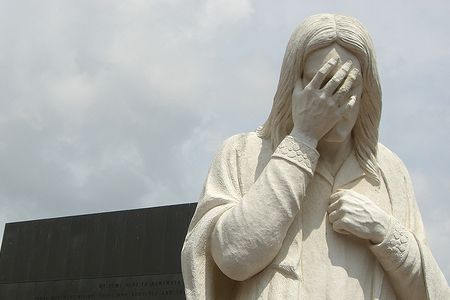
weeping-jesusThe Guardian quotes Father Thomas Doyle, a former canonical lawyer at the Vatican’s Washington embassy, as saying, “One of the massive holes in the Roman Catholic church’s approach to this issue, still today, is a failure to completely comprehend the depth of the spiritual damage that is done to the victims, to their families, especially their parents, to their friends and to the community itself.”  It is not difficult to understand why the faithful are confused when they were taught that sexual acts outside of marriage were intrinsically evil, always a mortal sin (an action that leads to a separation from God’s saving grace), and never moral, regardless of intention or circumstance. To preach one thing and act in opposition to what was taught would confuse anyone. I’m sure Jesus must be weeping.

What happened to the Golden Rule?

the-golden-rule.gifGrowing up I was always reminded of the Golden Rule, both at school and by my parents. Being raised in a Christian community this rule was always emphasized. It wasn’t always stated as “treat others the way you wish to be treated” but often in other ways such as, “show respect to your elders” and “always respect your teachers.” I have always believed that if all people could bring themselves to live by this ethic, humankind would be in a much better place.

The Ethic of Reciprocity, or what is better known as the Golden Rule, simply states that we are to treat other people the same way we would wish to be treated. It can be worded in various forms. Wikipedia describes this rule in three forms:

  1. Positive or directive form: One should treat others as one would like others to treat oneself.
  2. Negative or prohibitive form: One should not treat others in ways that one would not like to be treated.
  3. Empathic or responsive form: What you wish upon others, you wish upon yourself.

No matter how the rule is stated, it boils down to the word respect. Merriam Webster dictionary defines respect as “a feeling of admiring someone or something that is good, valuable, important, etc” or 
as “a feeling or understanding that someone or something is important, serious, etc., and should be treated in an appropriate way.” So when a person shows respect for another then they treat that person the way they would wish to be treated.

What always astounded me about the Golden Rule is that all organized religions have this ethic.

  • In Christianity it is found in Matthew 7:12 (NRSV) of the Christian bible where it is written, ‘in everything do to others as you would have them do to you; for this is the law and the prophets.”
  • In the Buddhist tradition it is found in a collection of verses known as the Udanavarga. In chapter 5, verse 18 of the Udanavarga it says, Hurt not others in ways that you yourself would find hurtful.”
  • In Hinduism, it is found in their sacred scriptures Mahabharata 5:1517 where it is written, this is the sum of duty: do not do to others what would cause pain if done to you.
  • Judaism has it in two places, the Talmud and Book of Tobit. The first book of the Talmud is about Shabbat, the Jewish day of rest. In Shabbat 31a. It states, “What is hateful to you, do not do to your fellow man. This is the law: all the rest is commentary.” In the Jewish scriptures, specifically the book of Tobit, it says, “And what you hate, do not do to any one.” (4:15)
  • In Islam, it can be found in a compilation of forty hadiths by Imam al-Nawawi, an influential Sunni hadith scholar. A hadith is one of various reports describing the words, actions, or habits of the Islamic prophet Muhammad. Number 13 of Imam Al-Nawawi’s Forty Hadiths, it says, “None of you [truly] believes until he wishes for his brother what he wishes for himself.”

The Golden Rule is such a simple thing and makes a lot of sense. It begs the question, why is it so important to live by the Golden Rule. The answer to that question has to do with the idiom, “What goes around comes around” or stated another way, “as you sow, so shall you reap”. These are simply reminding us that when people do bad things to other people, bad things will happen to them. This is what the expression, “you’ve made your bed, now lie in it,” refers to as well. An individual must accept the unpleasant results of something they have done. Really all of these expressions could be understood as karma, the law of cause and effect. Karma is a Sanskrit term that literally means “action” or “doing”. In the Buddhist tradition, karma refers to action driven by intention, which leads to future consequences. Good intent contributes to good karma and happiness in the future, while bad intent contribute to bad karma and suffering in the future.

The Huffington Post article on Karma puts it this way:

“Everything we say and do determines what’s going to happen to us in the future. Whether we act honestly, dishonestly, help or hurt others, it all gets recorded and manifests as a karmic reaction either in this life or a future life…There is no exact formula that is provided for how and when karmic reactions will appear in our lives, but one can be sure they will appear in some form or other. One may be able to get away with a crime they committed, or avoid paying taxes, but according to karma, no one gets away with anything for long.”

What I find even more thought provoking is that science supports this idea of “cause and effect”.  Science, specifically Quantum Physics, is providing evidence that the mind can affect matter. There is a theory known as quantum entanglement. According to Space.com, the theory states when changing one particle it changes the other even if they are on opposite sides of the galaxy, 100,000 light-years apart. In other words, they behave like one object even though they are physically apart. Einstein called this idea “spooky action at a distance”.

Quantum Entanglement: What It Is And Why It’s Relevant says,

“Quantum entanglement means that every action, thought, feeling and emotion is connected and can affect the whole in one manner or another. We are all made up of atoms, photons and electrons. We are all in a constant state of vibration. Our emotions, feelings, hearts and minds have the ability to affect what frequency our molecular structure vibrates at. Quantum entanglement is observed at a physical level, meaning what we do to one particle at one location, happens for another particle at the a different location.”

So even science reinforces the idea that every single thing that a person does, thinks, etc. has an affect. Now I know from experience that when I said something hurtful to a student or to a family member there was an effect. The impact was typically in the form of parental wrath or an angry family member.

9-11We’ve all felt the impact of the actions of an individual or group of people. There are many examples of this in history, such as the terrorist attacks in Paris in 2015. The affect of this event has made many people fearful and afraid to travel. We still feel the effects of the 9/11 attack in New York City as flight travel is much more cumbersome with all the extra security. Terrorism initiated by ISIL or ISIS caused much of world community to participate in a bombing campaign, bombing areas where the terrorists were located. What goes around comes around.

It’s fair to say that one person can impact the world. We just need to look at the legacies of Mahatma Gandhi and Martin Luther King Junior to see this. Mahatma Gandhi once said, “In a gentle way, you can shake the world.”

So remember every action you take, every word you say to someone, or even every action you don’t take has an impact on your community, on your planet or maybe even the universe. It seems to me that in this time of Islamophobia, fear of terrorists, and anti-immigration, the Golden Rule is very much needed. Perhaps people (no names mentioned) who spout anti-Muslim, anti-immigration, and racist rhetoric ought to remember, “What goes around comes around”.