Unexpected Bonuses to Briefly Coming Out of Retirement

Maybe the aboriginal people had it right all along.

You’ve perhaps noticed that I’ve published less frequently lately. Well, there’s a reason for that.  The six weeks prior to Christmas, I took off my retirement shoes and taught full time. The school I taught at for 27 years could not find a teacher to replace a maternity leave. Since the principal was sounding desperate, I agreed to take on a six-week contract.

I enjoyed being with young people again. That was why I went into teaching in the first place. Having said that, this experience definitely reaffirmed for me why I retired. Going back to planning lessons, marking assignments, and putting up with disruptive students confirmed for me that retirement from full-time teaching was the right choice.

Even though it was exhausting and demanding, I am truly grateful for the opportunities this experience provided. During my brief teaching stint, there was a professional development (PD) day scheduled. I admit, I was a bit negative about attending. After all, I would be retired once again in a few weeks. Why would I need more PD? I talked to my principal about it and he directed me to attend as the topic was general. I am so thankful he did. It was a very moving and powerful day.

In the morning, I attended a blanket ceremony. What is a blanket ceremony, you ask? This ceremony came about as a result of the Truth and Reconciliation Commission (TRC) initiated by the Canadian government in 2008. The commission provided those directly or indirectly affected by the legacy of the Indian Residential Schools system an opportunity to share their stories and experiences. Here is a paraphrased explanation of a blanket ceremony according to the Karios website:

In 1996, the Aboriginal Rights Coalition worked with Indigenous elders and teachers to develop an interactive way of learning the history most Canadians were never taught. The Blanket Exercise was the result. The Blanket Exercise is based on participatory education methodology and the goal is to build understanding about the shared history as Indigenous and non-Indigenous people in Canada by walking through pre-contact, treaty-making, colonization and resistance. Everyone is actively involved as they step onto blankets that represent the land, and into the role of First Nations, Inuit and later Métis people. By engaging on an emotional and intellectual level, the Blanket Exercise effectively educates and increases empathy.

Now I thought I knew about residential schools as I had taught about them  when the social studies curriculum changed in 2005; when residential schools were included in the high school curriculum. Experiencing this ceremony left me feeling both shocked and saddened. Shocked because to visually see the result of European contact on indigenous people was appalling, and saddened that my Eurocentric ancestors could be so cruel.

The afternoon of the PD day was spent learning about First Nation (FN) culture. I’ve always been drawn to the indigenous people’s culture, especially their spirituality. It is a spirituality that is so inclusive and respectful of nature. This Ancient Indian Proverb expresses FN spirituality well.

“Treat the Earth well. It was not given to you by your parents, it was loaned to you by your children. We do not inherit the Earth from our ancestors, we borrow it from our children.”

This Cherokee Prayer also illustrates the FN People’s sacredness.

“Oh Great Spirit, help me always to speak the truth quietly, to listen with an open mind when others speak, and to remember the peace that may be found in silence.”

The afternoon included a smudging ceremony. For the FN Peoples, the purpose of the smudging ceremony is to cleanse and to remove any negative energy that may be present in a place, an object or a person. This is why many FN activities start with a smudge. A smudge is made by lighting dried plants (sage, sweetgrass, cedar or tobacco) in a shell or bowl until they smoulder.

We were shown what to do when doing a smudge. The smoke from the smudge is directed towards the head, so a person can think clearly, ears so you can hear the good things in life of others and of yourself; your mouth so you can speak of good things and say kind words to one another; your heart so you can feel good about yourself and others; and lastly you smudge your whole self so you can be blessed for the day. How beautiful is that?

Another opportunity I had during my six-week teaching stint was I got in on a field trip that was already planned before I started. It was a trip to Blue Quills, formerly a Residential School.

Sadly, I knew nothing about the Residential Schools until the mid 2000’s. It certainly wasn’t taught to me in school or university.  In case you don’t know about the Residential Schools in Canada, here is a brief history.

The Residential School system was created with the intent of removing children from their own culture and assimilating them into Canadian culture. Many of the residential schools were run by churches of various denominations, with the majority run by the Roman Catholic Church. Over its more than hundred-year existence, roughly 150,000 Indigenous children were placed in residential schools nationally.  At least 6,000 of these students are estimated to have died while residents.

The residential school system harmed Indigenous children considerably by removing them from their families, depriving them of their native languages, and subjecting numerous of them to physical, mental and sexual abuse. Detached from their families and culture, and forced to speak only English or French, students who attended the residential school system were unable to fit into either their aboriginal communities or Canadian society. The legacy of the system has been connected to an increased incidence of post-traumatic stress, alcoholism, substance abuse, and suicide within Indigenous communities.

Back to my personal experience. The present Blue Quills Indian Residential School building was opened in 1931, and housed about 200 students a year. We toured the building and heard from two of the school’s survivors, both who were forcibly taken from their homes at the age of six to attend the school. They told many stories of the injustices that befell them; injustices such as lack of nutritious and sometimes inedible food, mental abuse, sexual abuse, and shaming practices by the staff. I was shocked to learn that the people of nearby community of St. Paul were not even aware that the school existed.

In 1969, residential schools were removed from churches. The government intended to sell Blue Quills to the nearby town of St. Paul for a dollar. Local Indigenous people formed the Blue Quills Native Education Council and sought authority to operate the school, but Indian Affairs disregarded their requests.

When they attempted to close Blue Quills in 1971, the local FN people held a sit-in at the school, demanding control of the school. Control was turned over to the Blue Quills Native Education Council and it became the first Canadian residential school administered by Aboriginal people. Blue Quills is now a FN college, run by the seven FN communities that surround it. The college’s central emphasis is on language revitalization, especially the Cree language. I applaud the FN people for their courage and determination, and for creating a fully functioning college which is still going strong in the 21st century.

John (Fire) Lame Deer was a Lakota-Sioux medicine man who once said,

“Before our white brothers arrived to make us civilized men, we didn’t have any kind of prison. Because of this, we had no delinquents. We had no locks nor keys and therefore among us there were no thieves. When someone was so poor that he couldn’t afford a horse, a tent or a blanket, he would, in that case, receive it all as a gift. We were too uncivilized to give great importance to private property. We didn’t know any kind of money and consequently, the value of a human being was not determined by his wealth. We had no written laws laid down, no lawyers, no politicians, therefore we were not able to cheat and swindle one another. We were really in bad shape before the white men arrived and I don’t know how to explain how we were able to manage without these fundamental things that (so they tell us) are so necessary for a civilized society.”

Our ancestors entered North America, known to some Indigenous groups as Turtle Island, with their superiority complex believing that they were the civilized ones and had a responsibility to “civilize” the original inhabitants of Turtle Island. Now I always taught my social students the importance of practicing “historical empathy,” to place themselves in the historical situation to gain a deeper understanding of the events. Our European ancestors were acting in the best way they knew with their belief systems of the period. However, I have come to realize that it was the indigenous culture who perhaps had it right with their culture of sharing the land, stewardship of the land and spirituality. Although FN spirituality varied between tribes, it taught reverence for their ancestors by honouring and respecting others, and a respect for the land. In comparison, Europeans had a culture of land ownership, land exploitation and who viewed FN spirituality as a collection of superstitions.  I have to wonder how different our country would be had our ancestors arrived with an attitude of receptivity to new ways, instead of an attitude of superiority.

Christmas Controversies 3.1

A commentary on political correctness.

Every Christmas since blogging, I’ve written about Christmas controversies and every year I keep reading about a “War on Christmas.”  It appears there are people who believe the Christian festival of Christmas is under attack. Personally, I have never witnessed it nor have I talked to people who feel this way.  People who believe there is a war on Christmas take all-encompassing phrases like “Happy Holidays” as insults to Christianity. They make holiday greetings and decorations into hypothetically divisive political issues.

I find it intriguing to discover, according to the Washington Post’s article, Poll: Conservatives most likely to be offended by holiday greetings, that,

“the demographic groups most offended by “Happy Holidays” include strong conservatives (21 percent) …Trump supporters (18 percent) and all men (18 percent). These are the same groups of people that tend to say there is too much political correctness in society, yielding a paradox: The folks who complain the most about political correctness are the ones who are the most offended by what they see as “incorrect” speech.

To frame it another way, conservatives [traditionalists] often caricature liberals [according to Dictionary.com, those who are open-minded or tolerant, especially free of or not bound by traditional or conventional ideas, values, etc.] as too quick to take offense over politically incorrect speech. But in the [Public Policy Polling] PPP poll, people who described themselves as “very conservative” were more than twice as likely to be offended by “Happy Holidays” (21 percent) as “very liberal” respondents were to be offended by “Merry Christmas” (10 percent).”

As I talked about in my last blog post, Christmas Controversies 3.0, Trump wholeheartedly jump on the “Christmas is under attack” bandwagon when he told a rally of his devotees in Grand Rapids, Michigan “We’re going to start saying ‘Merry Christmas’ again.”

Mostly of what I’ve read, this so-called war seems to be an American phenomenon, but unfortunately it is overflowing into Canada.  It appears that some Canadians, or at least some of our politicians in the province of Alberta, are claiming that Christmas is under attack. Newly elected United Conservative Party (UPC) leader Jason Kenney has turned the holiday celebrating Jesus’ birth into a political issue.

Global News’ article, Twitter mocks Jason Kenney for suggesting the left thinks ‘saying Merry Christmas is hateful’, reports that Kenney was quoted as saying in a column posted by the Calgary Sun,  “The problem is people on the left [those labelled liberal thinking] think saying ‘Merry Christmas’ is hateful,” and that  “Those voices of crazed political correctness will not govern what is allowed.”

What I found even more captivating is Kenney reacted to the Twitter backlash of his comment by tweeting on December 21st, “It was a *joke* about the excesses of political correctness.” Most confusing to me was he said in the tweet, “But not too far off the mark at a time when songs like Jingle Bells & White Christmas are generating controversy.”

I had never heard of the classic songs of Jingle Bells and White Christmas being scandalous. What is so controversial about one of the best-known and commonly sung songs in the world?  Even more surprising was to learn that the 1942, “White Christmas,” made famous by Bing Crosby; a song reminiscing about an old-fashioned Christmas scenery, that is, a snowy Christmas. What could be contentious about that? I wanted to know, so I did some research.

According to the Guardian, in the article, Is Jingle Bells racist? Despite backlash from the right, it’s not black and white, a Fox News host told viewers that the “Newest Christmas controversy has social justice warriors claiming this classic holiday carol is racist,” warning that Kyna Hamill was urging people to “shun the jaunty tune.”

Kyna Hamill is a university lecturer who probed the origins of the popular carol, and published her findings, perceiving that during the past 160 years the song had become an example of music whose “blackface and racist origins have been subtly and systematically removed from its history”. Hamill did say much reporting of her research was incorrect and laden with “all sorts of absolutely absurd” accusations.

It seems that there are those that think the popular Christmas song, ‘White Christmas’, is a racist song as well.  This controversy originated, according to Opposing Views, when country music star Darius Rucker,  an African American singer and songwriter, who was asked to perform at the annual Christmas tree lighting ceremony at the Rockefeller Center. When Rucker began singing ‘White Christmas,’ people protesting the death of Eric Garner, a black man who was killed by a white police officer in Staten Island, flooded the Rockefeller Center and the surrounding area. The public turned to Twitter to voice their objections. “The irony of watching Darius Rucker singing ‘White Christmas’ around the corner from the Eric Garner protest is mind-blowing,” tweeted a law student based in Cincinnati, Ohio.

Critics of the singing of White Christmas, believe that the reference to the colour “white” by a black singer during a time of racial tensions was offensive and suggested a contempt for the feelings of other black people. Now I can only speak for myself, but that seems to be a stretch for me. Some individuals appear to look for any opportunity to create a political issue. I am still trying to wrap my head around as to why they feel the need to do so.

My conclusions: There is NO “War on Christmas.” Christmas is not being attacked. There are those that want us to believe it is, but all evidence that I’ve found says this ‘war’ is a myth being perpetrated by some for political gain.

I really like what Christopher Stuart Taylor, a Diversity and Inclusion Professional, says in his Huffpost article, If We Can’t Say ‘Merry Christmas’ in Canada, Multiculturalism Failed. Mr. Taylor wrote:

“As I returned the greeting I wondered: since when did “Merry Christmas” become a political statement especially in multicultural Canada? … Multiculturalism is a complete and utter failure in Canada when it is politically incorrect to say ‘Merry Christmas.’ …. When was the last time you told someone you didn’t know ‘Merry Christmas’ without pausing and wondering if they may or may not be offended?”

For those that do not know, multiculturalism is official policy in Canada, as it should be. The Act says, it is hereby declared to be the policy of the Government of Canada to recognize and promote the understanding that multiculturalism reflects the cultural and racial diversity of Canadian society and acknowledges the freedom of all members of Canadian society to preserve, enhance and share their cultural heritage.

That tells me there is no need to stop wishing people ‘Merry Christmas’.  As I said in my last post, it is really about common-sense etiquette. If you know someone is a Christian who is celebrating Christmas wish them ‘Merry Christmas.’ Likewise, say ‘Happy Hanukkah’ to those you know to be Jewish.  To your Hindu friends say happy Diwali when they celebrate. During Ramadan, say “Ramadan Mubarak” which means “Happy Ramadan”. If you don’t know a person’s faith, don’t worry about political correctness. Just say what feels right. When in primarily a Christian country, no one should be offended when greeted with a ‘Merry Christmas.’. If I were in Israel, I would not be offended if someone wished me a “Happy Hanukkah.” Most non-Christians would not be offended when wished a Merry Christmas in a Christian country?

The statistics appear to agree. According to the Washington Post’s article I sited earlier, “only 3 percent of respondents said they’d be personally offended if somebody said “Merry Christmas” to them. But 13 percent said “Happy Holidays” would be offensive to them. So, individuals who opt for the more inclusive, nondenominational “Happy Holidays” may end up offending more people than if they’d just said “Merry Christmas” in the first place.”

The Importance of Remembering

A Commentary on the victims of war.

Once again, the November 11th Remembrance Day is upon us. It is the day of the year that marks the anniversary of the official ending of World War I. In Canada Remembrance Day is a national holiday and all Commonwealth Nations observe this day as a day to remember the members of their armed forces who have died in the line of duty. For those that don’t know, the Commonwealth is an organization of 53 member states that were mostly territories of the former British Empire, which includes the United Kingdom. The United States has a day of remembrance called Veterans Day, which is an official federal holiday that is observed annually on November 11. Its purpose is to honor people who have served in the U.S. Armed Forces, that is, veterans.

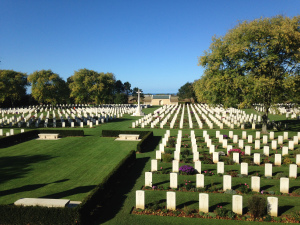
Allied military cemetery in Normandy, France

Since visiting Vimy Ridge and the Normandy Beaches in France two years ago, my wife and I have a stronger appreciation for all soldiers and the sacrifice they made to maintain freedoms. Visiting both WWI and WWII military commentaries was truly a humbling experience. What struck us both was the age of many of the soldiers, some as young as 17 years old. We now attend the Remembrance Day ceremonies with much more gratitude and appreciation for all soldiers.

Remembrance Day is an important day and it is imperative that we remember the soldiers who have lost their lives or put their lives on the line to protect the rights of its citizens. But what about the countless civilians that lost their lives during times of war or worse, through genocide. Article II of United Nation’s 1948 Genocide Convention describes genocide as “any of the following acts committed with intent to destroy, in whole or in part, a national, ethnical, racial or religious group, as such: Killing members of the group; Causing serious bodily or mental harm to members of the group; Deliberately inflicting on the group conditions of life calculated to bring about its physical destruction in whole or in part; Imposing measures intended to prevent births within the group; Forcibly transferring children of the group to another group.” Countless numbers of people have lost their lives as a result of genocide or because of bombing runs or merciless killing because they were considered enemies. Shouldn’t they be remembered too?

I would like to believe that one of the reasons the world went to war in 1939 (WWII) was because the Nazis were exterminating not only the Jews from continental Europe, but millions of others it deemed “undesirable.” By the end of the war in 1945, some eleven million people—over half of them Jews—had died, either through mass extermination, deportation, starvation or overwork in his prison camps. However, much of the world ignored or denied that the Nazis were doing this.  There is little doubt in my mind that it was a genocide that occurred.

Also during WWII, the Rape of Nanking took place. We seldom hear about this event as most schools in the West focus on the fascist Nazis. The Rape of Nanking began on December of 1937 when the Japanese Imperial Army marched into China’s capital city of Nanking and proceeded to murder 300,000 out of the 600,000 civilians and soldiers in the city. The shocking violence consisting of citywide burnings, stabbings, drownings, rapes, and thefts which continued for about six weeks. The Japanese troops are most notorious for raping over 20,000 women, most of whom were murdered thereafter so they could never bear witness. Clearly this was a genocide.

Then there was Joseph Stalin, the dictator of the Union of Soviet Socialist Republics (USSR) from 1929 to 1953. Stalin ruled by terror, and millions of his own citizens died during his brutal reign. It has been estimated that between 1934 and 1939, one million party members were arrested and executed. During the same period, it is thought that 10 million were sent to the gulags (system of forced-labor camps in the Soviet Union) with many of them dying either in transit or as a result of the terrible living conditions they had to endure.  This certainly was a genocide.

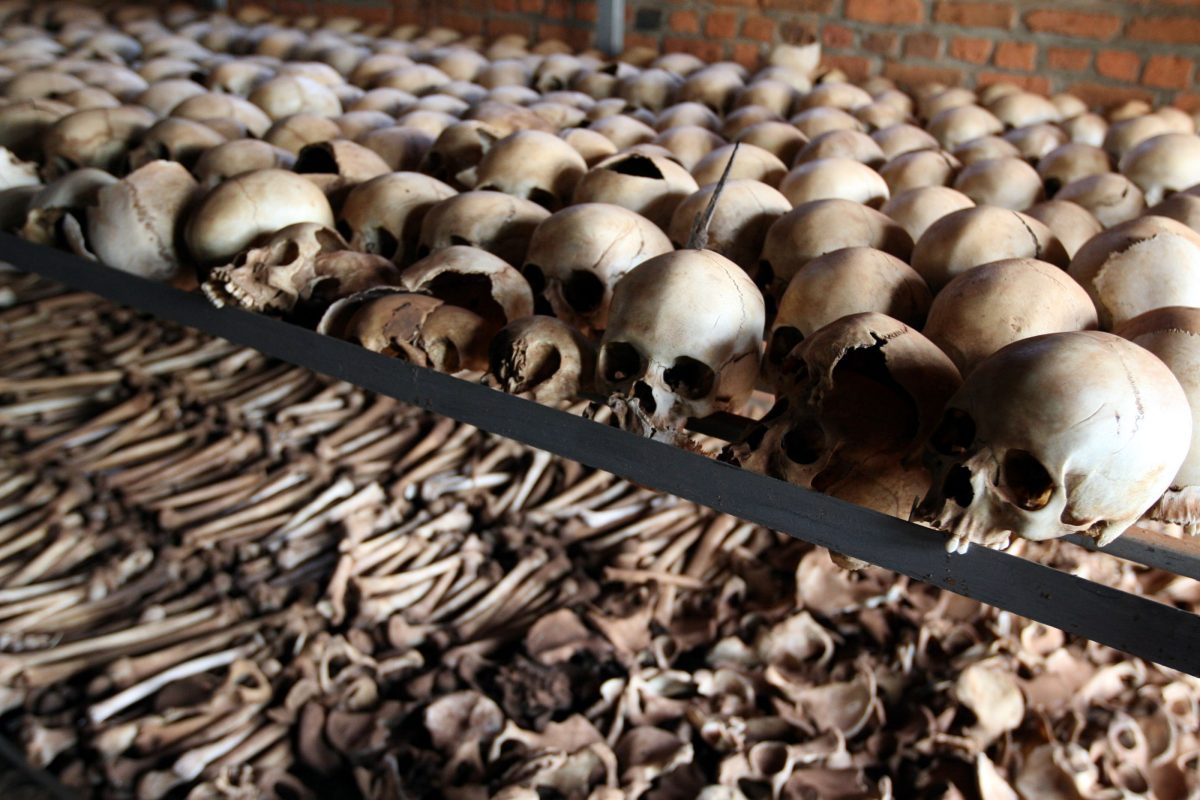
Bones of victims at a memorial to the Rwandan genocide By DFID.

Many of us older people remember the Rwandan Genocide which began on April 6, 1994. This was when groups of ethnic Hutus, using mainly machetes, began a campaign of terror and bloodshed the Central African country of Rwanda. For about 100 days, the Hutu militias followed a premeditated attempt to exterminate the country’s ethnic Tutsi population. The killings ended after armed Tutsi rebels, invading from neighboring countries, managed to defeat the Hutus and halt the genocide in July 1994. By then, over one-tenth of the population, an estimated 800,000 persons, had been killed. At least the history books label this event as a genocide.

There are many, many other genocides that have occurred in history. Those listed above are but a sampling. Shouldn’t the innocent victims of genocide as well as civilian casualties— referred to as “collateral damage” by the military, be remembered? Many of these victims were children.  Now I’m not suggesting this be done on Remembrance Day, but perhaps there could be another day set aside as a holiday to remember civilian victims of war and of genocide. Perhaps this day could be called Victims of War Day or Victims of Genocide Day. It just seems like the right thing to do.

Diane Samuels, a British author and playwright, said, “How can I pretend that nothing happened?”  Sometimes I feel like that is what is happening. We pretend that these genocides or civilian deaths did not happen because we focus solely on our soldiers.

But perhaps Aldous Huxley, an English writer, novelist, philosopher, said it best when he said,

“The most shocking fact about war is that its victims and its instruments are individual human beings, and that these individual beings are condemned by the monstrous conventions of politics to murder or be murdered in quarrels not their own.”

We need to pay more homage and respect for those who innocently have lost their lives in conflicts that were not of their own making. They deserve that respect and honour.

A Message to My Children

A Dad’s advice to his children.

If you were to give your children advice, what would it be? In my last post (Artists May Have the Answer) I mentioned that my wife and I attended a Chris de Burgh concert. At that concert, Chris de Burgh sang one of his newer songs called ‘Go Where Your Heart Believes’, a song I had never heard before; a song from his album “Moonfleet and Other Stories” released in January of 2011. If you’ve never heard the song, here it is.

This song helped me answer that question. In September, I wrote a post (When the Nest Empties) about Empty Nest Syndrome where I admitted that I was afflicted with this syndrome when my middle daughter moved to Dublin, Ireland to attend Trinity College. This song helped me understand why our daughter needed to do what  she was doing.

Chris de Burgh’s song, ‘Go Where Your Heart Believes’ has put Empty Nest Syndrome–those feelings of loneliness or sadness after children grow up and leave home—into perspective for me. Henry Ward Beecher, a clergyman, once said, “We never know the love of a parent till we become parents ourselves.” This is so true! Sometimes as parents, we love our children so much we don’t want to let them go. That seemed to hold true for me.

Actor and producer, Peter Krause, says, “Parenthood…It’s about guiding the next generation, and forgiving the last”.  My wife and I have guided our children as best we knew how, just as our parents did. Yes, we’ve made mistakes as our parents did, but we have to trust that our guidance has enabled our children to be independent, strong, brave, and productive citizens. Chris de Burgh’s song ‘Go Where Your Heart Believes’ expressed for me the message I want to deliver to my children.

The lyrics say, “I am old but there’s a wisdom that comes with years. You are young and it’s so easy when you have no fears.”  I learned much wisdom throughout my years and I continue to do so, but I’ve also learned that I am hanging onto many fears which I acquired from my life experiences. I am now working to release those fears as they no longer serve me. You, my children, are just beginning your life journey, so live it without fear. What is fear anyway? It is False Emotion Appearing (as) Real.

Now don’t get me wrong. Fear serves a purpose. Psychology Today says,

“Fear is a vital response to physical and emotional danger—if we didn’t feel it, we couldn’t protect ourselves from legitimate threats. But often we fear situations that are far from life-or-death, and thus hang back for no good reason. Traumas or bad experiences can trigger a fear response within us that is hard to quell. Yet exposing ourselves to our personal demons is the best way to move past them”.

As it says in Psychology Today, fear protects us from legitimate threats. These are healthy fears. These fears protect us from life and death situations. The fears that I am referring to are “false emotion appearing as real.” As it says in Psychology Today, we “fear situations that are far from life-or-death, and thus hang back for no good reason. Traumas or bad experiences can trigger a fear response within us that is hard to quell.”  Those are the ones we need to dispose of. It is these fears that I am working on releasing now that I have the time to do so. These are fears like the fear of darkness, spiders, dogs, flying in an airplane, and such things as these; irrational fears.

Frank Sant’Agata says, “Love and fear are the only emotions we as human entities are able to express. All the others are just sub-categorical emotions. For example, on love’s side there is joy, peacefulness, happiness, forgiveness, and a host of others. On the other hand, fear reflects: hate, depression, guilt, inadequacy, discontentment, prejudice, anger, attack, and so on”.  Even the Christian Scriptures it is written, “There is no fear in love, but perfect love casts out fear. For fear has to do with punishment, and whoever fears has not been perfected in love” (1 John 4:18). So, my advice to you, express love and not fear. Avoid those irrational fears.

The lyrics say, “Go, go where your heart believes, your memories are waiting, It’s the only way to find out who you are.”  So my advice to you is follow your dreams, your passions, your desires without fear! I truly wish I had done this more in my youth, but I held back because of irrational fears. I know many people who are afraid to travel to another country because of what they hear from the news media, mainly terrorism. Then there are those who fear flying likely because a bad experience or what they’ve heard on the news or tell themselves. These fears are “false emotion appearing as real.”  In an article called, Heart is more than a pump, it talks about a new branch of science called, Neurocardiology and studies in this field indicate there is constant communication between the heart and the brain. These scientific studies are showing that the heart may play a significant role in the way we experience emotions and make decisions. Maybe love is literally connected to the heart. Perhaps this is why the heart is a symbol of romantic love and a “wounded heart” means love sickness. It may also be why we have expressions like, “break my heart” (sadness due to breakup) or “have a heart” (show compassion) or “with all one’s heart” (deepest feeling). So, my advice to you is follow your heart. It is where your passions and desires are.

The lyrics say, “In this life, there is a road that you must follow, to the left or the right. One is wide but the other is hard and narrow. Take this one, and you can call it your own”. We can take the easy, safe road or we can take the tough road. I know I often took the safe road because of irrational fears. Looking back, I wish now I took the “harder” roads. Perhaps I would have taken that trip to Europe sooner. Perhaps I would have seriously considered teaching a year or two in another country, but I didn’t because I feared the amount of work involved and being far from home. So, my advice is to don’t always take the easy route!

The lyrics say, “There will be so many voices trying to turn you round, take a moment just to listen, then carry on”. Here is the most important message in the song. Stop believing what others say. It is fine to listen and consider what they are saying, but when deciding, follow your heart! I wish I had. I made the mistake of believing what others told me. My dad used to say, “If you have a job, hang on to it.” For him, a job pays the bills and to be fair, he lived through the Great Depression as a child and saw his dad–your great grandfather–struggle to feed the family. I listened to him and consequently, I went through periods of being discontented in my career.  In hindsight, I should have followed my heart.

The lyrics say, “There will be times when you’re lost and lonely, and you will have no-one beside you. And that is when you’ll find the hidden one inside, who will help you through.” There certainly will be times when you feel all alone and unsupported. These are the times when you need to trust your intuition; that knowing or understanding something without reasoning or proof. Trust that that is when the Universe, God, your angels, your guides are directing you. They are always with you. Most of the time we discredit our intuition with reasoning; telling ourselves it was our imagination. Trust it!

So, that is my message to you my three perfect children. It is a message not only for my children, but for all young people who are open to the message. Follow your heart without fear! Listen to others and decide with discernment what is best for you. Only you know what is best for you. Discover who you are. Better yet, decide who you are and be that person. And whatever you do, don’t fall victim to your fears!

Artists May Have the Answer

A commentary on the wisdom of war.

I came across a rather unsettling headline on the CBC News website: North Korea warns of nuclear war at ‘any moment’. There really hasn’t been much concern about nuclear weapons since the former Soviet Union fell. Whenever the topic of the United States comes up, I hear concern in people’s voices over what is transpiring with the North Koran leader, Kim Jong Un and the current resident of the White House. There has been a war of words between the two of them, each calling one other names. Trump called the North Korean leader ‘Rocket Man’ and Kim Jong Un responded saying Trump was “a mentally deranged U.S. dotard”.  In other words, Jong Un is insinuating that Trump’s mental faculties are declining. One has to wonder if there is some truth in that.

Seriously, these two world leaders are acting just like children act in the school yard. As a retired teacher, I have personally witnessed much bullying on the school playground. Donald Trump has made threats such as; “North Korea best not make any more threats to the United States. They will be met with fire and fury like the world has never seen”. (see NYT) and Jong Un has uttered such things as; “If the American imperialists provoke us a bit, we will not hesitate to slap them with a pre-emptive nuclear strike. The United States must choose! It’s up to you whether the nation called the United States exists on this planet or not.” (see NYT). Watching these two world leaders act like school yard bullies is really reminiscent of the numerous supervision shifts I did as a teacher. You expect children to act this way but it is just sad when grown-ups behave this way especially if they are leaders of a country.

My wife and I attended a Chris De Burgh concert earlier this week. We haven’t been to a concert of his since the late 80s. My wife is an avid fan of Chris De Burgh and was long before I met her, and that was how I got to know his music. It was a fabulous concert and he can still put on a great show even though he just started touring after 30 years in the past few years. I was reminded of why I used to go to his concerts and listen to his records. The messages of his songs are so powerful and usually touch people at the soul level.

Why am I bringing up a Chris De Burgh concert? Well, it struck me, listening to Chris De Burgh sing his songs that his messages could teach these leaders a thing or two. Perhaps instead of looking to our politicians to solve conflicts, we should be looking to our artists. One of the songs that De Burgh sang at his concert was one he dedicated to the Canadian soldiers who liberated Vimy Ridge during WWI from the Axis powers, not without a high cost of lives. The song was Borderline. If you’ve never heard it, hear it is.

http://www.youtube.com/watch?v=H1WDoDLRWSQ

The song is about a soldier leaving to go to the front in WWI but the soldier is torn because he didn’t want to leave the love of his life, hence the lyrics; I hear my country call me, but I want to be with you. But the most powerful message of the song is the soldier questioning what he is about to partake in when he says; How men can see the wisdom in a war… Is there wisdom in a war? I can’t think of any. It was U.S. president, Franklin D. Roosevelt, who said, “War is young men dying and old men talking.”  That is so true! The reality is a leader can only take his or her country to war if the people that they oversee agree with them and follow. It was Adolf Hitler who said, “How fortunate for governments that the people they administer don’t think.”  The only wisdom related to war that I know of was by Niccolò Machiavelli, an Italian diplomat, politician, historian, philosopher and writer of the Renaissance period. In one of his writings, The Prince, he says “Wisdom consists of knowing how to distinguish the nature of trouble, and in choosing the lesser evil.” Perhaps it was said better in the movie, Pearl Harbor (2001), by Admiral Yamamoto (Mako) who said, “A brilliant man will find a way not to fight a war.”

Chris De Burgh has another song, one of my favorites, which unfortunately he didn’t sing. The song is called, Up Here in Heaven and it too has a very powerful message. In case you’ve haven’t heard it, here it is.

The song talks about visiting a military cemetery. Two years ago, my wife and I visited several military cemeteries while visiting the Normandy beaches and Vimy Ridge in France.  It was probably one of the most humbling and emotional experiences of our trip. The lyrics of Chris De Burgh’s song say:

What of the children caught in the war,
How can we tell them what it’s for,
When they cry, when they cry are voices heard anymore?

Are you listening, are you listening men of the war?
There is nothing, there is nothing worth dying for;

Up here in heaven, we stand together,
Both the enemy and the friend, ’till the end of time,
Up here in heaven, we are forever,
There is only one God up here, for all of the world.

Allied WWII military cemetery visited in Normandy, France.

His second song touches on the same theme. As the lyrics say; What of the children caught in the war, how can we tell them what it’s for. When they cry, when they cry are voices heard anymore? The characters in the song are questioning if war is justifiable, especially when it comes to the young men and women who are expected to fight it. It certainly isn’t the politicians who are battling it out. But the most powerful part of the song are the lyrics: Up here in heaven, we stand together, Both the enemy and the friend, ’till the end of time. Up here in heaven, we are forever, there is only one God up here, for all of the world. I believe when our souls arrive on the other side, heaven if you will, we will discover a God that sees no differences; that loves everyone equally. There are no enemies. Even though in our societies, God is referred to as Yahweh by the Jews, God by the Christians and Allah by the Muslims, as the lyrics say, there is only one God.

For me anyway, there is so much truth in these two songs. When the soldier in the song Borderline wonders; How men can see the wisdom in a war, the truth is, there is no wisdom in a war.  War is merely a school yard fight carried out in a big way. This is the message that needs to be sent to the bully politicians of the world. There is no wisdom in war! There is simply no way to justify war to those who are expected to fight it which is usually our young people. You might ask: What do we do when a bully leader threatens a sovereign state?  It was World War 1 veteran, the late Harry Patch, who once said:

“If I had my way I would lock all leaders in a room, and let them fight it out. Then there’d be no need, for lads like me, to go to war. Why should the government send me to a battlefield, to fight a man I never knew, whose language I couldn’t speak? All those lives, lost in a war, finished over a table. Now where’s the sense in all that? Give you leaders give them each a gun, and let them fight it out themselves”.

That is what needs to be done. Place the North Koran leader and the current resident of the White house into a room and let them ‘duke it out’. No more young soldiers need to die, or in the case of a nuclear holocaust, people of all ages all because two world leaders are behaving like school yard bullies.

A Mass Shooting? Not Again!

One Canadian’s view on its gun obsessed neighbour.

Yet again, the world watched in horror as another gun slaughter took place in the United.States. October 1, 2017, was the deadliest shooting in modern US history with 58 dead and just under 500 people injured. The 2016 Pulse nightclub shooting in Orlando, Florida, previously was the deadliest with 49 killed. This latest bloodbath happened in Las Vegas, Nevada, where sixty-four-year-old Stephen Paddock opened fire on 22,000 concertgoers from his room at the Mandalay Bay Hotel. Paddock had no serious criminal history and killed himself with a self-inflicted wound before officers could reach him. Investigators are unable to find a motive for the killing spree.

What I find interesting, as many on Twitter have pointed out, is that the current resident of the White House did not use the words “terror” or “terrorist” during his remarks about the shooting, whereas he used those terms when referring to previous mass shootings. According to Merriam-Webster, an act of terror is “the use of violent acts to frighten the people in an area as a way of trying to achieve a political goal.”  Granted, we don’t know what the political aim of the shooter was but by definition it  sure sounds like an act of terror to me. I have to wonder if the president refrained from using the word “terrorist” because the shooter was white.

According to the article, Gun Violence by the Numbers, data from the U.S. Center for Disease Control and Prevention show that on an average day, 93 Americans are killed with guns and for every one person killed with guns, two more are injured. It is shocking to me that America’s gun homicide rate is more than 25 times the average of other high-income countries.

The CBS article, How U.S. gun deaths compare to other countries, reports that in 2010 the U.S. had a firearm homicide rate of 3.6 deaths per 100 000 people, the highest of all countries listed. Interestingly, the United Kingdom has a rate of zero as does Norway, Japan and the Republic of Korea or better known as South Korea. My country, Canada, has a rate of 0.5 deaths per 100 000 which is still too high in my view. One statistic that stands out for me is “even though it [the United States] has half the population of the other 22 [high-income] nations combined, the United States accounted for 82 percent of all gun deaths.”

According to CNN’s article on Mass Shootings, which used statistics from the Gun Violence Archive,  defining, a “mass shooting” as any incident in which a gunman shoots or kills four or more people in the same general time and location, reported that in the U.S. there have been 273 mass shootings so far in 2017  (January 1 to October 3, 2017). That averages to 7.5 mass shootings a week. It seems America, or maybe even the world, has become immune to these mass shootings since we only seem to hear about the big ones. Let’s compare that to Canada. According to Wikipedia’s chart of Massacres in Canada, Canada has had 23 mass killings since 1967, the most recent being the Quebec City mosque shooting on January 29, 2017, where a single gunman killed 6 people and wounded 18 others in Quebec City, Quebec. The difference between the two countries is astounding! I am so thankful to be living in Canada.

I’m dumbfounded! It seems so obvious to me what America needs to do. There ARE solutions, America! Let’s look at the Australian example.

CNN’s article, What the UK and Australia did differently after mass shootings, reports that Australian Prime Minister John Howard was six weeks into his new job when the Port Arthur massacre occurred. That incident occurred in 1996, where 28-year-old Martin Bryant went on a killing spree ending in the deaths of 35 people in  the town of Port Arthur in Tasmania, Australia.

PM Howard led the effort against a loud gun lobby and resistant state governments to push through a federal gun amnesty, in which the government compensated gun owners for the weapons they turned in. He also directed changes to gun laws that included lengthy background and identification checks for would-be gun buyers, and a ban on automatic and semi-automatic weapons.

That same article discusses the United Kingdom’s experience.  Also in 1996, 43-year-old Thomas Hamilton used legally owned handguns to kill 16 children aged 5 and 6 as well as a teacher before taking his own life. This massacre in Dunblane, Scotland, provoked public outrage and backing to ban handguns. After a public inquiry, the Conservative government banned all handguns in England, Scotland and Wales, with the exception of .22 caliber single-shot weapons, The Labour government elected afterwards added .22 caliber guns to the ban as well.

You might wonder why the United States does not follow the example of the UK and Australian. A PBS article titled, Obama to Gun Owners, provides President Obama’s explanation. If you listen to the news video, Obama compares the effort to implement gun safety measures to the effort to create more automobile laws, in which during the late 20th century, there were an excess of car deaths and accidents. Therefore, governments made it priority to make stricter driving laws to be able to drive. People need a license to drive, but people don’t need a license to buy a gun which is the problem, according to President Obama.

President Obama explains in the video that even suspected ISIL or ISIS, sympathizers who are banned from flying in the United States are able to buy guns, because the National Rifle Association (NRA) uses its power and wealth to lobby members of Congress. It is because of the NRA that stricter gun laws are so difficult to get passed in the United States.

So, the question is: Will stricter gun laws be implemented in the U. S. after the Las Vegas massacre?  Since no change occurred with the countless other gun massacres of the past, I doubt anything will change.

According to the National Safety Council located in the U.S. your chance of dying by a firearm in the U.S.  is 1 in 370. The chance of dying in a motor vehicle accident is far less, 1 in 114.

According to Politifact:

“Last year [2012], handguns killed 48 people in Japan, 8 in Great Britain, 34 in Switzerland, 52 in Canada, 58 in Israel, 21 in Sweden, 42 in West Germany and 10,728 in the United States.”

These statistics ‘blow my mind’. That is 10 670 more gun related deaths then in Canada. I am so grateful to live in a country that has tight gun control laws. They could be tighter still in my view. I just don’t understand how a country where the chances of being killed with bullets is 1 in 370 refuses to change. I’m mystified! If the current president really wants to make America great again, he could start by making America safe again and introduce stricter gun controls.

Do We Really Want to Erase History?

A commentary on how to handle controversial historical figures.

It seems there is a call for us North Americans to take another look at our history. That is a good thing. As a retired Social Studies and history teacher, I emphasized to my students that history is NOT fact since it is past events that have been interpreted by historians. In other words, historians analyze past events whereby they use diaries, archeological artifacts, and so on, to determine what happened. This is not without their biases and beliefs, or as Napoléon Bonaparte once allegedly said, “History is a set of lies agreed upon.” History is a historian’s interpretation of the past.

In  the United States many people are calling for long-standing monuments that honour confederate generals to be removed. A similar debate is also developing in Canada involving the country’s first prime minister (PM), Sir. John A MacDonald. Canada’s first PM was one of our more colourful politicians as he was a notorious drinker. It is well documented that MacDonald was a regular binge drinker.

I first heard of the controversial issue of removing statues of U.S. Confederate generals in April of this year when I watched a news report of New Orleans removing a monument during the dark. Numerous statues in various U.S. cities have been removed since. So why are they being removed?

General Robert E. Lee located in Charlottesville, Virginia

The Currents, CBC Radio program, addressed the issue of U.S. Confederate statues represent ‘image of America as a white society’. The article quotes Eric Foner, the author of The Fiery Trial: Abraham Lincoln and American Slavery. Foner argues what many Confederate statues actually represent is “this image of America as a white society. That’s why people object to them, not because of a lack of interest in heritage or legacy.” Foner says, He goes on to say, “These statues actually don’t have a lot to do with the Civil War …They were put up mostly to be part of the legitimacy of white supremacy, of the Jim Crow system in the South, long after slavery.” The Jim Crow system was a system of racial segregation in the southern U.S. Foner explains that many of the statues were erected in the 1890s when the rights of black people were severely reduced.

What is the debate in Canada about?  For those who don’t know Canadian history, Sir John A. Macdonald was one of the founders of the Dominion of Canada and during his terms as prime minister (1867-1873 and 1878-1891) he had a transcontinental railway built. The controversy regarding him comes from the fact that during that time, the federal government approved the first residential schools in Canada.

Sir John A. MacDonald, Canada’s first PM

The Global News’ article, The controversy over Sir John A. Macdonald, explains that the Elementary Teachers Federation of Ontario (EFTO), one of the teacher’s unions, is lobbying to remove MacDonald’s name from schools across the province. The union claims using Macdonald’s name creates an unsafe environment for kids to learn and work in because of what it calls Macdonald’s role as the “architect of genocide against Indigenous Peoples.”

James Daschuk, an assistant professor of history at the University of Regina and author of Clearing the Plains says. “It wasn’t just with Indigenous people. In 1885, Macdonald told the House of Commons that Canada should take away the vote from people of Chinese origin on the grounds that they were a different race than Europeans.”

It isn’t just about Sir. John A MacDonald. In July, CBC reported in its article, Statue of Edward Cornwallis, that the city of Halifax in Nova Scotia will make a decision on the fate of the city’s controversial statue of Edward Cornwallis, a military officer who founded Halifax for the British in 1749. It was Cornwallis that issued the so-called scalping proclamation, offering a cash bounty to anyone who killed a Mi’kmaq person.

So where do we draw the line? Do we stop at prime ministers? Fathers of Confederation? The Ottawa Citizen’s article, Where will it stop? refers to Michel Prévost, president of la Société d’histoire de l’Outaouais and a University of Ottawa archivist.  He says some people have lobbied for the removal of Mackenzie King’s statue from Parliament Hill for Canada’s decision in June 1939 to deny entry to more than 900 Jewish refugees who had fled Germany. Already barred from docking in Cuba and the United States, their ship, the MS St. Louis, returned to Europe, where more than 250 of them subsequently died in the Holocaust.

Prévost also explains that a Father of Confederation, Hector-Louis Langevin, would have his name stripped from the Wellington Avenue building that both bears his name and houses the prime minister’s office. Langevin was one of the original designers of the residential school system.

Preston Manning, one of our conservative Canadian politician on CBC Radio’s, The Sunday Edition said,

“I think there are unsavory aspects to populism. And I think one need to deplore those, but I think one needs to focus more on the root causes of that alienation, rather that fixating on just the negative eccentricities of it.”

Most often I disagree with Manning’s views, but I agree with this one. We are fixating on the negative. It is shameful to remove those names and statues of important figures in Canadian and American history. This is not the answer. Having said that, it is important to recognize the atrocities that these people have done. We mustn’t forget that Sir John A MacDonald was the “architect of genocide against Indigenous Peoples.” or wanted to take away the vote from Chinese people. Or, that Confederate statues represent an image of America as strictly a white society. As a retired teacher, the teacher in me says these could be some teachable moments. Instead of removing the names of these historical figures from buildings and streets, or taking down statues; instead we should be using them to educate people about both their achievements and the horrific things those historical figures did.

Debate about our histories is healthy! We should re-evaluate our history. Some historians agree with me. Don Doyle, a professor of history at the University of South Carolina, (see Historians Warn) says.

“I find it very exciting and refreshing that Americans are revisiting their history and questioning just why we honor some people, some events, and not others. It is a healthy reminder that history, as the search for understanding of the past, must always challenge public history as monuments and hero worship in the public sphere.”

Perhaps people are over reacting. Instead of removing all of these controversial statues of historical figures, erasing history so to speak, let’s relocate them to museums where people can be educated on both the positive and negative aspects our history. Good or bad, these people are still a part of our histories. Perhaps a plaque could be associated with each historical figure explaining the good achieved by the figure, as well as explaining the atrocities they are associated with that historical character. These people were only following the belief system of their time period. They didn’t know any different. When I taught history, I emphasized the importance of practicing historical empathy.  Historical empathy is the understanding of why people in history did what they did, as opposed to simply knowing what they did.  Instead of attempting to erase the dark periods of our histories, we need to practice historical empathy and acknowledge them. We should attempt to understand why these horrific things happened in our past so that they might not happen again. Maybe then healing can occur.

We Are Not All the Same

A commentary on stereotyping

I recently saw on Facebook a video called, All That We Share. It is a video that was created in Denmark and provides a powerful message about stereotyping. To be clear on what stereotyping is, Simply Psychology defines a stereotype as “a fixed, over generalized belief about a particular group or class of people.”  If you haven’t seen the video, here it is.

The video discusses many stereotypes, but let’s focus on some of the common ones. First, let’s look at a big one, perpetrated by rhetoric by populist movements about immigration. A common stereotype that I’ve personally heard many times is that ‘immigrants are taking our jobs’. The reality is immigrants are usually filling job vacancies.  A country that is short of skilled workers will fill them with skilled migrants. Immigrants also will take jobs that most others are not prepared to do such as housecleaning. The fact is, migrants are not taking jobs away, rather they are filling a void.

Other stereotypes I’ve heard are; Immigrants don’t contribute to society’, ‘They are costing the country money’ and ‘They send money out of the country’. Like all of us, foreign workers pay taxes, pay rent, and spend money in our local economies on supplies such as clothes and food.  Even if they send some money to their home country, they are still helping out our local economies.

Another stereotype is; ‘Immigrants put pressure on the health care and education system’. It is true that helping newly arrived children with their English does add extra stress on the education system, but children from other countries have helped to save some schools from closure and expose children to cultural diversity which in turn builds tolerance. Let’s be honest; health care services could not function without the many doctors, nurses and supplementary staff from other countries. That is especially true for rural areas. I live in a rural area and all of our doctors are immigrants.

According to Migration Policy Debates (May 2014) using new and internationally comparative evidence on the fiscal impact of migration for all European OECD countries, as well as Australia, Canada and the United States:

Immigrants are thus neither a burden to the public purse nor are they a panacea [cure all] for addressing fiscal challenges. In most countries, except in those with a large share of older migrants, migrants contribute more in taxes and social contributions than they receive in individual benefits. This means that they contribute to the financing of public infrastructure, although admittedly to a lesser extent than the native-born.

Now there are other stereotypes regarding immigrants, but those are the ones I personally have had people say to me. Stereotypical remarks are not only made about immigrants, but also about aboriginals.  One stereotype I often heard in my youth was the stereotype of the “drunken Indian”. It was assumed by some that if you were of aboriginal ancestry you had a drinking problem.

According to a CBC News article, employers felt justified in refusing employment to aboriginal people based on this stereotype. Landlords would not rent to aboriginal people. Some establishments, bars mostly, refused to let aboriginal people enter. Taxi drivers drove past aboriginal people on the street. The daily humiliations added up to real social and economic barriers.

Not all aboriginal people have a drinking problem. That is a fact! I can personally attest to this as I have had the privilege of working with First Nations peoples over the years. Having said that, aboriginal communities have high rates of alcohol and drug use and consequently high rates of Fetal Alcohol Syndrome among their children. The reasons why aboriginal people have struggled with addictions have been studied for years. The root causes are pretty well documented. It all connects to residential schools, the Indian Act, child welfare issues, Indian agents, geographic isolation, racism, intergenerational trauma and so on. I like the way the CBC article ends.

Let’s spend our energy in supporting the healing, rather than propping up a label that only makes the healing process that much harder.

Now let’s address the most common typecasting that is occurring in our society today; the stereotyping of Muslims.  According to the Huffington Post, there are five common stereotypes.

One such stereotype that I have heard is, “Muslims hate Jews and Christians’. This is simply wrong.  There are multiple chapters in the Quran that mention non-Muslims. Now the Quran, like the Christian bible is subject to interpretation and there are plenty of verses that could be interpreted as Muslims are called to reject non-Muslims.  However, there are verses in the Quran stressing that justice be given to even those who show hostility and hate to Muslims.  Qur’an 5:8 says; “Do not let the hatred and animosity of other people prevent you from being just. Be just! That is nearer to righteousness”. That does not sound like a hatred to me.

Another stereotype is, ‘Muslims don’t believe in Jesus Christ’. What does that mean exactly? Does that mean that Muslims do not believe that Jesus existed. What people don’t know is Jesus is actually mentioned more times in the Quran than Muhammad is. Muslims believe that Jesus is an important prophet, but they do not recognize Jesus is the son of God as the Christians do. Nor do Muslims believe that Jesus died on the cross. They believe Jesus escaped crucifixion somehow. Muslims do believe in God, but call God “Allah”, the Arabic word for God.

C8TAPN Headlines Concept – Terrorism

The most common stereotype I hear is; “Muslims are terrorists” or ‘Islam promotes groups like Al Qaeda and ISIS’. This is not so. The Huffington Post rationalizes it this way.

ISIS most closely follows the ideals of Wahhabism and Salafism, which are extremist and radical branches of Islam. By best estimates, 87-90 percent of Muslims are Sunni and 10-13 percent are Shi’a, with small numbers belonging to other sects. If we go with these statistics, it’s safe to assume that Salafism and Wahhabism are less than five percent of the global Muslim population, and most likely does not represent the beliefs, thoughts, opinions, or actions of other Muslims. Additionally, Islam was not meant to have sects. However, Islam does not promote, nor does it encourage, joining radical groups. If you see stories of how people get radicalized, it’s usually through ISIS members themselves on radical jihadist forums.

In June, a Muslim “peace march” against Islamic terrorism was held in the German city of Cologne. (see Muslim Peace March).  Hundreds of marchers held banners including one that said: “Love for all, hatred for none,” and “A Muslim protects lives and does not take them”. This clearly refutes the stereotype that Muslims are terrorists. Clearly there are some who are not.

To have “a fixed, over generalized belief about a particular group or class of people.” is simply ridiculous. To declare that all world leaders are ‘idiots’ based on the reported idiotic behaviour of one or two world leaders (no names mentioned) is flawed logic. There always have been some ‘idiot’ leaders and some fantastic leaders. It is wrong to lump a group of people together and think that they all act the same. Not all Christians act the same. Not all Caucasians act the same. Why would we think all immigrants, indigenous people and Muslims act the same? Ridiculous.