Stop the Complaining!

shame-clipart-152726101Grumpiness is so common these days. For many people it could be called a way of life. Now I understand everybody complains at times. I personally hear lots of complaining. Where I currently live, the economy is not good because of the low oil prices. I hear people grumble about the economy and most often will blame the government as if they have control over the oil markets. I hear people complain about the weather. It’s too cold, too hot, too much snow, not enough snow, too much rain, not enough rain and well you get the picture. I’ve heard people complain about their jobs, their bosses, and their families. When I taught school I heard people complain that teachers were too difficult, marked too hard, had no discipline, didn’t teach, and on and on. I even heard people grumble about all the time their children had off from school and how easy the teachers had it. Everywhere I go I hear complaining.

Now what good does complaining do? Really, no one wants to hear grumbling. Nobody really listens to you when you’re complaining nor do they feel sorry for you. So I ask again, what does complaining really do? The answer is pretty straightforward. It accomplishes nothing.

A few weeks ago I found this message in my email.

Moaning and groaning about things changes nothing, and it never does anyone any good.

The email went on to say, “If you don’t want to do anything to change it, stop complaining about it. If you can’t do anything to change it no matter how much you want to, then accept it for now and simply resolve to create a different tomorrow, but don’t let today be ruined while you are waiting.”

I think that is brilliant! Especially the line, “If you don’t want to do anything to change it, stop complaining about it.” Unless a person is willing to make changes, then you do not have the right to complain. Really, complaining is a useless activity as far as I am concerned. I know we all get on the ‘complaining bandwagon’; myself included, but is it good for us. Does it help us? I suspect not.

It’s not good for us according to the article, How Complaining Wires Your Brain for Negativity, published in Good Magazine. The article states:

“The brain is rewiring its own circuitry, physically changing itself, to make it easier and more likely that the proper synapses will share the chemical link and thus spark together—in essence, making it easier for the thought to trigger.” So essentially, the more often you complain, the more negative connections are created in your brain.”

According to the article, Top 10 Reasons Why Constant Complaining is so Toxic, it does things like:

  • Makes things look worse than they are
  • Becomes a habit
  • Attracts more negativity
  • Kills innovation
  • Promotes bad relationships

The article goes on to say that researchers of positive psychology say that people who see the world in a positive light have a long list of advantages, such as:

  • They live longer
  • They’re healthier
  • They have more friends and better social lives
  • They enjoy life more
  • They’re more successful at work

The late Dr. Wayne Dyer, a well known author and speaker, said, “Change the way you look at things and the things you look at change.” That is sound advice. Instead of focusing on the negative, start focusing on the positives. In other words, start showing gratitude for the good things in life. In fact, research is revealing that gratitude is healthy.

In the article, Why gratitude could be good for your health, published in Maclean’s Magazine, researcher Adam Anderson, a neuroscientist at Cornell University, examined the brain mechanisms of emotions. He discovered that negative experiences actually restrict humans’ ability to think in fresh ways whereas positive emotions, such as gratitude, activate neural circuits related to novel, creative thought processes. Anderson’s more recent research suggests gratitude also has the extraordinary ability to make good feelings last longer.

Positive thinking is good for you according to the article that I mentioned earlier, How Complaining Wires Your Brain for Negativity, as it says,

“The power of positive thinking has fantastic, far-reaching benefits. According to the Mayo Clinic, a positive attitude can increase your life span, improve your coping skills, and give you greater resistance to the common cold. Plus, it makes you much more fun to be around.”

Criss Jami, an American poet, essayist, and existentialist philosopher, is quoted in his writings, Killosophy, as saying:

“When you aren’t satisfied with what has already been done, make something better. That is the greatest responsibility and the true freedom of creativity. The freedom is in that it doesn’t need to complain.”

Jami is bang on. If we don’t like the way things are then make some changes. Do something about it and I don’t mean complain. You are in charge of our own destiny, so stop complaining and make some changes. As Jack Welsh, American business executive and author says, “Control your destiny or somebody else will.” Or, as American motivational speaker, Anthony Robbins says, “It is in your moments of decision that your destiny is shaped.” The bottom line is, stop complaining and make some changes!

Don’t throw that away!

The CBC news article, Starbucks pledges to donate 100% of unsold food, reported that Starbucks corporation on March 23, 2016 publicized plans to eliminate food waste and donate all of its unused food items from its U.S. stores to the needy within five years. Perishable items such as breakfast sandwiches, salads, and other ready-to-eat meal packages would be donated. The company said it will add up to five million meals in its first year, and more than 50 million free meals by 2021. They plan to use an agency called Food Donation Connection (FDC) to get the items to the food banks and homeless shelters. Since 2010, Starbucks has been collecting pastries at the company’s 7,600 stores after they can no longer be sold to customers, and working with FDC to get the pastries to people who need them.

Canadian Starbucks locations will not be included in the program, but a spokesperson told CBC News that Canadian Starbucks is watching closely. Food consultancy Value Chain Management International Inc. estimates that roughly $31 billion worth of food is wasted in Canada every year. According to a Starbucks spokesperson, “In Canada we currently have measures in place to donate unused food and are working to formalize the practices so that we can maximize our efforts in this market.”

I did some research and learned that there are other companies who donate unsold food. According to an article on AME Science, Tesco is a British multinational grocery and general merchandise retailer who plans to eradicate all its food waste by 2017. They’ve started several projects to achieve this goal. It has also started selling “wonky veg” boxes, to encourage consumers to buy imperfect foods. In a 14-store pilot programme the company provided the equivalent of 50,000 meals to less fortunate people.

oranges10a
from theguardian.com

According to figures published by Tesco 55,400 tonnes of food were thrown away at its stores and distribution centres across the country in 2015. This would be the equivalent of over 125,000,000 meals, assuming all the food were edible. Even if half of it is edible, that still brings a huge amount of meals. Another article by Salon reports Tesco’s initial report found the biggest losses were in bagged salad, two-thirds of which was being discarded either in-store or by customers; it was also wasting 40 percent of apples, a quarter of grapes and a fifth of bananas.

I was curious as to why grocery stores throw out so much food although it is only 10% of the total food wasted, whereas about 14% of all household food is wasted according to davidsuzuki.org. The site says over 30 percent of fruits and vegetables in North America don’t even make it onto store shelves because they’re not pretty enough for picky consumers. According to Business Insider, the reasons why stores waste is:

  • Most grocery stores assume that customers are more likely to buy produce if it’s from a fully stocked display.
  • Customers expect perfect produce. Retailers stock their produce according to that expectation.
  • Customers don’t understand what expiration dates, sell-by dates, use-by dates, or best-by dates mean. They assume that food is no longer good after these days. Instead, sell-by dates are guidelines for sellers to indicate peak freshness. Most foods are good long after the sell-by date. Consequently, most grocery stores pull the items from the shelves several days before the sell-by date.
  • Sometimes, product packaging gets damaged during shipping, causing supermarkets to toss products even though the food hasn’t been compromised. The assumption is that no consumer is going to buy it if a faulty one is right next to it.

So why don’t all stores donate the unsold food to charities. From what I can determine, the reason is businesses fear they will be held liable should the product donated later cause harm to the recipient. It’s Interesting to note that in 1996 U.S. President Bill Clinton passed the Good Samaritan Act to encourage companies to donate healthy food that would otherwise go to the waste dump. This law protects businesses from liability when they donate to a non-profit organization. To my knowledge Canada has no such law. The province of Ontario, however has such a law called the Donation of Food Act which was passed in 1994.

clapping-hands-transparent-b-g-mdKudos to the Starbucks and Tesco corporations. I’m quite sure my research is not thorough. I’m sure there are other companies out there so I applaud any of the companies I’ve missed who donate unsold food to charities.

On August 7, 2015 I wrote a post about the France National Assembly who voted unanimously to ban supermarkets from throwing away or destroying unsold food.  According to the article, France pass new law forbidding food waste, large grocery stores must donate edible food to charities and allow inedible food to be used for animal feed or compost.

I have since learned that Italy is set to become the second European country to pass legislation that will pressure supermarkets to stop throwing out food waste, and instead give it to those in need. (See Italy’s about to pass law). The soon to be Italian law is slightly different from the French law in that Italy’s legislation rewards companies for donating by reducing their rubbish tax. The more food companies donate, the bigger savings they’ll receive in taxes.

Thumbs upThumbs up to the European countries of Italy and France who are making efforts to waste less food and support less fortunate people. Kudos to the United States and to the province of Ontario for passing laws that protect companies who choose  to donate food instead of throwing it out. It is time for other provinces or Canada as a whole to do the same.

smileyMy research also showed me that there are many food rescue (also known as food recovery or food salvage) organizations in Canada and the United States. These organizations glean edible food from places such as restaurants, grocery stores, produce markets, or dining facilities and distribute it to emergency food programs. The food would otherwise go to waste. In Canada there are organizations such as Second Harvest and Forgotten Harvest. In the US there is Feeding America, Food Forward and many more. I salute those charity organizations who do the right thing.

British novelist and author of the Chronicles of Narnia, once said, “Integrity is doing the right thing, even when no one is watching.” I am so grateful that there are people, organizations, companies and countries in this world that have integrity.

Fear or Love

BELGIUM-BLASTc2303_620_427_100
Banner reads ‘I am Brussels’ in French & Flemish – Reuters pic

One week ago on Tuesday, March 22, 2016, three coordinated bombings occurred in Brussels, Belgium’s capital. Two attacks occurred in the Brussels airport, and one at its metro station. During these attacks, 31 innocent victims were killed along with three suicide bombers. Even more disturbing is the 300 innocent people who were injured.

I feel great sadness when I hear of a terrorist attack especially when it occurs in Europe because just six months ago my wife and I were in Europe. In October of 2015, my wife and I visited Belgium. While Brussels was not one of the places we visited, we did visit several of the World War One sites in Flanders’ Fields. We also visited Paris, France on our trip so when the Paris attacks happened it deeply affected us both, as did the Brussels attack.

As I stated in my November 27, 2015  post about the Paris attacks, terrorism is something I cannot understand. I’ve tried to put myself into the shoes of a terrorist in order to comprehend how someone can cause harm and death to innocent people like the bloodshed that happened in Brussels. The news media repeatedly tells us that the people who carry out such acts of violence have been radicalized.  Merriam-Webster dictionary defines a radical as  “advocating extreme measures to retain or restore a political state of affairs”. So as I understand it, radicals are people who carrying out acts of murder for political gain.  This is what I can’t wrap my head around.  In my mind killing innocent people for political gain, or any reason, is wrong!

How can someone with any kind of conscience murder innocent people? As I mentioned in the November post, the only thing I can come up with is that these people have been brainwashed. It is the only explanation that makes sense.

What disturbs me the most is when a terrorist attack  happens on our planet panic sets in. Panic is a symptom of fear. The school that I taught in is taking a group of students to Germany this month. The Brussels event set off a wave of panic among the parents. These parents were fearful because their children were off to Europe, where terrorist attacks occur. Now I’m a parent, so I understand the need to protect your children. But when we cave in to fear, the terrorists succeed.

Perhaps it’s time to look at the issue of terrorism from a different perspective. According to many spiritual writers today, all behaviours and emotions can be put into two categories – love and fear. These writers tell us fear is the opposite of love. So what is fear? Fear results in a feeling of not being protected or feeling secure. So when it comes to terrorism, fear sets in because we feel insecure and vulnerable. In fact, that is what terrorism is all about, instilling fear. Terrorists want us to be fearful. They want to cause terror. In fact, ‘terror’ is the root word of ‘terrorist’ or ‘terrorism’.

Fear limits our minds. People who live in fear will do harmful things. They lash out at those whom they perceive to be the cause of their pain. The same could be argued for animals. When do animals attack? It is when they fear for their survival.

Now most people would argue that the opposite of love is hate but when you think about it, hate is really stemming from fear. A person might “hate” someone who has abandoned or disrespected him. Abandonment makes more sense in terms of the fear. When a person feels abandoned, their emotions are stemming from fear of being alone. Disrespect is when a person feels scorned or disregarded, so it stems from the fear a person has when they are not honoured or regarded.

In a CNN report, Republican front-runner Donald Trump is quoted as saying,

“It’s going to get worse and worse. In my opinion, this is just the beginning. It will get worse and worse because we are lax and we are foolish — we can’t allow these people, at this point we cannot allow these people to come into our country. I’m sorry…”

His remarks clearly come from fear. His and others like him lack love and compassion. Banishing others does not stem from love. It stems from fear which indicates that there is no love.

Love on the other hand doesn’t hurt. If it hurts it is fear. Love is a core emotion from which many other emotions are created. Emotions such as happiness, kindness, charity, faith, empathy, fairness and compassion all come from loving intentions. This type of love is what the Greeks called agape love. This love is selfless, sacrificial, unconditional love. It is the highest form of love there is. With this type of love there is no exclusiveness.

Fear is the opposite of love because fear is the base emotion from which hate, prejudice, greed, stress, paranoia, and many other negative emotions are based.

1 John 4:18 of the Christian scriptures tells us, “There is no fear in love, but perfect love casts out fear; for fear has to do with punishment, and whoever fears has not reached perfection in love.” It is also interesting that scripture scholars tell us the phrases “do not fear” and “do not be afraid” appears 365 times in the Christian Bible. I don’t think that is coincidence. Perhaps a basic message in the scriptures is, do not have fear because when you are fearful, you do not possess love.

The CNN report referred to above quotes Pascale Rouhier, a 38-year-old resident of Brussels, as saying, “I’m not going to change my way of living because Brussels is my city.”

The article also reports that 2,000 people gathered in front of  the Brussels stock exchange, with Belgium Prime Minister Charles Michel and other leaders who laid wreaths at Maelbeek metro station.

German Chancellor Angela Merkel said, “Our strength lies in our unity, and our free societies will prove to be stronger than terrorism.” (see article)

These are all examples of people whereby fear has not taken hold. Their reactions and comments stem from love. Love unifies while fear divides.

Perhaps former Beatle John Lennon sums it up best when he said,

“There are two basic motivating forces: fear and love. When we are afraid, we pull back from life. When we are in love, we open to all that life has to offer with passion, excitement, and acceptance. We need to learn to love ourselves first, in all our glory and our imperfections. If we cannot love ourselves, we cannot fully open to our ability to love others or our potential to create. Evolution and all hopes for a better world rest in the fearlessness and open-hearted vision of people who embrace life.”

Franklin D. Roosevelt, the 32nd President of the United States was right when he said during his inaugural address on March 4, 1933,   “Let me assert my firm belief that the only thing we have to fear is…fear itself.”  If terrorists succeed in their mission to instil fear into the world then they will create a culture of fear; a culture where there is no love; a world full of hate, prejudice, greed, stress, and paranoia. But, if we don’t allow fear to take hold then we will have a culture filled with happiness, kindness, charity,  empathy, fairness and compassion; a culture where there is love. The choice is ours.

World Water Day

WaterDayTuesday, March 22, 2016 is World Water Day. I had not heard of this day until recently when reading a news article, so I decided to do some research to find out why a day deemed World Water Day was created. What surprised me is this day has been held annually since the 22nd of March 1993, which was the first World Water Day. How could there have been twenty-three World Water Days in the past and I had not heard of it before? Do I live in a bubble? I’ve always known that fresh water was, and still is, a precious resource and that it is rapidly disappearing due to pollution and melting glaciers. In fact, I taught many lessons to my students about it over the years, but when I did some research on the topic, I was surprised by what I learned.

If I am truly honest with myself, I have to admit that I’ve always taken water for granted. There has never been a water shortage where I live. There has always been plenty of fresh, clean water to drink, to have a shower, to operate the clothes washer, to run the dishwasher, and to even water the lawn occasionally. I’ve always assumed, like most people I suspect, that we would always have a supply of fresh water. After doing some research, now I’m not so sure.

The Water Project is a non-profit organization providing reliable water to communities in sub-Saharan Africa. According to the website, water Scarcity is a reality on our planet! That means there is either the lack of enough water or lack of access to safe water. This site says 1 in 9 people worldwide do not have access to safe and clean drinking water. That means over a billion people on our planet lack access to safe water. The site also says that in developing countries, as much as 80% of illnesses are linked to poor water and sanitation conditions.

The World Water Council is an international multi-stakeholder council that promotes awareness, builds political commitment and triggers action on critical water issues. According to the Council, 1.1 billion people live without clean drinking water. The daily per capita use of water in residential areas is

  • 350 litres in North America and Japan
  • 200 litres in Europe
  • 10-20 litres in sub-Saharan Africa

That means each citizen of North America uses 350 litres every day. That’s a lot of water. It begs the question, are we wasting water?

From an agricultural perspective, the Water Councils says the quantity of water needed to produce 1 kg of wheat is 1 000 litres. Rice needs 1 400 litres and beef requires 13 000 litres of water. Perhaps it’s time to eat less steak.

Water.org is an international non-profit organization that brings water and sanitation to the developing world. Here are some interesting statistics I found on their site.

  • 663 million people – 1 in 10 – lack access to safe water.
  • 4 billion people – 1 in 3 – lack access to a toilet.
  • Twice the population of the United States lives without access to safe water.
  • More people have a mobile phone than a toilet.
  • Every 90 seconds a child dies from a water-related disease
eye
From ideahack.me

The Guardian’s article, How will climate change impact fresh water security? says fresh water scarcity is best understood by contemplating the distribution of fresh water on our planet. Approximately 98% of our water is in our oceans, which consists of salt water, and only 2% is fresh water. Of that 2%, almost 70% is snow and ice (namely glaciers), 30% is groundwater, less than 0.5% is surface water (lakes, rivers, etc.) and less than 0.05% is in the atmosphere. Climate change has had enormous effects on the amounts of fresh water available to us on the planet. The primary one is that global warming causes the polar ice caps and the world’s glaciers to melt into the sea, turning it into seawater.

Does this mean we should we alarmed? Yes it does. Does it mean we should lose hope for the future? No it doesn’t. All the various organizations I mentioned above are working towards solving the water scarcity problem. Science is also working towards solutions.

According to The Guardian’s article, 8 unbelievable solutions to future water shortages, science has come up with innovative ideas such as,

  • Waterless bathing using a lotion called DryBath which is a blend of essential oils, bioflavonoids (group of plant pigments), and an odour-eliminating chemical that is said to save four litres of water ever session.
  • Ultra efficient showers that use a screw-in device that captures water at the beginning of a shower and feeds it back into the system.
  • Using lasers to induce rain at times of drought, an idea debated by the World Meteorological Organization.
  • Folding toilets that make more efficient use of water. Its inventors claim that if installed it could save 10,000 litres per person every year.
  • Using a solar-chemical purification process that involves exposing titanium dioxide and zinc oxide to ultra violet radiation from the sun to produce a photo catalytic composite that cleans water.

According to the Canada Free Press’ article, Israel holds the solution to world water crisis, Israel has many new innovative products and policies. Some of these are drip irrigation and “fertigation,” a process of injecting fertilizers, soil amendments, and other water-soluble products into an irrigation system. Israel promotes dual-flush toilets, seawater desalination, advanced wastewater treatment and reuse, free-market pricing of water, drought-resistant seeds, cutting-edge metering and leak-detection systems, conservation education and precision agriculture.

Perhaps the most alarming thing that I’ve learned was on the World Water Council website. It said,

“As the resource is becoming scarce, tensions among different users may intensify, both at the national and international level. Over 260 river basins are shared by two or more countries. In the absence of strong institutions and agreements, changes within a basin can lead to transboundary tensions. When major projects proceed without regional collaboration, they can become a point of conflicts, heightening regional instability.”

Water-Wars-Logo
Logo from touchland.com

The prospect of “water wars” has been flaunted for decades and according to the article, Global ‘water war’ threat by 2030 – US intelligence, it may become reality within a decade. The article says the Office of the Director of National Intelligence (ODNI), the organization that oversees US intelligence agencies such as the CIA and FBI, was commissioned by President Barack Obama to examine the impact of water scarcity worldwide on US security. The ODNI predicts that by 2040 water demand will outstrip current supply by 40 per cent. The organization says it could lead to outright fighting, or water could be used as a tool of political leverage, similar to how gas and oil are used today. It suggests revising international water treaties and investing in superior water purification technologies that will make the increasingly scarce resource plentiful again.

The world faces many serious problems such as global warming and water scarcity. It is time for us to get our “heads out of the sand” and educate ourselves about these issues. Even more, it is time for us to get involved, even if it is something as simple as donating to an organization that brings clean water and sanitation to the developing world, taking shorter showers, or purchasing water efficient appliances. If we all do our small part, we will make a difference.

“You’re Chicken”

Anybody that knows me understands that I am not one of the bravest people on the planet.  I do not like speed so I avoid being in fast cars, speed boats and roller coasters.  Moreover, I am afraid of heights. I was terrified standing on the CN Tower in Toronto, Canada. You could not pay me enough to stand on that glass bottom.  Strangely, standing on top of a mountain or walking along a trail with a steep cliff beside me, I’m not afraid.  But put me on a roof to shingle it, I’m terrified.  My brothers, when asking for family members to help shingle a roof don’t even bother asking me because they know I’m useless due to my fear of heights.

disneyland-resort-logo-540154My wife loves anything Disney, so in 2004, we took a family vacation to spend time at Disneyland in California, U.S.A.  I will admit, to use the idiom,  that I was a “chicken”.  I refused to go on anything labelled a roller coaster.  That meant that the Space Mountain ride was out.  We were in line to experience the ride Big Thunder Mountain Railroad when I noticed a sign stating that the ride was a roller coaster.  I questioned my wife about it and she assured me it was a very mild roller coaster.  So I went.  That was a one time experience though.  Then there is California Adventure Land. They have the California Screamin’, a huge roller coaster.  There was no way in hell that I was going on that.  Then there was the then newly opened The Twilight Zone Tower of Terror ride.  That is a ride that simulates an out of control elevator dropping.  That sounded just too terrifying for me, so I used my “I’ll pass” card.  Let’s face it, I am just a big chicken.

Three years ago, in 2013, my daughter volunteered in South Africa for two weeks with a group of university students.  She also spent two weeks traveling on safaris and experiencing Africa.  My daughter declared her  motto to be, “This is a once in a lifetime opportunity, so I’m going to experience all that I can.”  I was so proud of her.  She tried new foods such as crocodile, wildebeest, and warthogs. She went shark cage diving.  She did cliff diving, surfing and caving.  The list goes on and on. I thought she was incredibly brave.

clip-art-rollercoaster-347569That same year, my wife had a work related conference in Anaheim, California,  so we decided to make a vacation of it.  I, along with two of our children, went with her to once again experience Disneyland and California Adventure Land. So I thought, if my daughter can be brave and was willing to try new things in Africa, then I can be brave too.  My new motto for the trip was, “If my daughter can try new things, so can I”.  It was  carpe diem; “seize the day” for me. No one was going to accuse me of being chicken this time.  So off we went to experience the theme parks.

1280px-Tower_of_terror_dca
Disneyland’s Tower of Terror

My wife loved Space Mountain, so I said, “I’ll try that.” I did but only once.  Then there was the The Twilight Zone Tower of Terror which I was terrified to go on in 2004.  Not this time.  While waiting in line, I’ll be honest, I was nervous, very nervous actually, but if my daughter could be brave so can I.  The ride turned out to be fun.  In fact, we went three more times after that. I drew the line at the huge roller coaster known as California Sceamin’.  My wife and son loved it.  My eldest daughter and I just waited for them.  She is a bit like her Dad. She is not overly brave but she did try most rides like me.

We also spent a day at Universal Studios in Hollywood, California. I am so proud of myself as I did the new Transformers: the ride 3D and Revenge of the Mummy: the Ride, both of which are a type of roller coaster.

So, I learned something on that trip.  It is okay to try new things; to have new experiences.  Sometimes we just have to face our fears and ‘seize the day’.  I made a deal with myself then to take some risks and to just go for it, although I do draw the line at extreme activities such a sky diving and parasailing. Author Neil Gaiman in The Graveyard Book, says, “If you dare nothing, then when the day is over, nothing is all you will have gained.” That is so true!

The article, Seeking the potential vs the risk, in Huffpost Business says,

Taking risks empowers you to establish new limits in your mind. We all have boundaries or a comfort zone where we’d like to stay and many have misconstrued visions of what we think we deserve or are capable of accomplishing. When you take risks, you can eradicate that thinking, establish new boundaries, improve your outlook on life and your ability to achieve on high levels.

That is what happened to me. I like my comfort zones. In my mind I set limits like “no roller coasters” but when I decided to take risks, I eradicated those old limits and established new boundaries. I decided that I could handle some roller coasters and even an out of control elevator ride. So take some risks. Have some adventures in life. Life is too short to be scared. Helen Keller in her book,  The Open Door says, Life is either a daring adventure or nothing at all.” I prefer to have adventures. You should too.

Someone is Watching You

I regularly receive emails from various websites. Most of them are emails containing inspirational quotes or sayings; basically emails that encourage us to be better human beings. I recently received this one.

Remember that someone is looking up to you now, preparing to follow your example. Let this guide your next choice.

We often think that we are operating in a vacuum, that no one is watching us, that our actions are mostly private. Yet, what if you knew that your every thought, word, and deed today was going to be imitated by one who admires you?

I’ve been pondering on this email for a while now. Being in the teaching profession for 35 years I know unreservedly what being watched is like. Whether we teachers like it or not, we are always being watched by our students and their parents. It is a rare occurrence for me to not be seen by a former student of mine when out in public. It is not unusual to have some young person from the school I taught at in my community to yell out to me with a greeting or to wave at me when I am out and about in the community. It was also common to have a student, when I was still teaching, come up to me and tell me that they saw me in some store or walking on the street, or some such thing. As a teacher, you are always in the public eye. Now I admit, I have always had struggles with this. I sometimes avoided attending community events because of it. It has also given me a much greater compassion for our political leaders, entertainers, sports stars and other people who are even under more scrutiny by the public.

I often think of celebrities and how difficult it must be for them. Not only do random strangers notice them, but many of them are constantly followed by the Paparazzi. There is a reason that LAX is providing a new option for Hollywood celebrities looking to skirt airport paparazzi. The article states LAX is set to approve plans to convert a cargo office into a small new terminal that will allow passengers to drive into a secluded entrance, get screened by the Transportation Security Administration privately and be driven across the airfield straight to the stairs to board their flights.

In August of 2015, Buckingham Palace issued an appeal to world media not to publish unauthorized images of two-year-old Prince George, the elder child of Prince William, Duke of Cambridge, and Catherine, Duchess of Cambridge. He is third in line to succeed his paternal great-grandmother, Queen Elizabeth II, after his paternal grandfather Charles, and his father, William. (see Prince George harassed)

The palace says in recent months, photographers have done such things as used long-range lenses to photograph the Duchess of Cambridge playing with her son in private parks, have monitored the movements of Prince George and his nanny around London parks, as well as observed movements of other household staff, pursued cars leaving family homes, and used other children to draw Prince George into view around playgrounds. Whether people are a member of a Royal family, a Hollywood celebrity, or politician, these people have a right to privacy, although I am certain that they are all very aware that they are in the public eye.

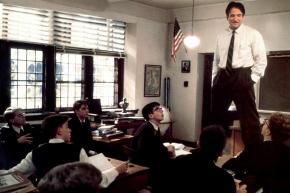
dead-poets-society*580xx936-624-0-45
Scene from Dead Poet’s Society

Over the years I have become more and more aware of how much I was being examined. Sometimes when talking to former students I will ask them what they remember about my classes. I have yet to have a former student tell me it was one of those brilliant lessons (at least I thought so) I had taught. Instead their response to my question is always connected to relationship. Former students would tell me it was most often something I said to a student. I had one former student tell me that it meant the world to him when I told him in school, paraphrased “You’re a lousy student but you are a really nice guy.” He said he appreciated the fact that I still liked him even though he wasn’t the best student. Another student told me that I was one of the teachers that cared; I was one of the teachers that always listened and helped. Now I write this with the risk of sounding vain but the point I am making is that students notice. They notice when you care. They notice when you are kind. They know when you like them or not.

A person does not realize how much they have impacted a student until they receive letters from them. One student wrote, “I haven’t been in this school very long; you were one of my first teachers… During the many classes we had together you made it very enjoyable and you were very understanding when people didn’t have a clue on what you were talking about.” Another student in a “Thank You” card wrote, “Thanks for being a part of my high school career. I know we had our ups and downs, but just know you have made a difference in my life, and every one else’s”. Still another student wrote in a letter, “I would like to start this letter of appreciation to you by saying what a great teacher you are. Whenever I needed help, you would come right over and do your best to help me understand and that goes for the rest of the class too…I feel lucky to be in your classes at school.” My intent here is not to boast but to demonstrate that people notice how you treat them, what you say to them and most importantly your attitudes towards them.

In the 1980s I worked at a summer camp for three years. I was part of a team that planned, organized and implemented the programs. One of the first weeks of camp we did was what was called Counsellors Week. It was the week where we prepared the counsellors for the weeks where they would be working with the 9, 10, 11, 12 and 13 year olds. I just went about doing my duties as a team member and being me. I had no idea how much I had impacted this one counsellor until I received a letter from him a number of weeks later. In the letter he told me that he had watched me during Counsellor’s Week, that I inspired him, and that he wanted to eventually be part of the team at camp so he could emulate me. I had no idea that I had such an impact on this young man. To say that I was shocked when I got the letter is an understatement. The point is people are noticing you even when you are not aware of it.

During a parent teacher interview many years ago, I expressed concern to the parents that I had noticed a change in their child.  I was stunned to learn that the reason for this change was due to something I had said to the child; something the young person took offense to. The choices we make affect others whether we’re aware of it or not.

lg-Eyes-OjosSo always remember that someone is likely seeing you, maybe even looking up to you, and preparing to follow your example. Let this guide your next choice.

We are NOT operating in a void where no one is watching us, that our actions are mostly remote. Someone who admires you will reproduce your every thought, your every word, and your every action? Make your next choice with this in mind. Your choices could impact another person for the rest of their lives. That could be positively or negatively. If you are not sure how to be the kind of person that people look up to, check out, How to be a good person that people look up to.


Political Bullying

I have always had an interest in politics. I taught social studies in high school for years and would passionately discuss politics with my students and give projects to them when election campaigns were on. I’ve even scrutineered once.  For those of you who don’t know what a scrutineer is, in the British and Canadian systems, a scrutineer is an official examiner of votes in an election. There was even a time when I would have seriously considered running for office. I used to think politicians were honourable people and individuals to be admired for their service. Now don’t get me wrong, there are still a few honourable people who are leaders. However, as I watch the politicking of our neighbours to the south, I begin to wonder if honourable and honest people enter politics anymore.

You’re probably wondering why I say such a thing. I was recently watching some of the analysis on CNN regarding the most recent primaries that are happening in the United States. One of the commentators was discussing the insults that were exchanged between Donald Trump and Marco Rubio, two candidates running for the Republican Party nomination for president. Here is an article about what I’m talking about –Us Election 2016. There were insults traded between the two candidates about misspelled tweets, wet trousers, wearing makeup and Trump ridiculing Marco Rubio for his love of drinking water.  Apparently, in a State of the Union response speech in 2013 while on national television Mr. Rubio paused for a sip of water. But what really got me were their exchanges about sweating.

Trump
From BBC.com

According to Business Insider, the exchange apparently happened backstage when they were debating one another. Mr. Rubio insinuated that Trump possibly “wet” himself. “He called me Mr. Meltdown,” Rubio went on to say, “Let me tell you, during one of the breaks — two of the breaks — he went backstage. He was having a meltdown. First he had this little makeup thing, applying makeup around his mustache, because he had one of those sweat mustaches. Then he asked for a full-length mirror. I don’t know why, because the podium goes up to here. Maybe he was making sure his pants weren’t wet. I don’t know.

Trump countered with, “He’s with a pile of makeup putting it on his face, I said Marco, easy with the makeup, you don’t need that much. You know the story with Marco. I watched Marco with this man [Christie]. Where Marco, he was right over here I asked him I said are you okay? He looked like he just came out of a swimming pool. He was a mess.” Anyway, I’m sure you get what I’m talking about.

The first question I have is, Why are they throwing insults when I’m sure the American people want to hear about solutions to the problems the country faces? Donald Trump’s campaign slogan is, “Make America Great Again.” A great slogan I might add. But I seldom hear him telling the American people how he intends to do that. What I typically hear is insults flying and Trump being a bully. The other Republican candidates don’t seem to be a whole lot better. Are these the best candidates that America has to offer, candidates throwing insults at one another? Granted, it might be entertaining, but really it’s bullying. No wonder our society has a bullying problem. When I vote, I vote for those candidates that reflect my values, but even more because they’ve explained what they will do to make their country better.

Canada is not immune to such antics. During the last 2015 Federal Election in Canada, the then reigning Conservative government placed ads in local newspapers and flyers, questioning whether Justin Trudeau, Canada’s current Prime Minister, shares their values. The ads tried to foster fear that a Liberal government would legalize marijuana, “making access easier for kids.” The ad warns there would be legal drug-injection sites in our neighbourhoods and that prostitution would be legalized, “putting brothels in our communities.” The Conservative Party attack ad finishes with, “Those aren’t our values either. Vote for your values.”  They were twisting the truth. Mr. Trudeau did make a campaign promise to legalize marijuana, but he never explicitly said he would legalize prostitution or drug injection sites. That was only Conservative fear mongering.

TrudeauOf course there was the long running television ads attacking Mr. Trudeau’s credibility saying, “He’s just not ready” to be prime minister. The Liberal Party of Canada is also guilty of attack ads. In 2006  then Liberal Party Leader Paul Martin approved a controversial ad suggesting the Tories would post armed soldiers on the streets of Canadian cities. During the last weeks of the campaign, the Liberals resorted to negative ads directed towards the Conservative party, attempting to depict its leader Stephen Harper as an extreme right-wing politician. The most controversial ad said, “Stephen Harper actually announced he wants to increase military presence in our cities. Canadian cities. Soldiers with guns. In our cities. In Canada.”
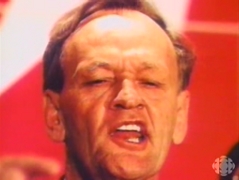
Chretien_AdHistorically, one that stands out for me was the 1993 Progressive Conservative Party attack on then Liberal leader Jean Chretien, who was elected as Prime Minister that year. The ad showed a picture (on left) of Mr. Chretien saying,”Is this a Prime Minister?” This ad was interpreted as mocking Chretien’s slight deformity and speech impediment that were leftover from a childhood case of Bell’s Palsy.  This is a condition where paralysis of the facial nerves occur, causing muscular weakness in one side of the face. To me, that was a “low blow.” That was “hitting below the belt.”

Why does politics have to be about attacking another’s character? Most people I have talked to express how repugnant this type of politicking is. I’m grateful that Canada’s present Prime Minister, Justin Trudeau, did not run any attack ads during the 2015 election and does not resort to bullying to achieve his goals. In fact, in October of 2015 on CTV’s Canada AM Mr. Trudeau said,“I don’t believe in attack ads. I think they hurt your ability to govern and my capacity to stay positive and focused on our platform.” I say kudos to Canada’s Prime Minister. It is time to get back to what I call honourable politicking, where politicians put forth their platforms for making their country great. It’s time to bring honour and respect back to politics.  Time to give us politicians who have creative new ideas, who aren’t bullies, and who want to lead because they want to make a difference in this world. It is a sad state of affairs when the only potential leaders that step forward are bullies who attack their opponents. Enough already!

Adventures with Mother Nature

Every summer since 2002, starting when my son was 8 years old, my son and I have taken hiking excursions to the Canadian Rockies. Traditionally, we go with my brother-in-law and his two sons. Sometimes my brother and his son would join us as well as a friend and his two sons at the beginning. These excursions entail carrying 40-pound backpacks containing food and cooking equipment, sleeping gear and a tent. On some occasions we carried our 40-pound packs 14 kilometres (8.7 miles) before reaching our destination.

Most hikes were to the backcountry, a remote undeveloped rural area accessible only by hiking trails. We would hike to places such as Landslide Lake, Ribbon Lake, Lillian Lake, Utopia Creek, Glacier Lake, and Celestine Lake to name a few. I realize that these names likely don’t mean much to many of you but I can assure you that these settings are some of the most breath-taking, beautiful scenery in the world.

hiking 04 fishing
Lillian Lake

We’ve had some adventures over the years. In what is called Kananaskis Country, we did a day hike to Ribbon Falls after a good night’s rest at the Ribbon Lake campground. To reach our destination, we had to maneuver down a vertical cliff. Thankfully, there were chains attached to help a person propel downward. By carefully finding footholds and hanging onto the chains we successfully got to the bottom part of the cliff. Being that I am afraid of heights, this was a terrifying experience for me. Climbing up the cliff was much easier.

After hiking the Galatea Creek Trail, also in Kananaskis Country, and arriving at our destination of Lillian Lake we put our backpacks down and went to scout out a site to set up our tents. Several minutes went by before we returned to collect our equipment to take to our chosen site. To our dismay, we discovered a chipmunk chewing its way through the top of my son’s brand new pack which I had just purchased for my son. In fact, this was his first trip with it. The chipmunk had chewed a hole into the top of the pack in an attempt to get at the trail mix inside. I was not happy with that animal and yelled some choice words at the creature. Thankfully the little beast was not successful in retrieving any of the trail mix.

Hinton Jasper 277
Geraldine Lake trail (boulder hoping)

One of the most difficult hikes we’ve done was to Geraldine Lakes in Jasper National Park. It involved a very steep climb beside the waterfalls between Lower and Upper Geraldine Lakes where you come to kilometres of boulder hopping across what is called talus field. To say it was exhausting hopping from boulder to boulder carrying a 40 pound backpack is an understatement. At one point I was feeling sorry for myself asking, “Why am I doing this?” Thinking that I was getting too old for this hiking business (I was in my 40s), we came upon a fellow hiker in his 70s. He told us that Geraldine Lakes was one of his favourite trails and that he had hiked the trail many times. I needed an attitude adjustment at that point and my outlook changed after talking to the senior hiker. If a 70-year-old man can hike that trail, I had nothing to complain about being I was 30 years younger than this man. It’s all about your mental attitude. Being in shape, of course, helps.

One of my favourite hiking experiences was our hike to Utopia Creek in Jasper National Park. There were eleven of us on that expedition. On the Saturday evening we decided to take a different trail back so that we could climb up to what is called the Sulphur Skyline, which has some of the most breathtaking panoramas in Jasper National Park. This meant hiking the Fiddle River 11 kilometre horse trail from our campsite, then going up a 700 metre (2300 feet)  elevation gain of about 2 kilometres (1.2 miles) to reach the skyline. The trailhead had a sign saying, “Trail not recommended,”  but this didn’t stop us. What we did not realize is that we had the cross the Fiddle River not once, not twice but six times.

On our first crossing we carefully hopped across the river from boulder to boulder with our backpacks on until the last bit whereby we took our packs off, tossed them a fair distance to another person on the riverbank and then hopped onto the bank ourselves. Thankfully no one fell into the water and our packs remained dry.

During the second crossing we decided to take our hiking boots off, put on our sandals and cross the river in our sandals. The current was strong and the glacier water literally made my feet hurt.

Now the third crossing was done in our bare feet. By this time the ritual of taking off our boots was becoming burdensome, so when we had to cross the river on the fourth, fifth and sixth occasion we just kept our boots on. The current was strong so there were times when I had to hang onto my son, age 12 at the time, to prevent him from being swept downstream by the current. We stopped at a trailhead leading to Mystery Lake to ring out our wet socks and dried our boots as best we could. We eventually made it to the Sulphur Skyline with one of the most spectacular views I have ever had the privilege to appreciate. The chipmunks on top of the skyline were brave creatures as they would come right up to your fingertips looking for food.

In 2009, nine of us spent three hours hiking the 7 kilometre (4.3 mile) trail to Celestine Lake in Jasper National Park. A friend of mine and I were the last to arrive at our campsite as the younger ones of the group were much quicker than us older ones. What made this adventure so memorable was the fact that when my friend and I arrived at the campsite, we were told that we had to go back as there was a forest fire nearby. Now we didn’t believe them, of course, until we saw the warden’s helicopter take off. Apparently, the park warden arrived in a chopper and called to my brother in law saying, “I have some bad news guys. You have to leave as there is a fire in the area.” So it turned out that we were told the truth. We had to spend the next three hours returning to our starting point.

2013-07-13 01.19.38Now I have been asked over the years why I would go into the back country where there is no contact with the outside world; where there are bears and cougars and it can sometimes get to below freezing at nights. Those are good questions. My first response to those questions is always that it is quality time with my son. But it is more than that. I do it for the adventures. There is nothing like being in nature and the experience of standing on top of mountain with the wind blowing through your hair. The beauty that Mother Nature has to offer is far-fetched until you see it, and even then it can be surreal. For me, being in the wilderness is a chance to touch the divine. It is during those times that I feel closest to God or the Universe.

According to the article, How Does Nature Impact our Wellbeing, put out by the University of Minnesota,

“Being in nature, or even viewing scenes of nature, reduces anger, fear, and stress and increases pleasant feelings. Exposure to nature not only makes you feel better emotionally, it contributes to your physical wellbeing, reducing blood pressure, heart rate, muscle tension, and the production of stress hormones. It may even reduce mortality, according to scientists such as public health researchers Stamatakis and Mitchell.”

Maybe that’s why I do it. Without knowing why, it made me feel better. So, go out into nature and reduce your stress. Speaking from experience it works. It is so easy to get so wrapped up in our daily urban lives that we forget what nature has to offer. Visit Mother Nature to de-stress. When you do you will discover that she is worth protecting.