Someone is Watching You

I regularly receive emails from various websites. Most of them are emails containing inspirational quotes or sayings; basically emails that encourage us to be better human beings. I recently received this one.

Remember that someone is looking up to you now, preparing to follow your example. Let this guide your next choice.

We often think that we are operating in a vacuum, that no one is watching us, that our actions are mostly private. Yet, what if you knew that your every thought, word, and deed today was going to be imitated by one who admires you?

I’ve been pondering on this email for a while now. Being in the teaching profession for 35 years I know unreservedly what being watched is like. Whether we teachers like it or not, we are always being watched by our students and their parents. It is a rare occurrence for me to not be seen by a former student of mine when out in public. It is not unusual to have some young person from the school I taught at in my community to yell out to me with a greeting or to wave at me when I am out and about in the community. It was also common to have a student, when I was still teaching, come up to me and tell me that they saw me in some store or walking on the street, or some such thing. As a teacher, you are always in the public eye. Now I admit, I have always had struggles with this. I sometimes avoided attending community events because of it. It has also given me a much greater compassion for our political leaders, entertainers, sports stars and other people who are even under more scrutiny by the public.

I often think of celebrities and how difficult it must be for them. Not only do random strangers notice them, but many of them are constantly followed by the Paparazzi. There is a reason that LAX is providing a new option for Hollywood celebrities looking to skirt airport paparazzi. The article states LAX is set to approve plans to convert a cargo office into a small new terminal that will allow passengers to drive into a secluded entrance, get screened by the Transportation Security Administration privately and be driven across the airfield straight to the stairs to board their flights.

In August of 2015, Buckingham Palace issued an appeal to world media not to publish unauthorized images of two-year-old Prince George, the elder child of Prince William, Duke of Cambridge, and Catherine, Duchess of Cambridge. He is third in line to succeed his paternal great-grandmother, Queen Elizabeth II, after his paternal grandfather Charles, and his father, William. (see Prince George harassed)

The palace says in recent months, photographers have done such things as used long-range lenses to photograph the Duchess of Cambridge playing with her son in private parks, have monitored the movements of Prince George and his nanny around London parks, as well as observed movements of other household staff, pursued cars leaving family homes, and used other children to draw Prince George into view around playgrounds. Whether people are a member of a Royal family, a Hollywood celebrity, or politician, these people have a right to privacy, although I am certain that they are all very aware that they are in the public eye.
dead-poets-society*580xx936-624-0-45
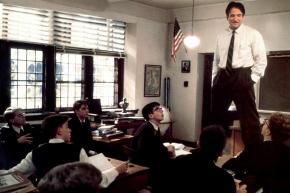
Scene from Dead Poet’s Society

Over the years I have become more and more aware of how much I was being examined. Sometimes when talking to former students I will ask them what they remember about my classes. I have yet to have a former student tell me it was one of those brilliant lessons (at least I thought so) I had taught. Instead their response to my question is always connected to relationship. Former students would tell me it was most often something I said to a student. I had one former student tell me that it meant the world to him when I told him in school, paraphrased “You’re a lousy student but you are a really nice guy.” He said he appreciated the fact that I still liked him even though he wasn’t the best student. Another student told me that I was one of the teachers that cared; I was one of the teachers that always listened and helped. Now I write this with the risk of sounding vain but the point I am making is that students notice. They notice when you care. They notice when you are kind. They know when you like them or not.

A person does not realize how much they have impacted a student until they receive letters from them. One student wrote, “I haven’t been in this school very long; you were one of my first teachers… During the many classes we had together you made it very enjoyable and you were very understanding when people didn’t have a clue on what you were talking about.” Another student in a “Thank You” card wrote, “Thanks for being a part of my high school career. I know we had our ups and downs, but just know you have made a difference in my life, and every one else’s”. Still another student wrote in a letter, “I would like to start this letter of appreciation to you by saying what a great teacher you are. Whenever I needed help, you would come right over and do your best to help me understand and that goes for the rest of the class too…I feel lucky to be in your classes at school.” My intent here is not to boast but to demonstrate that people notice how you treat them, what you say to them and most importantly your attitudes towards them.

In the 1980s I worked at a summer camp for three years. I was part of a team that planned, organized and implemented the programs. One of the first weeks of camp we did was what was called Counsellors Week. It was the week where we prepared the counsellors for the weeks where they would be working with the 9, 10, 11, 12 and 13 year olds. I just went about doing my duties as a team member and being me. I had no idea how much I had impacted this one counsellor until I received a letter from him a number of weeks later. In the letter he told me that he had watched me during Counsellor’s Week, that I inspired him, and that he wanted to eventually be part of the team at camp so he could emulate me. I had no idea that I had such an impact on this young man. To say that I was shocked when I got the letter is an understatement. The point is people are noticing you even when you are not aware of it.

During a parent teacher interview many years ago, I expressed concern to the parents that I had noticed a change in their child.  I was stunned to learn that the reason for this change was due to something I had said to the child; something the young person took offense to. The choices we make affect others whether we’re aware of it or not.

lg-Eyes-OjosSo always remember that someone is likely seeing you, maybe even looking up to you, and preparing to follow your example. Let this guide your next choice.

We are NOT operating in a void where no one is watching us, that our actions are mostly remote. Someone who admires you will reproduce your every thought, your every word, and your every action? Make your next choice with this in mind. Your choices could impact another person for the rest of their lives. That could be positively or negatively. If you are not sure how to be the kind of person that people look up to, check out, How to be a good person that people look up to.


Adventures with Mother Nature

Every summer since 2002, starting when my son was 8 years old, my son and I have taken hiking excursions to the Canadian Rockies. Traditionally, we go with my brother-in-law and his two sons. Sometimes my brother and his son would join us as well as a friend and his two sons at the beginning. These excursions entail carrying 40-pound backpacks containing food and cooking equipment, sleeping gear and a tent. On some occasions we carried our 40-pound packs 14 kilometres (8.7 miles) before reaching our destination.

Most hikes were to the backcountry, a remote undeveloped rural area accessible only by hiking trails. We would hike to places such as Landslide Lake, Ribbon Lake, Lillian Lake, Utopia Creek, Glacier Lake, and Celestine Lake to name a few. I realize that these names likely don’t mean much to many of you but I can assure you that these settings are some of the most breath-taking, beautiful scenery in the world.

hiking 04 fishing
Lillian Lake

We’ve had some adventures over the years. In what is called Kananaskis Country, we did a day hike to Ribbon Falls after a good night’s rest at the Ribbon Lake campground. To reach our destination, we had to maneuver down a vertical cliff. Thankfully, there were chains attached to help a person propel downward. By carefully finding footholds and hanging onto the chains we successfully got to the bottom part of the cliff. Being that I am afraid of heights, this was a terrifying experience for me. Climbing up the cliff was much easier.

After hiking the Galatea Creek Trail, also in Kananaskis Country, and arriving at our destination of Lillian Lake we put our backpacks down and went to scout out a site to set up our tents. Several minutes went by before we returned to collect our equipment to take to our chosen site. To our dismay, we discovered a chipmunk chewing its way through the top of my son’s brand new pack which I had just purchased for my son. In fact, this was his first trip with it. The chipmunk had chewed a hole into the top of the pack in an attempt to get at the trail mix inside. I was not happy with that animal and yelled some choice words at the creature. Thankfully the little beast was not successful in retrieving any of the trail mix.

Hinton Jasper 277
Geraldine Lake trail (boulder hoping)

One of the most difficult hikes we’ve done was to Geraldine Lakes in Jasper National Park. It involved a very steep climb beside the waterfalls between Lower and Upper Geraldine Lakes where you come to kilometres of boulder hopping across what is called talus field. To say it was exhausting hopping from boulder to boulder carrying a 40 pound backpack is an understatement. At one point I was feeling sorry for myself asking, “Why am I doing this?” Thinking that I was getting too old for this hiking business (I was in my 40s), we came upon a fellow hiker in his 70s. He told us that Geraldine Lakes was one of his favourite trails and that he had hiked the trail many times. I needed an attitude adjustment at that point and my outlook changed after talking to the senior hiker. If a 70-year-old man can hike that trail, I had nothing to complain about being I was 30 years younger than this man. It’s all about your mental attitude. Being in shape, of course, helps.

One of my favourite hiking experiences was our hike to Utopia Creek in Jasper National Park. There were eleven of us on that expedition. On the Saturday evening we decided to take a different trail back so that we could climb up to what is called the Sulphur Skyline, which has some of the most breathtaking panoramas in Jasper National Park. This meant hiking the Fiddle River 11 kilometre horse trail from our campsite, then going up a 700 metre (2300 feet)  elevation gain of about 2 kilometres (1.2 miles) to reach the skyline. The trailhead had a sign saying, “Trail not recommended,”  but this didn’t stop us. What we did not realize is that we had the cross the Fiddle River not once, not twice but six times.

On our first crossing we carefully hopped across the river from boulder to boulder with our backpacks on until the last bit whereby we took our packs off, tossed them a fair distance to another person on the riverbank and then hopped onto the bank ourselves. Thankfully no one fell into the water and our packs remained dry.

During the second crossing we decided to take our hiking boots off, put on our sandals and cross the river in our sandals. The current was strong and the glacier water literally made my feet hurt.

Now the third crossing was done in our bare feet. By this time the ritual of taking off our boots was becoming burdensome, so when we had to cross the river on the fourth, fifth and sixth occasion we just kept our boots on. The current was strong so there were times when I had to hang onto my son, age 12 at the time, to prevent him from being swept downstream by the current. We stopped at a trailhead leading to Mystery Lake to ring out our wet socks and dried our boots as best we could. We eventually made it to the Sulphur Skyline with one of the most spectacular views I have ever had the privilege to appreciate. The chipmunks on top of the skyline were brave creatures as they would come right up to your fingertips looking for food.

In 2009, nine of us spent three hours hiking the 7 kilometre (4.3 mile) trail to Celestine Lake in Jasper National Park. A friend of mine and I were the last to arrive at our campsite as the younger ones of the group were much quicker than us older ones. What made this adventure so memorable was the fact that when my friend and I arrived at the campsite, we were told that we had to go back as there was a forest fire nearby. Now we didn’t believe them, of course, until we saw the warden’s helicopter take off. Apparently, the park warden arrived in a chopper and called to my brother in law saying, “I have some bad news guys. You have to leave as there is a fire in the area.” So it turned out that we were told the truth. We had to spend the next three hours returning to our starting point.

2013-07-13 01.19.38Now I have been asked over the years why I would go into the back country where there is no contact with the outside world; where there are bears and cougars and it can sometimes get to below freezing at nights. Those are good questions. My first response to those questions is always that it is quality time with my son. But it is more than that. I do it for the adventures. There is nothing like being in nature and the experience of standing on top of mountain with the wind blowing through your hair. The beauty that Mother Nature has to offer is far-fetched until you see it, and even then it can be surreal. For me, being in the wilderness is a chance to touch the divine. It is during those times that I feel closest to God or the Universe.

According to the article, How Does Nature Impact our Wellbeing, put out by the University of Minnesota,

“Being in nature, or even viewing scenes of nature, reduces anger, fear, and stress and increases pleasant feelings. Exposure to nature not only makes you feel better emotionally, it contributes to your physical wellbeing, reducing blood pressure, heart rate, muscle tension, and the production of stress hormones. It may even reduce mortality, according to scientists such as public health researchers Stamatakis and Mitchell.”

Maybe that’s why I do it. Without knowing why, it made me feel better. So, go out into nature and reduce your stress. Speaking from experience it works. It is so easy to get so wrapped up in our daily urban lives that we forget what nature has to offer. Visit Mother Nature to de-stress. When you do you will discover that she is worth protecting.


Judge Not!

Now that I have some time, I spend some time perusing the internet reading interesting articles.  I recently read an article titled, We’re all the Same.  Basically, the article says we as humans are quick to judge others.  It makes bold statements like:

  • Let’s face it. We all do it. We judge.
  • We like to label others and shove them into this box.
  • We don’t like ”undefined” people.
  • We assume we know who someone is based on our interactions and observations.
  • Judging makes us feel safe and comfortable.
  • It gives us a sense of control.
  • But despite our best efforts to judge, we all know deep down inside, we can’t and shouldn’t really judge another person.

Now my initial reaction was, “Not me!  I don’t judge people.”  But who am I kidding?  So I thought about it.  Do I judge others or not?  If I am honest with myself, the answer of course is “Yes”.

The year 2015 was a year of change for my wife and I.  I retired from teaching.  My eldest daughter moved to a different apartment which is closer to her work.  My youngest daughter returned to university, so she is moved back to the city after living in the rural community she grew up in.  And my son, who has been going to the local college, is moved to the city to continue his education at university.  My wife is the only stable one (in more ways than one) as she is continuing with the same job.

JudgeSo a few months ago, my wife and I were helping our eldest daughter find furniture for her new apartment.  She had been getting some used stuff off of Kijji, an online garage sale site.  She had looked at a media unit with an electric fire-place and decided to purchase it.  She gave the young man $40 to hold it, and arranged to pick it up when I could bring up the truck. On a Saturday morning we arrived at this person’s apartment complex at the agreed upon time only to find that he was not there.  My daughter texted him and called him only to discover his voice mail box was full. Being the Dad that I am, I immediately jumped to conclusions. As far as I was concerned this guy had ripped off my daughter.  My daughter and wife, on the other hand, kept reminding me that maybe he had a family emergency or something.  I, on the other hand, was convinced that he had swindled my daughter out of  $40.  After an hour of waiting and me “steaming” we left and continued with our day.

Now it turns out that this fine, young man did indeed have a family emergency. His explanation to my daughter alluded to perhaps a death in the family.  This man felt very bad about the incident and returned my daughter’s $40 to her.   I had totally misjudged the situation and the young man involved.  Now I am the one feeling bad and guilty that I had so little faith in people. This was not the only time recently that I had jumped to conclusions and misjudged a situation.

As I mentioned earlier, I just retired from teaching.  The school that I worked at submits a weekly newspaper column in the local papers.  Well, at the end of June, I was all “bent out of shape” because my school (so I thought) did not even care that I was leaving after 26 years of service. They didn’t even have the decency to acknowledge my exit in the school column.  I was feeling sorry for myself.  I had convinced myself that my colleagues didn’t even care that I was leaving.

The next week the local papers arrived at our house and I my wife pointed out that I, and the other colleagues that retired with me, were acknowledged in the school column.  Lesson learned (I hope); Do not be so quick to judge people and situations. Once again, I felt bad and guilty that I  had so little faith in my colleagues. I know I could just blame it on “human nature”, but that is still not an excuse.

As a former school teacher I can recall numerous occasions where I prejudged students based on hearsay around the staffroom, only to discover that my experiences with those students were different from the prejudgements. It is so important to resist judging.

So, what is wrong with judging? I’m sure someone is wondering. The late Earl Nightingale, an American radio personality, writer, speaker and author who dealt mostly on the subjects of human character, once said, “When you judge others, you do not define them, you define yourself.” That is so true! Judging others is about our need to feel safe and comfortable. When we judge others we feel better about ourselves because judging others occurs when we believe we are better than the people we’ve judged. Really, we have no right to judge anyone unless we know everything about that person, which is impossible. There is a native American proverb that says, Don’t judge any man until you have walked two moons in his moccasins.” As I learned from my experience with the young man who I believed conned by daughter out of $40, you never really know what is going on in that person’s life, so as in my case, most often our judgements are based on ignorance or misinformation.

So remember, things are not always what you perceive them to be or believe them to be.  Don’t be so quick to judge a situation. Michael J. Fox, best known for his role as Marty McFly in the Back to the Future movie trilogy, once said,  The least amount of judging we can do, the better off we are.” He is right! I am going to try to follow Fox’s advice from now on, or at least that is the goal.

What to believe?

Napoleon Bonaparte was once reported to have said, “History is the version of past events that people have decided to agree upon.”   George Kitson Clark once said, “No historian should be trusted implicitly.”  Norman Pearson is quoted as saying, “To look back upon history is inevitably to distort it.” There was a time whenever I read something in a history book or was taught something in a history class, I believed it to be the “Gospel truth.”  Now being older and wiser I no longer do.  So why would I say that?

imagesI recently read a book titled, Inconvenient Indian by Thomas King. What surprised me, was that Mr. King claims that the massacre that allegedly occurred at the Alamo was a fabrication, a story created over the years. But that is not what history says.

I did some internet research and Wikipedia says this about the Alamo massacre: “In the early morning hours of March 6, 1866,  the Mexican Army advanced on the Alamo. After repulsing two attacks, the Texans were unable to fend off a third attack… Between five and seven Texans may have surrendered; if so, they were quickly executed. Most eyewitness accounts reported between 182 and 257 Texans died, while most historians of the Alamo agree that around 600 Mexicans were killed or wounded.”  I checked other websites which say more or less the same thing. So who is right?

Mr. King also says, the story about Pocahontas and John Smith, perpetrated by Disney’s movie Pocahontas  is also a myth, or in other words a fabricated story. He claims that John Smith would have been 24 years old and Pocahontas maybe 10 or 12 years old at best.

Now Disney’s version of the story is one of romance between an American Indian woman named Pocahontas and John Smith, who journeyed together to the New World with other settlers to begin new lives.  Do the children, or even adults for that matter, who have watched this movie believe they have watched a historically accurate depiction of events of the past?  Probably.  My experience as a teacher has been most young people think what they see in movies and on television is truth or is real history. At least Wikipedia sets the record straight about the story of Pocahontas as it says, “In a well-known historical anecdote, she [Pocahontas] is said to have saved the life of an Indian captive, Englishman John Smith, in 1607 by placing her head upon his own when her father raised his war club to execute him. The general consensus of historians is that this story, as told by Smith, is untrue.”  So we know Mr. King is likely right about the Pocahontas story.

In July of 2007 while on a family trip to Eastern Canada,  we visited the Maritime Museum of the Atlantic in Halifax, NS. At that time there was an exhibition on pirates. It was interesting to learn that commonly held belief that pirates make their enemies walk the plank as well as the belief that  pirates often have parrots on their shoulders are myths. We learned that these are myths. There apparently is no historical evidence to support these commonly held beliefs about pirates. Also, the wide held belief that pirates buried their treasures is also a myth. I guess I was somewhat disappointed to learn about these untruths as I always thought pirates did bury their treasures.

So what else have we been taught that is NOT a historical truth?  According to the article, Facts Prove Everything You Thought You Knew About History… Is Dead Wrong, Christopher Columbus did not discover America. He only discovered the Caribbean Islands.  I don’t know about you, but I was taught in school that Columbus discovered America.  It has been proven that the Vikings were in North America before Columbus as there is an archeological site at the northern tip of Newfoundland where they discovered the remains of the Viking’s houses. In fact, they reconstructed a replica of the settlement about 100 yards away from the site. It has been unquestionably determined that the Vikings were there for about 10 years, specifically, Leif Erikson and his extended family. I guess I can erase that untruth from my memory.

Dictonary.com defines the “Napoleon complex” as the condition of being small in stature but aggressively ambitious and seeking absolute control. It could just as easily be called the “Short Man Syndrome.” In other words, this complex is named after Napoleon Bonaparte because of the widely held belief that Napoleon was short. But according to the 16 facts article I referred to earlier, the truth is Napoleon Bonaparte was not short at all. He was five feet, seven inches. That was slightly taller than average for a Frenchman at the time. Another historical inaccuracy to erase from memory.

The idea that Albert Einstein failed math in school is an urban myth (see 20 things you need to know about Einstein). It turns out that Einstein didn’t fail math in school, it was a false claim published by Ripley’s. The truth be known is that when he was 15, he mastered differential and integral calculus which makes sense since he is widely held as one of the world’s few geniuses.

Then there is the History Channel series called Hunting Hitler that proposes that Hitler faked his own death, escaped through the Berlin underground to an airport, flew to Spain where he was smuggled onto a U-boat and taken to Argentina with a stop at the Canary Islands. He then lived hidden in the Argentina jungles and was eventually seen in Brazil and Columbia. Now I was always taught that Adolf Hitler committed suicide in his bunker in Berlin in 1945 although this apparently has never been confirmed. Now I must say after watching eight episodes and considering the evidence provided, I am now thinking what I’ve been taught about Hitler is wrong. I am now leaning towards the premise that Hitler did not die in his bunker in 1945.

Louis_RielIn Canada, history has always taught that Louis Riel, a Canadian Métis trailblazer, who led two resistance movements against the Canadian government and its first prime minister, Sir John A. Macdonald was a traitor. He was a traitor because he led two rebellions known as the Red River Rebellion of 1869–1870 and North-West Rebellion of 1885. In July of 1885 Riel was charged with treason. Riel was publicly executed by way of hanging in November of 1885. Since that time, the majority of Canadians have held the belief and been taught in school that Louis Riel was a trouble maker; someone who betrayed Canada which is why he was hung for treason. This is what I was taught in school and I have always believed that he was an insane traitor of Canada.  Ironically, on March 10, 1992, the Parliament of Canada passed a unanimous resolution that named Louis Riel as founder of the Province of Manitoba, because of his role in defending the interests of the Métis people and contributing to the political development of Western Canada.  So what is the truth?  Was he a traitor or was he one of Canada’s founders?  Personally, I now side with Riel as a hero who was willing to stand up to the government of the day for the rights of his people; the Métis people.

So what is a person to believe?  Should we trust what we read in the history books or what we see on the History Channel? I think not.  We must at the very least be skeptical. It is interesting how a person can grow up learning about historical events only to discover later in life that those events are untruths, or at least they have been exaggerated.  Having taught Social Studies for years, I have always taught my students to be skeptical.  History involves interpretation of the events that occurred in the past.  Therefore, interpretations can be slanted, exaggerated, and falsified.   To quote the Roman poet Phaedrus, “Things are not always what they seem; the first appearance deceives many; the intelligence of a few perceives what has been carefully hidden.” Things are seldom what we’ve been led to believe. I guess now I have become a bit of a skeptic.

Europe Then and Now

Since returning from our trip abroad, my wife and I have been asked numerous times what we found different in Europe compared to our first time over there which was 26 years ago. Our gut response is always to say, “It pretty much looks the same as it did last time we were there.”  Now that is the truth.  It still looks pretty much as it did in the 1980s.  Most of the buildings still look very old and the majority of the streets are still very narrow. However, if there is one thing that was noticeably different was the amount of English around.

When I taught Social Studies, we used to discuss the  question, Is English becoming a universal language? when teaching about how globalization is changing the world.  For me, it was interesting to see if what I taught was indeed truth.  According to the article, 10 Reasons why English is the World’s Language, some of  the reasons why English is considered by some to be, or at least on its way to being, a universal language are:

  1. English is the language of business & finance
  2. Hollywood is the capital of film-making and many foreign actors have had to learn to speak English to work in Hollywood.
  3. If you want to make in the international music arena, you must be able to sing in English.
  4. English is the language of travel. English is the language used when the local hotel, restaurant or retail staff members communicate with foreigners and visitors.
  5. English is the unofficial language of the internet. There are billions upon billions of websites on the Internet nowadays, and it’s estimated that more than half of the entire online material is published in English.
  6. The influence of the United States and the United Kingdom, two very influential English-speaking world players.

Kevin & Marilyn - 1557 of 2668Now this all makes sense to me, but I know when I was teaching this stuff I wondered if it really was that way.  Well I can tell you after returning from Europe, I have to say that I believe there is truth in these arguments.  Allow me to share some of my observations.  When we were in the airports and train stations I noticed the signage would have the language of the country we were in written first, with English written underneath. We were in airports in Athens (Greece), Rome (Italy), Paris (France) Istanbul (Turkey) and Warsaw (Poland).  This was the case in every one of those airports.  I don’t recall that being the case 26 years ago.  Announcements in the airports were also in both the language of the country and in English.  This was also the case for most train stations and we were in many, many train stations throughout Italy and France.

Before leaving for Europe, we prepared by downloading a translator app, and then we inputted and saved numerous phrases that we thought would be necessary when over in Italy, France and Greece.  We did not need to use this app once when talking to people.  Almost everyone we talked to in France, Italy, the Turkish airport, the Polish airport and in Greece spoke fluent English, although with an accent. We were most surprised when we found an English speaking waitress in the Warsaw airport.The only time we used the translator app was when looking at ingredients in a supermarket.

IMG_2491As for the restaurants, no matter what country we were in, most of the staff spoke English.  Not only that, almost every restaurant we ate at had menus in English.  Often they would have the Greek or Italian or French first with the English written underneath.

My wife and I drove in northern France. One day we decided to see what was on the radio, so we turned on the radio only to be pleasantly surprised to hear a song we recognized; a pop song in English.  As soon as the song was finished, we were astonished to hear the disk jockey speak in French.  It struck me as odd; as “out of sink”; as not fitting.  This certainly does suggest that much of the world’s popular music is indeed sung in English.

IMG_2857Another noticeable difference from the 1980s was the number of signs you see in English.  In all three of the countries we visited; France, Italy and Greece, you would see store or company signage in both the language of the country we were in and in English. Often it would be Greek (or Italian or French) on some businesses and English on others. Many of the directions for toilets, exits, or tourist sites would also have English on them.

Another topic I often discussed with my students was; Was the world  becoming more homogenized  (more the same) because of globalization?  I certainly saw evidence of this as well.  The youth in Europe for the most part wore blue jeans just as the youth in North America do.  This was not only true of the youth. The hair styles of the youth were the same styles you would see on North American youth. Then there is the cell phones.  Everyone appears to have one and be on it just like in North America. Whether we were on the Metro, on a bus, in a museum or walking down a street, you would see people texting or talking on their cell phones.This certainly suggests homogenization to me.

It was not unusual to see stores or products from the same corporations in European cities that you would see in North American cities.  I noticed many MacDonald’s restaurants, Burger King, Shell gas stations, Esso gas stations, and clothing stores such as Abercrombie & Fitch and the Gap.  I also noticed Apple Stores, Starbucks coffee, and Disneyland Paris.  There were Coca Cola and/or Pepsi signs every where. I’m sure I missed a few companies that operate in the European Union. This also advocates for the homogenization argument.  We went into one store in Greece only to discover that much of clothing they sold had American cities written on them or some  saying written in English.

IMG_3061I have mixed feelings about these changes that I’ve observed.  Regarding English as perhaps a universal language, that is great for those of us that English is our first language, or in my case the only language.  I guess I should be grateful that the language I was born into is being spoken in most parts of the world. After all, it makes travelling much less stressful.  What bothers me is the possibility that the world is becoming more and more the same culturally.  This saddens me because the point of travel for me at least is to experience the cultural diversity in the world.  I fear that as globalization continues to take hold, diversity will be lost.  The fact that youth in Europe and North America dress the same is evidence of this.  The truth that you see many of the same companies in the European Union as you do in North America suggests the world is indeed becoming more and more alike.  Like anything else there are always pros and cons.  I do hope that the various cultures of the world will be able to resist globalization enough so that they will continue to exist as a unique culture of the world. Variety makes the world more interesting.  If all countries of the world become more and more alike, then won’t that make for a boring world?

We Shall Never Forget!

As I’ve mentioned in my first Remembrance Day post, November 11th is an important day to observe as it marks the anniversary of the official ending of World War I. That war ended on the 11th hour of the 11th day of the 11th month thus explaining why Remembrance day is November 11th.  When in France recently, my wife and I visited the Normandy D-Day beaches. In case you don’t know the significance of those beaches, here is a history lesson.

On D-Day, June 6, 1944, “Operation Overlord”, the allied invasion of Nazi-occupied Europe started at 06:30. The target was an 80 kilometre (50-mile) stretch of the Normandy coast, which was divided into five sectors: Utah, Omaha, Gold, Juno and Sword Beach. The Utah and Omaha sectors would be assaulted by the American Army, Gold and Sword beaches by the British troops and Juno beach by the Canadians. We visited the British, Canadian and American beaches. The success of Operation Overlord was a turning point in World War II and led to the liberation of Europe and the defeat of Nazi Germany.

IMG_3091In regards to the Canadian mission, fourteen thousand young Canadians stormed Juno Beach on D-Day. The landings initially encountered heavy resistance from the German Division as well as Canadian soldiers faced mined beach obstacles. They also discovered upon their landing on the beach that the preliminary bombardment proved less effective than had been hoped, and rough weather forced the first wave to be delayed until 07:35. The Canadians took heavy casualties in the opening minutes of the first wave. Since they had strength of numbers, as well as fire support from artillery and armoured squadrons, the Canadian forces cleared most of the coastal defenses within two hours of landing.

IMG_3155The fighting they endured was fierce and frightening. The price the Canadians paid was high. The battles to take control of the beachhead cost 340 lives and another 574 wounded. John Keegan, distinguished British historian who wrote Six Armies in Normandy, stated the following concerning the Canadian 3rd Division on D-Day: “The opposition the Canadians faced was stronger than that of any other beach save Omaha. That was an accomplishment in which the whole nation could take considerable pride.”

It was very surreal to stand on Juno beach, knowing what happened on that beach 71 years ago. I knelt on the sand, ran the sand through my fingers as I thought about the D-Day invasion and what our troops endured that day. I toured the Nazi bunkers that are still there and envisioned how the Nazis would have operated. One of the most emotional moments at Juno Beach was during the video the museum showed at the end; a video titled, “They walk with us”.  It consisted of newsreel footage of the D-Day assault and ends with a father and mother walking down present day Juno beach discussing what happened there with their two children. I’ll say no more other than it affected both my wife and I deeply.

My wife and I also visited Pointe du Hoc located in between the two American beaches of Utah and Omaha. To understand the significance of this place, here is a history lesson.

IMG_3294
Pointe du Hoc lies 6.4 kilometres (4 miles) west of the center of Omaha Beach. As part of the Atlantic Wall fortifications, the prominent cliff top location was the most fortified part of the beaches by the Germans.

The American assault force was carried in ten landing craft with another two carrying supplies. One landing craft carrying troops sank and all but one of its occupants drowned, another was swamped. One supply craft sank and the other put the stores overboard to stay afloat. Once within  1.6 kilometres (a mile) of the shore, German mortars and machine guns fired on the craft. These initial setbacks resulted in a 40-minute delay in landing at the base of the cliffs, but British landing craft carrying the Rangers finally reached the base of the cliffs at 7:10 am with approximately half the force it started out with. The landing craft were fitted with rocket launchers to fire grapnels (a device with hooks) so ladders and ropes could be attached to the cliffs. The cliffs proved to be higher than the ladders could reach. As the Rangers (a U.S. WWII soldier specially trained for making surprise raids and attacks in small groups) scaled the cliffs, the Allied destroyers provided them with fire support and ensured that the German defenders above could not fire down on the assaulting troops.

IMG_3298The Rangers successfully scaled the 30 metre (100 foot) cliff only to find that their radios were ineffective. Those Rangers that reached the fortifications learned for the first time that the main objective of the assault, the artillery battery, had been removed. The Rangers regrouped at the top of the cliffs, and a small patrol went off in search of the guns. Two different patrols found five of the six guns nearby (the sixth was being fixed elsewhere) and destroyed their firing mechanisms. At the end of the two-day action, the initial Ranger landing force of over 225 was reduced to about 90 fighting men.

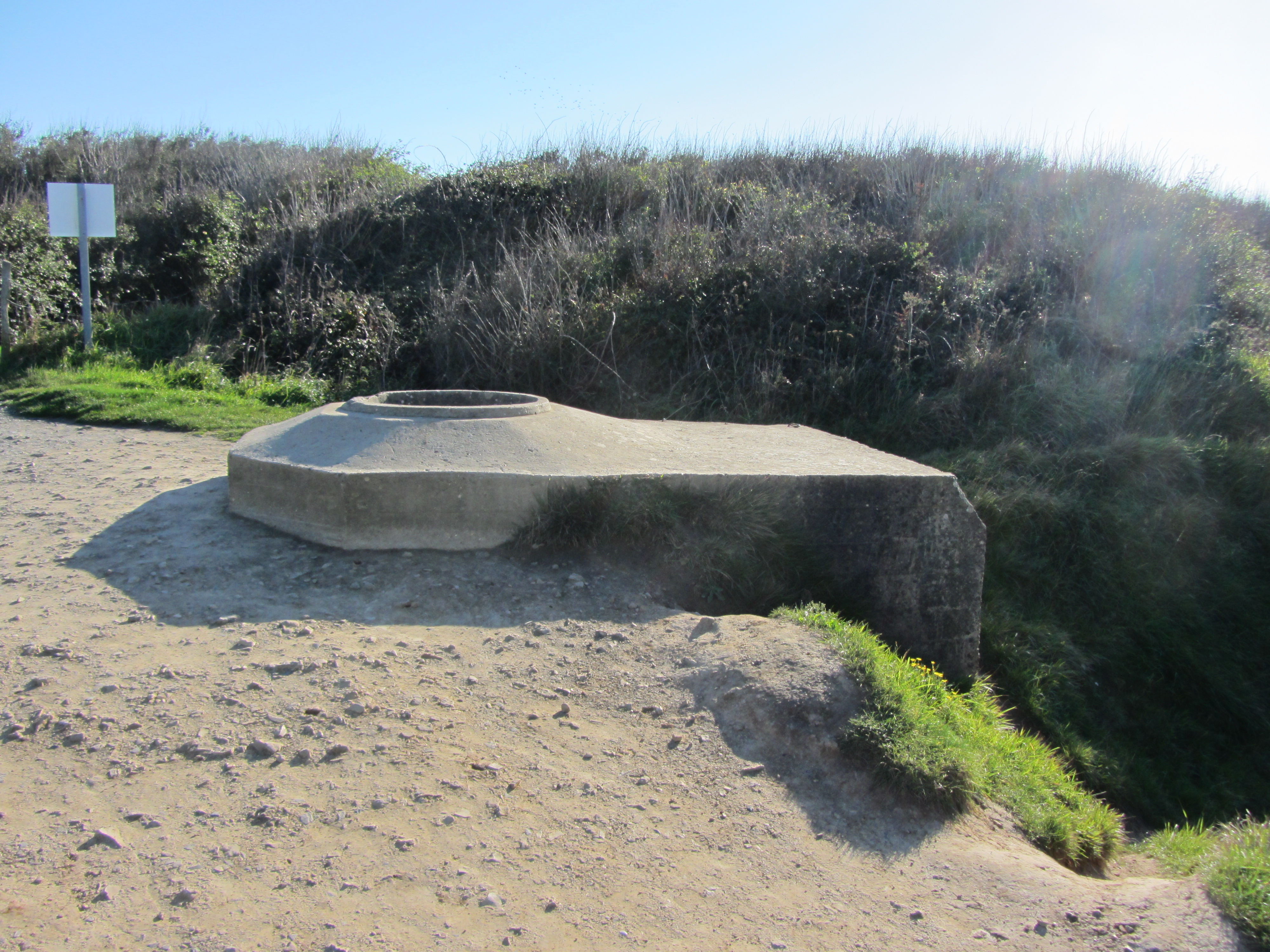
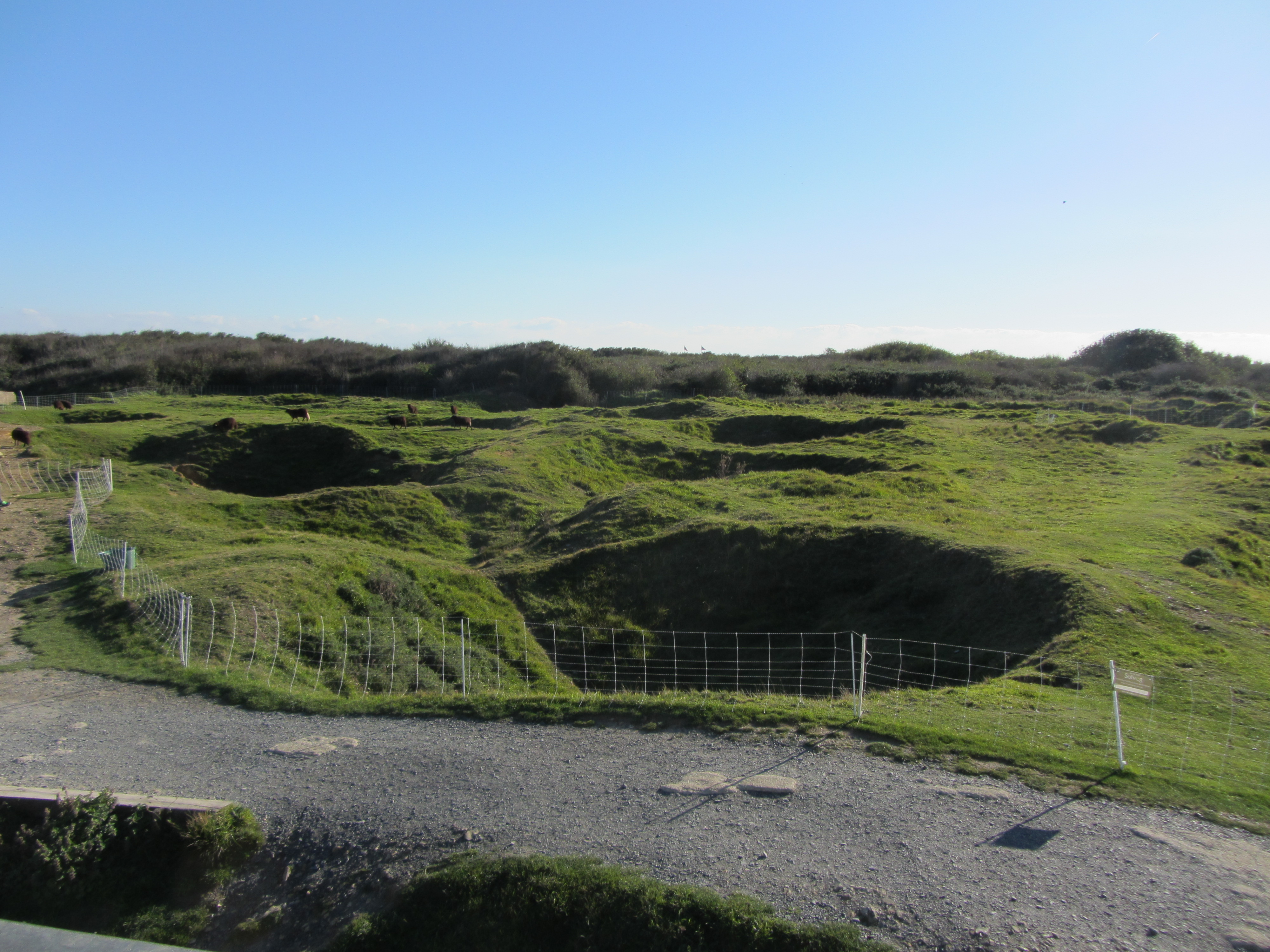
As it was in Juno beach, it was very surreal to be there, knowing what happened on that point 71 years ago. There are still some bunkers intact but the most noticeable markings of the event were the numerous craters caused by the air and naval bombardments. Some of the bunkers were in pieces. Some of the circular gun pits, which housed the 155mm guns, are still there. As we walked about the site I tried to envision what the American Rangers had to endure to succeed at their mission.

2015-10-08 17.16.25We also made a brief stop at Arromanches, located on the British Gold beach, where one of the two portable temporary Mulberry harbours is located that were built and operational within three days of the invasion. Mulberry A was for the Americans at Omaha Beach and Mulberry B was serving the British and Canadians at Arromanches. A heavy storm destroyed the American harbor on June 19, but Mulberry B remained in use for eight months. Block ships were sunk off the Normandy coast to create protection from the open sea. These ships are still there and my wife and I marveled at the ingenuity of the Allied planners. In the first 100 days following D-Day, the harbor landed over 2.5 million men, 500,000 vehicles and 4 million tons of supplies for the Battle of Normandy; successfully contributing to the liberation of Europe and the defeat of Nazi Germany.

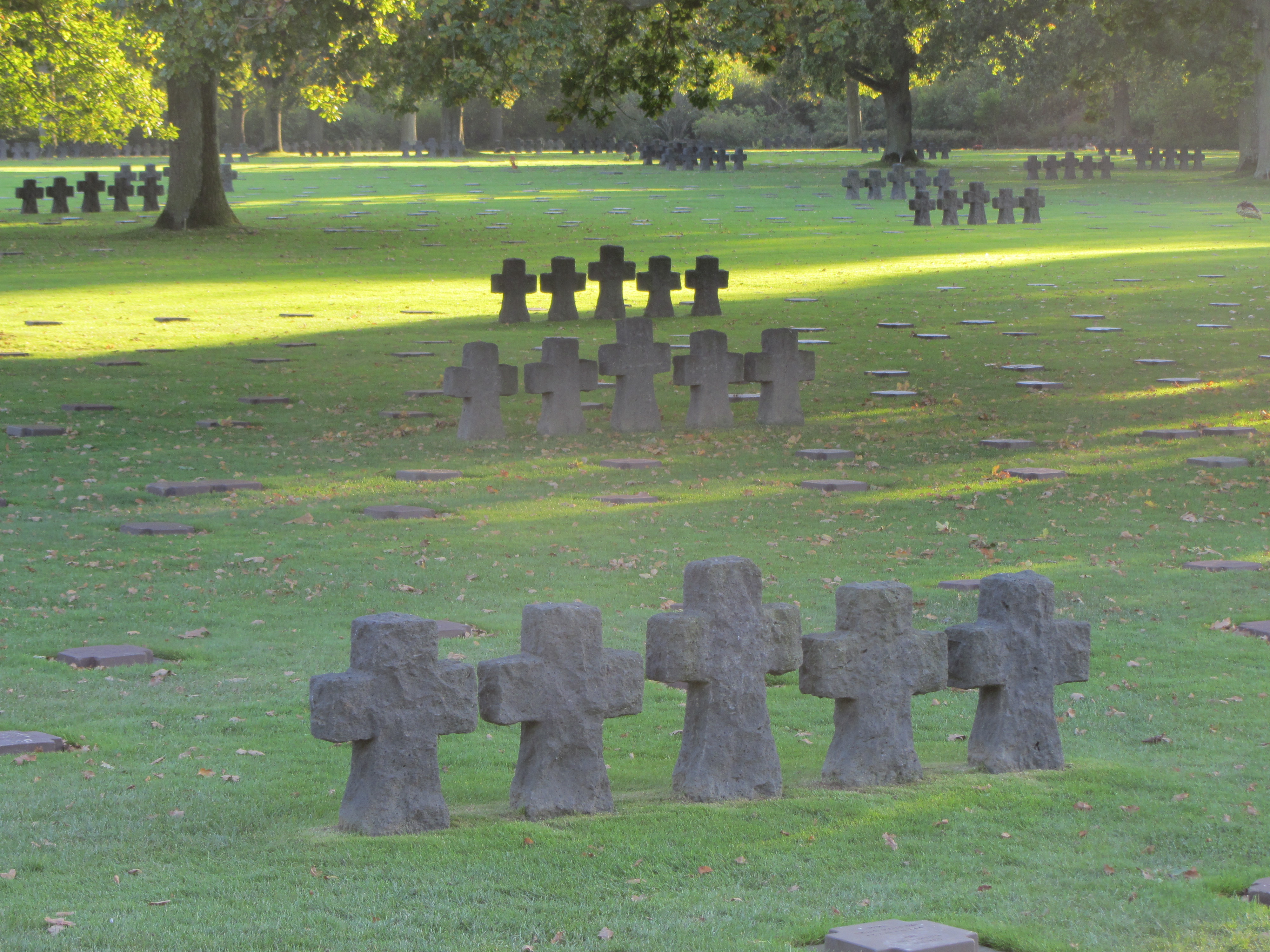
2015-10-08 16.16.41We also visited two of WWII cemeteries; the Canadian cemetery and the German cemetery. Again we were in admiration at how well-kept these cemeteries were, regardless of nationality. We were also saddened when looking at the various head stones when we learned many, many of these soldiers who died ranged between ages of 17 to 23. It was especially heart retching for my wife and I since our son is presently aged 21. Another very stirring moment for us was when we read the sign at the entrance of the German cemetery. The sign read, “Until 1947, this was an American cemetery. The remains were exhumed and shipped to the United States. It has been German since 1948, and contains over 21 000 graves. With its melancholy rigour, it is a graveyard for soldiers not all who had chosen either the cause or the fight. They too have found rest in our soil of France.” As I’ve stated IMG_3333before, this speaks of the nature of the French nation. They have a great respect for the dignity of all fallen soldiers. The French value and honor all soldiers, no matter what side of the war they fought for.

As we did for the WWI soldiers, my wife and I now have a whole new appreciation for the WWII soldiers and the sacrifice they made to liberate France and other European countries from Nazi oppression. I will attend the Remembrance Day ceremonies this year with much more gratitude and appreciation of all soldiers, especially knowing what the soldiers of WWII had to sacrifice to  achieve their assigned goals.

We Shall Remember!

November 11th is an important day to observe as it marks the anniversary of the official ending of World War I. That war ended on the 11th hour of the 11th day of the 11th month thus explaining why Remembrance day is November 11th. In Canada Remembrance Day is a national holiday and all Commonwealth Nations observe this day as a day to remember the members of their armed forces who have died in the line of duty. For those that don’t know, the Commonwealth is an organization of 53 member states that were mostly territories of the former British Empire, which includes the United Kingdom. The United States has a day of remembrance called Veterans Day, which is an official federal holiday that is observed annually on November 11. Its purpose is to honor people who have served in the U.S. Armed Forces, that is, its veterans. Armistice Day remains the name of the holiday in France and Belgium.

Now I’ve always felt that Remembrance Day was an important day to remember our fallen soldiers and I have often attended ceremonies, but since visiting the World War I and II sites in France, I have a whole new appreciation for this day. In this post, I will share my experiences visiting the WWI sites and cemeteries in France and Belgium. Experiences of my visits to WWII sites will be in another post.

2015-10-11 14.29.38The first site I visited was the Canadian National Vimy Memorial which has always been on my “bucket list” to visit. The memorial towers over the scene of Canada’s most recognizable First World War engagement, the Battle of Vimy Ridge, fought on  April 9 to 12, 1917. In 1922 the French Government granted land on the crest of the ridge to the Canadian nation and this piece of land is now a Canadian National Park. To help you understand the importance of this site, here is a history lesson.

The Battle of Vimy Ridge was a military operation fought primarily as part of the Battle of Arras during the First World War. The main combatants were the Canadian Corps, of four divisions, against three divisions of the German Sixth Army.

The Canadian Corps was ordered to seize the heavily German fortified Vimy Ridge in April 1917. Situated in northern France, this seven-kilometre (4 mile) ridge which held a commanding view over the Allied lines. In May 1915, the French army attempted to seize the ridge but failed with 150 000 casualties. In February 1916, the British Army attempted to take control of the ridge but the Germans were able to push them away from the ridge.

IMG_3473Attacking together for the first time, the four Canadian divisions stormed the ridge at 5:30am on 9 April 1917. More than 15,000 Canadian infantry overran the Germans all along the front. Canadians single-handedly charged machine-gun nests or forced the surrender of Germans in protective dugouts. Hill 145, the highest and most important feature of the Ridge, and where the Vimy monument now stands, was captured in a frontal bayonet charge against machine-gun positions. It was the first time all four Canadian divisions attacked together and men from all regions of Canada were present at the battle. Brigadier-General A.E. Ross declared after the war, “in those few minutes I witnessed the birth of a nation.”

IMG_3444For me, visiting Vimy Ridge was an “eye opening” experience even though I’ve taught about the Battle of Vimy Ridge for many years. The first thing you notice are the craters left behind from the three-week bombardment that preluded the attack that occurred on the 9th of April. They were everywhere you looked. Large areas are fenced off with electric fences with signs stating that there are still unexploded devices in these areas. In fact, the attendant in the information told us that recently someone brought in a what they thought was a rock only to find out it was an undetonated grenade from 98 years ago.

When visiting the preserved trenches, I was struck by how close the Allied and German trenches were to each other. We were told that the trenches were 25 metres apart in places. In the area between the opposing trenches, known as “no man’s land” are several huge craters. We were told that these craters were from Allied soldiers tunneling under “no man’s land” and detonating explosives. My wife and I learned about the conditions of the trenches. Soldiers would spend months in these trenches often standing in ankle to knee-deep mud and water which caused many soldiers to acquire infections in their feet known as “trench foot”. The soldiers also had to contend with rats and head lice in epidemic proportions. The food was usually canned food and not much variety either. Many soldiers perished not because of battle but because of the horrific conditions of the trenches.

The park also does a tour of the tunnels. The tunnels at Vimy Ridge were part of a 20 kilometre (12 mile) network of tunnels stemming from the city of Arras. The soldiers would exit these tunnels to go onto the battle field. While soldiers were in the tunnels awaiting battle, they had to be perfectly quiet as they could be heard in the nearby German tunnels. The lighting in the tunnels was minimal so when our guide demonstrated what it would be like in there in 1917, it was almost pitch black. The temperature in the tunnels is a constant 10 degree Celsius (50 degrees Fahrenheit).

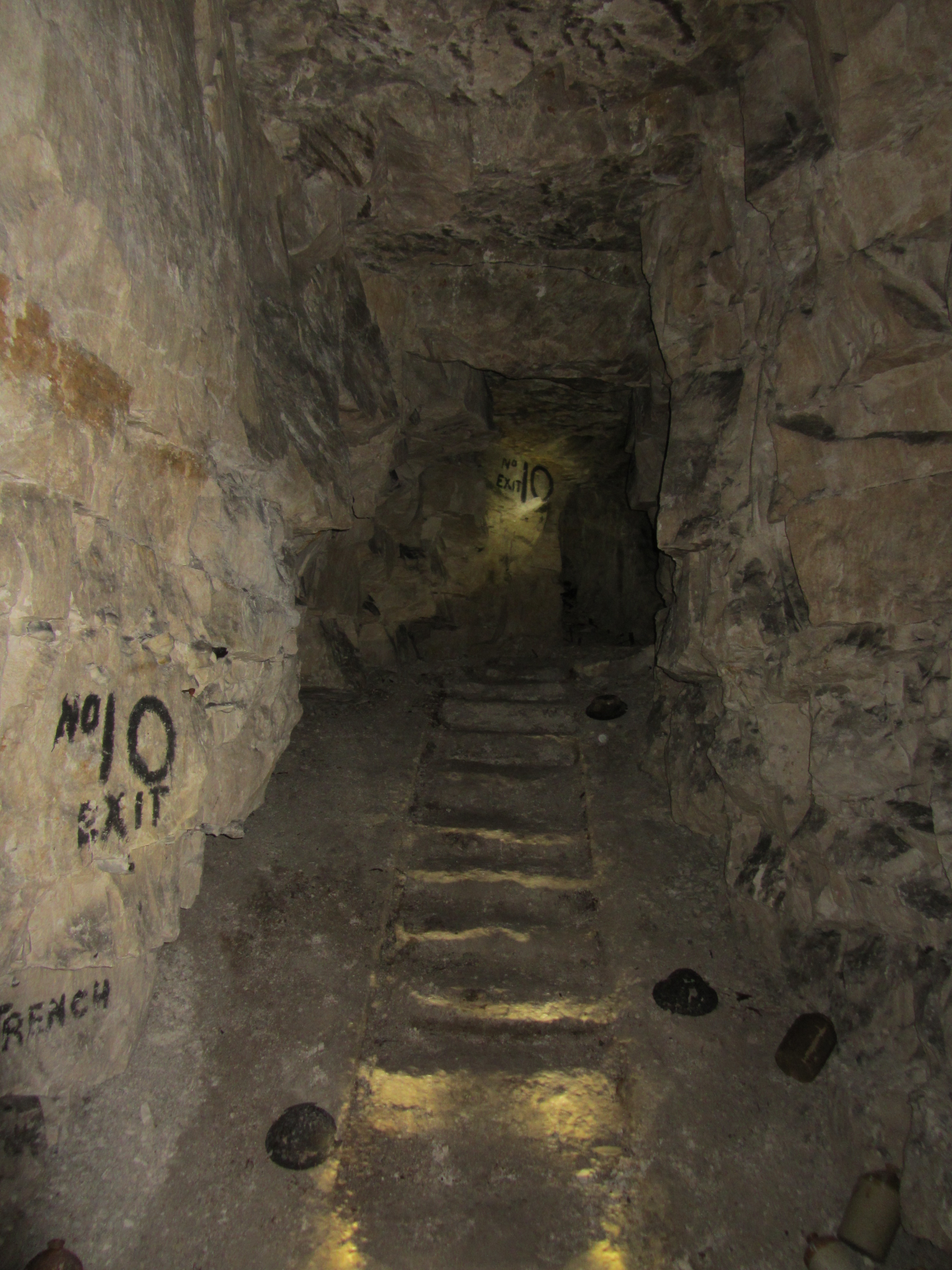
IMG_3726In the nearby city of Arras, my wife and I visited the Wellington Quarry (la Carrière Wellington) a museum that opened in 2008. The museum is a section of the many kilometres of tunnels dug by the British Army in WWI. Here is another history lesson.

From the Middle Ages through to the 19th century, the chalk beds underneath Arras were extensively quarried to supply stone for the town’s buildings. In 1916, during the First World War, the British forces decided to re-use the underground quarries to aid in a planned offensive against the Germans. The quarries were to be linked up so that they could be used both as shelters from the continual German shelling and as a means of conveying troops to the front in secrecy and safety, so 500 miners from the New Zealand Tunnelling Company, were brought in to dig 20 kilometres (12 miles) of tunnels. They worked alongside the British coal miners. Many were soldiers of below average height who had been rejected from regular units because they did not meet the height requirements.

The tunnel system could accommodate up to 20,000 men and these tunnels were outfitted with running water, electric lights, kitchens, latrines, a light rail system and a fully equipped hospital. Thousands of soldiers were billeted in the tunnels for eight days prior to the start of the Arras offensive on 9 April 1917. At 05:30 that morning, exits were dynamited to enable the troops to storm the German trenches. The Germans were taken by surprise and were pushed back 11 km (6.8 miles). However, the offensive soon bogged down and it was eventually called off after casualties reached 4,000 a day.

When you visit the quarry which lies 20 metres (65 feet) below the surface you are immediately struck by the numerous tunnels down there. A guide takes you through showing the many bottles, cans, shoes, and other WWI artifacts that are still there. You are also shown the graffiti on the walls left by the soldiers as well as one of the exits that led to the battlefield. It was truly one of the most moving and spiritual experiences I have ever had.

IMG_3434My wife and I also visited the many, many WWI military cemeteries in the area. We were actually overwhelmed by the sheer number of them. We visited three or four commonwealth cemeteries, which lay many Canadians. We visited a German cemetery and a French cemetery. What was astonishing to us was the number of unknown soldiers in these cemeteries. One of the cemeteries we visited had over half of the graves as unknown soldiers. Another surprising observation we made was how well-kept these cemeteries were. There were flowers growing between every headstone, the grass was always well-groomed  and monuments were found in every cemetery. I IMG_3518think this speaks of the character of the French people and nation. It says they have great respect for the dignity of all fallen soldiers. The French value and honor all soldiers, no matter what side of the war they fought for. I was also struck by the sense of peace in these cemeteries. It was truly a humbling and touching experience to visit these resting places of WWI soldiers.

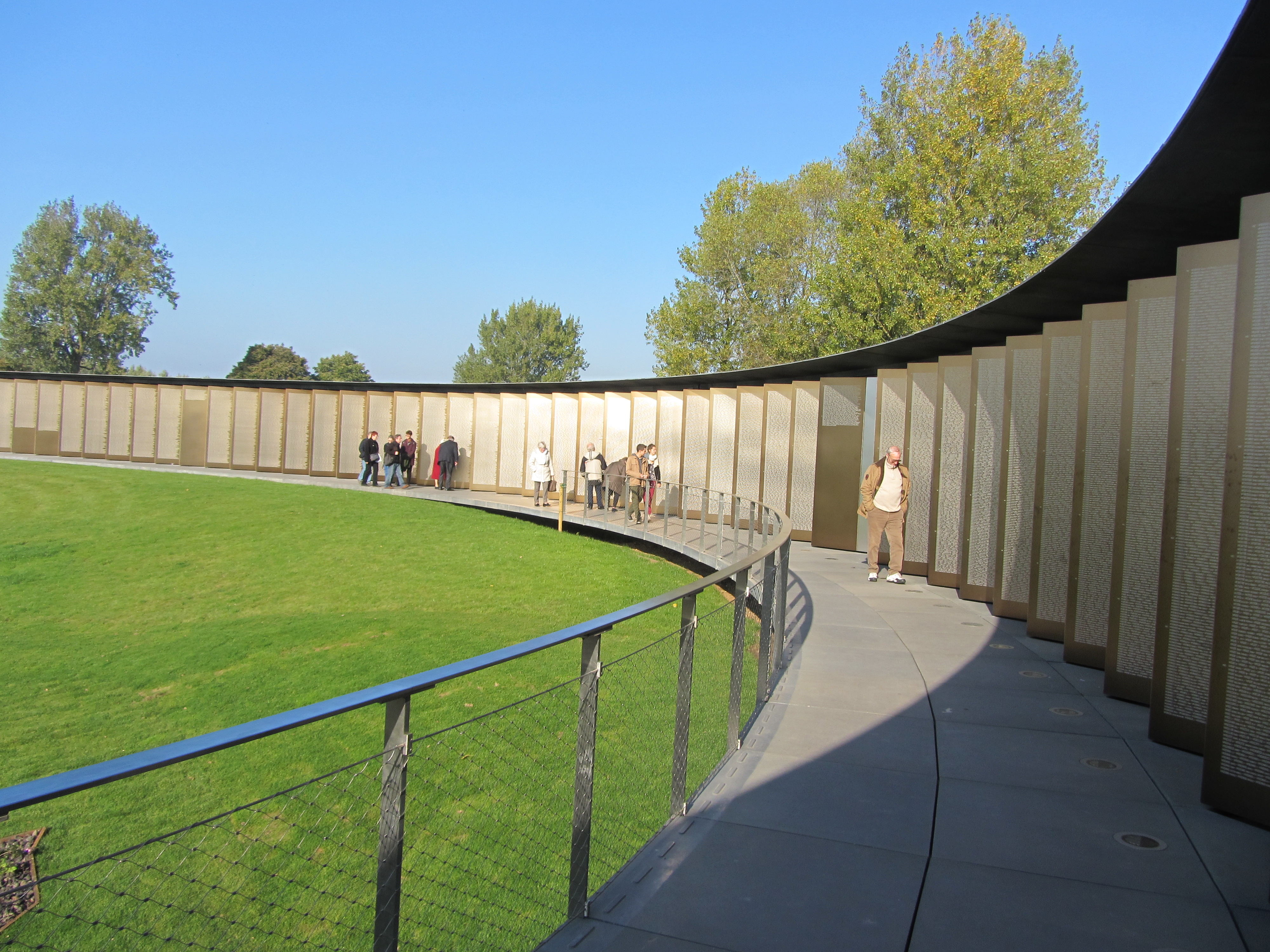
Notre Dame de Lorette is the world’s largest French military cemetery. Beside this cemetery is the Remembrance Ring  (Anneau de la Mémoire) officially known as Mémorial International Notre-Dame-de-Lorette.  This new memorial was inaugurated on November 11, 2014 and takes the form of a 328-metre ring of concrete with 500 sheets of bronzed stainless steel inside listing 579,606 German, IMG_3528French and British names. Now that is a lot of fallen soldiers and that does not include the many unknown soldiers whose names are not part of this memorial. What was so unusual to me was the fact that the French Government collected as many names as they could obtain of soldiers who perished in WWI regardless of their nationality; regardless of which side of the war they fought on. Once again this speaks of the character of the French nation. My wife and I wandered around in awe of this memorial finding our family names. It is very powerful and humbling experience to stare at 113 people with the same surname as me who fought with the Germans, the enemy of the day. As you might have gathered, my ancestry is German.

My wife and I now have a whole new appreciation for all soldiers and the sacrifice they made to maintain freedoms. Even though WWI was such an unnecessary war and a world war caused by the big egos of the leaders of the day, it was still necessary for soldiers to keep France and Belgium from being occupied and controlled by a foreign empire. I will attend the Remembrance Day ceremonies this year with much more gratitude and appreciation of all soldiers, especially knowing what the soldiers of WWI had to endure.

Those Crazy European Drivers

On our flight over to Europe, I watched the recently released movie called Spy whereby the main character, Susan Cooper, played by Melissa McCarthy. is a desk bound CIA analyst who volunteers to go undercover to infiltrate the world of a deadly arms dealer, and prevent a global disaster. The movie has a very funny driving scene where an Italian agent named Bradley Fine, played by Jude Law, picks Cooper up and drives her to her hotel. During that scene the Italian agent, driving a sporty convertible speeds through the narrow streets of Rome, paying more attention to the girls he is passing by than to his driving. The scene is very funny and typifies the way Europeans drive. Anytime I’ve watched scenes like this, I’ve always thought that the movies must be majorly exaggerating drivers in Europe. After returning home, I no longer think that.

IMG_1172Based on our experiences in Europe, it would seem that the stereotype, perpetrated by Hollywood movies,  that European drivers are crazy is true. Have you ever seen an intersection packed with cars at all different angles, none of them moving, many of them tooting angrily like it will possibly help? Well, we did in Paris when our shuttle driver entered the very large round about that encircles the Arc of Triumph (Arc de Triomphe).  There were no clear lanes and cars were everywhere and numerous horns were tooting. This is just one of the many driving experiences my wife and I, along with our friends, experienced when we visited Continental Europe. Even though I was aware of the stereotype, I was still “shell shocked when witnessing it”.

Our first taxi ride was on the island of Santorini, one of the Greek islands.  After a nice dinner at our hotel, we decided to visit the nearby village of Kamair, so we had the hotel call a taxi for us.  When the taxi arrived, My wife and our friends got in the back seat, and I got into the front with the driver.  No word of a lie, the driver put the “petal to the metal” and the car accelerated quickly.  Now in Greece, there are no side walks so pedestrians walk on the narrow roads.  There was a group walking down the road as the taxi driver sped toward them, showing no signs of slowing down.  The pedestrians scattered very quickly, as you might imagine.  The village was two kilometres from our hotel. and our taxi driver speeded the entire way there.  Thank God, we made it to the village alive.  We all were so shocked that all we could do was laugh. I would label this taxi driver as one of those stereotypical crazy European drivers.

IMG_1166Like the driver in Santorini, the taxi driver who took us to the airport in Athens “floored it” at every opportunity.  At one point he narrowly missed a car door that was opening. What made the situation even more humorous was the fact that just before the taxi arrived, a huge thundercloud moved over the city and a torrential rainstorm occurred as we were driving off.  Now as in many cities, Athens does not have the infrastructure to handle torrential downpours, so needless to say the streets of Athens were semi flooding, or in some case fully flooded.  That didn’t slow down our taxi driver.  He just sped through the water sending water everywhere.  Now we were nervous to say the least and I suspect our driver must have sensed that since he put in a CD of Greek music and “cranked” it up.  It worked, as we did relax and started swaying to the music. This driver fit the stereotype.

IMG_1738Being a pedestrian in Europe is truly an adventure.  Really you take your own life into your hands every time you step out onto the street as there was no other choice since sidewalks are rare in Europe.  There were many, many times when our friends and us would be walking in what we assumed was a pedestrian zone only to be shocked when a vehicle would drive through scattering all the pedestrians.  That happened in Florence and Sorrento in Italy, Mykonos town in Greece, and Bayeux in France, to name some places we experienced this.  In fact, at our vacation rental in Sorrento, the gate opened right onto the road, and I’m not kidding when I say the vehicles did not slow down on that road.  Numerous times we literally ran to cross the road for fear of getting hit by a car.  It was most entertaining when you watched some else doing so.

In places like Rome, Paris and Athens it is common to see the narrow streets jammed with unruly drivers, streetcars, buses, mopeds, and double-parked trucks.  It is also common in these cities to see massive horn-honking traffic jams.  The mopeds and motorbikes were plentiful on the streets and would weave in and out of the vehicles, and often would drive between two vehicles to get ahead.  There didn’t seem to be any sense of abiding by rules and such.

IMG_2752Then there is the parking.  In Rome and Paris, for example, you would see vehicles parked in every which direction.  There would be trucks parked in lanes with their flashers on.  We saw this often in Paris on the shuttle.   Vehicles would be parked up on sidewalks, if there was one, and it was not uncommon to see cars double parked.  Vehicles would just park beside other parked vehicles and turn on their flashers.  It just seemed liked chaos to me.

Now I realize that the reason drivers are so aggressive in Europe and why people park in any available space they can find in cities is because Europe does not have the space that North America has. Most of the cities in Europe are ancient.  To give you some perspective, parts of Rome are truly ancient.  If you look at the famous Roman Colosseum and inquire when it was built you would learn that it was commissioned around A.D. (CE) 70-72 by Emperor Vespasian. Paris existed long before Notre Dame Cathedral was built and the cathedral began its construction  in 1163 AD (CE). The site of Athens has been inhabited since before 3000 BC (BCE). The earliest buildings date from the late Bronze Age, about 1200 BC (BCE), when part of the town spread to the south of the citadel on the Acropolis. The Acropolis is an ancient citadel (fortress) located on a high rocky outcrop above the city of Athens and contains the remains of several ancient Greek Temples.  So as you can see, these cities are truly ancient thus explaining why the city streets are narrow.  They were built in times before vehicles were around.  These cities were never intended to have modern vehicles on them.  In fact, many of these streets are still cobblestone. Space is at a premium over in Europe.

Then there is the population factor. Italy, for example, has 60,808,000 inhabitants and is 33 times smaller than Canada and the United States. Canada’s population is about 35 million and the population of the United States is approximately 319 million. Now that doesn’t mean much until you compare the number of people to the land area, otherwise known as their population density.  According to the World Bank Data Website Italy has a population density of 209 people per sq. kilometre (km) of land area.  Canada, on the other hand, has a density of 4 people per sq. km of land area and the United States has 35 people per sq. km of land area.  So as you can see, Italy is much more densely populated than either Canada or the United States. In light of these statistics, it is easy to understand that Italy has much less space to handle its vehicles and pedestrians.

After returning home, I have come to appreciate  the amount of space we have in North America.  Our wide streets, our sidewalks for pedestrians our large, straight highways, our open space in rural areas  are so refreshing after being in Europe.  All the while we were in Europe we heard about the refugee crisis.  It was on the news.  It was in their news papers.  We even witnessed a demonstration in support of the Syrian refugees in Athens. North America has so much more space and fewer people when compared to the European nations, therefore we should not be afraid to take in more of the Syrian refugees, especially in light of the fact that Europe is experiencing a refuge crisis right now. North America can easily encompass more inhabitants.  We have the space!