We Shall Never Forget!

John 15:13 of the Christian Scriptures says, “No one has greater love than this, to lay down one’s life for one’s friends.” Always remember that this is what those who died fighting for our freedoms did.

Sommer season all year's avatarSommer Season all year

As I’ve mentioned in my first Remembrance Day post, November 11th is an important day to observe as it marks the anniversary of the official ending of World War I. That war ended on the 11th hour of the 11th day of the 11th month thus explaining why Remembrance day is November 11th.  When in France recently, my wife and I visited the Normandy D-Day beaches. In case you don’t know the significance of those beaches, here is a history lesson.

On D-Day, June 6, 1944, “Operation Overlord”, the allied invasion of Nazi-occupied Europe started at 06:30. The target was an 80 kilometre (50-mile) stretch of the Normandy coast, which was divided into five sectors: Utah, Omaha, Gold, Juno and Sword Beach. The Utah and Omaha sectors would be assaulted by the American Army, Gold and Sword beaches by the British troops and Juno beach by the Canadians. We visited the British, Canadian and American beaches. The success…

View original post 1,195 more words

We Shall Remember!

This post was first published on November 6th of last year upon returning from Europe. My wife and I spent time exploring the Normandy Beaches in France and the Vimy Ridge memorial. This was a profound experience for us and has made Remembrance Day that much more important. Never forget this ultimate sacrifice our soldiers made.

Sommer season all year's avatarSommer Season all year

November 11th is an important day to observe as it marks the anniversary of the official ending of World War I. That war ended on the 11th hour of the 11th day of the 11th month thus explaining why Remembrance day is November 11th. In Canada Remembrance Day is a national holiday and all Commonwealth Nations observe this day as a day to remember the members of their armed forces who have died in the line of duty. For those that don’t know, the Commonwealth is an organization of 53 member states that were mostly territories of the former British Empire, which includes the United Kingdom. The United States has a day of remembrance called Veterans Day, which is an official federal holiday that is observed annually on November 11. Its purpose is to honor people who have served in the U.S. Armed Forces, that is, its veterans. Armistice Day remains the name of…

View original post 1,556 more words

Thanksgiving, More Than a Holiday.

A commentary on the meaning of Thanksgiving

thanksgiving-clip-art-thanksgiving-turkey-clipart-4-jpg-jcnrel-clipartOn Monday, October 10, 2016 our family, like most Canadians, celebrated the Canadian Thanksgiving holiday. Thanksgiving is a statutory holiday in most of Canada, with the exceptions being the Atlantic provinces of Prince Edward Island, Newfoundland and Labrador, New Brunswick, and Nova Scotia, where it is an optional holiday. In its beginnings Thanksgiving was celebration for a successful harvest but the tradition has changed over the years. Now the focus is to get together with family to eat a large turkey dinner, including stuffing and pumpkin pie for dessert.

The first Thanksgiving Day after Canada’s Confederation was observed as a civic holiday on April 5, 1872. It was to celebrate the recovery of the Prince of Wales, who later became King Edward VII, from a serious illness. It was made official on January 31, 1957, when the Canadian Parliament proclaimed: A Day of General Thanksgiving to Almighty God for the bountiful harvest with which Canada has been blessed, to be observed on the 2nd Monday in October. During and after the American Revolution, Americans who remained loyal to Great Britain moved from United States to Canada. They brought with them the customs and practices of the American Thanksgiving, such as the turkey, pumpkin, and squash.

Thanksgiving in the United States is a public holiday, celebrated on the fourth Thursday in November by all 50 states. Americans commonly trace the Thanksgiving holiday to a 1621 celebration at the Plymouth Plantation, where the settlers held a harvest feast after a successful growing season. It has been celebrated as a federal holiday every year since 1863, due to President Abraham Lincoln’s proclamation declaring it as a national day of “Thanksgiving and Praise to our beneficent Father who dwelleth in the Heavens,” to be celebrated on the last Thursday in November.

An interesting difference between Canada and the US is that in America, Black Friday, the day after Thanksgiving, is one of their biggest shopping days.  Black Friday has been regarded as the beginning of the Christmas shopping season with stores offering many items on sale. That is not the case in Canada although we are starting to see retail outlets offer Black Friday sales in Canada. For Canadians, the holiday Monday means it’s a long weekend and shopping isn’t an essential part of it. Canada’s biggest shopping day of the year is December 26, Boxing Day, the day after Christmas.

Every thanksgiving, barring the occasional exception, we gather as a family to eat our turkey with stuffing, mashed potatoes and gravy, carrots harvested from my garden, and turnips. The meal always finishes with pumpkin pie. Before we eat our delicious meal each family member takes turns sharing with one another at least five things we are thankful for. We have done this since our three children were little. Sometimes they would complain becoming impatient since they were hungry. My wife and I had a policy that if we heard complaining, our children would have to share more than the required number of “thankfuls”. One year when our eldest daughter was in her early teens she starting complaining about the number of “thankfuls” she was required to share. Each time she complained my wife and I added more. She finally stopped complaining after she reached about 12. She reluctantly came up with 12 things she was thankful for. We still laugh about that.

I always take time to express the things I’m grateful for at thanksgiving. I will always be grateful for my loving and supportive wife. She puts up with all my crazy ideas and ventures. I will always be grateful for my three wonderful children. We are fortunate enough to have two daughters and a son. All three of them have made us proud with the hard work they did to achieve their university degrees and how they practice their careers with commitment, purpose and integrity. I am also grateful for my health and the health of my loved ones. I am grateful to be living in a country that is inclusive, safe and respected. I could go on and on.

attitude-whatsapp-profile-pictures-attitude-dp-coolstatus-co-yvaufa-clipartThinking about this post, I realized that Thanksgiving is really about our attitude. Thanksgiving is more than just a holiday. It’s also a reminder to us to have an “attitude of gratitude”. It should be an attitude that we have every day of our lives. Why, you may ask? Psychology Today says there are seven scientifically proven benefits of gratitude. They are

  • Gratitude opens the door to more relationships.
  • Gratitude improves physical health.
  • Gratitude improves psychological health.
  • Gratitude enhances empathy and reduces aggression.
  • Grateful people sleep better.
  • Gratitude improves self-esteem.
  • Gratitude increases mental strength.

The blog, Happier Human, has a post titled, The 31 Benefits of Gratitude You Didn’t Know About: How Gratitude Can Change Your Life, which obviously claims there are 31 benefits of Gratitude. One that caught my attention is gratitude lets you live longer. The Huffington Post’s article, 10 Reasons Why Gratitude Is Healthy, says it has benefits to the heart,  immune system and boosts general well-being.

The article titled, Why Gratitude Is Good, summarizes the benefits of gratitude this way:

Physical
• Stronger immune systems
• Less bothered by aches and pains
• Lower blood pressure
• Exercise more and take better care of their health
• Sleep longer and feel more refreshed upon waking

Psychological
• Higher levels of positive emotions
• More alert, alive, and awake
• More joy and pleasure
• More optimism and happiness

Social
• More helpful, generous, and compassionate
• More forgiving
• More outgoing
• Feel less lonely and isolated.

happy-thanksgiving-clipart-clipart-panda-free-clipart-images-ksmaop-clipartEven though there may not be agreement on the number of benefits to having an “attitude of gratitude”, one can safely conclude that there are benefits to having this attitude. So don’t just have this “attitude of gratitude” at Thanksgiving, have it every single day of your life. Maybe start a gratitude journal. I have done this from time to time. (Now that I think about it, I haven’t done a journal in a while. I need to do something about that). It forces us to think of things that we are thankful for. If you’re not sure what a gratitude journal is or how to do one, see the article, Tips for Keeping a Gratitude Journal. So I encourage you to develop that “attitude of gratitude.” The bottom line is, it’s good for you.

The World Should be Weeping

Aleppo, a selfish human tragedy!

In late September I saw this video in a news report.

http://www.youtube.com/watch?v=ipisDX6Rw5k

Now I had seen many news reports about Aleppo before but this video really got to me.  This video touched me on a deep level. The Canadian band, Nickelback, has a song called, “When We Stand Together”.  The beginning lyrics are,

One more depending on a prayer
And we all look away
People pretending everywhere
It’s just another day
There’s bullets flying through the air
And they still carry on
We watch it happen over there
And then just turn it off

The song portrays exactly what I have typically done and likely most people in the world do. We see what is happening in Aleppo, and other conflicts on the news and at the end of the news broadcast, we “just turn it [the TV] off”. Our mindset is, “it doesn’t really affect me. It’s happening far away from me.” But this time was different. This video got to me. It showed the human toll of this tragic conflict. The video showed how innocent people are being harmed by a senseless civil war and the emotional cost to its first responders.  We’re told that 250 000 innocent civilians are trapped in this city that is without clean water, functioning hospitals, and no aid. BBC News reports at least 18 people were killed earlier this month when trucks unloading at a Syrian Arab Red Crescent near Aleppo was attacked by fighter jets. The aid convoy was the result of a long process of obtaining permission and making preparations to assist isolated civilians after a ceasefire was negotiated. The attack occurred when the ceasefire failed.

I wondered what I could do. Donating for aid seemed to be pointless since aid was not reaching Aleppo, so I thought educating people. As a retired teacher that made sense. Maybe if there is enough of an outcry from the world’s people, the international community would do more. Maybe if enough of the world community said to the Syrian and Russian governments, “stop the bombing or else” things might change. I know it’s not as simple as this but peer pressure works.

So you, like I was, might be wondering what this conflict in Syria is all about. Here is some history based on information from Wikipedia.

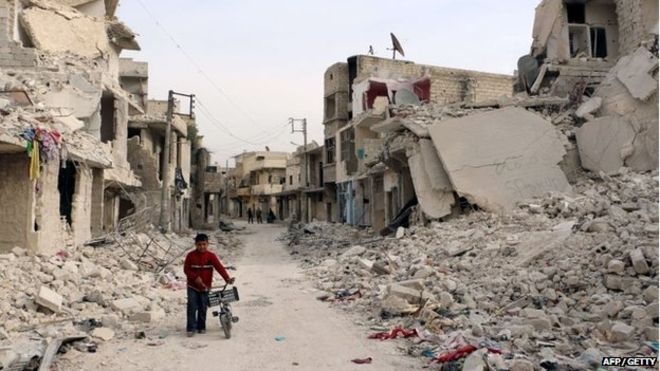
_78981659_18dbb1cb-9fd6-4299-b0b8-5ba4fd8194c1The war in Syria stems from the 2011 Arab Spring, a revolutionary upsurge of demonstrations and protests in the Arab world. The revolution started in December 2010 in Tunisia and spread. Major insurgencies occurred in Syria, Libya and Yemen.   Civil rebellions occurred in Egypt and Bahrain. Large street demonstrations happened in Algeria, Iraq, Jordan, Kuwait, Morocco, and Oman, and some minor protests in Saudi Arabia. In Syria , the revolution escalated to an armed conflict after the government of President Bashar al-Assad violently suppressed protests that were screaming for Assad’s removal. The war is now being fought among several factions which include the Syrian Government, a loose alliance of Syrian Arab rebel groups, the Syrian Democratic Forces, Salafi jihadist groups, and the Islamic State of Iraq and the Levant (ISIL). Many of these factions receive substantial support from foreign governments.

The Battle of Aleppo began in July of 2012.  Aleppo is the largest city in Syria with the Old City of Aleppo being a UNESCO World Heritage site. The ongoing war is between the Free Syrian Army, Islamic Front and other Sunni militants and  the armies of the Syrian Government who are also supported by Hezbollah and  Shiite  militants as well as Russia. The government forces and their allies are also attacking the Kurdish People’s Defence Units. The Kurdish people are an ethnic group located in northern Syria as well as in other Middle Eastern counties.  Kurdish nationalists are pursuing greater autonomy and cultural rights.

The battle for Aleppo has been marked by the Syrian army’s indiscriminate use of barrel bombs dropped from helicopters, killing thousands of people, and intentionally targeting the civilian population. This includes hospitals and schools. Hundreds of thousands have been forced to evacuate. On October 6th, 2016 President Assad offered amnesty to militants in the city, offering to evacuate them and their families to safe areas but the militants refused this proposal.

The battle has caused catastrophic destruction to the Old City of Aleppo, which I mentioned is a UNESCO World Heritage site. Here are some pictures taken by a drone showing the destruction of Aleppo.

In September 2012, Amnesty International, USA requested that the Geospatial Technologies and Human Rights Project of the American Association for the Advancement of Science (AAAS) to investigate human rights-related reports stemming from the escalating conflict in Aleppo.  Their conclusions on the Conflict in Aleppo was,

Space-based monitoring of the conflict in Aleppo has revealed a steady and continuous trend of degradation to the city’s buildings and infrastructure, including residential, religious, commercial, and industrial facilities. Roadblocks and other makeshift fortifications have continued to proliferate, with over a thousand visible in the latest imagery. Other signs of military activity, such as shell craters, armoured vehicle tracks, and evidence of aircraft deployments are likewise visible, and are consistent with reports of ongoing combat involving heavy weaponry in civilian areas. Damage resulting from fighting has resulted in severe losses to the city’s cultural heritage, both in the city as a whole as well as the area designated as a UNESCO World Heritage site.

It saddens me to see a UNESCO World Heritage site destroyed. In case you didn’t know, a World Heritage Site is a place that is listed by the United Nations Educational, Scientific and Cultural Organization (UNESCO) as being of exceptional cultural or physical significance to humanity.

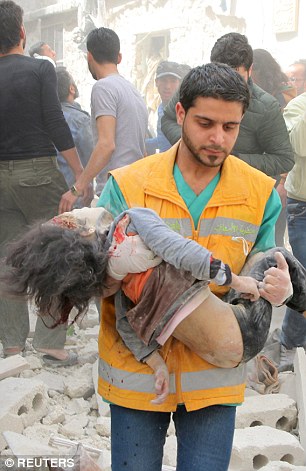
It saddens me even more to hear of the human suffering. The New York Times in its report, Why so many Children are Killed in Aleppo, tell us that roughly 250,000 people trapped in this Syrian city and about 100,000 are children. Children are the most vulnerable victims of the intensified bombings by Syrian forces and their Russian allies.

2821b1e600000578-3068063-image-m-17_1430817900726The Times article goes on to report that children in Aleppo face dire food and medicine shortages. Surgery and blood transfusions required for treating bomb wounds are practically impossible now. Medical workers have left children to die on hospital floors due to lack of supplies. Aid groups estimate that there are only 35 doctors remaining in East Aleppo, that is one for every 7,143 people, assuming a population of 250,000 people.

The reality is no one knows for sure how many people are trapped in Aleppo and how many are being killed. One person suffering, especially a child, is one too many. It all seems so senseless to see a world heritage site destroyed and learn of innocent people killed all because one man, Bashar al-Assad, a selfish leader who won’t give up his control of power. If the international community banded together to put serious pressure on the Assad government, maybe this nonsense would stop.

US Secretary of State, John Kerry, recently called for Syria and Russia to be investigated for war crimes since they keep hitting hospitals, medical facilities, children, and women (see The Guardian). I agree with Mr. Kerry as it appears to me that war crimes are occurring. War crimes are actions carried out during the conduct of a war that violates accepted international rules of war. There are 11 crimes which constitute grave breaches of the Geneva Conventions and applicable only to international armed conflict. These include willful killing and inhumane treatment, both of which have been violated. This would mean, in my view, Vladimir Putin and Bashar al-Assad are guilty of such crimes. It is time for the world to wake up and stop this senseless suffering, especially of innocent children.

Will There Ever be Peace Among Religions?

A commentary on the religious tensions on our planet.

09-donald-trump-bully.w536.h357.2xRepublican presidential candidate, Donald Trump has given several anti-Muslim orations perpetrating a
widespread belief that the United States is at war against Islam. Canada, too, has had its share of people who have an anti-Muslim sentiment.

The Archbishop of Canterbury in a Church Times article, is quoted as saying, “the global turmoil and conflict driven by extremism can be stopped only once religiously motivated violence has been purged from every faith tradition”. Archbishop Welby goes on to say; “the world was facing, for the first time in centuries, an obviously religious conflict that encompassed all faiths.” His claims are based in his travels around the Anglican Communion, where he says he had come across “Islamic violence, Christian violence, Hindu violence, Buddhist violence”.

Screen Shot 2016-03-16 at 7.36.11 PM

Euronews, a website that lists news about “Religious conflict” has numerous news articles about the latest religious skirmishes. Here are some of them.

Hundreds of Iranians held  protests in central Tehran over Saudi Arabia’s execution of the prominent Shiite cleric. A wave of anger against the Sunni-led kingdom has led to the ransacking of its embassy in Tehran.

Persecution against Pakistan’s Christians in the form of suicide bombs outside two churches killed at least 15 people in the eastern city of Lahore.

Iraq could once again descend into civil war between the Shiites and Sunni Muslim factions after the country’s most senior Shia Muslim cleric issued a call to arms to fight a rapidly advancing Sunni insurgency.

The United States, along with its allies, has launched airstrikes at Islamic State or ISIL (Islamic State of Iraq and the Levant) targets in Iraq in an expansion of its military campaign against the jihadists (those carrying out a war or struggle against unbelievers).

Two Buddhists have been jailed in the Southeast Asian nation of Myanmar for murders that took place during religious violence in March of 2015. They are the first Buddhists to be convicted of any serious offence relating to the rioting, which mainly targeted Muslims and left around 40 people dead.

The history of modern India has many incidents of violence. During the 1947 partition there was religious violence between Muslim-Hindu, Muslim-Sikhs and Muslim-Jains (followers of Jainism) on a gigantic scale. Hundreds of religious riots have been recorded since then in every decade of independent India. In these riots, the victims have included many Muslims, Hindus, Sikhs, Jains, Christians and Buddhists.

In 2013, hundreds of villagers fled their homes in the northern Indian state of Uttar Pradesh after three days of bloody sectarian clashes left at least 38 people dead and dozens wounded. The fighting between Hindus and Muslims in the area, the worst in years, was sparked by a violent dispute between two families of different faiths last month, authorities said.

Researchers say statistics from the multi-state study tell us in 2015, anti-Islam attacks in the United States were up 78% from 2014, and anti-Arab hate crimes increased 219%.

This is but a sampling of the numerous religious conflicts on the planet. Hans Küng, a Swiss Catholic priest, theologian, and author and President of the Foundation for a Global Ethic since 1995, once said, “No peace among the nations without peace among the religions. No peace among the religions without dialogue between the religions. No dialogue between the religions without investigation of the foundation of the religions.” I’m beginning to think Mr. Kung may be right.

Rebecca Rosen, in her book, Awaken the Spirit Within, says,

“the path to God in life was not the way, but only a way and that truly all paths lead home [to God]. Consider that God, metaphorically, is the centre of a wheel. The spokes on the wheel represent the many unique and different paths people use to reach God, and yet each spoke is connected to the same central hub. Meaning that all religions, all paths serve a similar purpose, [that is], to connect us to and bring us closer to God. In fact, the root of the word religion means “to bind” or “to connect. When you think about it, whether you practice Catholicism, Judaism, Buddhism, any other religion, or Atheism, it’s really meaningful and purposeful connection that you’re after…no matter what your religion or belief system, we’re all searching for and wanting the same basic stuff.”

Rebecca says it so well. There is no one path to God, there are many. Every religion is a path. Once humanity understands this and accepts this, then maybe there will be peace among religions. There are even references in the sacred scriptures from the various world religions that support the idea that there are many paths to God.

Christianity: And Peter opened his mouth and said, “Truly I perceive that God shows no partiality, but in every nation any one who fears him [meaning a sense of respect, awe] and does what is right is acceptable to him.” (Acts 10.34-35)  

Hinduism: As men approach Me [Krishna, a Hindu deity], so I receive them. All paths, Arjuna, lead to Me. (Bhagavad Gita 4.11)

Judaism: Rabbi Johanan ben Zakkai said, “Just as the sin-offering atones for Israel, so righteousness atones for the Peoples of the world.” (Talmud, Baba Batra 10b)

Islam: Say, “We believe in God, and in what has been revealed to us, and what was revealed to Abraham, Ishmael, Isaac, Jacob, and the Tribes, and in what was given to Moses, Jesus, and the Prophets from their Lord. We make no distinction between any of them, and to God do we submit.”(Qur’an 3.84)

Those who believe in the Qur’an, those who follow the Jewish scriptures, and the Sabeans and the Christians–any who believe in God and the Last Day, and work righteousness–on them shall be no fear, nor shall they grieve. (Qur’an 5.69)

Buddhism: Sometimes I [the Buddha] spoke of myself, sometimes of others; sometimes I presented myself, sometimes others; sometimes I showed my own actions, sometimes those of others. All my doctrines are true and none are false. (Lotus Sutra 16)

We must stop being so narrow-minded and get beyond the belief that “our religion” is the only path to the divine. It is incredibly naïve of a person to believe that they have the only exclusive knowledge on reaching God or the divine and that people of a different belief system have it wrong. Is it not so difficult to believe that all religions have truth and that there are many ways to reach the divine? Religious tolerance and understanding is a goal we must all strive for. Martin Luther King, Jr. once said, “We must learn to live together as brothers, or we are going to perish together as fools.”  Mahatma Gandhi says, “The pursuit of truth does not permit violence being inflicted on one’s opponent.”  Both of these men, two men who I admire, had wisdom for achieving peace, yet humanity continues to ignore it.peace-sign

Remembering 9/11 and Rethinking Terrorism.

A commentary on terrorism.

2011-09-11-schorwtc1
From Huffington Post

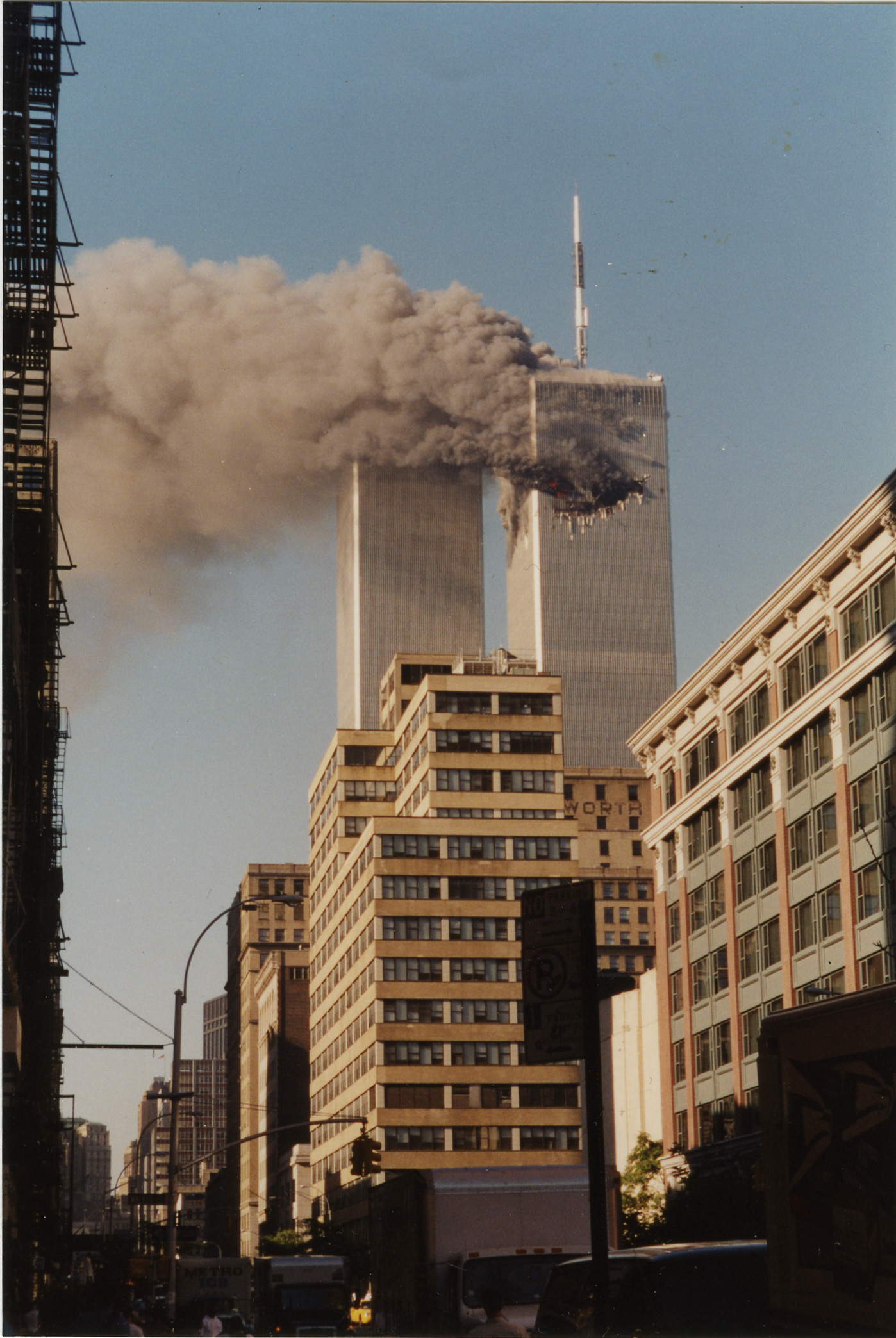
This week is the 15th anniversary of the 9/11 terrorist attacks against the United States. The world changed that day. I distinctly remember feeling that way when I learned of the horrific acts of terror effected that day. Mohammed Adam wrote a column in the Ottawa Citizen entitled, Fearful shadows of 9/11 still haunt Muslims, where he wrote:

Post-9/11, Islam was vilified and many Muslims were attacked and hounded as potential terrorists. Muslim women in particular, easily identifiable by their hijabs, faced verbal abuse, intimidation and even violence. A lot of bad things — the Iraq war, torture, Guantanamo — all happened. Draconian laws that curtailed age-old freedoms were passed, including here in Canada.

There has been a rise in anti-Muslim hate crimes in recent months especially since Donald Trump, Republican presidential nominee, has been spouting his rhetoric about a Muslim immigration ban.  The Guardian article, Hate crimes and attacks against Muslims, reports the Council on American-Islamic Relations (Cair) published new data showing that incidents against Muslims in California increased by 58% between 2014 and 2015, and that communities throughout the US are seeing similar trends.

afp_f02vx_49929083
From National Post

Many French Riviera mayors imposed a ban on full-body bathing suits known as burkinis this summer. France’s top court later ruled that basic freedoms were infringed upon and that mayors had overstepped their powers when they decreed a ban on burkinis at the beach. BBC News reports that French cities, such as Nice, have since lifted the controversial ban to be in line with a national court ruling. French opinion polls suggested most French people backed the burkini bans igniting fierce debate in France and around the world, with Muslims saying they were being unfairly discriminated against. Now I think the court decision was the right decision. It is simply discriminatory for one group with one set of values to tell another group that their set of values is wrong or at the very least unwelcome.

Pope_Francis_Korea_Haemi_Castle_19_(cropped)Even Pope Francis, leader of the world’s Catholics, defends Muslims. In the CBC article, Pope Francis defends Muslims, the pope says,

“I think it is not right to identify Islam with terrorism. It is not right and it is not true. I don’t like to talk about Islamic violence because every day when I look at the papers I see violence here in Italy – someone killing his girlfriend, someone killing his mother-in-law. These are baptized Catholics. If I speak of Islamic violence, I have to speak of Catholic violence. Not all Muslims are violent.”

The pope went on to talk about the causes of terrorism. He said,

“I know it is dangerous to say this but terrorism grows when there is no other option and when money is made and it, instead of the person, is put at the centre of the world economy. I ask myself how many young people that we Europeans have left devoid of ideals, who do not have work. Then they turn to drugs and alcohol or enlist in ISIS.”

Now  I certainly don’t agree with everything Pope Francis says but I agree with him on this. I agree that terrorism is related to social problems. Terrorism is defined by Dictionary.com as the use of violence and threats to intimidate or coerce, especially for political purposes. With that definition one could argue that many if not most acts of violence are acts of terrorism. Let’s look at the city of Chicago, Illinois in the United States as an example. That city has been making news headlines lately because of its high rate of gun violence. CNN reports in its report, 500 homicides. 9 months. 1 American city, that on Labor Day weekend Chicago’s 500th homicide of the year took place.  These are Americans carrying out acts of terror on one another and I suspect the majority of violent acts are not carried out by Muslims. So I asked myself, Why? This article says there are nearly 82 shootings per week. What does that tell me? Guns are too readily available but that is a whole other post. But why would people want to carry out acts of violence? Some Chicagoans blame the violence on economic struggles and lack of jobs. What’s interesting to note is Chicago’s unemployment rate fell from 6.1% in 2015 to 5.5% in 2016. Others say social problems are the root cause of the violence. Regardless of the cause, my point is that there is so much media emphasis on Islamic extremism when really there is much more terrorism being caused by non-Muslims. Most acts of terrorism are carried out by home grown  non-Muslim citizens.

In our local paper recently there was headline titled, Mobile Muslims launch 40-day campaign. The story explained that members of the Muslim community stopped in our little town spreading teachings of peace and love in hopes of changing their religion’s stereotype. One of the Mobile Muslims said, “There are many and false teachings associated with Islam and we need to dispel them.” CBC did a piece on this group called, Muslims go on cross-country tour. Kudos to the Mobile Muslims who are trying to set the record straight. It’s time to stop blaming terrorism on the all Muslims.  The number of radical Muslims who practice terrorism is only a small group.

But let’s not forget that radicalism is not unique to Islam. The news site, AlterNet.org, published an article called, 6 Modern-Day Christian Terrorist Groups You Never Hear About, which talks about six Christian terrorist groups. These are groups like the “Army of God” who openly promote killing abortion providers and who also have a history of promoting violence against the LGBT community. It also talks about “The Lord’s Resistance Army” (LRA) who according to Human Rights Watch, has committed thousands of killings and kidnappings. It seems terrorism does not exclusively belong to Muslim extremists. The Christian religion has had its fair share of extremists. Terrorism, no matter who carries it out, is WRONG! Discrimination against any group is WRONG! It’s time we focus on building a world of tolerance and understanding.

Dance Could Change the World Too

A commentary on the value of dancing.

A few weeks ago I wrote a post entitled, Music can change the world suggesting that music is a way to unite the world. I personally believe this to be true. A few days ago a link to the following video landed in my inbox.

Dance has always been a part of my world. I grew up in a small town where there were dances, often wedding dances, many weekends of the year. It was at those small town dances that I learned to dance. When I was in college and university I joined the dance club where we learned to do such dances as the Rumba, Samba, the Foxtrot, old-time waltz, swing and even square dance. My wife tells me that one of the things that attracted her to me was the fact that I could dance. She also tells me that now I don’t dance with her enough. Our daughters danced for years with the local dance association doing Hip Hop, Ballet, Modern, Jazz and Lyrical dance. My wife and I also volunteered when our club held their dance festivals. So when I watched this video I was immediately enlivened and inspired. What a great video! Watching it put a smile on my face. The video raises one’s spirits. Dance, even just watching it, has the ability to put us in a better mood.

I wanted to learn more about what kind of person would make such a video and why they would make it, so, like I typically do, I did some research.   Can dancing unite the world? is an article I found on the Pocket Cultures site, a website which aims to increase connections, awareness and understanding between different cultures.  According the article, the video was created by Matt Harding who became an Internet celebrity by creating a series of videos of himself doing silly dances in numerous countries around the world. The video above is his latest and was made in 2012. If you go to Mr. Harding’s website, where the heck is Matt, you will find other videos he has created. Matt says he started dancing with locals because he thought it looked like fun but some people have argued that he is actually improving world relations by connecting people around the world. clapping-hands-transparent-b-g-mdI applaud Mr. Harding for his diplomatic projects and for showing us that everyone in this world just wants to dance and enjoy life.

Dancing is a great way to connect people around the world, just as music is. Really, when you think about it, the two are connected. You can’t have dance without music and probably visa versa. It’s difficult to dance without music and I suspect music is what inspired dancing to arise in the first place. So I wondered, are there organizations or movements that share this vision of connecting through dance to unite the world? Using Google, this is what I discovered. United Dance is an organization with the purpose to unite and train dancers all over the world. They desire to show the heart of God in unity through creative expressions of worship and dance to the world. Another is Movement Exchange, a community of dance diplomats, who aim to unite the world through dance and service. This movement believes that sharing movement creates more joy in our world. That is so true! If you watch the above video carefully, you will notice that no matter what country Matt is in, the people dancing with him are smiling and joyful. I’m sure there are other movements as well.

Even the United Nations acknowledges dance music as a positive global force. According to this article, United Nations Secretary General Bam Ki-Moon praised Belgium’s Tomorrowland music festival, one of the most noteworthy global music festivals; a festival that began in 2005.

The Secretary General commented on the true power of global dance music, and its positioning within a wider cultural dialogue; one meant for a world of togetherness and universal acceptance. Now even though the festival isn’t specifically a dance festival, you can bet that the “dance music” had people dancing. In my view, dance and music go hand in hand.

Not only does music and dance unite people of different races and cultures, but dance is good for you.  According to the Better Health Channel’s article, Dance-Health Benefits, the health benefits of dancing are:

  • improved condition of your heart and lungs
  • increased muscular strength, endurance and motor fitness
  • increased aerobic fitness
  • improved muscle tone and strength
  • weight management
  • stronger bones and reduced risk of osteoporosis
  • better coordination, agility and flexibility
  • improved balance and spatial awareness
  • increased physical confidence
  • improved mental functioning
  • improved general and psychological well being
  • greater self-confidence and self-esteem
  • better social skills.

Time’s article, The Hidden Health Benefits of Dance, says:

“People who took dance class improved their fitness three times more than non-dancers”.

The Toronto Star reports in the article, Toronto researchers test benefits of dance for dementia patients, that a few studies suggest dancing programs in care homes appear to decrease problematic behaviour and increase social interaction and enjoyment.

Psychology Today’s article, Why Should We Dance?  says,

Studies have shown that dance, in particular, can decrease anxiety and boost mood more than other physical outlets

So the bottom line is dance has value in this world. We live in a world that needs unity. All one has to do is watch the news to come to that conclusion. So the more ways there are to unite the world, the better this world will be. I think dance, like music, is another way to do this. So, I encourage you to celebrate the different forms of dance in the world. I especially enjoy watching people from Africa dance. The African people know how to move and express themselves.

dancingSo let loose and dance. To quote Satchel Paige, an African-American Major League Baseball pitcher,

“Dance like nobody’s watching.”

It’s a good way to get fit. It makes you feel better. It unites the world because every country has their own unique dance forms. What more can I say?

So now I’m curious. Tell me what you think?

Bears Have Rights Too

tentI mentioned in a previous blog post, The Encounter, that my son and I do annual hiking trips in the Canadian Rocky Mountains. This past weekend we did a trip to Jasper National Park hiking up the Sunwapta Peak trail.  This was our 14th trip together. We stayed in a campground called, Wabasso, near the town of Jasper. When we were registering at the campground, we were warned that a black bear had been in the campsite the previous night. While eating our supper that evening, the people at the tent next to us started yelling, “there’s a bear!” They made a bunch of noise to scare the bear away. We never did get a glimpse of the wild animal but nonetheless, the possibility of a bear nearby always makes a person a bit anxious.

Now in the 14 years of doing this, we have only encountered a bear once (if you can call it that).  It was five years ago and the black bear was on the trail in Jasper National Park some 500 or more metres ahead of us.  When we yelled and my brother-in-law set off a “bear banger” (that is a device that makes a very loud bang) the bear took off. Bears are always on your mind when hiking in the mountainous wilderness so we’ve always taken precautions. All of us carry bear spray, a type of pepper spray or capsicum deterrent that is used to deter aggressive bears. Thankfully, we’ve never had to use it although we have talked to hikers who have. When we hike we travel in groups and make lots of noise so that if there is a bear nearby, it knows humans are nearby as Parks Canada advises. (see Safe Travel in Bear Country). We also make sure our food is stored in vehicles, lockers or on bear poles. Bear poles are tall metal poles with hooks so that hikers can hoist their bags (food especially) up to the hooks for safekeeping overnight.

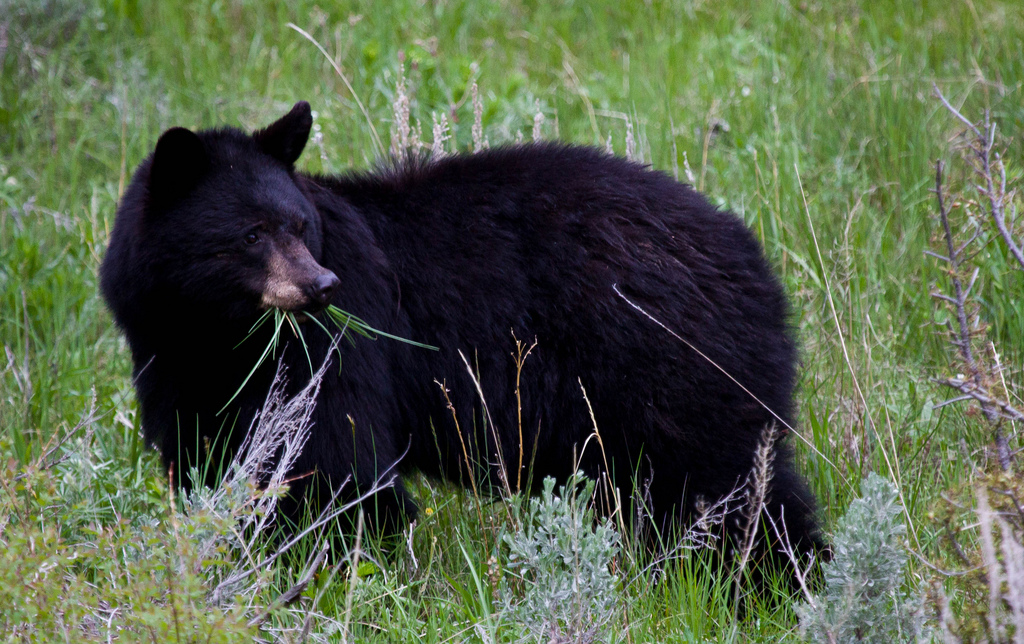
black-bear-blogHaving freshly done a mountain hike in bear country, I began to have some questions about bears so I did some research. The first question I wondered: Just how common are bear attacks? According to the article, Behaviour, by the Get Bear Smart Society,

Bears are NOT mean or malicious. Bears are normally shy, retiring animals that have very little desire to interact with humans. Unless they are forced to be around humans to be near a food source, they usually choose to avoid us.

That leads to my second question: Just how common are bear attacks? According to the article, A few surprises in decades-long black bear study, in the  Globe and Mail,

“Fatal black bear attacks were rare from 1900 to 2009 but they disproportionately occurred in Canada, according to an analysis published in the Journal of Wildlife Management. Of the 63 people who died in 59 incidents, 44 victims were mauled in Canada. It’s not known why, but periodic food shortages due to shorter growing seasons could be a factor.”

That means there were only 44 Canadian victims in 109 year span. The article also reports,

Researchers found that the vast majority of the confrontations weren’t the result of chance meetings in the woods, but the outcome of predatory behaviour, nearly always by lone male black bears. Surprisingly, only 8 per cent of the deadly attacks were attributed to mother bears.

So that made me wonder: Why are there bear attacks?  According to the Globe and Mail article,

Bear-caused fatalities have increased largely in lockstep with the continent’s human population growth and subsequent rise of recreational activities. Most of the deadly encounters with bears – 86 per cent – were recorded since 1960. Nine out of 10 times, the victim was alone or with only one other person. Improperly stored food and garbage was a likely attractant in 38 per cent of the incidents… In all cases, researchers found that bear pepper spray was not deployed as a measure of defence.

Another question: How do conservationists respond to bear habituation? Habituation is when a bear has constant, repeated exposure to people. When this happens bears can become increasingly bold and less afraid of people. These bears run the risk of becoming “problem” bears that enter townsites and campgrounds, places they are more likely to be illegally fed or rewarded with improperly stored garbage or pet food. Parks Canada’s wildlife specialists do their best to reverse this behaviour, but if a bear can’t be rehabilitated they are destroyed because they became too much of a risk to public safety. In areas outside the national parks, bears are often destroyed once they’ve been habituated. In Revelstoke, British Columbia, nine bears were destroyed in one week. (see the CBC article,  9 Bears Killed in one Week).

Recently Josh Bowmar, an American and a former javelin athlete, posted a video of himself killing a black bear in Alberta with a spear. That video caused sharp criticism on social media and from the provincial government. In the video, a black bear can be seen circling and then approaching the area that had been baited where Bowmar stands nearby before he impels the spear into the bear’s stomach.  The bear ran off, likely suffering for many hours and was found dead the next day. Alberta’s government have since announced it will introduce a ban on spear hunting this fall as part of those updated regulations. (see Alberta Government orders Investigation). If you haven’t seen the video, here it is.

I was surprised that spear hunting was even legal in Alberta. I was even more surprised to learn that baiting bears and other animals was also legal. Personally, I’ve never understood the appeal of hunting. When I was a teen I once shoot a sparrow with my pellet gun and killed the bird. I felt so incredibly guilty when the bird died that I’ve never intentional killed an animal since except for mosquitos, flies and spiders when my wife forces me to. Typically, I rescue the spiders and put them outside.

The bottom line is we humans have an obligation to learn how to live in harmony with wildlife. All living creatures have a right to exist. In fact, UNESCO, an agency of the United Nations, issued a Declaration for All Life on Earth which declared, we shall create a world based on love and harmony in which all forms of life are respected. Organizations such as, World Wildlife Federation (WWF) states their mission to stop the degradation of the planet’s natural environment and to build a future in which humans live in harmony with nature. I believe this is possible and education is the key. Dr. Jane Goodall, an animal rights activist and best known for dwelling with Tanzanian chimps to observe their behaviour, said it best when she said, “Only if we understand, will we care. Only if we care, will we help. Only if we help shall all be saved.”  If you are going to be in bear country, it is imperative that you get educated.  A good place to start is to read the Dispelling Myths article by the Get Bear Smart Society. To quote Nelson Mandela, “Education is the most powerful weapon which you can use to change the world”.