What is Wrong With Being Wrong?

A commentary on our culture’s obsession with being right.

Numerous posts come across my Facebook feed, and for the most part, I typically ignore them, but this week a post caught my attention. It contained the following meme:
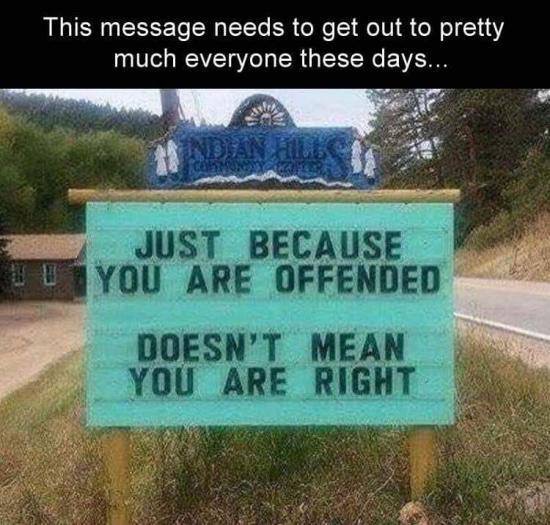
It’s true. People do get offended if you say, or even imply, they might be wrong. I’ve experienced it. I have to admit that even I have had times in my life when it was important for me to be right. I can think of many times when I was offended when told I was wrong. It got me thinking about the question: Why are people so obsessed with being right? Why are people so afraid to admit they’re wrong? An email, which I get regularly from Neal Donald Walsch, arrived in my inbox, and ironically it was about that topic. It read:

I believe God wants you to know that being “right” has nothing to do with it.

The idea that you call “right” is the idea that someone else calls “wrong.” The solution that you call “perfect” is the solution that another calls “unworkable.” The position that you feel is unassailable is the very position that others assail.

What will solve all of this? Not attack, that’s for sure.  And not defence, either. So what is left? Simple human love. The kind of love that says, “It doesn’t matter who is right or wrong. It only matters that you are not hurt.  And that we both can benefit. All true benefits are mutual.”

Wow! Those are some wise words, but it didn’t answer the question: Why is it so imperative to be right? I did some research, and in a Psychology Today article titled, Why Is It So Important to Be Right?  it said,

…this fixation is more likely wed to highly competitive cultures than traditionally oriented, cooperative societies. In the latter, issues of right and wrong don’t equivalently inform one’s sense of self or identity. The ego may be shaped by other influences, such as being honored, respected, or altruistic. In first-world cultures, the drive to be right advances one in the competitive race. In the desire to get ahead, this is utilized as a core value.

That explains it.  That answers the question. We live in a highly competitive world and being right (or being the best or being number one) is highly valued.   Our parents, our schools, and even our governments encourage us to be competitive; to be the best. If we’re not the best, then we are failures. Cooperation is encouraged by our religions, but even our religions are competing with one another to draw in believers. Cooperation is NOT highly valued in our culture. Our need to be right is ingrained in us from the moment we are born, because of the culture we live in.

In an another article titled, Why It’s Better to be Human Than to Be Right, it says the consequences of having to be right are:

  1. We oversimplify reality, as not everything can be divided into right or wrong.
  2. No matter how smart or logical we are, our mind plays a role in filtering our experience.
  3. We fear being wrong. We believe if we are wrong there’s something wrong with us.
  4. The decree to be always rights adds huge stress. Our brain is under constant pressure either justifying our thoughts or hiding our flaws.
  5. We stop listening to others. The belief of ‘being always right’ assumes that everyone else is wrong. When we own the truth, we stop trying to understand other people’s points of view.
  6. Resistance to being wrong paralyzes our understanding.
From: sheofferedthemchrist.wordpress.com

The above listed costs to needing to be right make a lot of sense. We do oversimplify reality, because let’s face it, our puny brains will never fully understand reality. Quantum Physics is proving that. We do fear being wrong, because we do think there is something wrong with us if we admit we’re wrong. Let’s be honest, being right adds enormous stress to our lives. Our brain must work overtime to justify our positions, or maybe we really are hiding our defects. Having to be right does paralyze our understanding. There is little doubt in my mind that obsessing about being right is damaging.

Psychology Today’s article, What’s Wrong With Being Right, says

Yet neither the positive nor negative perceptions that we hold represent an absolutely accurate reflection of reality. They are, rather, interpretations of ourselves, other people, and our world produced and shaped by our mental software. The difference between what is and what I think is can be an incredibly difficult distinction to make, because our thoughts can be extremely convincing when we are trying to discern the truth.

Practicing open-mindedness and reflection is enormously valuable in our close relationships [or any relationship for that matter]. It can be very difficult for those of us who have long been so attached to being right. It’s freeing, but humbling.

Realistically, our brain can never know all the facts, or understand the information we receive, because of our programming. A Christian would interpret information through Christian beliefs and values, whereas a Buddhist would interpret information through Buddhist thinking. A conservative would interpret information through conservative beliefs and values, whereas a liberal would interpret information through liberal beliefs and values. Our thoughts—or ego—convinces us that we are right and the opposing viewpoint is wrong. This doesn’t mean one is wrong and one is right. They’re just two different point of views, but as long as the need to be right exists, cooperation and consensus building cannot occur.

Perhaps American poet, author and teacher, Stephen Levine, said it best when he said, “Our addiction to always being right is a great block to the truth. It keeps us from the kind of openness that comes from confidence in our natural wisdom.”

So how do we move beyond the need to be right? Neal Donald Walsch says, “Simple human love.” Mother Teresa said, “Let us always meet each other with a smile, for the smile is the beginning of love.” I think Gautama Buddha, or The Buddha, said it best when he said, “Sometimes it’s better to be kind than to be right. We do not need an intelligent mind that speaks, but a patient heart that listens.” 

My favourite answer is a quote by Paula Heller Garland, a lecturer at University of North Texas. She says, “Often after arguing about differing opinions, I hear people say, “let’s agree to disagree.” I look forward to a time, so open-minded I’ll hear people say, “I’m right and you can be, too” That is what I’m working towards.

Is Democracy Broken?

A commentary on the present state of the world’s democracies.

A few weeks ago, we visited friends in a nearby city. During one of our discussions, this friend mentioned that he is disillusioned with democracy (not his exact words). I asked him why and he questioned the type of leaders that were being elected; leaders who were racist, narcissistic, misogynistic, anti-immigration, and who support white supremacy. This got me thinking. I began to wonder if democracy is broken.

When I visited China last November, our tour guide said something that made me question democracy. Our guide said the democratic world accomplishes little as governments are always squabbling. He further explained, whenever a democratic country elects a new political party, the previous party’s policies are reversed, thus little progress is made. I elaborated on this in my post on China (see China post). This begs the question: Are our democracies working efficiently? Is there something wrong with the way democracy is presently practiced?

Presently, there is increasing popularity in electing extremist right-wing politicians. According to Reference, neoconservatism is considered to be one of the more extreme right-wing ideologies. It takes a firm stance against anti-authority media and aligns itself with religious conservatives. Religious conservatives have specific positions on certain political issues such as abortion, homosexuality, creationism, science education, treatment of prisoners, immigration, and many other issues. Typically, conservative Christians favour anti-abortion laws, oppose gay marriage,  and many have a hardline against illegal immigration (see Intelligence Report).

Extremist right-wing politicians also tend to be nationalistic. In high school social studies—one of the courses I taught for many years—nationalism is defined as the belief that nations will benefit from acting independently rather than collectively, emphasizing national rather than international goals. Nationalist leaders are gaining momentum in Europe (see BBC). American president Donald Trump calls himself a nationalist. (See HuffPost). There are many extremist right-wing nationalistic politicians being elected. Why is this so? Does this mean democracy is failing us?

When our politicians act more like school aged children with their bullying behaviours and temper tantrums when they don’t get their way, I believe democracy is broken. When it becomes acceptable to vote for politicians who spout rhetoric that is divisive and “unchristian,” democracy is failing us.  When it becomes acceptable for the US president to use profanity, such as the “F” bomb (listen to Trump), we are electing a breed of politicians of the lowest kind.

Israeli Prime Minister Benjamin Netanyahu faced criminal investigations for fraud and bribery. A google search shows numerous US politicians under investigation. The US president is under investigation for obstruction of justice as well as other crimes. Two former Brazilian presidents were investigated for a scandal known as Operation Car Wash (see BBS).

My province recently elected a premier who was under investigation of voter fraud (see CBC). I thought politicians where supposed to have integrity. Even more disturbing for me, is our newly elected premier handed out earplugs to his caucus, clearly indicating his refusal to hear debate from democratically elected opposition members about a bill that removes some bargaining rights for government workers (see HuffPost). This kind of behaviour from a leader stems from arrogance; a leader who thinks his party knows best and those who have alternative views are to be ignored. I thought the heart of democracy was healthy debate. Apparently not in my province. Former US president, Barack Obama said, “The strongest democracies flourish from frequent and lively debate, but they endure when people of every background and belief find a way to set aside smaller differences in service of a greater purpose.” I believe this to be true. When healthy debate is squashed in our legislatures, then as far as I am concerned, democracy is broken.

That leads us to the question: What is wrong with democracy? Former British Prime Minster, Winston Churchill once said, “The best argument against democracy is a five-minute conversation with the average voter.” Perhaps he is onto something.  Louis L’Amour, an American novelist said, “To make democracy work, we must be a nation of participants, not simply observers. One who does not vote has no right to complain.” Exactly!

My brother and his wife worked during our province’s recent election, and both expressed how appalled they were by the electorate. They said they had numerous voters in their 30s and 40s who were voting for the first time. They also said they fielded numerous questions asking how the voting process works. Both my brother and his wife were shocked when several voters asked them why there were names on the ballots which they did not recognize. Many of them were looking for the party leaders’ names on the ballot. I was shocked to hear this. This is why, at least in part, democracy is broken. The voters are failing democracy.

Former US president, Franklin D. Roosevelt said, “Democracy cannot succeed unless those who express their choice are prepared to choose wisely. The real safeguard of democracy, therefore, is education.” That is it! Voters are too apathetic to educate themselves. That explains, at least in part, why Donald Trump won the 2016 election.  Trump’s supporters are largely uneducated, according to polls (see Inquisitr).

Former US president, John F. Kennedy, once said, “The ignorance of one voter in a democracy impairs the security of all.”  I have to wonder if unprepared voters, who buy into the dangerous rhetoric being spouted by extremist right-wing nationalistic politicians is putting world security at risk. History teaches extreme nationalism started both world wars. Jose Marti, a Cuban poet, writer, and nationalist leader said, “The first duty of a man is to think for himself.”  Democracy is literally “rule by people,” and is a system where the citizens choose their leaders or government. To fix our broken democracy, people need to start thinking for themselves and educating themselves. Voters need to make informed decisions when voting, and that means determining what news stories are true and which are “fake news” stories. This does not seem to be happening at the moment as most voters believe the rhetoric spouted by extremist right-wing nationalistic politicians. English humourist, writer, and journalist, Allan Coren says, “Democracy consists of choosing your dictators, after they’ve told you what you think it is you want to hear.”  Ralph Waldo Emerson, American 19th-century philosopher says, “Democracy becomes a government of bullies tempered by editors.” Are we electing dictators? Seems that way to me. Are we electing bullies?  I see this more and more, and voter ignorance is to blame.

Former US president, Abraham Lincoln said democracy is “government of, by and for the people.”  I still believe this is why democracy is the better system when it is not broken. Former US president Barack Obama said, “No party has a monopoly on wisdom. No democracy works without compromise.” Perhaps compromise is another problem. We’re living in a polarized time in history and compromise seems to have gone out the window. Each political party thinks they know best and are unwilling to listen to other parties’ views. An openness to different points of views and a willingness to compromise must occur for democracy to work effectively! Politicians must unite and do what is best for all. 

I know it is more complicated than what I’ve outlined, and democracy has problems other than those I’ve addressed above. The issue of corporate donations to help political parties get elected, for example.  Corporate wealth increases when a corporation’s preferred political party is elected and makes policies that perpetuate corporate greed. An informed electorate that votes responsibly is a good start to fixing our broken democracies.

Is Hate the New Norm?

A commentary on the increase of hate crimes.

Lately I’ve been seeing a lot of news reports about hate crimes; reports that I find both disturbing and alarming. Here are a few examples.

I recently read about a homophobic attack on a lesbian couple in London, England. The couple were travelling on a city bus where they were assaulted by a group of teens after they allegedly refused to kiss each other on demand (see Homophobic Attack).

The New York Times reported that in “Staten Island, the phrase ‘Synagogue of Satan’ was spray painted on a wall outside of a Jewish school. In Brooklyn, a pro-Hitler message was scrawled on a poster outside a Jewish children’s museum whose mission is to fight anti-Semitism. In Manhattan, two rainbow pride flags were set on fire outside of a gay bar.” (see Swastikas and Burning Pride Flags).  Another New York Times article reports “The number of reported murders, rapes and robberies in New York is lower now [2019] than it was a year ago…These recent figures show that the drop in crime that began in the mid-1990s has largely continued…Reported hate crimes are up 64 percent compared with this time a year ago. A majority of those incidents were targeted at Jews, officials said” (see Hate Crimes Up).

In my country, Canada, CBC News reports that “the number of police-reported hate crimes reached an all-time high in 2017, largely driven by incidents targeting Muslim, Jewish and black people, according to Statistics Canada data… [saying] hate crimes have been steadily climbing since 2014, but shot up by some 47 per cent 2017, the last year for which data was collected” (see Hate crimes reach all time high).

This is just a small sampling of articles I’ve seen about hate crimes. Not only was I alarmed and disturbed, but began to wonder if hate was the new norm. One of last times hate was so prevalent on our planet was pre WWII, during a time when Hitler set out to eliminate Jews, LTQB, and other undesirables. It was also the time of the Nanking massacre in China by the Japanese. The last time the world went down a path of hate; a path lead by Hitler and other extremist leaders, WWII occurred.

I used to naively think that the human race had learned from WWI and WWII and would never make that mistake again. Now I am not so sure. One thing that strikes me, is many of those who are perpetrating hate claim to be Christians. THEY ARE NOT TRUE CHRISTIANS.

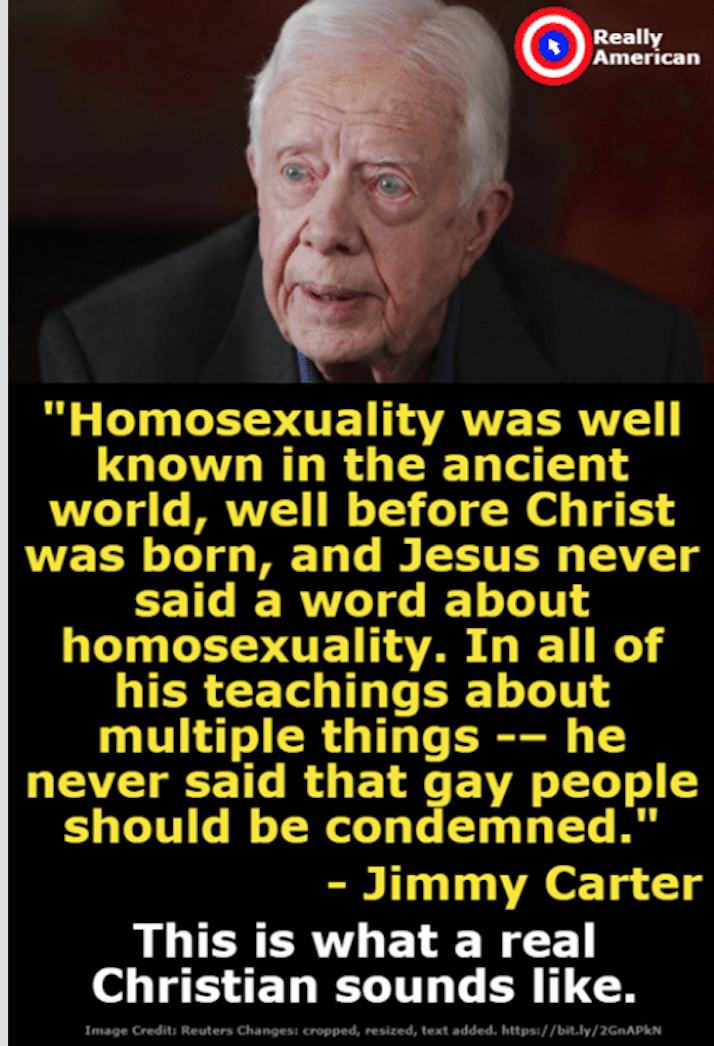
A meme recently went across my Facebook feed which is a quote from Jimmy Carter, the 39th president of the United States.

I agree with the former US president. Homophobes are not real Christians! I saw another meme on my Facebook feed.

That sums it up. Hate is the choice. We cannot choose homosexuality no more than we can choose to be heterosexual. It wasn’t a choice for me. I was just attracted to the opposite sex. I did not choose to be Caucasian. I did not choose to be born in Canada, although I am grateful I was. I did not choose to  come from European heritage. I can, however, choose to hate because I fear someone different than me. I can also choose to include and love those different from me.

Pope Francis is quoted as saying: “A person once asked me, in a provocative manner, if I approved of homosexuality. I replied with another question: ‘Tell me: when God looks at a gay person, does he endorse the existence of this person with love, or reject and condemn this person? We must always consider the person” (see  America Magazine in 2013). Pope Francis also said, “It is deplorable that homosexual persons have been and are the object of violent malice in speech or in action. Such treatment deserves the condemnation from the church’s pastors wherever it occurs.”

Where is all this hate coming from. One word answers that. FEAR. Much of that fear is propagated by extremist leaders.

Kevyn Aucoin, American makeup artist, photographer, and author, once said:

Fear is the most debilitating emotion in the world, and it can keep you from ever truly knowing yourself and others – its adverse effects can no longer be overlooked or underestimated. Fear breeds hatred, and hatred has the power to destroy everything in its path.

How true that is. Angela Merkel, former Chancellor of Germany, once said, “Hatred, racism, and extremism have no place in this country.” I agree with Ms. Merkel wholeheartedly. Hatred, racism, misogynism, anti-immigration, or anti-tolerance of any kind has no place in any country, especially my country.

The bottom line is unless humanity makes the choice to love one another, humanity is headed down perhaps another dark path like those that caused WWI and WWII.  After all,  Jesus commanded in John 13:34 of the Christian scriptures,

“I give you a new commandment, that you love one another. Just as I have loved you, you also should love one another.”

This is what a true Christian does!

These Pathogens Have Not Been Eradicated?

A commentary on the state of our world.

A Pow Wow my wife and I attended two years ago.

Last week my wife, a friend, and I attended an event called, “Meet the Inuit.” It was a series of talks by Inuit, Metis and Indigenous speakers, along with cultural performances. Many speakers said things that caught my attention. One Indigenous speaker talked about the clash of two cultures; Indigenous, Inuit, and Metis cultures verses European culture.

This made sense to me. Indigenous culture is present orientated—time conscious without clocks—whereas European Canadians are future oriented—time conscious with clocks. Indigenous Canadians (likely all Indigenous peoples) share their possessions freely—at least traditionally,  cooperate, are spiritual, and live in harmony with nature whereas European Canadians are savers and hoarders, compete for goods, driven by capitalism, and try to conquer nature. The world views of these two groups are vastly different.

Some of the speakers shared their experiences in the Residential Schools. It always strikes me when a Residential School survivor speaks of being taken away from their parents at ages 4 or 5, given haircuts and new clothes, told never to speak their native tongue, kept from their siblings who were attending the same school, and forced to stay several years in an unwelcoming large building. One speaker even told us how his brother literally was taken off the street by government agents without his parents being informed. His parents thought his brother had gone  missing.

CBC News has an article titled, Genocide against Indigenous Peoples, reports that the Canadian Museum for Human Rights in Winnipeg, Manitoba, now deems the treatment of Indigenous Peoples in Canada a genocide. Previously, the museum had said Indigenous Peoples faced cultural genocide rather than genocide.

The United Nations’ convention on Genocide (1948) says a genocide is:

  1. causing serious bodily or mental harm to members of the group
  2. deliberately inflicting on the group conditions of life calculated to bring about its physical destruction in whole or in part
  3. forcibly transferring children of the group to another group.

As The Star’s article, Cultural genocide?  says;

Canada did not pack Indigenous people onto train cars and send them to be gassed, or march them into fields and execute them with machine-gun fire. However, our country committed not “cultural” genocide, but just regular genocide.

We forcibly took children from families — sometimes at gunpoint — and flew them to remote locations they could not escape — sometimes in tiny handcuffs — where they were submitted to a program of forced labour and “education” designed to destroy their cultures and civilizations. This desire to destroy cultures seems to be the reasoning for various public figures’ use of the adjective “cultural” before genocide. The other reason, I presume, is that some cling tightly — and childishly — to the idea that Canada has always been on the side of goodness and justice, and they find it very hard to accept, admit, and announce that we are a country that committed a program of genocide that lasted for many decades.

Results of Rwandan Genocide

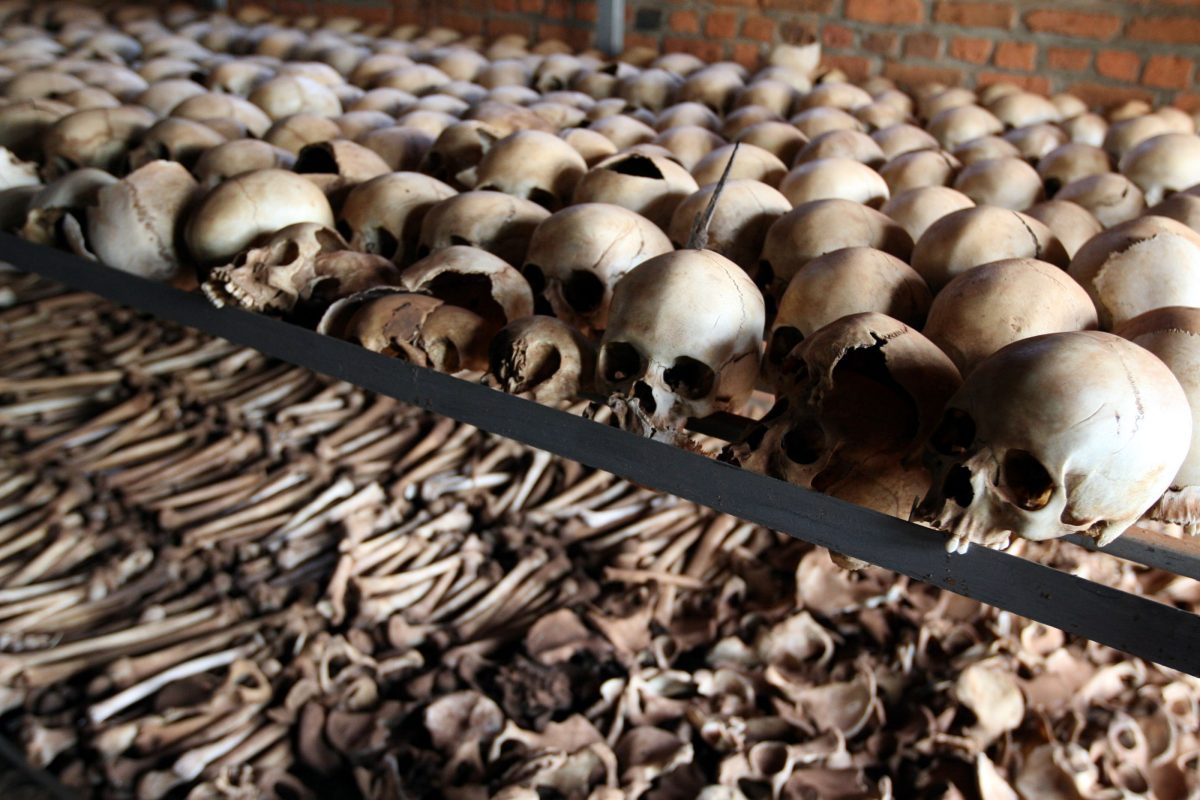
Let’s call “a spade a spade.” Canada committed genocide against our Indigenous, Inuit and Metis people; a genocide no different than the ones committed by Nazi Germany during WWII, or Rwanda in 1990s.  I must confess, I was one of those Canadians that held to the idea that Canada has always been on the side of goodness and justice. I no longer think that, and I now recognize that Canada has a dark past. Let us not forget the Japanese Internment during WWII; another dark part of our history.

One of the Indigenous speakers talked about how our greatest hurdles come from within. He spoke about what he called, The Six Social Pathogens.

Merriam-Webster defines a pathogen as a specific causative agent of disease. It typically refers to a bacterium or virus, but in the context of the speaker, a pathogen is a causative agent of the disease of racism. The six pathogens are: assumptions, presumptions, stereotyping, profiling, bias (for, or against), and misappropriation of feelings. This speaker says everyone—whether we’re aware of it or not—has some or all of the for mentioned pathogens working within us.

Before I go any further, let’s define the six pathogens. An assumption refers to something that is accepted as true without proof, whereas a presumption refers to an idea that is considered to be true on the basis of probability. Stereotyping is a set idea that people have about what a person, or group of people, are like. Profiling is the act of suspecting or targeting a person on the basis of observed characteristics or behaviour. A bias is a particular tendency, trend, inclination, feeling, or opinion, especially one that is preconceived or unreasoned.  Misappropriation means to put to a wrong use, so misappropriation of feelings is putting our feelings to a wrong use.

These six pathogens don’t just apply to attitudes towards the Indigenous, Metis, and Inuit people. They can apply to any group. As I observe what is happening in my country and the world, I would argue that these pathogens are presently very active. A Statistics Canada report in 2016 (the latest statistics I could find), revealed that the number of violent hate crimes rose 16% from the previous year, driven by increases in common assault, criminal harassment and uttering threats.” A 2014 Statistics Canada report found that, in two-thirds of cases, victims of crimes don’t report these hate crimes to the police.

As long as these six pathogens are alive and active, and there is a “us verses them” attitude, racism, prejudices, hate crimes, and so on, will continue. As long as we identify with a tribe instead of the human race, there will be conflict. As long as Christians, or Jews, or Hindus, or Muslims, or Buddhists think their faith is the right faith, there will be religious conflict. As long as there is masculism, there will be feminism. As long as feminist seeks to promote the rights and equality of women—which they should—and see themselves as equal with men, there will be misogyny, which is the disrespect and oppression of women.

As long as conservatives, as opposed to liberals, think their philosophy is best, there will be political tensions. As long as there are people who believe in “White Supremacy,” there will be racism and hate crimes. As long as there is ethnocentrism—The Cultural Superiority Complex, there will be anti-immigration. I could go on and on. Neale Donald Walsch, in one of his Conversations With God books, said, “Your way is not the only way. It’s just a way.”  We humans need to integrate that. Unless humans are willing to understand and accept differences, our planet is headed down a dark path.

Now, I had to ask myself: Do I have these pathogens? When I thought about it, and was completely honest with myself, the answer is yes. Have I made assumptions, or presumptions? Yes. I once believed Christianity was the superior religion. Did I stereotype? Yes. I once thought that people living on the streets were just too lazy to get a job. Did I profile? Yes. I targeted “unique” individuals in high school. Did I have biases. Yes. I had preconceived ideas about Indigenous people—they were lazy, drunks, etc.—until I educated myself. Were my feelings misappropriated? Yes.  I had my opinions about the LGBT community until I got to know some of their members. I would judge people based on first impressions, when I knew nothing about them, or knew anything about their story. In other words, I didn’t follow the Muslim proverb:  To understand a man, you’ve got to walk a mile in his shoes, whether they fit or not. Other variations of this proverb are: walk a mile in someone else’s moccasins, put oneself in another’s shoes, put oneself in another’s place, walk a mile in someone else’s shoes, and see the world through someone else’s eyes. Now, I try to do this; I try and  understand others and avoid judging them. I’m not saying I’m always successful, but I try.  If humanity did the same, perhaps our planet would be in a better place.

When Will the Meanness End?

As a teacher, I spent my entire career trying to instill in my students the values of respect, responsibility, honesty, integrity, kindness, and compassion. I know many of my colleagues did as well. We tried, as teachers, to show students that bullying behaviour was unacceptable, and not the way to solve problems. We also taught that all people were equal and that racism was immoral.

What is discouraging is the amount of bullying I see happening in the world. The World Health Organization defines bullying as, “repeated exposure of one person to physical and/or emotional aggression including teasing, name calling, mockery, threats, harassment, taunting, hazing, social exclusion or rumours.”  Here are two recent examples.

The Edmonton Journal reported that an Edmonton, Alberta mosque received a detestable letter in January of this year. Here are some of the highlights of the letter:

“On behalf of real Albertans, we would like to advise you that you and your religion [Muslims] don’t belong here in Alberta…We are White. We are Christians. We are Proud…Our Premier to be…is going to take Alberta back…We are not racist. We just want our way of life back.”

What amazes me is the author(s) say they speak on behalf of real Albertans. For those who may not know, an Albertan is a person who lives in Alberta, one of the ten provinces in Canada. I googled ‘real Albertans’ because I really don’t know what a real Albertan is. I could not find a definition. By the tone of the letter, I would say I am not a real Albertan, even though I was born, raised, and lived here all my life.

The letter says ‘we are White’ and ‘We are Christians.” I’m also white and raised Christian. A declaration of ‘we are white’ can only be interpreted as a declaration of white supremacy. Meriam-Webster Dictionary defines white supremacy as a “person who believes that the white race is inherently superior to other races and that white people should have control over people of other races.” So, that definitely makes me not a real Albertan as I think ALL humans are equal. That is what the UN Declaration of Human Rights says in Article 1: “All human beings are born free and equal in dignity and rights.”

Now what astonishes me the most about this terrible letter is the declaration, “We are Christian.” There is nothing Christian about this letter’s message. Romans 2:11, in the Christian Bible says, “For God shows no partiality.” Furthermore, Mark 12:31 commands, “You shall love your neighbour as yourself.” The message of the letter is the opposite. There is NOTHING Christian about this letter’s message.

The declaration, “We are not racist,” in the letter is what astounds me the most. Meriam-Webster Dictionary defines racism as “a belief that race is the primary determinant of human traits and capacities and that racial differences produce an inherent superiority of a particular race.” The letter’s declaration of “We are White” infers whites are superior. Clearly the author(s) of this letter are racist and don’t know what a racist is, nor what a Christian is.

In January of this year, CTV News reported that a threatening letter was left on the doorstep of a Leduc, Alberta Indigenous family urging them to ‘move out’.  The letter said, ‘We do not like your kind’. This is eerily similar to a letter I referred to in an earlier blog post, Should we be worried.  That letter, like this one, was signed “Your friendly Neighbours.” There is nothing friendly about a letter that threatens. The authors of this letter are hypocrites.

Furthermore, this is a racist letter. The author(s) are suggesting superiority of a particular race—the white race—for they stated, ‘We do not like your kind’.  They disapproved of the family’s “lifestyle,” criticizing the upkeep of the family’s home. The writers wrote, “If you cannot take care of your property, then go back to the Indian reservation where it is accepted…We gave you land and you need to respect the generosity.”

The last statement is insulting, as the author(s) clearly don’t know Canada’s history. Indigenous people are the original peoples—thus why they are referred to as First Nations People—of Canada. A website of the government of British Columbia (another Canadian province), also called B.C. says, “Indigenous people have lived in the area now known as B.C. for more than 10,000 years.” Europeans, on the other hand, landed in Canada in 1497 with the expedition of John Cabot. Really, the Norsemen (Vikings) were the first in Canada dating to around the year 1000. L’Anse aux Meadows, in Newfoundland and Labrador is the only confirmed Norse archeological site in North America, and is widely accepted as evidence. Indigenous people were in Canada long before Europeans.  This is why the letter’s statement, “We gave you land and you need to respect the generosity,” is absurd. If anyone was generous, it was the Indigenous people who welcomed and allowed the Europeans to stay.

I like to believe that we teachers made a difference in instilling values into our students. I’ve had parents tell me we have. But, it only takes one person to undermine what teachers and parents do. The Psychology Today’s article, The Trump Effect: An Update, says,

“Last spring, we wrote a two-part post about “The Trump Effect,” which was originally defined as an increase in bullying in schools caused by the rhetoric Donald Trump used during his presidential campaign. Now, a year into Mr. Trump’s presidency, the definition of The Trump Effect has expanded to include religious and racial bullying by adults as well as: misogyny, sexual assault, and other socially unacceptable behaviours.”

The article goes on to say,

“Free speech and expressing our opinion is a constitutional right. It’s up to others whether or not they want to listen. But when the speaker is POTUS, we all listen. And when the president’s use of provocative rhetoric that causes harm to others, including and especially innocents, or when he behaves in previously unacceptable ways, what can we do? What should we do?

First, we can realize the only person we have control over is ourselves. We control what we think, what we choose to say, and how we act and react. We can choose to be harsh and damaging, or to be kind and compassionate.”

It is not fair to put all the blame on the current resident of the White House, as there are other world leaders spewing rhetoric promoting racism and bullying. However, Trump is likely the single most negative influence in North America. This childish man has brought out the worst in some people and his rhetoric is impacting my country. What Trump has taught me is our world needs more love, kindness and compassion.  Thankfully, there are good people. Neighbours of the Leduc Indigenous family overwhelming came out supporting the family. (see Hateful letter backfires).

A TRUE Christian speaks out against unkindness, racism and bullying. Christian or not, that is what we need to do. I think Francis of Assisi said it best in the Serenity Prayer. “Lord, grant that I might not so much seek to be loved as to love.”  Or as the Christian Bible says in 1 John 4:20,

“If anyone says, “I love God,” and hates his brother, he is a liar; for he who does not love his brother whom he has seen cannot love God whom he has not seen.” If the authors of these letters claim to be Christian, then they need to act as one.

Did the Pope Really Refuse to Apologize?

A commentary on whether the Pope should apologize to Canada’s Indigenous people.

Back in May of 2017, Canada’s Prime Minister Justin Trudeau met with Pope Francis and asked him to apologize for the Catholic Church’s role in the residential school system where abuse of indigenous children occurred (see Newsweek).  When I first heard about this, I was confused as I thought the Pope had already apologized. I  wondered why the Catholic leader was being asked to apologize again.  Newsweek’s article explains that in 2009 the previous pontiff, Pope Benedict, met with survivor of the system Phil Fontaine, then national chief of the Assembly of First Nations. The article asserts that the pope did not formally apologize. Instead, he simply shared his ‘sorrow’ and ‘sympathy.’

Pope Francis

In March, the headline, Pope’s decision to not issue apology , appeared on the CBC News website. The article says Pope Francis claimed he could not personally apologize for residential school abuses. This month, Global News reported that the Canadian Parliament held a “historic” debate on whether to ask Pope Francis to formally apologize for the substantial role the Catholic church played in the residential school system. This week The National Post reports that Canadian Members of Parliament (MPs) passed a motion to invite the Pope to Canada to apologize for residential schools. The vote was passed by a margin of 269-10 .  One of the advocates of the motion was residential school survivor and MP, Romeo Saganash. The article says that an apology is one of the 94 Calls to Action of the Truth and Reconciliation Commission; a Commission that recommended an apology be delivered in Canada by the pontiff, for the church’s role in the residential school abuse of First Nations, Inuit and Metis children.

All this talk about another apology from a pope piqued my curiosity. If the previous pope, Pope Benedict, already issued an apology, what is this all about? I set out to find out.

The National Observer’s article, Bishops try to clarify Pope’s refusal to apologize for residential schools, says the Canadian Conference of Catholic Bishops sent a background paper to MPs and senators. The paper says the church has “on a number of occasions expressed regret and remorse at the involvement by various Catholics” in the schools. It also reminds us that Pope Benedict met with a delegation of Indigenous leaders in 2009 “and expressed sorrow and regret for the abuses suffered” in the schools. The Bishop’s paper said Phil Fontaine declared that the meeting with Pope Benedict “closes the circle of reconciliation.” It also said

  “To suggest that the Catholic community has not accepted responsibility for its involvement in residential schools is simply inaccurate. The Catholic Church has apologized in the way it is structured.”

The New York Times article, A Pope Given to Apologies Has Nothing for Indigenous Canada, says that Phil Fontaine has since stated, “It was right for the moment,” about Pope Benedict’s expression of sorrow. “But there’s a lot we didn’t know about in 2009: We didn’t know the number of deaths, the numbers of those abused. So much has been exposed through the Truth and Reconciliation Commission, it’s really so different now.”

 I have to agree with Mr. Fontaine. Since 2009 we’ve learned a lot more about the horrors that occurred in those schools. In fact, I was shocked to learn doing this post that CBC News reported that Ontario Provincial Police files reveal that an Ontario residential school, St. Anne’s, had built its own electric chair. In my last post, Hockey is Part of Canada, I talked about how residential school students lived in substandard conditions, endured physical, emotional and sexual abuse by brothers, priests and nuns who claimed they represented God.

This begs the question: Was the 2009 apology a true, sincere apology, and what constitutes an accurate apology anyways?  Mindtools.com in its article, How to Apologize: Asking for Forgiveness Gracefully, says to apologize correctly, an apology must:

  1. start with two magic words: “I’m sorry,” or “I apologize.”
  2. admit responsibility for actions or behaviour and acknowledge what an offender did.
  3. take action to make the situation right.
  4. explain that the offender will never repeat the action or behaviour again.

Psychology Today’s article, The Five Ingredients of an Effective Apology, says in order for an apology to be effective, it must have the following ingredients:

  1. A clear ‘I’m sorry’ statement.
  2. An expression of regret for what happened.
  3. An acknowledgment that social norms or expectations were violated.
  4. An empathy statement acknowledging the full impact of the offender’s actions on the victim(s). In other words, to truly forgive, a victim needs to feel that the offender completely understands the full impact their actions had on them.
  5. A request for forgiveness.

So, do the Canadian Conference of Bishops have a valid argument? Has the Catholic Church given a proper apology? Using the above criteria, l shall analyze Pope Benedict’s 2009 apology.

CTV News in 2009 reported, that the pontiff expressed his sorrow and emphasized that “acts of abuse cannot be tolerated”.  Pope Benedict went on to say,

“Given the sufferings that some indigenous children experienced in the Canadian residential school system, the Holy Father expressed his sorrow at the anguish caused by the deplorable conduct of some members of the church and he offered his sympathy and prayerful solidarity.”

Both Mindtools.com and Psychology Today say the words “I’m sorry,” or “I apologize” need to be used. They were not used by the pontiff in 2009. This is the primary argument for why it was  not a real apology. Pope Benedict’s apology definitely fails on this point.

Psychology Today says there needs to be an expression of regret for what happened. The Pontiff expressed his sorrow at the anguish. I’d say that shows regret, so it’s a pass on this one.

Mindtools.com says an apology needs to take responsibility for actions or behaviour as well as acknowledge what occurred. The Holy Father did acknowledge what happened, i.e. “the deplorable conduct of some members of the church”.  It’s debatable whether he’s taken responsibility. Another word for responsibility is accountability, which means being answerable for one’s actions.  Expressing “sorrow” and “regret” is not being accountable . I’d give a fail for this one.

Psychology Todays says an empathy statement acknowledging the full impact of an offender’s actions on the other person, needs to be given.  Benedict talked about “the anguish caused by the deplorable conduct of some members of the church” but that is hardly acknowledging the full impact of the actions. I would give a fail on this one.

Mindtools.com says the offender must take action to make the situation right and promise to never repeat the action or behavior. The pope’s apology fails on these points. Psychology Today says there needs to be a request for forgiveness. This did not happen, so a fail on this one as well.

Canada’s Parliament Buildings

Is our Prime Minister and Canada’s Members of Parliament justified in asking Pope Francis to apologize? After my analysis, I would say a resounding YES. Furthermore, aboard the Papal plane back in 2016, Pope Francis told reporters that gays — and all the other people the church has marginalized, such as the poor and the exploited — deserve an apology (see CBC).  It would seem to me that the indigenous people were marginalized, meaning they were seen as less important by members of the church, as late as 1996 when the last federally operated residential school closed. Actions speak louder than words. The pope needs to put his own words into action and deliver a sincere, acceptable apology to the indigenous people of Canada on behalf of the church he represents. It’s the Christian thing to do!

Just Another Movie About a Myth

A commentary about myths perpetrated by Hollywood.

Hostiles is Hollywood’s latest Western movie that was released January 21. I haven’t seen the movie yet, but I was curious as to whether this movie was different from other Westerns I’ve seen. A typical Western is cowboys fighting the savage Indians or Native Americans. Was this latest movie any different?  This is a synopsis from Tribute.ca.

Embittered U.S. Cavalry officer Captain Joseph J. Blocker is given the task of accompanying Cheyenne Chief Yellow Hawk and his family from Fort Berringer, an isolated Army outpost in New Mexico, back to their tribal lands in Montana in the late 1890s, in order to make sure they arrive safely without incident. Yellow Hawk, who has spent seven years in captivity, has cancer, and wants to die in peace on his own land.

Blocker hates “Indians,” having slaughtered many of them himself, and having nearly died at the hands of a Kiowa. Although he sees them as nothing but savages, he’s still forced to accept the assignment. Once he and his soldiers get out of sight of the fort, he orders that the Chief and his family are put in chains.

Here is the trailer


I’m saddened to say Hostiles is just another Western portraying the aboriginal people as savage, uncivilized people who need to be wiped out or at the very least civilized. I grew up watching movies that portrayed Native Americans as savages. The Oxford Dictionary defines savage as barbaric, primitive or uncivilized. Because of Hollywood stereotypes, I believed Native Americans were inferior to Caucasians. We never studied First Nations (FN) culture in school. This video clip shows Hollywood’s portrayal of the FN people and consequently reinforcing stereotypic beliefs which are still alive today.

It seems this movie is no different. The Guardian’s review seems to agree with me.

It sometimes looks as if [Scott] Cooper [the director] thinks that his film can acknowledge and cancel the historical issues of white oppression simply by turning the violence levels up to boiling point, so that the shock of its cruelty, and the virulence of toxic masculinity, combined with the emollient beauty of the surrounding natural world and a growing emotional tenderness between Rosalie and Blocker, will somehow dissolve the great historical wrongs within a romantic narrative of learning and personal discovery…A flawed, but interesting drama.

I had hoped that in this 21st century Hollywood would at least begin to show the world the truth about FN people. Everything I’ve learned and taught (I taught Social Studies for many years) says that aboriginal people were highly civilized thus refuting the myth that when the European settlers arrived in the “New World”, they encountered bands of primitive, uncivilized, pagan savages.

Allow me to prove my point. Wikipedia’s Indigenous people in Canada says the First Nations people had settled and established trade routes across what is now Canada by 500 BCE–1,000 CE. Communities developed each with its own culture, customs, and character. Many Aboriginal civilizations established characteristics that included permanent urban settlements or cities, agriculture, civic and monumental architecture; a reference to the Mound Builders.  Mound Builders were inhabitants of North America during a 5,000-year period who constructed various styles of earthen mounds for religious and ceremonial, burial, and residential purposes. Most notably, this article says the Indigenous people had complex societal hierarchies, meaning First Nations people had a division of labour in which its members of society were more or less specialized in particular activities and depended on others for goods and services;  a system regulated by custom and laws.

Ojibwa Chief George Copway whose Ojibwa name was Kah-Ge-Ga-Gah-Bowh meaning “He Who Stands Forever.” He lived from 1818-1863 and was a writer, ethnographer, Methodist missionary, lecturer, and advocate of Native Americans. Chief Copway is reported to say;

“Among the Indians there have been no written laws. Customs handed down from generation to generation have been the only laws to guide them.  Every one might act different from what was considered right did he choose to do so, but such acts would bring upon him the censure of the Nation….  This fear of the Nation’s censure acted as a mighty band, binding all in one social, honorable compact.”   (source)

An ancient Cherokee proverb says: “When the white man discovered this country Indians were running it. No taxes, no debt, women did all the work. White man thought he could improve on a system like this.” (source)

This Iroquois Prayer gives us an understanding of the Psyche of some the FN people.

We return thanks to our mother, the earth, which sustains us. We return thanks to the rivers and streams, which supply us with water. We return thanks to all herbs, which furnish medicines for the cure of our diseases. We return thanks to the corn, and to her sisters, the beans and squash, which give us life. We return thanks to the bushes and trees, which provide us with fruit. We return thanks to the wind, which, moving the air, has banished diseases. We return thanks to the moon and the stars, which have given us their light when the sun was gone. We return thanks to our grandfather He-no, who has given to us his rain. We return thanks to the sun, that he has looked upon the earth with a beneficent eye. Lastly, we return thanks to the Great Spirit, in whom is embodied all goodness, and who directs all things for the good of his children  (Source: Huffington Post)

Do these quotes sound like they’re from an uncivilized, savage people? Definitely not. They reveal a people who had a strong connection and respect for the land. They describe a people who were highly organized and structured. That would not be the case if they were savages. They were not barbaric which Meriam-Webster defines as marked by a lack of restraint. FN people showed much restraint when it came to the land and using its resources.

Most western movies portrayed the FN people as wild, savage killers; not a peaceful people. Did the various aboriginal tribes fight with one another? Yes. This was a way to settle disputes, but their preference, like us, was to live in peace.

Duhaime’s Encyclopedia of Law tells of a peace accord, roughly 1100, between the Cayuga, Mohawks, Senecas, Oneidas and Onondagas Indians (collectively, the “Iroquois”). This accord is also referred to as the Oral Constitution of the Five Nations Indian Confederacy. But it is known to the aboriginal people of North America as the Great Law or Great Law of Peace.

The website, The Great Peacemakers explains that the accord

… protected the independence and liberties of each individual, each clan, and each nation while uniting the five nations into a confederacy, committed to inward well-being and outward strength. Raw materials and hunting grounds were to be shared. All religions were to be accepted. Unauthorized search was prohibited. Immigration into a nation within the League was welcomed regardless of ethnicity, but predicated upon acceptance of the Great Law.

It reminds me of the European Union, an organization that enhances common citizenship rights and improves cooperation, among other things. It is difficult to refute that the FN people were uncivilized. The Free Dictionary defines civilized as  ” having a highly developed society  and culture”.  The Great Law verifies just that.  It seems to me that Hollywood should be making movies that celebrate the truth about First Nations people instead of keeping a myth alive. But then again, maybe that would not be the makings for a very exciting movie.

Unexpected Bonuses to Briefly Coming Out of Retirement

Maybe the aboriginal people had it right all along.

You’ve perhaps noticed that I’ve published less frequently lately. Well, there’s a reason for that.  The six weeks prior to Christmas, I took off my retirement shoes and taught full time. The school I taught at for 27 years could not find a teacher to replace a maternity leave. Since the principal was sounding desperate, I agreed to take on a six-week contract.

I enjoyed being with young people again. That was why I went into teaching in the first place. Having said that, this experience definitely reaffirmed for me why I retired. Going back to planning lessons, marking assignments, and putting up with disruptive students confirmed for me that retirement from full-time teaching was the right choice.

Even though it was exhausting and demanding, I am truly grateful for the opportunities this experience provided. During my brief teaching stint, there was a professional development (PD) day scheduled. I admit, I was a bit negative about attending. After all, I would be retired once again in a few weeks. Why would I need more PD? I talked to my principal about it and he directed me to attend as the topic was general. I am so thankful he did. It was a very moving and powerful day.

In the morning, I attended a blanket ceremony. What is a blanket ceremony, you ask? This ceremony came about as a result of the Truth and Reconciliation Commission (TRC) initiated by the Canadian government in 2008. The commission provided those directly or indirectly affected by the legacy of the Indian Residential Schools system an opportunity to share their stories and experiences. Here is a paraphrased explanation of a blanket ceremony according to the Karios website:

In 1996, the Aboriginal Rights Coalition worked with Indigenous elders and teachers to develop an interactive way of learning the history most Canadians were never taught. The Blanket Exercise was the result. The Blanket Exercise is based on participatory education methodology and the goal is to build understanding about the shared history as Indigenous and non-Indigenous people in Canada by walking through pre-contact, treaty-making, colonization and resistance. Everyone is actively involved as they step onto blankets that represent the land, and into the role of First Nations, Inuit and later Métis people. By engaging on an emotional and intellectual level, the Blanket Exercise effectively educates and increases empathy.

Now I thought I knew about residential schools as I had taught about them  when the social studies curriculum changed in 2005; when residential schools were included in the high school curriculum. Experiencing this ceremony left me feeling both shocked and saddened. Shocked because to visually see the result of European contact on indigenous people was appalling, and saddened that my Eurocentric ancestors could be so cruel.

The afternoon of the PD day was spent learning about First Nation (FN) culture. I’ve always been drawn to the indigenous people’s culture, especially their spirituality. It is a spirituality that is so inclusive and respectful of nature. This Ancient Indian Proverb expresses FN spirituality well.

“Treat the Earth well. It was not given to you by your parents, it was loaned to you by your children. We do not inherit the Earth from our ancestors, we borrow it from our children.”

This Cherokee Prayer also illustrates the FN People’s sacredness.

“Oh Great Spirit, help me always to speak the truth quietly, to listen with an open mind when others speak, and to remember the peace that may be found in silence.”

The afternoon included a smudging ceremony. For the FN Peoples, the purpose of the smudging ceremony is to cleanse and to remove any negative energy that may be present in a place, an object or a person. This is why many FN activities start with a smudge. A smudge is made by lighting dried plants (sage, sweetgrass, cedar or tobacco) in a shell or bowl until they smoulder.

We were shown what to do when doing a smudge. The smoke from the smudge is directed towards the head, so a person can think clearly, ears so you can hear the good things in life of others and of yourself; your mouth so you can speak of good things and say kind words to one another; your heart so you can feel good about yourself and others; and lastly you smudge your whole self so you can be blessed for the day. How beautiful is that?

Another opportunity I had during my six-week teaching stint was I got in on a field trip that was already planned before I started. It was a trip to Blue Quills, formerly a Residential School.

Sadly, I knew nothing about the Residential Schools until the mid 2000’s. It certainly wasn’t taught to me in school or university.  In case you don’t know about the Residential Schools in Canada, here is a brief history.

The Residential School system was created with the intent of removing children from their own culture and assimilating them into Canadian culture. Many of the residential schools were run by churches of various denominations, with the majority run by the Roman Catholic Church. Over its more than hundred-year existence, roughly 150,000 Indigenous children were placed in residential schools nationally.  At least 6,000 of these students are estimated to have died while residents.

The residential school system harmed Indigenous children considerably by removing them from their families, depriving them of their native languages, and subjecting numerous of them to physical, mental and sexual abuse. Detached from their families and culture, and forced to speak only English or French, students who attended the residential school system were unable to fit into either their aboriginal communities or Canadian society. The legacy of the system has been connected to an increased incidence of post-traumatic stress, alcoholism, substance abuse, and suicide within Indigenous communities.

Back to my personal experience. The present Blue Quills Indian Residential School building was opened in 1931, and housed about 200 students a year. We toured the building and heard from two of the school’s survivors, both who were forcibly taken from their homes at the age of six to attend the school. They told many stories of the injustices that befell them; injustices such as lack of nutritious and sometimes inedible food, mental abuse, sexual abuse, and shaming practices by the staff. I was shocked to learn that the people of nearby community of St. Paul were not even aware that the school existed.

In 1969, residential schools were removed from churches. The government intended to sell Blue Quills to the nearby town of St. Paul for a dollar. Local Indigenous people formed the Blue Quills Native Education Council and sought authority to operate the school, but Indian Affairs disregarded their requests.

When they attempted to close Blue Quills in 1971, the local FN people held a sit-in at the school, demanding control of the school. Control was turned over to the Blue Quills Native Education Council and it became the first Canadian residential school administered by Aboriginal people. Blue Quills is now a FN college, run by the seven FN communities that surround it. The college’s central emphasis is on language revitalization, especially the Cree language. I applaud the FN people for their courage and determination, and for creating a fully functioning college which is still going strong in the 21st century.

John (Fire) Lame Deer was a Lakota-Sioux medicine man who once said,

“Before our white brothers arrived to make us civilized men, we didn’t have any kind of prison. Because of this, we had no delinquents. We had no locks nor keys and therefore among us there were no thieves. When someone was so poor that he couldn’t afford a horse, a tent or a blanket, he would, in that case, receive it all as a gift. We were too uncivilized to give great importance to private property. We didn’t know any kind of money and consequently, the value of a human being was not determined by his wealth. We had no written laws laid down, no lawyers, no politicians, therefore we were not able to cheat and swindle one another. We were really in bad shape before the white men arrived and I don’t know how to explain how we were able to manage without these fundamental things that (so they tell us) are so necessary for a civilized society.”

Our ancestors entered North America, known to some Indigenous groups as Turtle Island, with their superiority complex believing that they were the civilized ones and had a responsibility to “civilize” the original inhabitants of Turtle Island. Now I always taught my social students the importance of practicing “historical empathy,” to place themselves in the historical situation to gain a deeper understanding of the events. Our European ancestors were acting in the best way they knew with their belief systems of the period. However, I have come to realize that it was the indigenous culture who perhaps had it right with their culture of sharing the land, stewardship of the land and spirituality. Although FN spirituality varied between tribes, it taught reverence for their ancestors by honouring and respecting others, and a respect for the land. In comparison, Europeans had a culture of land ownership, land exploitation and who viewed FN spirituality as a collection of superstitions.  I have to wonder how different our country would be had our ancestors arrived with an attitude of receptivity to new ways, instead of an attitude of superiority.