
Napoleon Bonaparte was once reported to have said, “History is the version of past events that people have decided to agree upon.” George Kitson Clark once said, “No historian should be trusted implicitly.” Norman Pearson is quoted as saying, “To look back upon history is inevitably to distort it.” There was a time whenever I read something in a history book or was taught something in a history class, I believed it to be the “Gospel truth.” Now being older and wiser I no longer do. So why would I say that?
 I recently read a book titled, Inconvenient Indian by Thomas King. What surprised me, was that Mr. King claims that the massacre that allegedly occurred at the Alamo was a fabrication, a story created over the years. But that is not what history says.
I did some internet research and Wikipedia says this about the Alamo massacre: “In the early morning hours of March 6, 1866, the Mexican Army advanced on the Alamo. After repulsing two attacks, the Texans were unable to fend off a third attack… Between five and seven Texans may have surrendered; if so, they were quickly executed. Most eyewitness accounts reported between 182 and 257 Texans died, while most historians of the Alamo agree that around 600 Mexicans were killed or wounded.” I checked other websites which say more or less the same thing. So who is right?
Mr. King also says, the story about Pocahontas and John Smith, perpetrated by Disney’s movie Pocahontas is also a myth, or in other words a fabricated story. He claims that John Smith would have been 24 years old and Pocahontas maybe 10 or 12 years old at best.
Now Disney’s version of the story is one of romance between an American Indian woman named Pocahontas and John Smith, who journeyed together to the New World with other settlers to begin new lives. Do the children, or even adults for that matter, who have watched this movie believe they have watched a historically accurate depiction of events of the past? Probably. My experience as a teacher has been most young people think what they see in movies and on television is truth or is real history. At least Wikipedia sets the record straight about the story of Pocahontas as it says, “In a well-known historical anecdote, she [Pocahontas] is said to have saved the life of an Indian captive, Englishman John Smith, in 1607 by placing her head upon his own when her father raised his war club to execute him. The general consensus of historians is that this story, as told by Smith, is untrue.” So we know Mr. King is likely right about the Pocahontas story.
In July of 2007 while on a family trip to Eastern Canada, we visited the Maritime Museum of the Atlantic in Halifax, NS. At that time there was an exhibition on pirates. It was interesting to learn that commonly held belief that pirates make their enemies walk the plank as well as the belief that pirates often have parrots on their shoulders are myths. We learned that these are myths. There apparently is no historical evidence to support these commonly held beliefs about pirates. Also, the wide held belief that pirates buried their treasures is also a myth. I guess I was somewhat disappointed to learn about these untruths as I always thought pirates did bury their treasures.
So what else have we been taught that is NOT a historical truth? According to the article, Facts Prove Everything You Thought You Knew About History… Is Dead Wrong, Christopher Columbus did not discover America. He only discovered the Caribbean Islands. I don’t know about you, but I was taught in school that Columbus discovered America. It has been proven that the Vikings were in North America before Columbus as there is an archeological site at the northern tip of Newfoundland where they discovered the remains of the Viking’s houses. In fact, they reconstructed a replica of the settlement about 100 yards away from the site. It has been unquestionably determined that the Vikings were there for about 10 years, specifically, Leif Erikson and his extended family. I guess I can erase that untruth from my memory.
Dictonary.com defines the “Napoleon complex” as the condition of being small in stature but aggressively ambitious and seeking absolute control. It could just as easily be called the “Short Man Syndrome.” In other words, this complex is named after Napoleon Bonaparte because of the widely held belief that Napoleon was short. But according to the 16 facts article I referred to earlier, the truth is Napoleon Bonaparte was not short at all. He was five feet, seven inches. That was slightly taller than average for a Frenchman at the time. Another historical inaccuracy to erase from memory.
The idea that Albert Einstein failed math in school is an urban myth (see 20 things you need to know about Einstein). It turns out that Einstein didn’t fail math in school, it was a false claim published by Ripley’s. The truth be known is that when he was 15, he mastered differential and integral calculus which makes sense since he is widely held as one of the world’s few geniuses.
Then there is the History Channel series called Hunting Hitler that proposes that Hitler faked his own death, escaped through the Berlin underground to an airport, flew to Spain where he was smuggled onto a U-boat and taken to Argentina with a stop at the Canary Islands. He then lived hidden in the Argentina jungles and was eventually seen in Brazil and Columbia. Now I was always taught that Adolf Hitler committed suicide in his bunker in Berlin in 1945 although this apparently has never been confirmed. Now I must say after watching eight episodes and considering the evidence provided, I am now thinking what I’ve been taught about Hitler is wrong. I am now leaning towards the premise that Hitler did not die in his bunker in 1945.
 In Canada, history has always taught that Louis Riel, a Canadian Métis trailblazer, who led two resistance movements against the Canadian government and its first prime minister, Sir John A. Macdonald was a traitor. He was a traitor because he led two rebellions known as the Red River Rebellion of 1869–1870 and North-West Rebellion of 1885. In July of 1885 Riel was charged with treason. Riel was publicly executed by way of hanging in November of 1885. Since that time, the majority of Canadians have held the belief and been taught in school that Louis Riel was a trouble maker; someone who betrayed Canada which is why he was hung for treason. This is what I was taught in school and I have always believed that he was an insane traitor of Canada. Ironically, on March 10, 1992, the Parliament of Canada passed a unanimous resolution that named Louis Riel as founder of the Province of Manitoba, because of his role in defending the interests of the Métis people and contributing to the political development of Western Canada. So what is the truth? Was he a traitor or was he one of Canada’s founders? Personally, I now side with Riel as a hero who was willing to stand up to the government of the day for the rights of his people; the Métis people.
So what is a person to believe? Should we trust what we read in the history books or what we see on the History Channel? I think not. We must at the very least be skeptical. It is interesting how a person can grow up learning about historical events only to discover later in life that those events are untruths, or at least they have been exaggerated. Having taught Social Studies for years, I have always taught my students to be skeptical. History involves interpretation of the events that occurred in the past. Therefore, interpretations can be slanted, exaggerated, and falsified. To quote the Roman poet Phaedrus, “Things are not always what they seem; the first appearance deceives many; the intelligence of a few perceives what has been carefully hidden.” Things are seldom what we’ve been led to believe. I guess now I have become a bit of a skeptic.
 If you don’t know much about the legacies of Residential Schools, here is another lesson. (It’s the teacher in me. I just have to teach). After the closing of the schools, which operated from the 1870s to 1996, and held some 150,000 aboriginal children over the decades, many former students made allegations of physical, psychological, and sexual abuse, plus accusations of neglect. The sole aim of residential schools was to assimilate First Nations children into the European culture. There were also student deaths at these institutions as well as burials of numerous deceased students in unmarked graves without the notification or consent of the parents. I personally have heard residential school survivors tell their stories and break down weeping when doing so. It is a very painful topic for many of them. This is not a part of our history that I am proud of. I have also taught about the atrocities that have occurred in these schools and witnessed students distraught because of it. Students instinctively know, as all of us do, that the way the indigenous people were treated was unjust.
  Then there is the missing and murdered aboriginal women in Canada, an issue that First Nations people have been lobbying our government to conduct an inquiry on for at least a decade. The following statistics are from the
  The October 2015 federal election saw
  attention. In October Hurricane Patricia, the most intense hurricane ever recorded in the Western Hemisphere, had winds up to 322 kilometres per hour (200 mph). November saw multiple attacks by Islamic State of Iraq and the Levant (ISIL), the best known was the attack in Paris, France, resulting in 130 fatalities. Also in November of this year Turkey shot down a Russian fighter jet which is the first case of a NATO member destroying a Russian aircraft since the 1950s. In June of 2015, ISIL claimed responsibility for three attacks around the world during Ramadan such as the one in Kuwait City where a suicide bomber attacked a Mosque killing 27 people and injuring 227 others. Then there was the Greek government debt crisis in July when Greece became the first developed economy to miss a payment to the International Monetary Fund (IMF) in the 70-year history of the IMF.
 hostility between the nations. In December, a global climate change pact was agreed upon at the COP 21 summit, where 195 countries adopted the first-ever universal, legally binding global climate deal. This is great news for the planet. Also in December of this year SpaceX, a company that hopes to revolutionize space technology, lands a Falcon 9 rocket. This is the first reusable rocket to successfully enter the Earth’s orbit and return. This brings hope for space travel as it makes it cheaper. December also saw Indian Prime Minister Narendra Modi make a surprise visit to Pakistan to meet his counterpart, Nawaz Sharif. This is the first time an Indian leader has visited Pakistan in over a decade. Relations between these two countries have been bitter ever since the violent division of British India in 1947, and the two nations have a history of numerous military conflicts. This shows that good relations are possible between rivals. That gives hope that peace is achievable. Also in December the members of the Scottish Parliament voted unanimously in favour of a law to ban smoking in cars that are carrying children. That’s great news for kids. There are certainly more positive events of 2015 I could report, but you get the idea.
 So what will 2016 bring? The pessimists will likely envision , more ISIL terrorist attacks, more anger from Mother Nature in the form of violent storms, more conflicts between nations, more economic problems, and on and on. Optimists will focus on the positives like improved political relations, the international community working together to slow climate change, improvements in human rights, improvements in health, and so on. I choose to be in the optimist camp. I choose to believe that 2016 will bring many good things. Really, the only thing we can control is the choices we make. To quote Brad Paisley, “Tomorrow is the first blank page of a 365 [366 for 2016] page book. Write a good one.” I’m choosing to make it a good one. I’m choosing to make 2016 a great year!

 headlines in November. The company typically has its red holiday cups decorated with snowflakes, Christmas ornaments or reindeer, but chose for a minimalist design this year with cups that are red with nothing but its green logo. Starbucks executives said they wanted to embrace “simplicity and quietness.” However some Christian conservatives saw these new cups as an attempt to diminish the importance of Christmas.
 Another controversy occurred in Oakville, Washington, a town of 700 people who typically celebrates Christmas without controversy (see
  The Jewish tradition celebrates Hanukkah or the “Feast of Dedication,” also known as the “Festival of Lights”. This festival is celebrated on the 8th day of December and it is a time when Jewish people recall a miracle in the Jerusalem temple during a war fought by the Maccabees for the cause of religious freedom. Temple candles only had enough oil to burn for a single day. Yet they burned for eight days. Jews light candles on a menorah, two on the first day, three on the second, to nine on the eighth day. Jews should not feel restricted in any way when celebrating Hanukkah. In fact, this celebration should be encouraged. Perhaps in addition to Starbucks having cups with Christmas decorations on it, the company should also include cups with the menorah on it.



 It is referred to as the greenhouse effect because the earth acts just like a greenhouse does. The sun gives off electromagnetic radiation, in particular infrared radiation, visible light, and ultraviolet light. Visible light consists of short wavelengths of energy, which are able to pass through the glass or plastic of a greenhouse, and are absorbed. It is then released back as heat (thermal energy) or infrared radiation. This is what heats up the greenhouse as infrared radiation consists of long wavelengths of energy which are unable to pass through the greenhouse’s glass or plastic, thus are trapped in the greenhouse.
 water supply is in the glaciers that are disappearing. That’s not mentioning the numerous plant and animal species that will likely disappear because of global warming. (see
 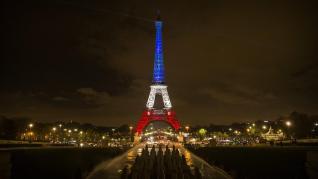 Since my wife and I had just been in Paris, France a month ago, I was filled with great sadness when I heard about the terrorist attacks that occurred in Paris on Friday, November 13, 2015. Terrorism is something I have a difficult time wrapping my head around. I cannot for the life of me understand how someone can cause harm and death to innocent people such as the carnage we saw in Paris. The news media has repeatedly said that the people who carry out such acts of violence have been radicalized, that is, have become more radical. Merriam-Webster dictionary defines a radical as “advocating extreme measures to retain or restore a political state of affairs”. I guess for radicals that means carrying out acts of murder. This is what I can’t get my head around. How can someone with any kind of conscience murder innocent people? The only explanation I can come up with is these people have been brainwashed. The MacMillan Dictionary defines brainwash as “to force someone to accept a particular set of beliefs by repeating the same idea many times so that the person cannot think in an independent way”. How exactly terrorist groups such as Al-Qaeda or ISIL (Islamic State of Iraq and the Levant) are able to do this using the internet is a mystery to me, but this must be what is happening.
 What concerns me the most is that many people are becoming fearful. On November 23rd, the American Government issued a
  This fear, caused by the Paris terrorists and other terror attacks, has changed the debate over refugees. Since returning home from Europe a few weeks ago I have been asked many times if we were affected by the refugees that had been dominating the news media before the Paris incident. Of course we were not. My wife and I even had a conversation with another couple recently at an airport where this couple expressed real concern over Canada accepting refugees from Syria. They told us that they heard one of the Paris extremists was a refugee. Once again their concerns were stemming from fear.
 Sommer Season all year