Remembrance Day is More Important Now then Ever Before

A commentary on the importance of remembering the world wars of the past.

November 11th Remembrance Day is once again upon us. In case you are not familiar with this holiday, it is a commemorative day observed in Commonwealth of Nations to remember the members of their armed forces who have died serving their country.  The observation of Remembrance Day in most countries is to remember the end of World War I, which ended on November 11 in 1918.
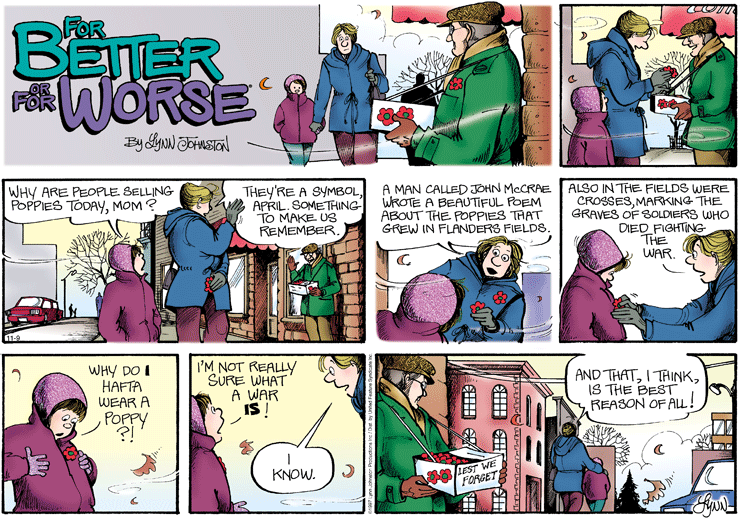
From: http://www.fborfw.com/stripcatalog/indexholidays.php?q=remembrance

I came across the above For Better or Worse comicWhy we wear a poppy—by Lynn Johnston released November 10, 2013, on social media. [In case you find the above version difficult to read, see For Better or Worse]. What is interesting about this comic is the child in the strip didn’t understand the point of the poppies and even voiced, “I’m not really sure what a war is.”  My take on this comic strip is Lynn Johnston is saying that ‘we remember, so we avoid repeating the mistake of world conflict again.’ Ironically, the first world war, or the Great War,—dubbed the war to end all wars—was thought to be a world conflict never to be repeated. Regrettably, a second world war broke out in 1939. It seems we humans are slow learners.

As I reflect on the state  of our world now, I wonder if we humans are about to make the same error once again.  The New York Times has an article, To Counter Russia, U.S. Signals Nuclear Arms Are Back in a Big Way, reporting  that Trump called on Congress to “modernize and rebuild our nuclear arsenal” in his State of the Union address in February of this year. Trump’s administration claims that President Vladimir V. Putin of Russia has accelerated a dangerous game that the United States must match, even if the price tag soars above $1.2 trillion.  The Military Times says, “Since his first day in office, President Donald Trump has promised to “rebuild” the military by increasing the number of ships, aircraft and ground combat vehicles in the services’ inventory.” The Diplomat’s article, China’s 2018 Military Budget: New Numbers, Old Worries, reports that China announced that its defence expenditure in 2018 would be over 1.1 trillion yuan ($174.5 billion).  The Guardian reports,

“Vladimir Putin has announced that Russia has developed and is testing a new line of strategic nuclear-capable  weapons that would be able to outmanoeuvre US defences, in a possible signal of a new arms race between Moscow and the west.” It appears that an arms race involving China, Russia and the United States is presently happening. That is not to say other countries are not building their militaries as well.”

That is exactly what happened in both world wars. Between 1890 and 1913, the European powers began building up their military power. This included the countries of Britain, France, Germany, Russia, and Austria-Hungary. The reason for the military buildup was primarily nationalism in which each country wanted to be “better” than the others. In the period of time leading up to World War II, Adolf Hitler publicly announced in early 1935, that a secret rearmament had been going on since the late 1920s, breaking one of the terms—the disarmament clause—of the Treaty of Versailles. When I taught history classes, I taught that the causes of World War I were alliances, imperialism, militarism, and nationalism. The world seems to be practicing militarism once again.

I also taught that one of the key causes of World War II, was fascism. Some European countries were overtaken by dictators forming fascist governments. These included Italy ruled by the dictator Mussolini, Adolf Hitler with his takeover of Germany, and the Fascist government in Spain ruled by the dictator Franco. The legal definition of fascism is

“a political ideology that seeks to regenerate the social, economic, and cultural life of a country by basing it on a heightened sense of national belonging or ethnic identity. Fascism rejects liberal ideas such as freedom and individual rights, and opposes free elections, legislatures, and other elements of democracy. Fascism is strongly associated with right-wing fanaticism, racism, totalitarianism, and violence.”

In my assessment of today’s world, I alarmingly see signs of fascism on the rise. The Business Insider’s article, Nine European Countries Where Extreme Right-Wing Parties Are On The Rise, lists the rise of nine European right-wing parties, many of which have won elections and taken power. The Washington Post article, How fascist is Donald Trump? describes Trump as a semi-fascist. Even in Canada, provincial governments recently elected in Ontario and Quebec are considered right-wing.

Are we living in troubling times? Is militarism on the rise? It seems so. Is nationalism on the rise? Donald Trump has referred to himself as a nationalist. (see Washington Post).  Is fascism on the rise? In the nine European countries article I cited above, it says the Swedish Democrats’ slogan is “Keep Sweden Swedish,” who are mostly known for anti-immigrant nationalism.” That sounds like nationalism to me.
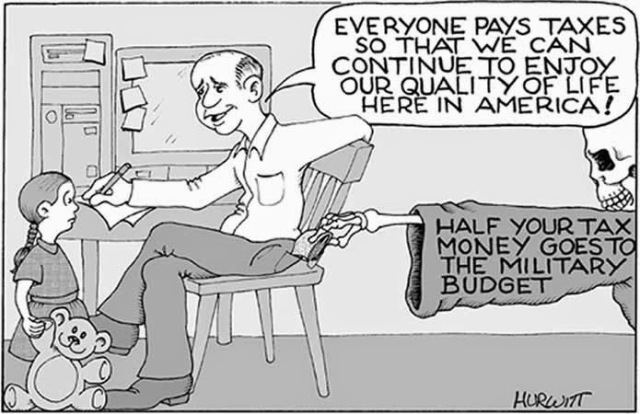
From: https://malenadugroup.wordpress.com/category/political-jokes/

The Washington Post article, U.S. military budget inches closer to $1 trillion mark, as concerns over federal deficit grow, says, “the U.S. Senate [in June] voted to give the military $716 billion for 2019, approving one of the biggest defence budgets in modern American history.” The U.S. spends the most on military spending out of all nations. Think of the kind of world that could be created if just a portion of that trillion dollars—that is 12 zeros—were used for establishing respect, honesty, integrity, kindness, compassion, peace and equality. American politician, George McGovern, once said, “I’m fed up to the ears with old men dreaming up wars for young men to die in.” Former first lady, Eleanor Roosevelt, once said, “Anyone who thinks must think of the next war as they would of suicide.” I concur wholeheartedly. War is suicide on a mass scale.

I hope the world wakes up to what is happening and isn’t stupid enough to make the same mistake a third time. What mistake am I talking about? Another world conflict! As a former social studies teacher, I see many of the pre-war signs. We the people have the final say. We can stop these extremist governments from being elected. We just need to exercise our democratic right, and vote for governments and leaders who promote respect, honesty, integrity, kindness, compassion, peace, and equality as opposed to anti-isms. These are Christian values which many of these extremist leaders claim to have.  The above For Better or Worse comic reminds us of this. Remembrance Day is a day to remember the horror of  past conflicts, and a reminder to never make that mistake again.  If future generations never know what war is, then this day has done what it is intended to do.

Should We Be Worried?

A commentary on the rise of bigotry

On October 27th, yet another mass shooting occurred in the United States at a Pittsburgh synagogue. A radicalized, American born citizen expressed his hatred of Jews during the rampage, telling police officers afterward that Jews were committing genocide and he wanted them all to die. Sadly, this disturbed individual shot and killed 11 Jewish worshipers during the Jewish Sabbath service. (see Pittsburgh synagogue)

anti-hateWhile watching CNN, I saw an interview with a Jewish Rabbi hours after the mass shooting happened. The words uttered by the Rabbi struck me. He said, “I worry that hatred is becoming mainstream.” These words struck me because he expressed what I’ve been feeling. It seems people feel empowered to express their hatred towards people, such as visible minorities, indigenous people, Jewish people, Muslim people, immigrants, LGBT people, transgender people, and the list goes on and on. This sense of permission to express hatred is not only happening in the U. S. but in my country as well. I began to recall all the things I’ve read or heard in the news this month.
Earlier this month, CBC News reported in an article entitled,  ‘Go back where Indians belong’: St. Albert mother frightened by racist letter from neighbour, that a  woman living in St. Albert, a city two hours from where I live, fears for her children’s safety so has decided to move out of her rented condo.

An anonymous letter, which her 12-year-old daughter found in the mailbox, complained about children riding a scooter on driveways and playing basketball and football on the street. Then the letter said, “We don’t like your kind around here.” The tone of the letter became threatening and focused on the family’s First Nations or indigenous background. The letter told the family to, “Move out or things will escalate. Would not want to see the kids getting hurt. This isn’t a reserve. Go back to the reserve where Indians belong.” The letter ended with, “Your friendly Phase II Neighbours.”

Now I find this entire worrisome incident ironic for two reasons. First, the letter is signed “Your friendly Neighbours.” I would hardly call a letter threatening a family as friendly. The author or authors of this letter is/are hypocrites to say the least. Secondly, it is ironic that these neighbours, presumably white Caucasians, are telling an indigenous family to go back where they belong—in their minds the reserve—when indigenous people have been living on this land that we call Canada for thousands of years before the white Europeans arrived. It was our ancestors who created reserves in  the first place to acquire land for the state. It seems to me that if anyone should be telling someone to go back to where they belong, it should be the indigenous people telling the Caucasians to go back where they belong. I would be willing to bet that the “friendly Neighbours” are ignorant of Canadian history.

Another CBC News titled, Indigenous man kicked out of McDonald’s after racist confrontation says he feels lucky to be alive, describes how an Indigenous man in June was kicked out of one of the city of Red Deer’s MacDonald’s restaurants  following a racist and profanity-laced encounter with another customer. Zach Running Coyote, an indigenous actor from a nearby town, says he decided to confront a man who used a racial slur. Coyote said he wanted the man to say it to his face when he heard the racist say, ‘What’s your f–king problem?’ The racist customer then turned to his girlfriend saying, ‘That, “insert expletive,” little Indian know-it-all should mind his own business.'” Leaving the restaurant’s parking lot, the bigot yelled that he was sick of Coyote’s people “mooching” off tax dollars and living on welfare, spewing more profanity as he sped away. Clearly, the xenophobic is ignorant of history. If you read my post entitled, Is First Contact with Indigenous People Necessary? or do some research on your own, you will learn most of the indigenous stereotypes are based on misconceptions. To stereotypically label all indigenous people as welfare recipients simply is untrue.

Also, in the province where I reside, a story came out this month about one of Alberta’s new political parties, the United Conservative Party (UCP), claiming it does not share the “hateful views” of Soldiers of Odin, a white supremist group, after three candidates, contending to run as a UCP candidate, posed for photos with members of the extremist hate group. (see Candidates unknowingly posed).

What I find ironic, is in another CBC report, UCP nomination candidate says he knew Soldiers of Odin were coming to party’s pub night, the candidate told reporters that, ‘People have a constitutional right to voice their opinions and I’m not going to deny them that.’ In other words, he knew all along who the Soldiers of Odin were. Is this new political party attracting racists? Do its policies allow extremists to feel comfortable in their party? I have a difficult time believing any political party encourages racist extremists to join them, but sometimes actions speak louder than words.

These are just three examples of intolerance in my province. There are many more, I assure you. If this is occurring in every province, then racism seems to be rampant in my country. Hate crimes are on the increase. The National Observer reported last year that police-reported hate crimes in Canada rose in 2016 for the third year in a row, and became much more violent, according to data from Statistics Canada. With all the rhetoric coming from the current resident of the American White House bombarding  the Canadian news, it doesn’t surprise me that hatred is becoming mainstream. Even some of our Canadian politicians are spouting that there should be less immigration. Maxime Bernier, a once outspoken Conservative MP who left the party and has since formed a new political party, criticized an immigration system that he said was attempting to “forcibly change the cultural character and social fabric of Canada.” (see Maxime Bernier’s rebellion) Are these politicians bigots or just ignorant? Whatever it is, I don’t want to live in a world that is divisive and exclusive.

One thing I have learned from the many years of travel and experiencing numerous cultures, is that every human being, no matter what race or culture, just wants to live comfortably, enjoy life and live in peace and safety. The late Pierre Berton, a Canadian non-fiction author and journalist, once said, “Racism is a refuge for the ignorant. It seeks to divide and to destroy. It is the enemy of freedom, and deserves to be met head-on and stamped out.” I believe that to be true. Racism comes from ignorance. Racism is a learned attitude. Racism does not belong in my world or in my country. It needs to be met head-on and stamped out. Everyone, regardless of race, religion or sexual orientation have the right to live their lives with dignity. As stated in the United Nations Universal Declaration of Human Rights, declared in 1948,

“All human beings are born free and equal in dignity and rights. They are endowed with reason and conscience and should act towards one another in a spirit of brotherhood.”

The bottom line is a bigot is a bully. Bullies intimidate to get their way. There is no place for a bully in my world.

Are Our Countries Undergoing a Divorce?

A commentary on the current relationship between Canada and the United States.

U.S. President John F. Kennedy in his address to the Canadian Parliament in 1961 told Canadians, “Geography has made us neighbours. History has made us friends. Economics has made us partners. And necessity has made us allies. Those whom nature hath so joined together, let no man put asunder. What unites us is far greater than what divides us.” Republican President Ronald Reagan in his 1981 address to the Canadian Parliament told us, “We are happy to be your neighbour. We want to remain your friend. We are determined to be your partner and we are intent on working closely with you in a spirit of co-operation.”

I have always considered our southern neighbours to be friends, family really, as my ancestors emigrated from the American states of North and South Dakota. We share the longest undefended border in the world and I am very proud of that. I believe all Canadians felt this way. It seems that is no longer the case. I, as most Canadians, were angered by Trump’s childish  behaviour at the G7 meeting. I have talked to numerous people who have told me they plan to avoid travelling to the United States because of the way the current resident of the White House treated Canada and our Prime Minister (PM), and because of the tariffs unfairly placed on Canada.  I have also seen several campaigns on social media promoting the boycotting of American made products.

The New York Post’s article, Canadians boycott US products, cancel vacations to America reports that Canadian shoppers are shunning Kentucky bourbon, California wine and Florida oranges, and avoiding American companies like Starbucks, Walmart and McDonald’s. The article claims Twitter hashtags like #BuyCanadian, #BoycottUSProducts and #BoycottUSA are spreading over anger because of Trump’s trade tariffs. The article also describes an Ottawa man who posted a “Trump-free grocery cart” full of products from Canada or from “countries with strong leadership.” It also says that many Canadian travelers have declared they would be staying in Canada this summer instead of booking trips to the US.  One person tweeted “F​–k​ you Trump. We just booked a $3,000 vacation to beautiful British Columbia. Happy anniversary to us. #Canadastrong #BuyCanadian #F***Tariffs.” 

An article by Maclean’s called, Canadians join movement to boycott academic events in the U.S., reports that hundreds of academics who teach at universities across Canada have joined more than 6,200 academics around the world pledging to stay away from international conferences held in the United States. It is very evident to me that Canadians are upset.

According to  public opinion polls, Canada has consistently been Americans’ favourite nation, with 96% of Americans viewing Canada favourably in 2012. I guess Trump wasn’t one of them. In 2013, Pew Research Centre reported 64% of Canadians had a favourable view of the U.S. while only 30% viewed the U.S. negatively. Sadly, a 2017 Global Attitudes Survey, says 43% of Canadians view U.S. positively, while 51% hold a negative view of its southern neighbour, a drop of 21% since 2013.

How can relations between two countries who share the longest undefended border in the world become so sour? The answer: Donald J Trump.  According to the 2017 Global Attitudes Survey I cited earlier, in more than half of the 37 nations surveyed, the positive views of the U.S. experienced double-digit drops. It seems it is not just Canadians who are changing their views of the U.S.A. This is a trend that both disturbs and saddens me.

What is even more disturbing to me is the number of posts on social media that refer to Trump as a fascist.  Merriam- Webster defines fascism as a political philosophy, movement, or regime that exalts nation and often race above the individual and that stands for a centralized autocratic government headed by a dictatorial leader, severe economic and social regimentation, and forcible suppression of opposition.” Granted, there is debate as to whether the U.S. leader is a dictator or not, but what disturbs me is the current U.S. administration displays all the warning signs of fascism.

There are many social media and internet articles telling of a sign hanging in the U.S. Holocaust Museum that defines what to look for when you are worried that your country may be slipping into fascism. It lists the following 12 early warning signs of fascism.

  1. Powerful and continuing nationalism
  2. Disdain for human rights
  3. Identification of enemies as a unifying cause
  4. Rampant sexism
  5. Controlled mass media
  6. Obsession with national security
  7. Religion and government intertwined
  8. Corporate power protected
  9. Labor power suppressed
  10. Disdain for intellectual and the arts
  11. Obsession with crime and punishment
  12. Rampant cronyism and corruption

I was shocked at how many of these apply to the present-day occupant of the White House. I could easily provide evidence that the U.S. president exhibits every one of these early warning signs. I won’t do that as I think each person should draw their own conclusions. I would encourage you to do that with your own research.

An article, Canada ranked as ‘most admired’ country in the world: report, by CTV News  says that Canada is the “most admired” country with the “best reputation” in the world, according to the 2015 report from the Reputation Institute, an annual survey ranking the reputations of developed nations across the globe. In particular, the report praised Canada for its “effective government,” “absence of corruption,” “friendly and welcoming people” and welfare support system. That is what makes us proud Canadians. I have to wonder if the majority of Americans are proud of their country these days.

I know, as most Canadians do, that the majority of Americans do NOT think the same as their president. I know many are outraged by the behaviours of their elected leader. The Globe and Mail reports that Americans have written numerous letters to them reacting to Donald Trump’s conduct at the G7 meeting of world leaders in Quebec.  Here is one of many such letters.

Dear Canada: Please do not judge us Americans by the actions and words of the President. He continues to alienate our friends. What he recently said and did is not supported by all of us. Canada and the U.S. have had, and will continue to have, a great relationship. This will pass. We have far more in common than some small differences.   Name withheld, North Huntingdon, Pa.

It is letters like these that give me hope.  I look forward to that day when America returns to the principles stated in the United States Declaration of Independence, where it states in the Preamble: “We hold these truths to be self-evident, that all men are created equal, that they are endowed by their Creator with certain unalienable Rights, that among these are Life, Liberty and the pursuit of Happiness.”  Based on my observations, these principles have been abandoned under the current leadership.

Could Meditation be the Answer?

A commentary on the use of mindfulness programs in schools.

If you have  been reading my blog for a while, you know that I am a retired teacher who taught for 35 years. I still substitute teach from time to time, so I stay in touch with the teaching world. I’ve spent my career wondering what the best way to deal with disruptive, reluctant learners is. I often debated whether to kick a disruptive kid out of class, keep them in at breaks, send him or her to the office or just tolerate them. When I began my teaching career, the school I was at practiced corporal punishment in the form of strapping students. Physical abuse is not the answer either.  In 35 years I have never found an ideal method.

I recently came across an article on a blog called: The Way of Meditation. The article was titled: School Replaced Detention with Meditation. Now this intrigued me. I meditate regularly and it certainly has made a difference in my life. The article quotes the Dalai Lama who said, “If every 8-year-old in the world is taught meditation, we will eliminate violence from the world within one generation.” Wow!  That would be amazing. Just watching the news occasionally tells me there is an enormous need. Not only that, could this be the answer to a school’s discipline problems?

The article tells of Coleman Elementary School in Baltimore, a city located in the state of Maryland in the United States. This school starts its day with a breathing exercise over the PA system and ends it with an after-school program of yoga and meditation in addition to the usual sports activities. The school’s staff guide students through breathing and other centering exercises in the Mindful Moment room, which is a calming space with cozy cushions and beanbags, lit by glowing pink Himalayan salt lamps. When one of the students become a discipline problem, he or she is sent to the Mindful Moment room. In the room, unruly students are guided to sit, breathe and meditate in order to calm down and re-center. They are also counselled to talk about what happened.

Tibet’s spiritual leader, the Dalai Lama

Now what a fantastic idea! A Mindful Moment room—meditation room—instead of a detention room. I wish I had thought of that. In another article, Meditation is Imperative: Schools Replacing Detention…, it tells of a dialogue with the Dalai Lama after the Paris Attacks in November 2015. The Tibetan spiritual leader claimed that humanity bears part of the responsibility for the emergence of global terrorism. He said praying to God for a solution and using the hashtag of the likes of #PrayforParis won’t do much to help. I agree! His most impactful statement was, “Let us work for peace within our families and society, and not expect help from God, Buddha or the governments.”  He’s right! Praying to God or wanting governments to fix things hasn’t worked so far. As the Buddha says, “Peace comes from within. Do not seek it without.” Or as Ralph Waldo Emerson puts it, “Nothing can bring you peace but yourself.”  

The Guardian’s article: One of San Francisco’s toughest schools transformed by the power of meditation, tells of Visitacion Valley middle school in San Francisco, California, which is a school surrounded by drugs and gang violence.  Students at this school were often stressed out and agitated as on one occasion three dead bodies were dumped in the schoolyard. In 2007, a meditation program called Quiet Time was brought in to deal with worried students. A month after the meditation program began, teachers noticed changes in behaviour. Students appeared happier, worked harder, paid more attention, were easier to teach and the number of conflicts fell dramatically.

Now, I began to wonder if there are schools in Canada that practice mindfulness. In case you are not familiar with this word, the Mindfulness Institute of Canada defines mindfulness as “a state of being fully present in the present moment, with acceptance and without judgement.”  This is really the same thing as meditation as the Free Dictionary defines meditation as “a practice of concentrated focus upon a sound, object, visualization, the breath, movement, or attention itself in order to increase awareness of the present moment, reduce stress, promote relaxation, and enhance personal and spiritual growth.” It seems there are schools in Canada that have instituted this practice.

Young girl meditating

According to Macleans.ca, in the city of Toronto, Ontario,  the District School Board introduced lessons in mindfulness to all of its 200 Grade 9 students. In six workshops over a two-month period, led by the school’s teachers, students practiced breathing, “body scans” (a meditation exercise that draws attention to different parts of the body), and learned to “surf the wave” of difficult emotions, like anger and anxiety. The article reports that the “response was overwhelmingly positive.” Another place in Canada that has adopted mindfulness is in Vancouver, British Columbia,  where Renfrew Community Elementary School is located. In this school students begin their day by heading outside to do tai chi.  The school’s assemblies always start with a mindful breathing exercise.

Unfortunately, not everyone agrees that mindfulness is the answer. Change.org has an online petition to remove Mindfulness Programs from Canadian Public Schools. The petition’s authors argue that legislated meditation in Canadian public classrooms is unlawful, and are alarmed that mindfulness stems from Buddhist meditation. They argue that if mindfulness meditation is permitted, then what is to stop decision makers from forcing students to engage in mandatory Transcendental Meditation? Or mandatory hypnosis? Or require all students to eat bacon three times per day, regardless of their vegetarian or vegan standing. This seems to me to be somewhat of a paranoid reaction, none-the-less, everyone is entitled to their point of view.

Forbes.com published an article titled, Science Shows Meditation Benefits Children’s Brains and Behavior, which lists the following benefits of meditation:

  1. Increased attention: A study in 2013 showed that in boys with ADHD, with an eight-week training in mindfulness, significantly reduced hyperactive behaviours and improved concentration.
  2. Increased attendance and grades in school: One school district in California prolonged its school day in some of its “high-risk” schools in order to add meditation into the day. These schools have reported better attendance and grades, fewer suspensions, and happier, less aggressive kids.
  3. A reprieve from outside trauma: Meditation and mindfulness have been shown to help kids who are dealing with stressors such as neglect at home.
  4. Better mental health: One study found that an afterschool program consisting of yoga and meditation helped kids feel happier and more relaxed.
  5. Self-awareness and self-regulation: A study found that a mindful yoga treatment helped kids improve their ability to self-regulate, or control themselves, over the longer-term in a one-year study.
  6. Social-emotional development: One study found that a social-emotional learning program coupled with mindfulness was more effective than a classic “social responsibility” program as kids using mindfulness in their treatment had greater empathy, perspective-taking, and emotional control, compared to the control group.

The Harvard Gazette reports an eight-week study conducted by Harvard researchers at Massachusetts General Hospital, a study which involved taking magnetic resonance images (MRI) from 16 study participants two weeks prior to the study, determined that meditation literally rebuilds the brain’s grey matter in just eight weeks.

If you are not familiar with the nervous system’s grey and white matter, here is a quick biology lesson. Grey and white matter are found in the brain and spinal cord. Grey matter is found in brain areas that control an individual’s perception, such as how things are seen or heard, the formation of memories and the influencing speech and emotions. White matter connects one region of the brain or spinal cord to another transferring nerve impulses in and out of the grey matter.  Medical science has always told us that grey matter cannot rebuild, but Harvard’s research seems to suggest otherwise.

There is no doubt in my mind that meditation, or mindfulness, reduces stress, promotes relaxation, improves personal happiness and induces feelings of peacefulness. I have personally experienced it. As a retired teacher, I would have welcomed anything that curbed undesirable student behaviours, improved student work habits and grades, and made the classroom a better learning environment. If mediation–mindfulness programs–does that, then I say bring it on.

Is Brainwashing a Real Thing?

A commentary on the use of thought reform in the military

Tibet’s exiled spiritual leader the Dalai Lama

On my last post: Why is war so popular? I sited His Holiness the 14th Dalai Lama of Tibet, specifically his talk on the Realities of War. I would like to continue with that discussion.  His Holiness says,


War is like a fire in the human community, one whose fuel is living beings…Modern warfare waged primarily with different forms of fire, but we are so conditioned to see it as thrilling that we talk about this or that marvelous weapon as a remarkable piece of technology without remembering that, if it is actually used, it will burn living people. War also strongly resembles a fire in the way it spreads. If one area gets weak, the commanding officer sends in reinforcements. This is throwing live people onto a fire. But because we have been brainwashed to think this way, we do not consider the suffering of individual soldiers. No soldiers want to be wounded or die. None of his loved ones wants any harm to come to him [or her]. If one soldier is killed, or maimed for life, at least another five or ten people – his relatives and friends – suffer as well. We should all be horrified by the extent of this tragedy, but we are too confused.

I mentioned in my last post that I was transfixed by the Dalai Lama’s use of the phrase, “we have been brainwashed.”  In my last post I concluded that we, the general public, have been brainwashed to accept war as normal and necessary. But what about the soldiers? Have they been brainwashed as well? The Dalai Lama later in his message says,

It is not only during times of war that military establishments are destructive. By their very design, they were the single greatest violators of human rights, and it is the soldiers themselves who suffer most consistently from their abuse…They are then compelled to forfeit their individual will, and, in the end, to sacrifice their lives.

His Holiness seems to think so as he says, soldiers “are then compelled to forfeit their individual will.” I guess I’ve never really thought about it before. It is unrealistic to believe that an individual could join the military and be able to do what is required of them without ‘reprogramming’. So, what happens to a person when they join? Are they brainwashed or reprogrammed so to speak?

According to Wikipedia’s, Recruit Training, psychological conditioning techniques are used to shape attitudes and behaviours of soldiers in training, so that the recruits will obey all orders, face mortal danger, and kill their opponents in battle.  The article goes on to quote specialists in US recruit training. These specialists say,

“The intense workload and sleep restriction experienced by military recruits leaves them little attention capacity for processing the messages they receive about new norms…Therefore, recruits should be less likely to devote their remaining cognitive effort to judging the quality of persuasive messages and will be more likely to be persuaded by the messages…”

Is this brainwashing? Is this mind control?

In the 1983 PBS production, Anybody’s Son Will Do, gave this assessment of what it means to be trained to be a soldier. Here is one of the opening quotes: “The secret about basic training is that it’s not really about teaching people things at all. It’s about changing people so that they can do things they wouldn’t have dreamed of doing otherwise.”  It can be found on YouTube. Here is part two.

In part V of Anybody’s Son Will Do, the commentator mentions the trainers indoctrinate the recruits with the idea that the enemy, whoever he may be, is not fully human, and so it’s all right to kill him. I haven’t viewed the entire program, but what I did view I found disturbing.  Don’t take my word for it. Have a look starting at 2:00.

http://www.youtube.com/watch?v=ETOlkv58iLY

Now I was curious. Is the military – and it doesn’t matter whether it is the Canadian, American, Chinese,  Russian military or any other country’s military – using mind control techniques, otherwise known as brainwashing?

HowStuffWorks is an award-winning source of unbiased, reliable, easy-to-understand answers and explanations of how the world actually works. In its explanation of how cults work, it claims cults use techniques known as “mind control,” or otherwise known as “thought reform,” “brainwashing” and “coercive persuasion.” It is the systematic breakdown of a person’s sense of self. The article explains that cults use:

  • Deception where new recruits are conned into joining the group.
  • Use of deprivation where a person may be deprived of adequate nutrition and/or sleep so the mind becomes confused.
  • Isolation where individuals are cut off from outside world or each other to produce intense introspection, confusion, loss of perspective and a distorted sense of reality.
  • Induced Dependency where total, obedient devotion, loyalty and submission is demanded.

There is no question in my mind that there are similarities between the mind-control practices used by cults and boot camp training in military.  It is important to note that there are differences. Firstly, military recruits know from day one of joining that they are giving up some of their autonomy. A military recruit makes a knowledgeable decision to relinquish that autonomy, whereas a cult recruit does not since they are deceived.  Also, a recruit signs up for a definite period of time, that is, he or she agrees to a legal contract that states how long he will be a soldier and what he will get in return. A person who joins a cult is deceived into thinking he or she can leave whenever he/she desires, but in reality, they cannot easily leave.

Now let’s be clear. At this time in history, we do need the military. There are times when a country needs to call upon their military. His Holiness, the Dalai Lama agrees as he states:

I want to make it clear, however, that although I am deeply opposed to war, I am not advocating appeasement. It is often necessary to take a strong stand to counter unjust aggression. For instance, it is plain to all of us that the Second World War was entirely justified. It “saved civilization” from the tyranny of Nazi Germany, as Winston Churchill so aptly put it. In my view, the Korean War was also just, since it gave South Korea the chance of gradually developing democracy. But we can only judge whether or not a conflict was vindicated on moral grounds with hindsight.

He goes on to say:

…in the case of the Cold War, through deterrence may have helped promote stability, it did not create genuine peace. The last forty years in Europe have seen merely the absence of war, which has not been real peace but a facsimile founded dear. At best, building arms to maintain peace serves only as a temporary measure. As long as adversaries do not trust each other, any number of factors can upset the balance of power. Lasting peace can assure secured only on the basis of genuine trust.

So what is the answer? Can a world ever be created by us humans where the military is obsolete. I believe the Dalai Lama has the answer. Until we build a world where there is trust; trust between religions, trust between nations, trust of governments, trust between corporations, and so on, we will never have genuine peace on this planet. Perhaps it is better put by this unknown person: “A relationship with no trust is kind of like having a phone with no service. You just end up playing games.” This is true whether we’re referring to a person, government, nation, or organization.

Why is War so Popular?

A commentary on why humanity engages in warfare.

A CBC News article, Here’s a look at Russia’s ‘invulnerable’ weapons, reports that on March 1st, Russian President Vladimir Putin announced to the world that Russia possesses an arsenal of new nuclear weapons that can’t be stopped. He publicized such weapons as nuclear-powered subs called uninhabited underwater vehicles (UUV), nuclear-powered missiles and hypersonic, intercontinental ballistic missiles. This kind of language has not been used since the Cold War. Why is Putin telling the world about its weapons of mass destruction? Is this talk of war?

Wikipedia has a list of ongoing armed conflicts. Two of the most notable are the Syrian civil war and the Iraq civil war. These are the two conflicts we hear about most often in the news. There are many others; many of them on the continent of Africa. This got me thinking. Why are humans set on war?

I recently read an interesting article called, The Dalai Lama’s Hard Hitting Message for World Leaders About The Reality of War.  Now the Dalai Lama is someone I deeply respect and I believe has much wisdom to offer the world. For those who don’t know, the Dalai Lama is the spiritual leader of Tibetan Buddhism and traditionally the political leader of Tibet, but the Chinese government forced him into exile in 1959 because of its imperialistic policies.  Here is some of the Dalai Lama’s message.

“…war and the large military establishments are the greatest sources of violence in the world. Whether their purpose is defensive or offensive, these vast powerful organizations exist solely to kill human beings. We should think carefully about the reality of war. Most of us have been conditioned to regard military combat as exciting and glamorous – an opportunity for men to prove their competence and courage. Since armies are legal, we feel that war is acceptable; in general, nobody feels that war is criminal or that accepting it is criminal attitude. In fact, we have been brainwashed. War is neither glamorous nor attractive. It is monstrous. Its very nature is one of tragedy and suffering.”

The words “we have been brainwashed” really struck me. Have we been brainwashed? I was attracted to the military as a youngster. I always thought it would have been glamorous to come back a war hero. I never actually seriously considered joining, except maybe on the day I had to register for university classes in the 1970s; a very stressful experience. What attracted me mostly was its discipline. Interestingly, the Dalai Lama was also attracted to the military in his youth. He explains in his message.

“Frankly as a child, I too was attracted to the military. Their uniform looked so smart and beautiful. But that is exactly how the seduction begins. Children start playing games that will one day lead them in trouble…Again, if we as adults were not so fascinated by war, we would clearly see that to allow our children to become habituated to war games is extremely unfortunate. Some former soldiers have told me that when they shot their first person they felt uncomfortable but as they continued to kill it began to feel quite normal. In time, we can get used to anything.”

I think the Dalai Lama is right. Society has been brainwashed. I used to play war games as a kid. I even had plastic soldiers to play with. Nowadays, there are numerous video games involving killing in war scenarios. As the Dalai Lama says, this “is exactly how the seduction begins.”  Or, shall we say the brainwashing begins.

One might ask: Why would our leaders want us to believe war is “exciting and glamorous”?  In June of last year, the Atlantic announced that the U.S. Approves $1.4 Billion Military Sale to Saudi Arabia. CNN says the U.S. accounts for one-third of global arms sales. If you are curious to who the Americans sell arms to, see: Here’s who buys the most weapons from the U.S.  So why are we being brainwashed to see war as “exciting and glamorous”?  It seems war is big business. If you want to make money selling arms, you must have wars. It seems very logical to me.

The New York Times published an article in 2014 entitled: The Lack of Major Wars May Be Hurting Economic Growth.  It says,

The continuing slowness of economic growth in high-income economies has prompted soul-searching among economists. They have looked to weak demand, rising inequality, Chinese competition, over-regulation, inadequate infrastructure and an exhaustion of new technological ideas as possible culprits. An additional explanation of slow growth is now receiving attention… the persistence and expectation of peace.

This is the only answer I can come up with. War makes money, so it makes sense in light of the fact that the U.S. accounts for one-third of global arms sales.

Buffy Sainte-Marie is an indigenous Canadian singer-songwriter, musician, composer, visual artist, educator, pacifist, and social activist. She wrote a song titled, ‘Universal Soldier’. If you’ve never heard it, here it is. The song begins at 1:48.

The lyrics go as follows:

He’s five feet two and he’s six feet four
He fights with missiles and with spears
He’s all of thirty-one and he’s only seventeen
He’s been a soldier for a thousand years

He’s a catholic, a Hindu, an Atheist, a Jane
A Buddhist and a Baptist and Jew
And he knows he shouldn’t kill and he knows he always will kill
You’ll for me my friend and me for you

And he’s fighting for Canada, he’s fighting for France
He’s fighting for the USA
And he’s fighting for the Russians and he’s fighting for Japan
And he thinks we’ll put an end to war this way

And he’s fighting for democracy he’s fighting for the reds
He says it’s for the peace of all
He’s the one who must decide who’s to live and who’s to die
And he never sees the writing on the wall

But without him how would Hitler have condemned him at Le Val
Without him Caesar would have stood alone
He’s the one who gives his body as the weapon to the war
And without him all this killing can’t go on

He’s the universal soldier and he really is to blame
But his orders come from far away no more
They come from him and you and me and brothers can’t you see
This is not the way we put an end to war?

It is the last stanza that reveals Buffy Sainte-Marie’s key message. The artist reveals that it is us (you and me) that are the ones who start, continue and end wars.  Remember, the politicians are controlled by the people and work for the people. Or as Abraham Lincoln, one of the American presidents, said in his Gettysburg Address, delivered on November 19, 1863, “government of the people, by the people, for the people.” If citizens refuse to support and/or participate in conflict and wars, then the killing will stop. As long as people agree to fight unnecessary wars for their political leaders, the killing continues. Let’s face it. Hitler could not have carried out his atrocities without his countrymen supporting him and without their willingness to carry them out.

The Importance of Remembering

A Commentary on the victims of war.

Once again, the November 11th Remembrance Day is upon us. It is the day of the year that marks the anniversary of the official ending of World War I. In Canada Remembrance Day is a national holiday and all Commonwealth Nations observe this day as a day to remember the members of their armed forces who have died in the line of duty. For those that don’t know, the Commonwealth is an organization of 53 member states that were mostly territories of the former British Empire, which includes the United Kingdom. The United States has a day of remembrance called Veterans Day, which is an official federal holiday that is observed annually on November 11. Its purpose is to honor people who have served in the U.S. Armed Forces, that is, veterans.

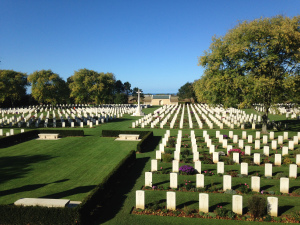
Allied military cemetery in Normandy, France

Since visiting Vimy Ridge and the Normandy Beaches in France two years ago, my wife and I have a stronger appreciation for all soldiers and the sacrifice they made to maintain freedoms. Visiting both WWI and WWII military commentaries was truly a humbling experience. What struck us both was the age of many of the soldiers, some as young as 17 years old. We now attend the Remembrance Day ceremonies with much more gratitude and appreciation for all soldiers.

Remembrance Day is an important day and it is imperative that we remember the soldiers who have lost their lives or put their lives on the line to protect the rights of its citizens. But what about the countless civilians that lost their lives during times of war or worse, through genocide. Article II of United Nation’s 1948 Genocide Convention describes genocide as “any of the following acts committed with intent to destroy, in whole or in part, a national, ethnical, racial or religious group, as such: Killing members of the group; Causing serious bodily or mental harm to members of the group; Deliberately inflicting on the group conditions of life calculated to bring about its physical destruction in whole or in part; Imposing measures intended to prevent births within the group; Forcibly transferring children of the group to another group.” Countless numbers of people have lost their lives as a result of genocide or because of bombing runs or merciless killing because they were considered enemies. Shouldn’t they be remembered too?

I would like to believe that one of the reasons the world went to war in 1939 (WWII) was because the Nazis were exterminating not only the Jews from continental Europe, but millions of others it deemed “undesirable.” By the end of the war in 1945, some eleven million people—over half of them Jews—had died, either through mass extermination, deportation, starvation or overwork in his prison camps. However, much of the world ignored or denied that the Nazis were doing this.  There is little doubt in my mind that it was a genocide that occurred.

Also during WWII, the Rape of Nanking took place. We seldom hear about this event as most schools in the West focus on the fascist Nazis. The Rape of Nanking began on December of 1937 when the Japanese Imperial Army marched into China’s capital city of Nanking and proceeded to murder 300,000 out of the 600,000 civilians and soldiers in the city. The shocking violence consisting of citywide burnings, stabbings, drownings, rapes, and thefts which continued for about six weeks. The Japanese troops are most notorious for raping over 20,000 women, most of whom were murdered thereafter so they could never bear witness. Clearly this was a genocide.

Then there was Joseph Stalin, the dictator of the Union of Soviet Socialist Republics (USSR) from 1929 to 1953. Stalin ruled by terror, and millions of his own citizens died during his brutal reign. It has been estimated that between 1934 and 1939, one million party members were arrested and executed. During the same period, it is thought that 10 million were sent to the gulags (system of forced-labor camps in the Soviet Union) with many of them dying either in transit or as a result of the terrible living conditions they had to endure.  This certainly was a genocide.

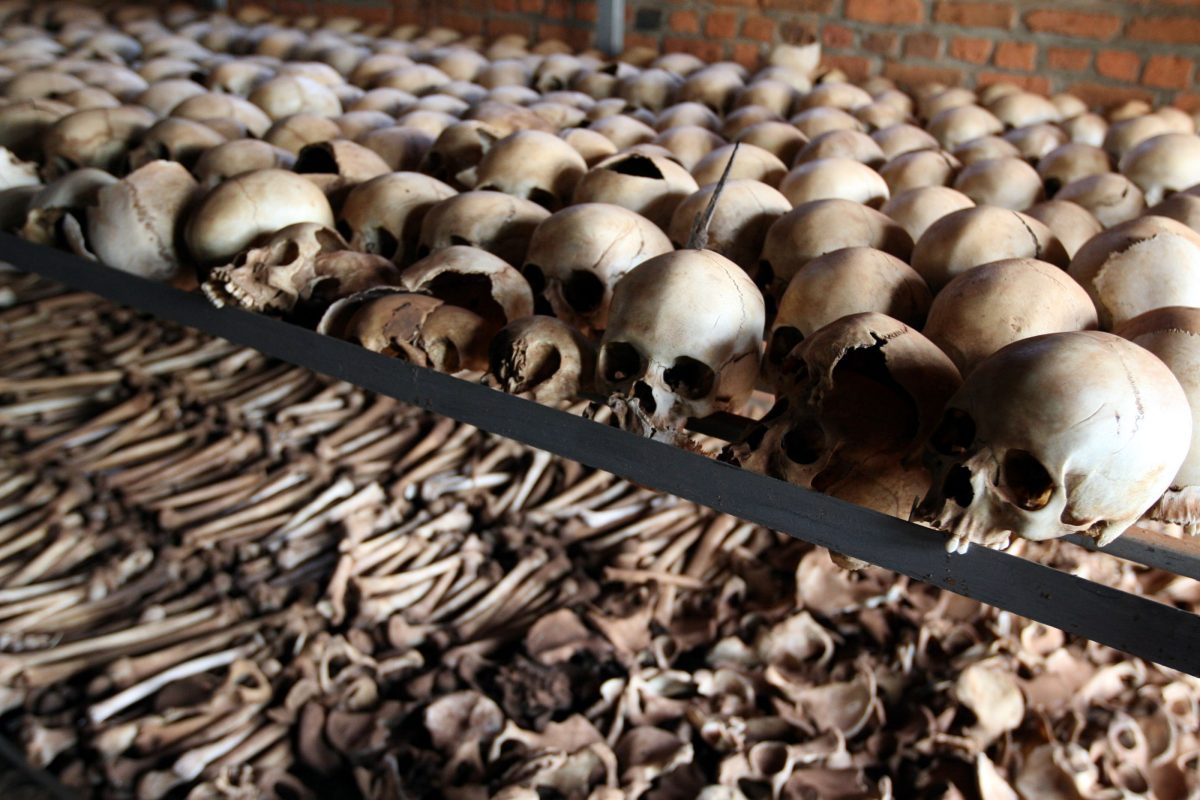
Bones of victims at a memorial to the Rwandan genocide By DFID.

Many of us older people remember the Rwandan Genocide which began on April 6, 1994. This was when groups of ethnic Hutus, using mainly machetes, began a campaign of terror and bloodshed the Central African country of Rwanda. For about 100 days, the Hutu militias followed a premeditated attempt to exterminate the country’s ethnic Tutsi population. The killings ended after armed Tutsi rebels, invading from neighboring countries, managed to defeat the Hutus and halt the genocide in July 1994. By then, over one-tenth of the population, an estimated 800,000 persons, had been killed. At least the history books label this event as a genocide.

There are many, many other genocides that have occurred in history. Those listed above are but a sampling. Shouldn’t the innocent victims of genocide as well as civilian casualties— referred to as “collateral damage” by the military, be remembered? Many of these victims were children.  Now I’m not suggesting this be done on Remembrance Day, but perhaps there could be another day set aside as a holiday to remember civilian victims of war and of genocide. Perhaps this day could be called Victims of War Day or Victims of Genocide Day. It just seems like the right thing to do.

Diane Samuels, a British author and playwright, said, “How can I pretend that nothing happened?”  Sometimes I feel like that is what is happening. We pretend that these genocides or civilian deaths did not happen because we focus solely on our soldiers.

But perhaps Aldous Huxley, an English writer, novelist, philosopher, said it best when he said,

“The most shocking fact about war is that its victims and its instruments are individual human beings, and that these individual beings are condemned by the monstrous conventions of politics to murder or be murdered in quarrels not their own.”

We need to pay more homage and respect for those who innocently have lost their lives in conflicts that were not of their own making. They deserve that respect and honour.

Artists May Have the Answer

A commentary on the wisdom of war.

I came across a rather unsettling headline on the CBC News website: North Korea warns of nuclear war at ‘any moment’. There really hasn’t been much concern about nuclear weapons since the former Soviet Union fell. Whenever the topic of the United States comes up, I hear concern in people’s voices over what is transpiring with the North Koran leader, Kim Jong Un and the current resident of the White House. There has been a war of words between the two of them, each calling one other names. Trump called the North Korean leader ‘Rocket Man’ and Kim Jong Un responded saying Trump was “a mentally deranged U.S. dotard”.  In other words, Jong Un is insinuating that Trump’s mental faculties are declining. One has to wonder if there is some truth in that.

Seriously, these two world leaders are acting just like children act in the school yard. As a retired teacher, I have personally witnessed much bullying on the school playground. Donald Trump has made threats such as; “North Korea best not make any more threats to the United States. They will be met with fire and fury like the world has never seen”. (see NYT) and Jong Un has uttered such things as; “If the American imperialists provoke us a bit, we will not hesitate to slap them with a pre-emptive nuclear strike. The United States must choose! It’s up to you whether the nation called the United States exists on this planet or not.” (see NYT). Watching these two world leaders act like school yard bullies is really reminiscent of the numerous supervision shifts I did as a teacher. You expect children to act this way but it is just sad when grown-ups behave this way especially if they are leaders of a country.

My wife and I attended a Chris De Burgh concert earlier this week. We haven’t been to a concert of his since the late 80s. My wife is an avid fan of Chris De Burgh and was long before I met her, and that was how I got to know his music. It was a fabulous concert and he can still put on a great show even though he just started touring after 30 years in the past few years. I was reminded of why I used to go to his concerts and listen to his records. The messages of his songs are so powerful and usually touch people at the soul level.

Why am I bringing up a Chris De Burgh concert? Well, it struck me, listening to Chris De Burgh sing his songs that his messages could teach these leaders a thing or two. Perhaps instead of looking to our politicians to solve conflicts, we should be looking to our artists. One of the songs that De Burgh sang at his concert was one he dedicated to the Canadian soldiers who liberated Vimy Ridge during WWI from the Axis powers, not without a high cost of lives. The song was Borderline. If you’ve never heard it, hear it is.

http://www.youtube.com/watch?v=H1WDoDLRWSQ

The song is about a soldier leaving to go to the front in WWI but the soldier is torn because he didn’t want to leave the love of his life, hence the lyrics; I hear my country call me, but I want to be with you. But the most powerful message of the song is the soldier questioning what he is about to partake in when he says; How men can see the wisdom in a war… Is there wisdom in a war? I can’t think of any. It was U.S. president, Franklin D. Roosevelt, who said, “War is young men dying and old men talking.”  That is so true! The reality is a leader can only take his or her country to war if the people that they oversee agree with them and follow. It was Adolf Hitler who said, “How fortunate for governments that the people they administer don’t think.”  The only wisdom related to war that I know of was by Niccolò Machiavelli, an Italian diplomat, politician, historian, philosopher and writer of the Renaissance period. In one of his writings, The Prince, he says “Wisdom consists of knowing how to distinguish the nature of trouble, and in choosing the lesser evil.” Perhaps it was said better in the movie, Pearl Harbor (2001), by Admiral Yamamoto (Mako) who said, “A brilliant man will find a way not to fight a war.”

Chris De Burgh has another song, one of my favorites, which unfortunately he didn’t sing. The song is called, Up Here in Heaven and it too has a very powerful message. In case you’ve haven’t heard it, here it is.

The song talks about visiting a military cemetery. Two years ago, my wife and I visited several military cemeteries while visiting the Normandy beaches and Vimy Ridge in France.  It was probably one of the most humbling and emotional experiences of our trip. The lyrics of Chris De Burgh’s song say:

What of the children caught in the war,
How can we tell them what it’s for,
When they cry, when they cry are voices heard anymore?

Are you listening, are you listening men of the war?
There is nothing, there is nothing worth dying for;

Up here in heaven, we stand together,
Both the enemy and the friend, ’till the end of time,
Up here in heaven, we are forever,
There is only one God up here, for all of the world.

Allied WWII military cemetery visited in Normandy, France.

His second song touches on the same theme. As the lyrics say; What of the children caught in the war, how can we tell them what it’s for. When they cry, when they cry are voices heard anymore? The characters in the song are questioning if war is justifiable, especially when it comes to the young men and women who are expected to fight it. It certainly isn’t the politicians who are battling it out. But the most powerful part of the song are the lyrics: Up here in heaven, we stand together, Both the enemy and the friend, ’till the end of time. Up here in heaven, we are forever, there is only one God up here, for all of the world. I believe when our souls arrive on the other side, heaven if you will, we will discover a God that sees no differences; that loves everyone equally. There are no enemies. Even though in our societies, God is referred to as Yahweh by the Jews, God by the Christians and Allah by the Muslims, as the lyrics say, there is only one God.

For me anyway, there is so much truth in these two songs. When the soldier in the song Borderline wonders; How men can see the wisdom in a war, the truth is, there is no wisdom in a war.  War is merely a school yard fight carried out in a big way. This is the message that needs to be sent to the bully politicians of the world. There is no wisdom in war! There is simply no way to justify war to those who are expected to fight it which is usually our young people. You might ask: What do we do when a bully leader threatens a sovereign state?  It was World War 1 veteran, the late Harry Patch, who once said:

“If I had my way I would lock all leaders in a room, and let them fight it out. Then there’d be no need, for lads like me, to go to war. Why should the government send me to a battlefield, to fight a man I never knew, whose language I couldn’t speak? All those lives, lost in a war, finished over a table. Now where’s the sense in all that? Give you leaders give them each a gun, and let them fight it out themselves”.

That is what needs to be done. Place the North Koran leader and the current resident of the White house into a room and let them ‘duke it out’. No more young soldiers need to die, or in the case of a nuclear holocaust, people of all ages all because two world leaders are behaving like school yard bullies.