Not Another Terror Attack

A commentary on the latest terror attack in England.

from Huffington Post

Yet again, the world has witnessed a horrific terror attack by a radicalized 22-year-old individual linked to ISIS. On Monday, May 22 where twenty two mostly young people were killed. In fact, 12 children under the age of 16 were injured or killed, one as young as an eight-year-old. At least 59 people were injured by the suicide bomber attack in total.  This terrible event occurred at a concert of singer Ariana Grande in Manchester, England. (see CBC’s Taken too soon).

Reflecting on this latest act of terrorism, I began to wonder: Are we presently living in more turbulent and unstable times compared to other times in history? Is there more terrorism today then before? If you listen to and believe the rhetoric coming from the American president, you would likely answer yes. I did some research to find out.

I focused on the historical time period in which I was alive. I grew up in the 1960s and 1970s, so I’ll look at each decade starting with the 1960s. Here is but a small sampling of terrorism and turmoil starting with the 1960s.

1960s

  • In Canada, Quebec separatists set off bombs and robbed armories in a bid to establish a separate French-speaking country. The Front de libération du Québec, or FLQ, (in English “Quebec Liberation Front”) was a separatist and Marxist-Leninist paramilitary group in Canada’s province of Quebec. The FLQ promised to destroy “all colonial symbols and institutions, in particular the Royal Canadian Mounted Police (RCMP) and the armed forces.
  • On August 13, 1961, the Berlin Wall was erected in the dead of night. It was a physical division between West Berlin and East Germany in order to keep East Germans from fleeing to the West.
  • The disastrous Bay of Pigs Invasion occurred. This was when a CIA financed and trained group of Cuban refugees to invade Cuba attempting to topple the communist government of Fidel Castro. The attack was an utter failure.
  • The frightening Cuban Missile Crisis befell with the confrontation between the United States and the former Soviet Union over the American deployment of missals in Italy and Turkey causing the Soviets to deploy missiles in Cuba. The confrontation is often considered the closest to a full-scale nuclear war the world has ever come.
  • On November 22, 1963, President, John F. Kennedy, was assassinated by Lee Harvey Oswald while he and Mrs. Kennedy were riding in a motorcade in Dallas, Texas.
  • On April 4, 1968, American Civil Rights leader Martin Luther King was assassinated by James Earl Ray in Memphis, Tennessee while standing on a motel balcony.
  • On June 5, 1968, Robert F. Kennedy, presidential candidate and brother of John F Kennedy, was assassinated at a campaign victory celebration in a Los Angeles hotel after primary victories.

Regarding terrorism in 1960s

  • It was in the 1960s when “The Troubles” occurred in Northern Ireland eventually ending with the Good Friday “Belfast” Agreement of 1998.This was a conflict between nationalists (self-identified as Roman Catholic) and unionists (self-identified as British or Protestant). Although the Troubles mainly took place in Northern Ireland, violent acts of terror (bombings, etc.), spilled over into parts of the Republic of Ireland, England and mainland Europe.

1970s

  • In Canada, the FLQ or October Crisis of 1970 happened. Pierre Elliott Trudeau’s federal government reacted toughly to the kidnapping of two high-ranking men and murder of Quebec Labour Minister Pierre Laporte. A state of war was declared in Quebec when the War Measures Act was instituted. Hundreds of intellectuals, political activists and trade-union leaders were imprisoned.
  • The Munich massacre takes place at the 1972 Summer Olympics Munich, Germany, where Palestinian Arab terrorists of the Black September terrorist organization kidnap and murdered eleven Israeli athletes.
  • United States President Richard Nixon resigned as President on August 9, 1974, while facing charges for impeachment for the Watergate scandal.

Regarding terrorism in 1970s

  • The use of terrorism by militant organizations across the world such as the Red Army Faction in Germany, Action Directe in France and the Red Brigades in Italy escalated in 1970s.
  • On September 6, 1970, the world witnessed the beginnings of a series of plane hijackings. It started on what is today called Skyjack Sunday. Palestinian terrorists hijacked four airliners and took over 300 people on board as hostage. The hostages were later released, but the planes were blown up.

1980s

  • The 1984 anti-Sikh riots in India took place. This was when Hindu militants rioted against Sikhs in response to the assassination of Indian Prime Minister Indira Gandhi by a Sikh militant.
  • In 1989, the Tiananmen Square protests occurred in the People’s Republic of China, in which pro-democracy protesters demanded political reform. The protests were crushed by the People’s Liberation Army.
  • Canada saw political unrest in the province of Quebec, due to the differences between the dominant francophone (French) population and the Anglophone (English) minority,  which caused the provincial government to call a public referendum on partial separation from the rest of Canada in 1980. The referendum ended with the “no” side winning majority (59.56% no, 40.44% yes).

Regarding terrorism in 1980s

  • Air India Flight 182 was destroyed on June 23, 1985, by Sikh-Canadian militants. It was the biggest mass murder involving Canadians in Canada’s history.
  • On December 21, 1988, Pan Am Flight 103 was blown up over the village of Lockerbie, Scotland, while on route from London’s Heathrow Airport to New York’s JFK. The bombing killed 270 people who were citizens of 21 nationalities. The bombing was and remains the worst terrorist attack in United Kingdom.
  • The Rome and Vienna airport attacks took place on December 27, 1985, against an Israeli airline. The attack was done by militants loyal to a militant Palestinian splinter group backed by the government of Libya.

1990s

  • The shameful Rwandan Genocide occurred between April 6, 1994 until mid-July 1994 involving mass killing of hundreds of thousands of Rwanda’s Tutsis and Hutu political moderates. Over the course of approximately 100 days, at least 500,000 people were killed. It resulted in serious criticism of the United Nations for failing to stop the genocide.
  • Oka Crisis

    In 1990, Canada had the Oka Crisis involving an armed standoff between people of the Mohawk nation (indigenous peoples in Canada), and the Canadian military over a dispute involving land held via treaty to the Mohawk people.

  • The 1995 Quebec referendum on sovereignty was held in the province of Quebec in Canada. If accepted Quebec would become an independent country with an economic association with Canada. The proposal is narrowly rejected by Quebec’s voters by 50.4% no, and 49.6% yes. 

Regarding terrorism in 1990s

  • The 1993 World Trade Centre bombing occurred when a truck bomb detonated in New York City intending to send the North Tower crashing into the South Tower potentially killing tens of thousands of people. Thankfully, it failed to do so but killed six people and injured over a thousand.
  • In 1995 was the Oklahoma City bombing when a bombing of a federal building in Oklahoma City, Oklahoma killed 168.
  • After the bombings of United States embassies in Kenya and Tanzania by Al-Qaeda militants, the United States naval forces launch cruise missile attacks against Al-Qaeda bases in Afghanistan in 1998.
  • Ironically, on 15 June 1996, the IRA set off a bomb in Manchester, England targeting the city’s infrastructure causing widespread damage in which 212 people were injured.

2000s

  • In 2001, the war on Terror was launched largely against Islamist groups such as al-Qaeda, Hezbollah and Hamas from posing a threat to the U.S. and its allies.
  • 2003–2011 was the Iraq War when the United States, the United Kingdom, Spain, Australia and Poland invaded and occupied Iraq.
  • 2001–2014 was the war in Afghanistan when the United States, the United Kingdom, Italy, Spain, Canada and Australia invaded Afghanistan seeking to oust the Taliban and find al-Qaeda mastermind Osama bin Laden.

Regarding terrorism in 2000s

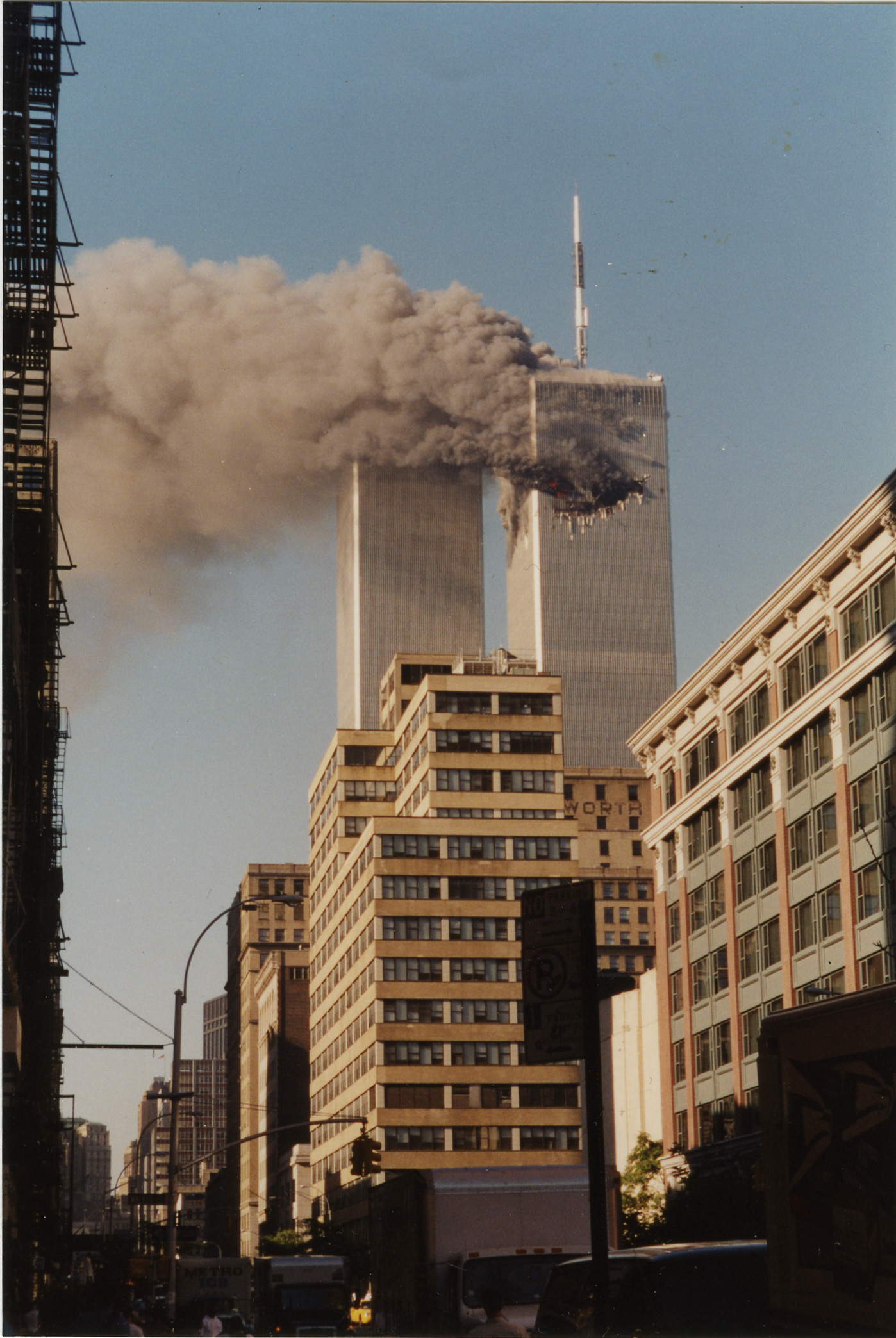
  • We all remember 9/11 when on September 11, 2001, 19 militants associated with the Islamic extremist group al-Qaeda hijacked four airliners and carried out suicide attacks against targets in the United States. Two of the planes were flown into the World Trade Centre towers in New York City, a third plane hit the Pentagon just outside Washington, D.C., and the fourth plane crashed in a field in Pennsylvania.
  • On the 7th of July 2005, London experienced bombings in which a series of coordinated terrorist suicide bomb attacks targeting civilians in London’s underground public transport system during the rush hour was carried out.

Sadly, there has not been a decade in my life time where there has not been turbulence and terrorism happening on our planet. It seems we humans just can’t seem to get along with one another. Why can’t humans just be loving and get along? My answer is ego. Vocabulary.com defines the ego as an inflated feeling of pride in your superiority of others. It is ego that causes us to push our beliefs and values onto others. The Rig Veda the oldest of the Vedas, the Hindu sacred scriptures, says “Ego is the biggest enemy of humans.” I would have to agree. Dorothee Solle, a German theologian once said, “With the disappearance of God, the Ego moves forward to become the sole divinity.” Until humanity learns to control the ego, nothing will change.

“Peace Through Strength”; I Don’t Buy It!

A commentary on the belief that peace is achieved by strength.

NBC News reports that current Secretary of State, Rex Tillerson, made the comment that “all options are on the table” over derailing North Korea’s weapons program. The news article also reports that Tillerson’s bluntness was met with immediate alarm by national security analysts and academics.

The Washington Times article, Trump administration: ‘America First’ and ‘Peace Through Strength’ national security policies states that President Donald Trump and his administration face an array of security threats and challenges around the world as the new president seeks to refocus U.S. government policies on putting America first. It also says the Trump administration’s immediate priorities include revamping the military and intelligence policies toward the Islamic State terrorist group. Just on March 16, the budget released by Trump’s administration proposes a $54 billion hike in defence.

Time, the online version of Time Magazine, has a section titled, Unpredictable America. In that section it says, the world’s sole superpower was once the international trump card, imposing order to force compromise and head off conflict. Now it’s a wildcard, because instead of creating policies designed to bolster global stability, President Trump will use U.S. power overwhelmingly to advance U.S. interests, with little concern for the broader impact.

On January 14, 2017, US Senator, John McCain said,

“What we have to understand is what Vladimir Putin is and so we have to go back to the days of Ronald Reagan. Peace through strength, the only thing that Vladimir Putin understands is strength, that for his aggression the price is higher than what he might gain from it.”

Those of us who are more matured remember the Cold War. Wikipedia explains that this was a “war” of geopolitical tension between powers in the Eastern Bloc (the Soviet Union and its satellite states) and powers in the Western Bloc (the United States, its NATO allies and others). Each side had a nuclear strategy that discouraged an attack by the other side, on the basis that such an attack would lead to the total destruction of the attacker. In essence, peace through strength. “Peace through strength” is a phrase which suggests that military power can help preserve peace.

George Washington, one of the Founding Fathers of the United States, allegedly said, “To be prepared for war is one of the most effective means of preserving peace”. But it was Ronald Reagan, the 40th President of the United States, who made the phrase standard when he said, “We maintain the peace through our strength; weakness only invites aggression”. What alarms me is Mike Pence, the present vice president of the United States is quoted as saying, “I think I’ve always believed in Ronald Reagan’s adage, “Peace through Strength”.

Ironically, I received the following quote in my email inbox from NealeDonaldWalsch.com.

On this day of your life, Dear Friend,

I believe God wants you to know that peace cannot come to this world until you are convinced that violence will never produce it. Hurt does not heal hurt. Violence will not bring an end to violence. Help the world to understand this by reacting differently, responding newly, when anger and a need to hurt you is sent your way.

You will have such an opportunity in your life. And probably, more than once. Do not miss the chance to humbly send a message of love.

The words, “peace cannot come to this world until you are convinced that violence will never produce it… Help the world to understand this…” literally jumped out at me. Why I wondered? Then the answer came to me. This is truth!

It is what is said in the western religions sacred scriptures of the world. In the Hebrew scriptures it says, “Depart from evil, and do good; seek peace, and pursue it”. In the Christian scriptures it is written, in 1 Peter 3:11, “let them turn away from evil and do good; let them seek peace and pursue it”.  In Islam’s sacred scriptures, the Quran, it says in chapter 49, verse 11, “Surely all believers are brothers. So, make peace between brothers, and fear Allah that mercy may be shown to you”.

Even many of the world’s greats have said that “peace through strength” is not the way. A man who is one of my heroes, Mahatma Gandhi, the leader of the Indian independence movement in British-ruled India, famously declared, “An eye for an eye only ends up making the whole world blind”.  Martin Luther King, Jr. was an American activist for the Civil Rights Movement. He is best known for his role in the advancement of those rights using nonviolent civil disobedience based on his Christian beliefs and the influence of Gandhi. King once declared, “I refuse to accept the view that mankind is so tragically bound to the starless midnight of racism and war that the bright daybreak of peace and brotherhood can never become a reality… I believe that unarmed truth and unconditional love will have the final word”.  Even Albert Einstein, widely regarded as a genius said, “Peace cannot be kept by force; it can only be achieved by understanding”.

Bridget of Sweden, a mystic and saint, and founder of the Bridgettines nuns and monks, allegedly once said, “The world would have peace if the men of politics would only follow the Gospel”. Margaret Mead, an American anthropologist during the 1960s and 1970s, is quoted as saying, “The first step in the direction of a world rule of law is the recognition that peace no longer is an unobtainable ideal but a necessary condition of continued human existence”. With all the world’s racism, war mongering, anti-Muslim, and anti-immigration rhetoric, citizens of this planet are craving to obtain a peaceful world and Mead is right; it is necessary for human existence.

For the most part, men have been the leaders in this world and still are. UN Women Website reports that as of June 2016, only 22.8% of all national parliamentarians were women, a slow increase from 11.3% in 1995.  We continue live in a world, as it has been for most of world history, ruled by males.

BBC has an article called, What if women ruled the world?  The article quotes Janet Napolitano, United States Secretary of Homeland Security from 2009 to 2013, under President Barack Obama as saying, “I think it’s fair to say that women are a little more collaborative in their approach overall, and a little less driven to conflict as opposed to driven to working out problems.” Mary Robinson, President of Ireland from 1990 to 1997, once said, “We need to take decisions now that will make for a safer world for our grandchildren and their grandchildren, and I think women are more likely to do that when they come into positions of leadership.”

More and more I am coming to the conclusion that people like Janet Napolitano and Mary Robinson are right. Maybe the world would be a more peaceful place if more women were running things.

Alice H. Eagly did a study in 2013 at Northwestern University called Women as Leaders. In this study she looked at leadership style versus leaders’ values and attitudes. Northwestern University is a private research university based in Evanston, Illinois. Her conclusion was, “There are multiple indications that women, compared with men, enact their leader roles with a view to producing outcomes that can be described as more compassionate, benevolent, universalistic, and ethical, thus promoting the public good”.

Something has to change if peace on this planet is ever to be obtained. Women, by their very nature would understand that peace cannot come to this world until humans are persuaded that violence will never produce it.

We Shall Never Forget!

John 15:13 of the Christian Scriptures says, “No one has greater love than this, to lay down one’s life for one’s friends.” Always remember that this is what those who died fighting for our freedoms did.

Sommer season all year's avatarSommer Season all year

As I’ve mentioned in my first Remembrance Day post, November 11th is an important day to observe as it marks the anniversary of the official ending of World War I. That war ended on the 11th hour of the 11th day of the 11th month thus explaining why Remembrance day is November 11th.  When in France recently, my wife and I visited the Normandy D-Day beaches. In case you don’t know the significance of those beaches, here is a history lesson.

On D-Day, June 6, 1944, “Operation Overlord”, the allied invasion of Nazi-occupied Europe started at 06:30. The target was an 80 kilometre (50-mile) stretch of the Normandy coast, which was divided into five sectors: Utah, Omaha, Gold, Juno and Sword Beach. The Utah and Omaha sectors would be assaulted by the American Army, Gold and Sword beaches by the British troops and Juno beach by the Canadians. We visited the British, Canadian and American beaches. The success…

View original post 1,195 more words

The World Should be Weeping

Aleppo, a selfish human tragedy!

In late September I saw this video in a news report.

http://www.youtube.com/watch?v=ipisDX6Rw5k

Now I had seen many news reports about Aleppo before but this video really got to me.  This video touched me on a deep level. The Canadian band, Nickelback, has a song called, “When We Stand Together”.  The beginning lyrics are,

One more depending on a prayer
And we all look away
People pretending everywhere
It’s just another day
There’s bullets flying through the air
And they still carry on
We watch it happen over there
And then just turn it off

The song portrays exactly what I have typically done and likely most people in the world do. We see what is happening in Aleppo, and other conflicts on the news and at the end of the news broadcast, we “just turn it [the TV] off”. Our mindset is, “it doesn’t really affect me. It’s happening far away from me.” But this time was different. This video got to me. It showed the human toll of this tragic conflict. The video showed how innocent people are being harmed by a senseless civil war and the emotional cost to its first responders.  We’re told that 250 000 innocent civilians are trapped in this city that is without clean water, functioning hospitals, and no aid. BBC News reports at least 18 people were killed earlier this month when trucks unloading at a Syrian Arab Red Crescent near Aleppo was attacked by fighter jets. The aid convoy was the result of a long process of obtaining permission and making preparations to assist isolated civilians after a ceasefire was negotiated. The attack occurred when the ceasefire failed.

I wondered what I could do. Donating for aid seemed to be pointless since aid was not reaching Aleppo, so I thought educating people. As a retired teacher that made sense. Maybe if there is enough of an outcry from the world’s people, the international community would do more. Maybe if enough of the world community said to the Syrian and Russian governments, “stop the bombing or else” things might change. I know it’s not as simple as this but peer pressure works.

So you, like I was, might be wondering what this conflict in Syria is all about. Here is some history based on information from Wikipedia.

_78981659_18dbb1cb-9fd6-4299-b0b8-5ba4fd8194c1The war in Syria stems from the 2011 Arab Spring, a revolutionary upsurge of demonstrations and protests in the Arab world. The revolution started in December 2010 in Tunisia and spread. Major insurgencies occurred in Syria, Libya and Yemen.   Civil rebellions occurred in Egypt and Bahrain. Large street demonstrations happened in Algeria, Iraq, Jordan, Kuwait, Morocco, and Oman, and some minor protests in Saudi Arabia. In Syria , the revolution escalated to an armed conflict after the government of President Bashar al-Assad violently suppressed protests that were screaming for Assad’s removal. The war is now being fought among several factions which include the Syrian Government, a loose alliance of Syrian Arab rebel groups, the Syrian Democratic Forces, Salafi jihadist groups, and the Islamic State of Iraq and the Levant (ISIL). Many of these factions receive substantial support from foreign governments.

The Battle of Aleppo began in July of 2012.  Aleppo is the largest city in Syria with the Old City of Aleppo being a UNESCO World Heritage site. The ongoing war is between the Free Syrian Army, Islamic Front and other Sunni militants and  the armies of the Syrian Government who are also supported by Hezbollah and  Shiite  militants as well as Russia. The government forces and their allies are also attacking the Kurdish People’s Defence Units. The Kurdish people are an ethnic group located in northern Syria as well as in other Middle Eastern counties.  Kurdish nationalists are pursuing greater autonomy and cultural rights.

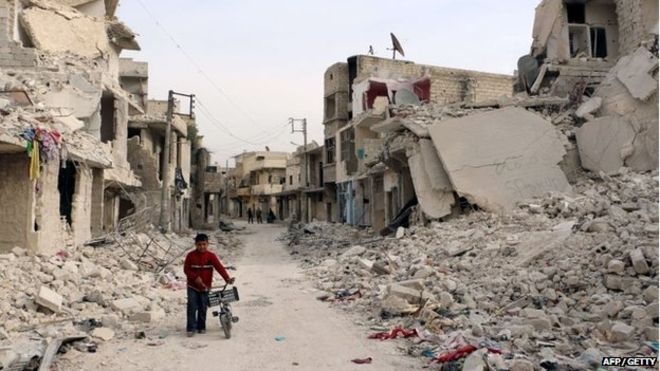
The battle for Aleppo has been marked by the Syrian army’s indiscriminate use of barrel bombs dropped from helicopters, killing thousands of people, and intentionally targeting the civilian population. This includes hospitals and schools. Hundreds of thousands have been forced to evacuate. On October 6th, 2016 President Assad offered amnesty to militants in the city, offering to evacuate them and their families to safe areas but the militants refused this proposal.

The battle has caused catastrophic destruction to the Old City of Aleppo, which I mentioned is a UNESCO World Heritage site. Here are some pictures taken by a drone showing the destruction of Aleppo.

In September 2012, Amnesty International, USA requested that the Geospatial Technologies and Human Rights Project of the American Association for the Advancement of Science (AAAS) to investigate human rights-related reports stemming from the escalating conflict in Aleppo.  Their conclusions on the Conflict in Aleppo was,

Space-based monitoring of the conflict in Aleppo has revealed a steady and continuous trend of degradation to the city’s buildings and infrastructure, including residential, religious, commercial, and industrial facilities. Roadblocks and other makeshift fortifications have continued to proliferate, with over a thousand visible in the latest imagery. Other signs of military activity, such as shell craters, armoured vehicle tracks, and evidence of aircraft deployments are likewise visible, and are consistent with reports of ongoing combat involving heavy weaponry in civilian areas. Damage resulting from fighting has resulted in severe losses to the city’s cultural heritage, both in the city as a whole as well as the area designated as a UNESCO World Heritage site.

It saddens me to see a UNESCO World Heritage site destroyed. In case you didn’t know, a World Heritage Site is a place that is listed by the United Nations Educational, Scientific and Cultural Organization (UNESCO) as being of exceptional cultural or physical significance to humanity.

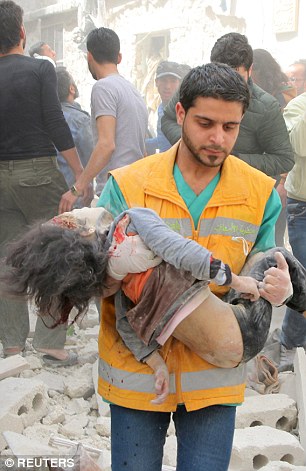
It saddens me even more to hear of the human suffering. The New York Times in its report, Why so many Children are Killed in Aleppo, tell us that roughly 250,000 people trapped in this Syrian city and about 100,000 are children. Children are the most vulnerable victims of the intensified bombings by Syrian forces and their Russian allies.

2821b1e600000578-3068063-image-m-17_1430817900726The Times article goes on to report that children in Aleppo face dire food and medicine shortages. Surgery and blood transfusions required for treating bomb wounds are practically impossible now. Medical workers have left children to die on hospital floors due to lack of supplies. Aid groups estimate that there are only 35 doctors remaining in East Aleppo, that is one for every 7,143 people, assuming a population of 250,000 people.

The reality is no one knows for sure how many people are trapped in Aleppo and how many are being killed. One person suffering, especially a child, is one too many. It all seems so senseless to see a world heritage site destroyed and learn of innocent people killed all because one man, Bashar al-Assad, a selfish leader who won’t give up his control of power. If the international community banded together to put serious pressure on the Assad government, maybe this nonsense would stop.

US Secretary of State, John Kerry, recently called for Syria and Russia to be investigated for war crimes since they keep hitting hospitals, medical facilities, children, and women (see The Guardian). I agree with Mr. Kerry as it appears to me that war crimes are occurring. War crimes are actions carried out during the conduct of a war that violates accepted international rules of war. There are 11 crimes which constitute grave breaches of the Geneva Conventions and applicable only to international armed conflict. These include willful killing and inhumane treatment, both of which have been violated. This would mean, in my view, Vladimir Putin and Bashar al-Assad are guilty of such crimes. It is time for the world to wake up and stop this senseless suffering, especially of innocent children.

Remembering 9/11 and Rethinking Terrorism.

A commentary on terrorism.

2011-09-11-schorwtc1
From Huffington Post

This week is the 15th anniversary of the 9/11 terrorist attacks against the United States. The world changed that day. I distinctly remember feeling that way when I learned of the horrific acts of terror effected that day. Mohammed Adam wrote a column in the Ottawa Citizen entitled, Fearful shadows of 9/11 still haunt Muslims, where he wrote:

Post-9/11, Islam was vilified and many Muslims were attacked and hounded as potential terrorists. Muslim women in particular, easily identifiable by their hijabs, faced verbal abuse, intimidation and even violence. A lot of bad things — the Iraq war, torture, Guantanamo — all happened. Draconian laws that curtailed age-old freedoms were passed, including here in Canada.

There has been a rise in anti-Muslim hate crimes in recent months especially since Donald Trump, Republican presidential nominee, has been spouting his rhetoric about a Muslim immigration ban.  The Guardian article, Hate crimes and attacks against Muslims, reports the Council on American-Islamic Relations (Cair) published new data showing that incidents against Muslims in California increased by 58% between 2014 and 2015, and that communities throughout the US are seeing similar trends.

afp_f02vx_49929083
From National Post

Many French Riviera mayors imposed a ban on full-body bathing suits known as burkinis this summer. France’s top court later ruled that basic freedoms were infringed upon and that mayors had overstepped their powers when they decreed a ban on burkinis at the beach. BBC News reports that French cities, such as Nice, have since lifted the controversial ban to be in line with a national court ruling. French opinion polls suggested most French people backed the burkini bans igniting fierce debate in France and around the world, with Muslims saying they were being unfairly discriminated against. Now I think the court decision was the right decision. It is simply discriminatory for one group with one set of values to tell another group that their set of values is wrong or at the very least unwelcome.

Pope_Francis_Korea_Haemi_Castle_19_(cropped)Even Pope Francis, leader of the world’s Catholics, defends Muslims. In the CBC article, Pope Francis defends Muslims, the pope says,

“I think it is not right to identify Islam with terrorism. It is not right and it is not true. I don’t like to talk about Islamic violence because every day when I look at the papers I see violence here in Italy – someone killing his girlfriend, someone killing his mother-in-law. These are baptized Catholics. If I speak of Islamic violence, I have to speak of Catholic violence. Not all Muslims are violent.”

The pope went on to talk about the causes of terrorism. He said,

“I know it is dangerous to say this but terrorism grows when there is no other option and when money is made and it, instead of the person, is put at the centre of the world economy. I ask myself how many young people that we Europeans have left devoid of ideals, who do not have work. Then they turn to drugs and alcohol or enlist in ISIS.”

Now  I certainly don’t agree with everything Pope Francis says but I agree with him on this. I agree that terrorism is related to social problems. Terrorism is defined by Dictionary.com as the use of violence and threats to intimidate or coerce, especially for political purposes. With that definition one could argue that many if not most acts of violence are acts of terrorism. Let’s look at the city of Chicago, Illinois in the United States as an example. That city has been making news headlines lately because of its high rate of gun violence. CNN reports in its report, 500 homicides. 9 months. 1 American city, that on Labor Day weekend Chicago’s 500th homicide of the year took place.  These are Americans carrying out acts of terror on one another and I suspect the majority of violent acts are not carried out by Muslims. So I asked myself, Why? This article says there are nearly 82 shootings per week. What does that tell me? Guns are too readily available but that is a whole other post. But why would people want to carry out acts of violence? Some Chicagoans blame the violence on economic struggles and lack of jobs. What’s interesting to note is Chicago’s unemployment rate fell from 6.1% in 2015 to 5.5% in 2016. Others say social problems are the root cause of the violence. Regardless of the cause, my point is that there is so much media emphasis on Islamic extremism when really there is much more terrorism being caused by non-Muslims. Most acts of terrorism are carried out by home grown  non-Muslim citizens.

In our local paper recently there was headline titled, Mobile Muslims launch 40-day campaign. The story explained that members of the Muslim community stopped in our little town spreading teachings of peace and love in hopes of changing their religion’s stereotype. One of the Mobile Muslims said, “There are many and false teachings associated with Islam and we need to dispel them.” CBC did a piece on this group called, Muslims go on cross-country tour. Kudos to the Mobile Muslims who are trying to set the record straight. It’s time to stop blaming terrorism on the all Muslims.  The number of radical Muslims who practice terrorism is only a small group.

But let’s not forget that radicalism is not unique to Islam. The news site, AlterNet.org, published an article called, 6 Modern-Day Christian Terrorist Groups You Never Hear About, which talks about six Christian terrorist groups. These are groups like the “Army of God” who openly promote killing abortion providers and who also have a history of promoting violence against the LGBT community. It also talks about “The Lord’s Resistance Army” (LRA) who according to Human Rights Watch, has committed thousands of killings and kidnappings. It seems terrorism does not exclusively belong to Muslim extremists. The Christian religion has had its fair share of extremists. Terrorism, no matter who carries it out, is WRONG! Discrimination against any group is WRONG! It’s time we focus on building a world of tolerance and understanding.

Are All Muslims Extremists?

A commentary on “Islamic or Muslim Extremists”.

On June 21, CBC.ca reported that a Muslim woman was attacked in a shopping mall. The article says a Muslim woman shopping with her four-month-old son was attacked in a London, Ontario supermarket and according to police the fourth reported event against visible minorities in the city in the past eight months. The day before, CBC reported A pig’s head left outside a Quebec City mosque was the latest in a string of incidents pointing to a rising tide of Islamophobia across Quebec. This is just days after the horrific attack in Orlando, Florida when a gunman massacred 49 people in a nightclub.

On June 12, the night of the attack, Donald. Trump, GOP presidential nominee tweeted: What has happened in Orlando is just the beginning. Our leadership is weak and ineffective. I called rtx1gzco (1)it and asked for the ban. Must be tough. In other words, his view is to ban all Muslims from entering the USA, a position he put forth during the primaries.

On June 13 Donald Trump gave an address on terrorism, immigration and nation security. During that address he said;

The immigration laws of the United States give the President the power to suspend entry into the country of any class of persons that the President deems detrimental to the interests or security of the United States, as he deems appropriate. I will use this power to protect the American people. When I am elected, I will suspend immigration from areas of the world when there is a proven history of terrorism against the United States, Europe or our allies, until we understand how to end these threats.

It’s no secret that Mr. Trump plans to ban Muslims from entering the United States. So what is happening? Is Mr. Trump, along with many other individuals, stereotyping Muslims, that is, categorizing them as potential “radical Islamists”? So I have to ask the questions: Is it fair to lump all Muslims together and label them potential “radical Islamists”? Should we fear Muslims because they might be terrorists? To answer these questions I did some research.

Globalresearch.ca is a Centre for Research on Globalization (CRG). It is an independent research and media organization based in Montreal, Quebec, Canada. Since the CRG is a registered non-profit organization and was created to do research on global issues, I would then conclude that it is a credible source. This organization has concluded that non-Muslims carried out more than 90% of all terrorist attacks in the United States. (see Non-Muslims…) The article cites a graph that provides statistics from 1980 to 2005 from the FBI Database. According to this data, there were more Jewish acts of terrorism (7%) within the United States than Islamic (6%).  The article also says the U.S. News and World Report noted in February 2013: Of the more than 300 American deaths from political violence and mass shootings since 9/11, only 33 have come at the hands of Muslim-Americans, according to the Triangle Center on Terrorism and Homeland Security. 

The Economist’s article, The plague of global terrorism reports:

Last year (2014) 32,700 people were killed in attacks worldwide, nearly twice as many as in 2013… Most of the deaths last year (and every year) are in the Middle East and Africa, not the West. Iraq, Nigeria, Syria, Pakistan and Afghanistan together account for three-quarters of the global total. Western countries suffered under 3% of all deaths in the past 15 years…The Paris attacks and the downing of a Russian airliner in Egypt killed more than 100 people each. Such lethal attacks are rare but are increasing. Last year, there were 26 compared with a handful in 2013. Most were carried out by ISIS, and most occurred in Iraq. And terrorism is spreading. 67 countries saw at least one death last year compared with 59 the year before.

So according to the Economist, less than 3% of all deaths in the West in the past 15 years were due to terrorist attacks. According to globalresearch.ca article, The Terrorism Statistics Every American Needs to Hear, the leading cause of deaths for Americans traveling abroad is not terrorism or murder or even a crime of any sort; it’s car crashes. With the exception of the Philippines, more Americans died from road crashes in all of the 160 countries surveyed than from homicides. The article also claims, you are 35,079 times more likely to die from heart disease than from a terrorist attack It too says you are 33,842 times more likely to die from cancer than from a terrorist attack.

The World Post has an article titled, Muslims Are Not Terrorists: A Factual Look at Terrorism and Islam, which makes some interesting points. One of their points is: Even if all terrorist attacks were carried out by Muslims, you still could not associate terrorism with Islam. It supports that statement with the fact that there have been 140,000 terror attacks committed worldwide since 1970. Even if Muslims carried out all of these attacks, those terrorists would represent less than 0.00009 percent of all Muslims. To put things into perspective, this means that you are more likely to be struck by lightning in your lifetime than a Muslim is likely to commit a terrorist attack during that same time span.

This article also says that if you’re going to claim that all Muslims are terrorists, then  you must also claim all Muslims are peacemakers. The article says that the same statistical assumptions being used to falsely portray Muslims as violent people can be used more accurately to portray Muslims as peaceful people. If all Muslims are terrorists because a single digit percentage of terrorists happen to be Muslim, then all Muslims are peacemakers because 5 out of the past 12 Nobel Peace Prize winners (42%) have been Muslims.

So what are my conclusions? My take on things is that the media has perpetrated the belief that most or even all terrorism is due to “Muslim extremists”. I say this because as typical of the news media, terrorist attacks, especially those carried out by “Muslim extremists”, get sensationalized in the media.. This myth perpetrated by the media is contrary to the evidence I sited earlier. It is blatantly unethical to group all believers of Islam as potential terrorists. That is why Donald Trump’s call for the Untied States to ban all Muslims for entering the States is unmerited and is based on misconceptions. Besides, banning Muslim immigrants does not guarantee a nation’s safety from terrorism since the latest incident in Orlando, Florida was carried out by an American born, non-practicing Muslim. I do not believe all Muslims are potential terrorists. I believe that most Muslims are peaceful, law-abiding people. Mr. Trump has used the phrase “Islamic Extremists” numerous times as have others. To think there is only extremism in Islam is naïve. The Christian religion has had its share as well. One of the latest, according to Wikipedia, was in November of 2015 when Robert Lewis Dear killed three and injured nine at the Planned Parenthood clinic in Colorado Springs, Colorado. The Christian terrorist voiced on several occasions his support for radical Christian views and interpretations of the Bible, and praised people who attacked abortion providers, saying they were doing “God’s work.” It’s interesting to note that this incident was not talked about for numerous days afterward.

Is our world less safe than it once was because of extremism? Yes it is. But should we be fearful of Muslims and Islamic terrorists? No. If we become a culture of fear then terrorists groups, such as ISIS, have succeeded in their mission which is to instill terror. Besides you’re more likely to be killed in a vehicle accident than in a terror attack.

Many Islamic leaders have condemned attacks carried out by “Muslim extremists”. I believe they will continue to do so and I have heard of many Muslims working to change the image people have of their religion. An ad campaign was launched in the United Kingdom to improve the image of Muslims. (see U.K. ad campaign). To quote the late Muhammad Ali, Terrorists are not following Islam. Killing people and blowing up people and dropping bombs in places and all this is not the way to spread the word of Islam. So people realize now that all Muslims are not terrorists. I say it is time to stop the senseless attacks on Muslims. Not all Muslims are a threat!actions do

Namaste, a Reverent Gesture

A_yoga_namaste_Hindu_culture_religion_rites_rituals_sights.jpgOver the years I have been periodically greeted with a greeting known as “Namaste”. This is a gesture that entails a slight bow made with hands pressed together, palms touching and fingers pointed upwards in front of the chest. I have witnessed speakers and performers greet their audiences with this sign. Many years ago our school hosted an exchange student from Thailand who when she first arrived would greet her teachers and fellow students with the Namaste gesture. Some of my yoga instructors concluded every practice by uttering “Namaste” while bowing with hands pressed together. Even in Taekwondo we bowed to our opponents although not with our hands together. A bow in Taekwondo was a sign of respect which is its meaning in all martial arts. We even bowed when we entered the dojang or gym as a sign of respect for it.

Whenever someone greets me with the Namaste gesture, and especially when saying the word “Namaste”, I feel very honoured. I feel respected and accepted. It truly is a wonderful feeling when acknowledged with a gesture of Namaste. So what does this form of salutation mean? Where does it come from as it is not a common form of greeting in my part of the world?

In my part of the world, the handshake is the popular form of greeting. A handshake is a ritual in which two people grasp one of each other’s like hands and give a brief up and down movement of the grasped hands. The origins of the handshake are unknown as historians say that the handshake predates written history, and therefore is somewhat difficult to track down. What I find fascinating is there are some historians who claim the ritual dates to the Romans who would approach each other and grab the forearm to make sure the other man was not carrying a weapon. If that is true, then the handshake has a very different connotation than Namaste does.

The  Namaste gesture is widely used throughout India, Nepal, and parts of Asia.  Namaste or namaskar is used as a respectful form of greeting, acknowledging and welcoming a relative, guest or stranger as well as with goodbyes. It is also used when a person expresses gratitude for assistance offered or given, and to thank the other person for his or her benevolence.

The gesture (or mudra) of Namaste is a simple act made by bringing together both palms of the hands before the heart (sometimes the forehead), and lightly bowing the head. In the simplest of terms it is accepted as a humble greeting straight from the heart and reciprocated accordingly. But does it have a deeper meaning? Being a teacher who taught Religious Education, I knew it did. So here is a lesson.

From the great religion of Hinduism, the sign of Namaste is an ancient Sanskrit greeting still in everyday use in India and especially on the trail in the Nepal Himalaya. Translated roughly, it means, “I bow to the God within you,” or “The Spirit within me salutes the Spirit in you,” a Hindu knowing that we are all made from the same One Divine Consciousness. More specifically, nama means bow, as means I, and te means you. Therefore, Namaste literally means, “bow me you” or “I bow to you.”

Now this can be thought of in many ways. These are some of the ways the meaning of Namaste has been explained to me.

  • The Divine light in me acknowledges the Divine light in you.
  • The God in me greets the God in you.
  • I honor the spirit in you that is also in me.
  • The Divine wisdom in me recognizes and acknowledges the Divine wisdom in you.

Hinduism Today says the Namaste gesture

“bespeaks our inner valuing of the sacredness of 216px-An_Oberoi_Hotel_employee_doing_Namaste,_New_Delhiall. It betokens our intuition that all souls are divine. It reminds us in quite a graphic manner, and with insistent repetition, that we can see God everywhere and in every human being we meet. It is saying, silently, ‘I see the Deity in us both, and bow before It. I acknowledge the holiness of even this mundane meeting. I cannot separate that which is spiritual in us from that which is human and ordinary.’”

One practicing Hindu put it this way.

“I’ve heard it means, ‘I salute God within you.’ The true Namaste gesture is accompanied by bowing the head and shoulders slightly. This is a gesture that lessens our sense of ego and self-centeredness, requiring some humility to do it well–whereas shaking hands can be quite an arrogant event.”

According to Buddha Weekly, it is not just a salutation. For Buddhists the gesture is called Anjali and it serves many purposes. In spiritual activities, the mudra Anjali (offering with both hands), indicates we are making a “divine offering.” In a Buddhist context, it is the “cure” for pride, one of the great obstacles in their practice. In day-to-day life it indicates respect, literally meaning “I bow to you.”  Also, in acupuncture terms, the tips of the fingers activate certain energies.

Now I was raised a Christian, so how might this fit into a Christian context. In 1 Corinthians 3:16 it says, “Do you not know that you are God’s temple and that God’s Spirit dwells in you?” (NRSV) To me that aligns with the Hindu claim that the divine is within us. Christians just call it the Holy Spirit. I was taught that at baptism or confirmation, depending on the religious tradition, that the Holy Spirit entered and from then on resided in us.

In Galatians 5:22-23 it is written, “By contrast, the fruit of the Spirit is love, joy, peace, patience, kindness, generosity, faithfulness, gentleness, and self-control. There is no law against such things.” (NRSV) So Christians believe that if a person allows the spirit to be active in them, then that person should express love, joy, peace, and so on. Wouldn’t it be wonderful if Christians supported this belief with the Namaste gesture, a slight bow made with hands pressed together.

namaste-2No matter how Namaste is interpreted, it invokes a sense of sharing a spiritual connection and creates a sense and feeling of oneness. It is a way to feel connected. It conjures up feelings of respect. It is a sign of universal oneness. Maybe this world would be in a better place if all humans practiced this simple gesture. As the Buddhists believe, it just may be a “remedy” for pride that is the cause of many problems. I’m convinced this simple gesture brings about more feelings of reverence and honour for others. Mohandas K. Gandhi allegedly said once, “Namaste. I honor the place in you where the entire universe resides. A place of light, of love, of truth, of peace, of wisdom. I honor the place in you where when you are in that place, and I am in that place, there is only one of us.” Such a simple sign, a bow with hands together, with the intended meaning as Gandhi explained, just might make all the difference in this world.
Bring the New Year

Here we are again saying goodbye to another year and bringing in another new year. It boggles my mind (mainly because it reminds me that I’m getting older) how fast annual events come about, whether they be birthdays, anniversaries, holidays or even the Stanley Cup playoffs. New Years is one of those annual events.

Now when you talk to people you discover that some people tend to live in fear. For example, these individuals are afraid to travel because “terrible things,” like terrorism, might (and I emphasize the word might) occur in the world. I categorize these individuals as the pessimists. Now I will admit that I sometimes can fall into this category. It’s easy to do. These are the people who always point out the negative in the world. These are the folks who say, “What kind of world will our children or grandchildren live in?” Fearful individuals seem to believe the world is “going to hell” and are anxious because 2016 will be even worse than 2015.

What I find interesting is that attitudes have not changed. My Mom talks about how her parents used to worry about the kind of world their children and grandchildren would be born into. My parents used to be concerned about the state of the world as they lived during the Cuban Missile Crisis and the Cold War. The world has always faced challenges and threats. Today is no different. The reality is the world continues to survive.

Now to be fair, there is some merit to their fear; to their pessimism.  2015 has seen many heartbreaking events. Here are some that caught my imagesattention. In October Hurricane Patricia, the most intense hurricane ever recorded in the Western Hemisphere, had winds up to 322 kilometres per hour (200 mph). November saw  multiple attacks by Islamic State of Iraq and the Levant (ISIL), the best known was the attack in Paris, France, resulting in 130 fatalities. Also in November of this year Turkey shot down a Russian fighter jet which is the first case of a NATO member destroying a Russian aircraft since the 1950s. In June of 2015, ISIL claimed responsibility for three attacks around the world during Ramadan such as the one in Kuwait City where a suicide bomber attacked a Mosque killing 27 people and injuring 227 others. Then there was the Greek government debt crisis in July when Greece became the first developed economy to miss a payment to the International Monetary Fund (IMF) in the 70-year history of the IMF.

Of course, I would be remiss if I didn’t mention the story that has been dominating the news most of the 2015 year and that is the Syrian refugee crisis; the worst refugee crisis since the Second World War.  The International Organization for Migration claims that more than one million migrants and refugees crossed into Europe in 2015. Now I could list other events, but there is no question that there have been numerous shameful events in 2015.

Thank God  (or Allah, or Yahweh, or the Universe) there are those who always see the good in the world. I categorize them as the optimists.  Optimists are filled with hope. These are folks who believe that the world can be better; that humanity is not all bad. Individuals such as these look to 2016 with an attitude of hope, hoping that things will improve.  I choose to align myself with the optimists.

There is merit to their argument. Here are some of the jovial events that caught my attention. In April, health officials declared the Americas the first region in the world to be free of the endemic rubella, or German measles, thanks to a 15-year effort to vaccinate men, women, and children everywhere in the northern hemisphere. This is great news since rubella can cause death or severe birth defects when women catch the disease during pregnancy. In July, history was made when Cuba and the United States reestablished full diplomatic relations, ending a 54-year history of GUSTAVO-CAMACHO-GONZALEZ-L1060274_(23430273715)hostility between the nations. In December, a global climate change pact was agreed upon at the COP 21 summit, where  195 countries adopted the first-ever universal, legally binding global climate deal. This is great news for the planet. Also in December of this year SpaceX, a company that hopes to revolutionize space technology, lands a Falcon 9 rocket.  This is the first reusable rocket to successfully enter the Earth’s orbit and return. This brings hope for space travel as it makes it cheaper. December also saw Indian Prime Minister Narendra Modi make a surprise visit to  Pakistan to meet his counterpart, Nawaz Sharif.  This is the first time an Indian leader has visited Pakistan in over a decade.  Relations between these two countries have been bitter ever since the violent division of British India in 1947, and the two nations have a history of  numerous military conflicts. This shows that good relations are possible between rivals. That gives hope that peace is achievable. Also in December the members of the Scottish Parliament voted unanimously in favour of a law to ban smoking in cars that are carrying children. That’s great news for kids. There are certainly more positive events of 2015 I could report, but you get the idea.

The Atlantic Monthly in December of 2015 , a magazine published in Washington, D.C,  wrote an article called 2015: The Best Year in History for the Average Human Being. The article cites numerous reasons for making this claim.  Here are a few that caught my attention.

“At the Paris climate conference in December, countries demonstrated renewed resolve to tackle global climate change together. Absent any policies enacted to slow climate change since 2010, the world might have been more than 4 degrees Celsius hotter in 2100 than pre-industrial temperatures. Existing policies to cut emissions reduced that forecast to 3.6 degrees, and the additional pledges in Paris brought it to 2.7 degrees Celsius.”
“The Global Terrorism Index says, 11,133 people died in terrorist attacks—suggesting terrorism accounted for about 1.8 percent of violent deaths worldwide. And for all that terrorism deaths have increased since 2012, they remain responsible for perhaps three hundredths of one percent of global mortality…Rabies was responsible for three times as many deaths as terrorism that year. Stomach cancer killed more people than murder, manslaughter, and wars combined…”
“Civil and political rights also continued their stuttering spread. While 2015 saw rights on the retreat in countries including Turkey and Thailand, the number of electoral democracies worldwide remains at a historic high according to Freedom House…This year, there were peaceful and democratic transitions of power in settings as diverse as Burkina Faso, Tanzania, Myanmar, and Argentina. And Saudi Arabia held local elections where, for the first time ever, women were allowed to stand as candidates and vote.”
The Atlantic Monthly focuses on the positives of 2015. What astounds me is instead of feeling good about the progress made in 2015, the pessimists choose to downplay the article. CBC did this in their article, 2015 ‘the best year in history’? Not everyone agrees. Why not be proud of what humanity has achieved in 2015? Why can’t humans celebrate the positives rather than dwell on the negatives?
When doing research for this post, I ‘googled’ predictions for 2016. What is intriguing to me is the vast majority of the predictions are ‘doom and gloom’ predictions.  One ‘hit’ was titled 2016 will be a year of living dangerously for the global economy.  The Inquisitr, an internationally recognized news website, predicts World War Three will start in 2016.  When you think about it, the third world war has already started as the war on terrorism involves much of the world community. I guess they’re right about that prediction. At least Newsweek predicts a  rise in electric cars which if it becomes true is great for the environment.  Now remember, a prediction is just a guess or a forecast.  When I ‘googled’, “How many predictions came true in 2015?” the vast majority of ‘hits’ were talking about the movie Back to the Future II. In this movie Marty McFly and Doc Brown travel to the future in their time machine, the DeLorean. The date set on the time machine was October 21, 2015.  The various websites were comparing the 2015 of today with the 2015 of the movie. I had little luck finding anything else. That leads me to believe that most of the predictions made for 2015 didn’t come true. Certainly some of the political changes that occurred in 2015 weren’t predicted.

best-year-everSo what will 2016 bring? The pessimists will likely envision , more ISIL terrorist attacks,  more anger from Mother Nature in the form of violent storms, more conflicts between nations, more economic problems, and on and on. Optimists will focus on the positives like improved political relations, the international community working together to slow climate change, improvements in human rights, improvements in health, and so on. I choose to be in the optimist camp. I choose to believe that 2016 will bring many good things. Really, the only thing we can control is the choices we make. To quote Brad Paisley, “Tomorrow is the first blank page of a 365 [366 for 2016] page book. Write a good one.” I’m choosing to make it a good one. I’m choosing to make 2016  a great year!

Interesting reads: 5 Major Trends and Make your 2016 better