
Since returning from our trip abroad, my wife and I have been asked numerous times what we found different in Europe compared to our first time over there which was 26 years ago. Our gut response is always to say, “It pretty much looks the same as it did last time we were there.” Now that is the truth. It still looks pretty much as it did in the 1980s. Most of the buildings still look very old and the majority of the streets are still very narrow. However, if there is one thing that was noticeably different was the amount of English around.
When I taught Social Studies, we used to discuss the question, Is English becoming a universal language? when teaching about how globalization is changing the world. For me, it was interesting to see if what I taught was indeed truth. According to the article, 10 Reasons why English is the World’s Language, some of the reasons why English is considered by some to be, or at least on its way to being, a universal language are:
- English is the language of business & finance
- Hollywood is the capital of film-making and many foreign actors have had to learn to speak English to work in Hollywood.
- If you want to make in the international music arena, you must be able to sing in English.
- English is the language of travel. English is the language used when the local hotel, restaurant or retail staff members communicate with foreigners and visitors.
- English is the unofficial language of the internet. There are billions upon billions of websites on the Internet nowadays, and it’s estimated that more than half of the entire online material is published in English.
- The influence of the United States and the United Kingdom, two very influential English-speaking world players.
 Now this all makes sense to me, but I know when I was teaching this stuff I wondered if it really was that way. Well I can tell you after returning from Europe, I have to say that I believe there is truth in these arguments. Allow me to share some of my observations. When we were in the airports and train stations I noticed the signage would have the language of the country we were in written first, with English written underneath. We were in airports in Athens (Greece), Rome (Italy), Paris (France) Istanbul (Turkey) and Warsaw (Poland). This was the case in every one of those airports. I don’t recall that being the case 26 years ago. Announcements in the airports were also in both the language of the country and in English. This was also the case for most train stations and we were in many, many train stations throughout Italy and France.
Before leaving for Europe, we prepared by downloading a translator app, and then we inputted and saved numerous phrases that we thought would be necessary when over in Italy, France and Greece. We did not need to use this app once when talking to people. Almost everyone we talked to in France, Italy, the Turkish airport, the Polish airport and in Greece spoke fluent English, although with an accent. We were most surprised when we found an English speaking waitress in the Warsaw airport.The only time we used the translator app was when looking at ingredients in a supermarket.
 As for the restaurants, no matter what country we were in, most of the staff spoke English. Not only that, almost every restaurant we ate at had menus in English. Often they would have the Greek or Italian or French first with the English written underneath.
My wife and I drove in northern France. One day we decided to see what was on the radio, so we turned on the radio only to be pleasantly surprised to hear a song we recognized; a pop song in English. As soon as the song was finished, we were astonished to hear the disk jockey speak in French. It struck me as odd; as “out of sink”; as not fitting. This certainly does suggest that much of the world’s popular music is indeed sung in English.
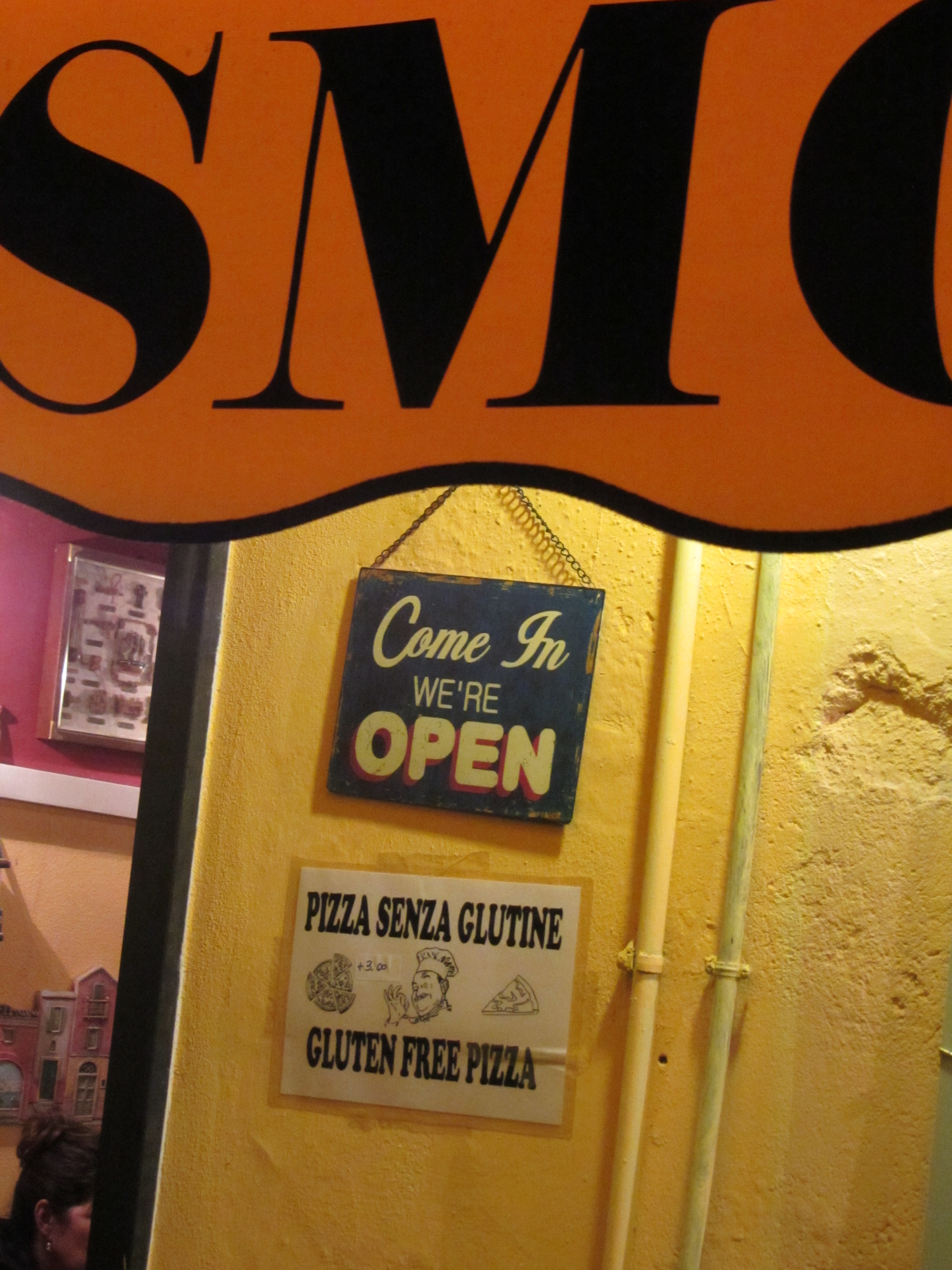 Another noticeable difference from the 1980s was the number of signs you see in English. In all three of the countries we visited; France, Italy and Greece, you would see store or company signage in both the language of the country we were in and in English. Often it would be Greek (or Italian or French) on some businesses and English on others. Many of the directions for toilets, exits, or tourist sites would also have English on them.
Another topic I often discussed with my students was; Was the world becoming more homogenized (more the same) because of globalization? I certainly saw evidence of this as well. The youth in Europe for the most part wore blue jeans just as the youth in North America do. This was not only true of the youth. The hair styles of the youth were the same styles you would see on North American youth. Then there is the cell phones. Everyone appears to have one and be on it just like in North America. Whether we were on the Metro, on a bus, in a museum or walking down a street, you would see people texting or talking on their cell phones.This certainly suggests homogenization to me.
It was not unusual to see stores or products from the same corporations in European cities that you would see in North American cities. I noticed many MacDonald’s restaurants, Burger King, Shell gas stations, Esso gas stations, and clothing stores such as Abercrombie & Fitch and the Gap. I also noticed Apple Stores, Starbucks coffee, and Disneyland Paris. There were Coca Cola and/or Pepsi signs every where. I’m sure I missed a few companies that operate in the European Union. This also advocates for the homogenization argument. We went into one store in Greece only to discover that much of clothing they sold had American cities written on them or some saying written in English.
 I have mixed feelings about these changes that I’ve observed. Regarding English as perhaps a universal language, that is great for those of us that English is our first language, or in my case the only language. I guess I should be grateful that the language I was born into is being spoken in most parts of the world. After all, it makes travelling much less stressful. What bothers me is the possibility that the world is becoming more and more the same culturally. This saddens me because the point of travel for me at least is to experience the cultural diversity in the world. I fear that as globalization continues to take hold, diversity will be lost. The fact that youth in Europe and North America dress the same is evidence of this. The truth that you see many of the same companies in the European Union as you do in North America suggests the world is indeed becoming more and more alike. Like anything else there are always pros and cons. I do hope that the various cultures of the world will be able to resist globalization enough so that they will continue to exist as a unique culture of the world. Variety makes the world more interesting. If all countries of the world become more and more alike, then won’t that make for a boring world?
 It is referred to as the greenhouse effect because the earth acts just like a greenhouse does. The sun gives off electromagnetic radiation, in particular infrared radiation, visible light, and ultraviolet light. Visible light consists of short wavelengths of energy, which are able to pass through the glass or plastic of a greenhouse, and are absorbed. It is then released back as heat (thermal energy) or infrared radiation. This is what heats up the greenhouse as infrared radiation consists of long wavelengths of energy which are unable to pass through the greenhouse’s glass or plastic, thus are trapped in the greenhouse.
 water supply is in the glaciers that are disappearing. That’s not mentioning the numerous plant and animal species that will likely disappear because of global warming. (see
  Since my wife and I had just been in Paris, France a month ago, I was filled with great sadness when I heard about the terrorist attacks that occurred in Paris on Friday, November 13, 2015. Terrorism is something I have a difficult time wrapping my head around. I cannot for the life of me understand how someone can cause harm and death to innocent people such as the carnage we saw in Paris. The news media has repeatedly said that the people who carry out such acts of violence have been radicalized, that is, have become more radical. Merriam-Webster dictionary defines a radical as “advocating extreme measures to retain or restore a political state of affairs”. I guess for radicals that means carrying out acts of murder. This is what I can’t get my head around. How can someone with any kind of conscience murder innocent people? The only explanation I can come up with is these people have been brainwashed. The MacMillan Dictionary defines brainwash as “to force someone to accept a particular set of beliefs by repeating the same idea many times so that the person cannot think in an independent way”. How exactly terrorist groups such as Al-Qaeda or ISIL (Islamic State of Iraq and the Levant) are able to do this using the internet is a mystery to me, but this must be what is happening.
 What concerns me the most is that many people are becoming fearful. On November 23rd, the American Government issued a
  This fear, caused by the Paris terrorists and other terror attacks, has changed the debate over refugees. Since returning home from Europe a few weeks ago I have been asked many times if we were affected by the refugees that had been dominating the news media before the Paris incident. Of course we were not. My wife and I even had a conversation with another couple recently at an airport where this couple expressed real concern over Canada accepting refugees from Syria. They told us that they heard one of the Paris extremists was a refugee. Once again their concerns were stemming from fear.












 Sommer Season all year