My Blog Posts

Is Hate the New Norm?

A commentary on the increase of hate crimes.

Lately I’ve been seeing a lot of news reports about hate crimes; reports that I find both disturbing and alarming. Here are a few examples.

I recently read about a homophobic attack on a lesbian couple in London, England. The couple were travelling on a city bus where they were assaulted by a group of teens after they allegedly refused to kiss each other on demand (see Homophobic Attack).

The New York Times reported that in “Staten Island, the phrase ‘Synagogue of Satan’ was spray painted on a wall outside of a Jewish school. In Brooklyn, a pro-Hitler message was scrawled on a poster outside a Jewish children’s museum whose mission is to fight anti-Semitism. In Manhattan, two rainbow pride flags were set on fire outside of a gay bar.” (see Swastikas and Burning Pride Flags).  Another New York Times article reports “The number of reported murders, rapes and robberies in New York is lower now [2019] than it was a year ago…These recent figures show that the drop in crime that began in the mid-1990s has largely continued…Reported hate crimes are up 64 percent compared with this time a year ago. A majority of those incidents were targeted at Jews, officials said” (see Hate Crimes Up).

In my country, Canada, CBC News reports that “the number of police-reported hate crimes reached an all-time high in 2017, largely driven by incidents targeting Muslim, Jewish and black people, according to Statistics Canada data… [saying] hate crimes have been steadily climbing since 2014, but shot up by some 47 per cent 2017, the last year for which data was collected” (see Hate crimes reach all time high).

This is just a small sampling of articles I’ve seen about hate crimes. Not only was I alarmed and disturbed, but began to wonder if hate was the new norm. One of last times hate was so prevalent on our planet was pre WWII, during a time when Hitler set out to eliminate Jews, LTQB, and other undesirables. It was also the time of the Nanking massacre in China by the Japanese. The last time the world went down a path of hate; a path lead by Hitler and other extremist leaders, WWII occurred.

I used to naively think that the human race had learned from WWI and WWII and would never make that mistake again. Now I am not so sure. One thing that strikes me, is many of those who are perpetrating hate claim to be Christians. THEY ARE NOT TRUE CHRISTIANS.

A meme recently went across my Facebook feed which is a quote from Jimmy Carter, the 39th president of the United States.
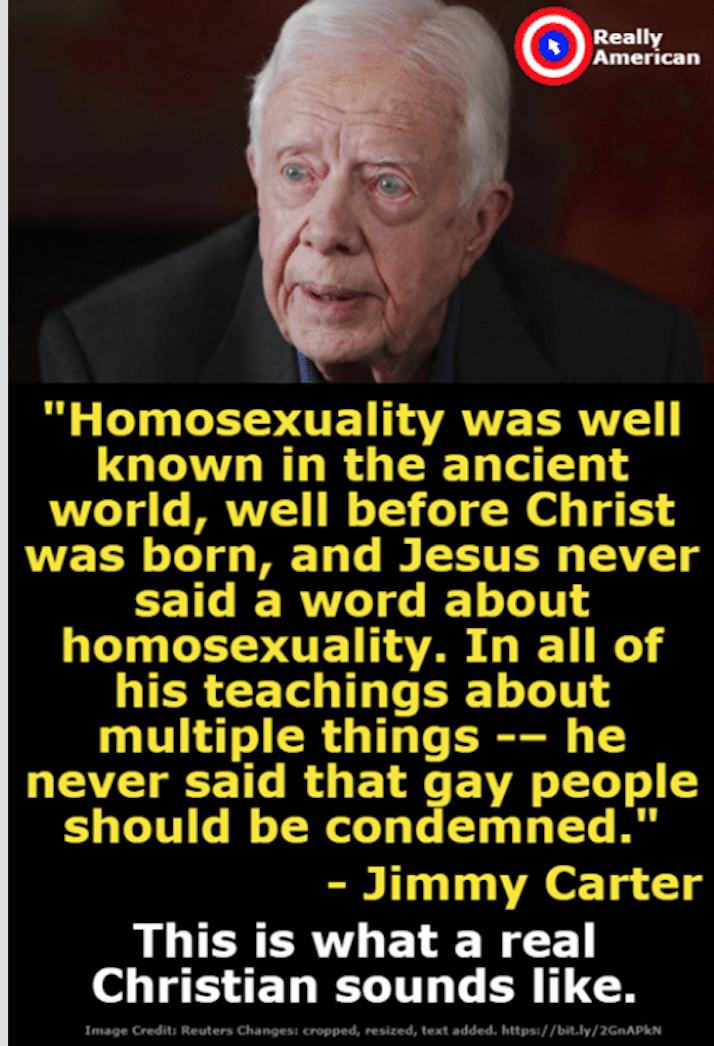
I agree with the former US president. Homophobes are not real Christians! I saw another meme on my Facebook feed.

That sums it up. Hate is the choice. We cannot choose homosexuality no more than we can choose to be heterosexual. It wasn’t a choice for me. I was just attracted to the opposite sex. I did not choose to be Caucasian. I did not choose to be born in Canada, although I am grateful I was. I did not choose to  come from European heritage. I can, however, choose to hate because I fear someone different than me. I can also choose to include and love those different from me.

Pope Francis is quoted as saying: “A person once asked me, in a provocative manner, if I approved of homosexuality. I replied with another question: ‘Tell me: when God looks at a gay person, does he endorse the existence of this person with love, or reject and condemn this person? We must always consider the person” (see  America Magazine in 2013). Pope Francis also said, “It is deplorable that homosexual persons have been and are the object of violent malice in speech or in action. Such treatment deserves the condemnation from the church’s pastors wherever it occurs.”

Where is all this hate coming from. One word answers that. FEAR. Much of that fear is propagated by extremist leaders.

Kevyn Aucoin, American makeup artist, photographer, and author, once said:

Fear is the most debilitating emotion in the world, and it can keep you from ever truly knowing yourself and others – its adverse effects can no longer be overlooked or underestimated. Fear breeds hatred, and hatred has the power to destroy everything in its path.

How true that is. Angela Merkel, former Chancellor of Germany, once said, “Hatred, racism, and extremism have no place in this country.” I agree with Ms. Merkel wholeheartedly. Hatred, racism, misogynism, anti-immigration, or anti-tolerance of any kind has no place in any country, especially my country.

The bottom line is unless humanity makes the choice to love one another, humanity is headed down perhaps another dark path like those that caused WWI and WWII.  After all,  Jesus commanded in John 13:34 of the Christian scriptures,

“I give you a new commandment, that you love one another. Just as I have loved you, you also should love one another.”

This is what a true Christian does!

These Pathogens Have Not Been Eradicated?

A commentary on the state of our world.

A Pow Wow my wife and I attended two years ago.

Last week my wife, a friend, and I attended an event called, “Meet the Inuit.” It was a series of talks by Inuit, Metis and Indigenous speakers, along with cultural performances. Many speakers said things that caught my attention. One Indigenous speaker talked about the clash of two cultures; Indigenous, Inuit, and Metis cultures verses European culture.

This made sense to me. Indigenous culture is present orientated—time conscious without clocks—whereas European Canadians are future oriented—time conscious with clocks. Indigenous Canadians (likely all Indigenous peoples) share their possessions freely—at least traditionally,  cooperate, are spiritual, and live in harmony with nature whereas European Canadians are savers and hoarders, compete for goods, driven by capitalism, and try to conquer nature. The world views of these two groups are vastly different.

Some of the speakers shared their experiences in the Residential Schools. It always strikes me when a Residential School survivor speaks of being taken away from their parents at ages 4 or 5, given haircuts and new clothes, told never to speak their native tongue, kept from their siblings who were attending the same school, and forced to stay several years in an unwelcoming large building. One speaker even told us how his brother literally was taken off the street by government agents without his parents being informed. His parents thought his brother had gone  missing.

CBC News has an article titled, Genocide against Indigenous Peoples, reports that the Canadian Museum for Human Rights in Winnipeg, Manitoba, now deems the treatment of Indigenous Peoples in Canada a genocide. Previously, the museum had said Indigenous Peoples faced cultural genocide rather than genocide.

The United Nations’ convention on Genocide (1948) says a genocide is:

  1. causing serious bodily or mental harm to members of the group
  2. deliberately inflicting on the group conditions of life calculated to bring about its physical destruction in whole or in part
  3. forcibly transferring children of the group to another group.

As The Star’s article, Cultural genocide?  says;

Canada did not pack Indigenous people onto train cars and send them to be gassed, or march them into fields and execute them with machine-gun fire. However, our country committed not “cultural” genocide, but just regular genocide.

We forcibly took children from families — sometimes at gunpoint — and flew them to remote locations they could not escape — sometimes in tiny handcuffs — where they were submitted to a program of forced labour and “education” designed to destroy their cultures and civilizations. This desire to destroy cultures seems to be the reasoning for various public figures’ use of the adjective “cultural” before genocide. The other reason, I presume, is that some cling tightly — and childishly — to the idea that Canada has always been on the side of goodness and justice, and they find it very hard to accept, admit, and announce that we are a country that committed a program of genocide that lasted for many decades.

Results of Rwandan Genocide

Let’s call “a spade a spade.” Canada committed genocide against our Indigenous, Inuit and Metis people; a genocide no different than the ones committed by Nazi Germany during WWII, or Rwanda in 1990s.  I must confess, I was one of those Canadians that held to the idea that Canada has always been on the side of goodness and justice. I no longer think that, and I now recognize that Canada has a dark past. Let us not forget the Japanese Internment during WWII; another dark part of our history.

One of the Indigenous speakers talked about how our greatest hurdles come from within. He spoke about what he called, The Six Social Pathogens.

Merriam-Webster defines a pathogen as a specific causative agent of disease. It typically refers to a bacterium or virus, but in the context of the speaker, a pathogen is a causative agent of the disease of racism. The six pathogens are: assumptions, presumptions, stereotyping, profiling, bias (for, or against), and misappropriation of feelings. This speaker says everyone—whether we’re aware of it or not—has some or all of the for mentioned pathogens working within us.

Before I go any further, let’s define the six pathogens. An assumption refers to something that is accepted as true without proof, whereas a presumption refers to an idea that is considered to be true on the basis of probability. Stereotyping is a set idea that people have about what a person, or group of people, are like. Profiling is the act of suspecting or targeting a person on the basis of observed characteristics or behaviour. A bias is a particular tendency, trend, inclination, feeling, or opinion, especially one that is preconceived or unreasoned.  Misappropriation means to put to a wrong use, so misappropriation of feelings is putting our feelings to a wrong use.

These six pathogens don’t just apply to attitudes towards the Indigenous, Metis, and Inuit people. They can apply to any group. As I observe what is happening in my country and the world, I would argue that these pathogens are presently very active. A Statistics Canada report in 2016 (the latest statistics I could find), revealed that the number of violent hate crimes rose 16% from the previous year, driven by increases in common assault, criminal harassment and uttering threats.” A 2014 Statistics Canada report found that, in two-thirds of cases, victims of crimes don’t report these hate crimes to the police.

As long as these six pathogens are alive and active, and there is a “us verses them” attitude, racism, prejudices, hate crimes, and so on, will continue. As long as we identify with a tribe instead of the human race, there will be conflict. As long as Christians, or Jews, or Hindus, or Muslims, or Buddhists think their faith is the right faith, there will be religious conflict. As long as there is masculism, there will be feminism. As long as feminist seeks to promote the rights and equality of women—which they should—and see themselves as equal with men, there will be misogyny, which is the disrespect and oppression of women.

As long as conservatives, as opposed to liberals, think their philosophy is best, there will be political tensions. As long as there are people who believe in “White Supremacy,” there will be racism and hate crimes. As long as there is ethnocentrism—The Cultural Superiority Complex, there will be anti-immigration. I could go on and on. Neale Donald Walsch, in one of his Conversations With God books, said, “Your way is not the only way. It’s just a way.”  We humans need to integrate that. Unless humans are willing to understand and accept differences, our planet is headed down a dark path.

Now, I had to ask myself: Do I have these pathogens? When I thought about it, and was completely honest with myself, the answer is yes. Have I made assumptions, or presumptions? Yes. I once believed Christianity was the superior religion. Did I stereotype? Yes. I once thought that people living on the streets were just too lazy to get a job. Did I profile? Yes. I targeted “unique” individuals in high school. Did I have biases. Yes. I had preconceived ideas about Indigenous people—they were lazy, drunks, etc.—until I educated myself. Were my feelings misappropriated? Yes.  I had my opinions about the LGBT community until I got to know some of their members. I would judge people based on first impressions, when I knew nothing about them, or knew anything about their story. In other words, I didn’t follow the Muslim proverb:  To understand a man, you’ve got to walk a mile in his shoes, whether they fit or not. Other variations of this proverb are: walk a mile in someone else’s moccasins, put oneself in another’s shoes, put oneself in another’s place, walk a mile in someone else’s shoes, and see the world through someone else’s eyes. Now, I try to do this; I try and  understand others and avoid judging them. I’m not saying I’m always successful, but I try.  If humanity did the same, perhaps our planet would be in a better place.

It All Makes Sense to Me Now

A commentary on the meaning of self love

I usually have no problems coming up with topics to blog about, but for this post, I struggled—and I don’t know why—to come up with a topic. That is why I have taken longer than usual to post again.

That all changed last week, as two things happened that profoundly affected me. The first was a short video, titled, What’s the Perfect Relationship, that appeared on my Facebook feed. This video caught my attention, so I watched it numerous times. Please view the video, maybe even more than once.

Watch Me:   What’s The Perfect Relationship

The video’s message is profound, yet simple. Its message is not even a new message to me as I have heard and read this message many times. Many people have said it, but I like the way the late Dr. Wayne W Dyer said it. “If you don’t love yourself, nobody else will. You can only learn to love others if you start loving yourself.”

After watching this video numerous times, I asked myself: Do I fully love myself?  If I am honest with myself, the answer is ‘NO’. I realized that I have never fully loved and accepted myself. Yes, I loved some parts of me, but I certainly didn’t love all aspects of myself. I was never completely happy with myself. I was often self-critical. I would think, my gut is too big, my hair is too grey, I should have been more assertive, and on and on. I have always lacked self-confidence, and if I fully loved myself, I would be confident. Furthermore, if I am critical of myself, then it makes it easy for me to be critical of others.

Then I asked myself: Have I believed the lies society and my culture have taught me, and if I am completely honest with myself, the answer is ‘YES’. The reality is, we compare ourselves to others, we judge, are judged, and we learn to judge ourselves.

Let’s look at two of those lies.

Looking young is better than looking older.

From: http://www.dazeddigital.com/

Let’s face it, we live—at least in North America—in a society that idolizes youth. We are told through advertising, that ‘we must look young’. That is why according to Marketwatch, the global anti-aging market is expected to exceed more than US$ 216 Billion by 2021. There is no shortage of anti-wrinkle creams, anti-aging supplements, and hair colouring products on the market. Then there are the anti-aging procedures; surgical procedures such as brow lifts, eye bag removal, fat transfer (also known as fat injections), facelifts, liposuction, neck lifts, tummy tucks, and so on (See procedures explained). There are also many nonsurgical procedures as well. Let’s be honest,  body shaming and fat shaming are a big problem in our societies. (see 14 Painful Examples Of Everyday Fat-Shaming). My point is, many or perhaps most people believe the lie that we must look young and therefore, chase the ‘fountain of youth’, and a lot of people are wealthy because so many believe this lie.

I had to ask myself: Have I bought into this lie? and if I am completely honest, the answer is ‘YES’. I sometimes put on anti-aging creams. I have seriously considered dying my grey hair at times. Yes, I did not like that I looked older. I thought looking young was better.

Success = money, status, or a satisfying career.

We live in a materialistic society. Society teaches that if we want to be happy, we must own a lot of expensive things like big screen TVs, a nice house, the latest iPhone, or a new car. To do this we need wealth. If we have wealth, we can buy the expensive items that give us status. And even more,  if we can become that six figure CEO, then we will have a satisfying career and we will have achieved the ultimate in success.

I had to ask myself: Have I bought into this lie? and if I am completely honest, the answer is ‘YES’. I thought I had to have the nice house, the nice vehicle, and a nice RV to be happy. When I had the wealth to buy these things, then I was successful, and I would have status. Yes, I believed the lie.

The video says society teaches, “You are not enough.” I believed it; I believed I was not enough. The reality is, “I am already enough.” I am perfect the way I am just as you are perfect the way you are. I did not treat myself like someone I loved. As the video says, “treat yourself like someone you loved.”

Even though I had heard the message, ‘you have to love yourself, before you can ever love someone else’, the fact is, I really didn’t understand what that meant.  How do you love yourself?  I didn’t know the answer to that question, until now.

It was the second profound thing that happened to me this week that enabled me to understand what ‘loving yourself’ means. This weekend, my wife and I attended a ‘Celebration of Life’ for a 15-year-old who literally didn’t wake up one morning. The young lady who sadly passed away in her sleep was a granddaughter of very good friends of ours, and her mother was someone I once had the privilege of teaching.

During her ‘Celebration of Life’, numerous friends, teachers, coaches, cousins, aunts, uncles, a godmother, and her parents spoke about the impact this teenager had on their lives. Over and over, I heard of how this young lady, who was 6 foot, 4 inches tall (193 cm), was confident, wise beyond her years and profoundly impacted everyone she met. Almost every tall teenager that I had ever taught was self-conscious about their height and lacked confidence. I kept thinking all during the celebration, I wish I could have known this young lady, and what an incredible young lady she must have been.  I kept wondering: What is it about this young lady, who sadly passed away much too soon, that made her so special? Why did she have such a profound effect on those who knew her?

Then it came to me; I knew the answer, or at least the only thing that made sense to me. This 15-year-old teen was able to deeply impact others because she fully loved herself.  She did not believe the lies society taught. She did not believe the lie, “You are not enough.” This young lady saw herself as “already enough;” “perfect the way she was,” and because she did, she saw everyone else she met as already enough, and perfect the way they were. She treated herself like someone she loved.  She did not judge herself and therefore, she did not judge others.  She did not compare herself to others, and she did not compare others. She completely loved and accepted herself—tallness and all—unconditionally. She fully loved herself, so she was able to fully love others. When you are able to fully love another, you profoundly affect them.

The article, Psychological Facts About Love, says,

Studies have shown that happiness is contagious.  It can be hard for people to walk away from someone who is happy, or not love someone who is happy simply because they are so enjoyable to be around.

Every speaker during this teen’s  ‘Celebration of Life’, commented on how she brought so much joy into their lives. She was able to do this because she fully loved herself, and when you love yourself, you are joyful.

It made sense to me now. I understood what loving myself really means. It means accepting that I am good enough the way I am; faults and all. It doesn’t matter that my hair is greying—who am I kidding—grey and I have a few wrinkles. I don’t have to look young. I don’t have to have material things to be happy. I am perfect the way I am, and it does not matter one iota what others think. Now I know what I must learn to do. This is what this special teen whom I never knew taught me, and for that I thank her.

Tribalism Isn’t Working, so There Needs to be a Better Way

A commentary on our present state of democracy.

The province where I live is presently immersed in an election to determine who will govern  for the next four years. As I educate myself and watch the campaigning, I am alarmed.  Why you ask? The Edmonton Journal’s article, Controversies hound numerous MLA hopefuls ahead of Tuesday’s election, outlines numerous candidates, most from one political party, who have posted homophobic, Islamophobic, and white supremacist comments on social media. There are other controversies as well, such as one of the parties being under RCMP investigation for voter fraud and a “kamikaze’ scheme during the leadership race, yet people continue to support this party. I don’t understand why.

More and more, it feels like elections and politics are becoming increasingly divisive and polarized. Politicians show no shame in provoking anger, attacking one another, bolstering fear, and pitting people against each other. This certainly is true for the provincial election happening right now. I see it in our Federal politics as well, with the current Prime Minister and his government attacking the opposition leader and his party and visa versa. Threats of lawsuits for defamation of character are taunted. Then there is the United States, the most polarized country with its president constantly attacking someone and most definitely displaying these polarized views.

I’ve gone through numerous elections before, so I’m trying to understand what is happening in this one. I don’t recall them being so divisive before. It could be my memory, but I don’t believe so. We seem to be living in turbulent times. Recently, someone helped me understand what is happening. He said—not  in these exact words—’our democratic system is based on tribalism’. What is he talking about?

The Oxford Dictionary defines tribalism​ as “the state or fact of being organized in a tribe or tribes,” and “the behaviour and attitudes that stem from strong loyalty to one’s own tribe or social group.” Yes, this is what is happening in our politics. We have tribes—political parties with specific philosophies on how to govern—with members loyal to the tribe, that is, political party, and its tribe members refuse to consider philosophies different from the one they align themselves with.

From Debate.org

I see two main philosophies; conservatism and liberalism, or some may say the progressives. The Oxford Dictionary defines conservatism as “commitment to traditional values and ideas with opposition to change or innovation,” and “the holding of political views that favour free enterprise, private ownership, and socially conservative ideas.” It defines Liberalism as, “willing to respect or accept behaviour or opinions different from one’s own; open to new ideas,” and “favourable to or respectful of individual rights and freedoms.” That same dictionary defines progressives as “an idea favouring social reform,” and “favouring change or innovation.”

That appears to be it. Both philosophies are found in most democratic countries,  and its people are aligned with one or the other. In Canada, some of our political parties even have these words in their names. Federally, we have the Conservative Party of Canada and the Liberal Party of Canada. In my province, we have a Liberal Party and the United Conservative Party (UCP). In the U.S. there are the Democrats—the tribe that follows liberal/progressive philosophy—and the Republicans—a conservative philosophy. Even churches like the Catholic church is divided into conservatives and liberals. I’ll be honest about which tribe I align with. It’s the Liberal tribe as we have to be open to new ideas, since many of the old ways are not working.

From my point of view, political tribalism is failing us. As I mentioned earlier, it stokes anger, promotes attacks on one another, bolsters fear, and pits people against each other. I’ve read many of the comments on political stories involving the provincial election, and people are nasty, and insults are written to those who oppose their views. Conservatism is strong in rural areas of my province, and my experience has been most are unwilling to listen to other points of view. They dig into their positions and refuse to listen to counter arguments. This is NOT healthy!

The New York Times has an opinion article called, The Destructive Dynamics of Political Tribalism, which outlines the many ways tribal politics is detrimental to our societies. Canada’s Maclean’s Magazine has an article titled, Tribalism is tearing Canada apart. The title needs no explanation.

There must be a better way; a gentler, kinder, and more cooperative way. I’ve pondered this and the only system that makes sense to me is a system of governance involving consensus, which means a general agreement must occur in decision-making.

Wikipedia explains consensus decision-making as,

a group decision-making process in which group members develop, and agree to support a decision in the best interest of the whole group or common goal. Consensus may be defined professionally as an acceptable resolution, one that can be supported, even if not the ‘favourite’ of everyone.”

Wikipedia says consensus decision-making aims to be:

  1. Agreement Seeking: A consensus decision-making process attempts to generate as much agreement as possible.
  2. Collaborative: Participants contribute to a shared proposal and shape it into a decision that meets the concerns of all group members .
  3. Cooperative: Participants in an effective consensus process strive to reach the best possible decision for the group and all its members, rather than competing for personal preferences.
  4. Egalitarian: All members of a consensus decision-making body are afforded, as much as possible, equal input into the process. All members could present, and amend proposals.
  5. Inclusive: As many stakeholders as possible should be involved in the consensus decision-making process.
  6. Participatory: The consensus process should actively solicit the input and participation of all decision-makers.
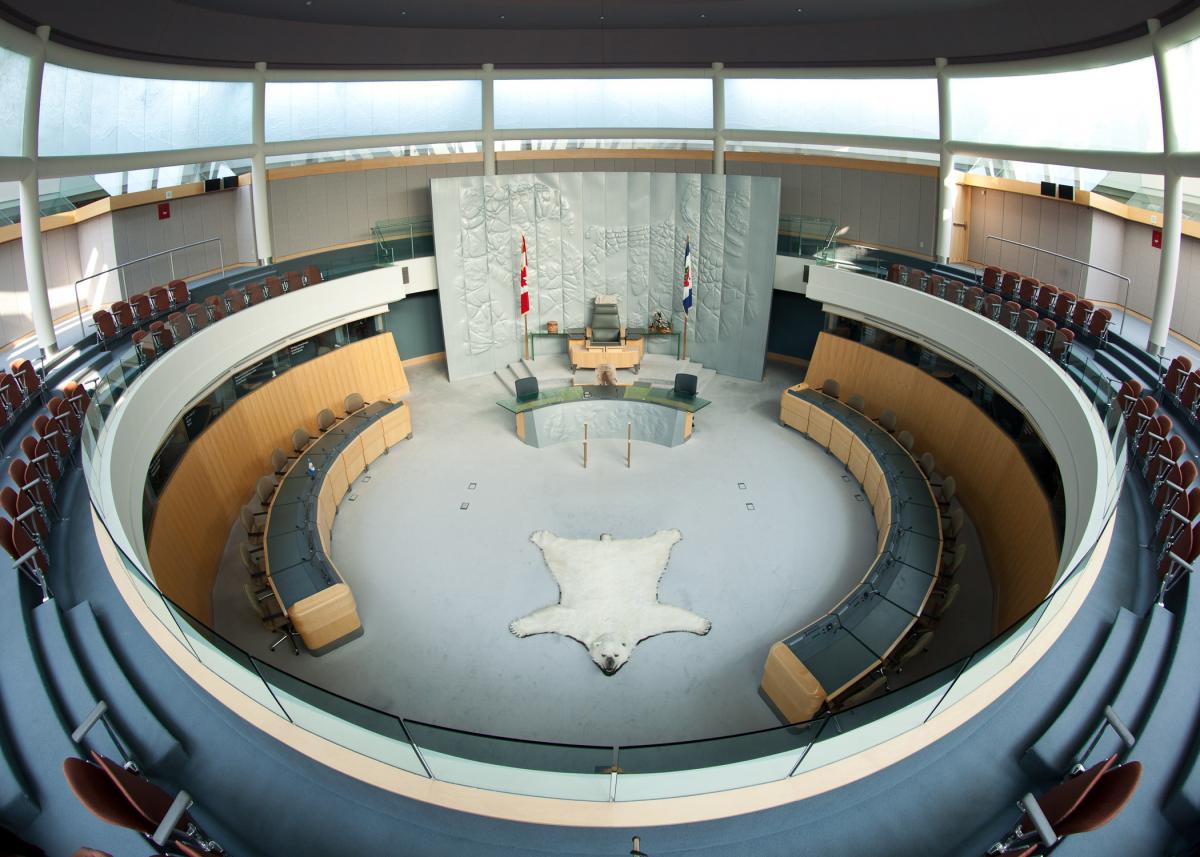
The Legislative Building of the NWT.

Does consensus decision-making exist in governance today? Absolutely. Consensus democracy government is alive and well in Canada as it is used in two of Canada’s three territories; Northwest Territories and Nunavut. These Legislatures are designed so politicians sit in a circle, symbolizing a unity of purpose.  In Provincial Legislatures, opposing parties sit across from each other, symbolizing opposing views. It’s interesting to note that the population of these territorial jurisdictions are a majority of Indigenous people.

Consensus democracy government stems from the Indigenous culture. I’ve always maintained that the traditional Indigenous people have always done things right, and this is but another example. A blog by Indigenous Corporate Training Inc. called What does traditional consensus decision making mean? explains some of the roots of this form of governance. I know many of you are thinking “no way consensus democracy would work because it is impossible to get everyone to agree.” This blog explains,

Consensus is not the same as unanimity. Consensus means a group or community arrives at a consensus by listening to the opinions and concerns of others – they work towards a suitable decision. Not everyone is necessarily pleased with the outcome but they realize it is the best decision for the community. Unanimity requires that everyone involved agrees.

This is how governments should work, and need to work. Perhaps it is time for democratic countries to seriously look at alternatives, such as consensus democracy. Just because tribal politics has been our the way till now, doesn’t mean we can’t make a change for the better.

Oh, Those Stereotypes.

A commentary on stereotyping.

A stereotype is an over-generalized belief about a particular group of people. Business Insider’s article, 5 mistaken ideas about Americans, says a common stereotype of Americans throughout the world, is Americans are loud, arrogant, and entitled. That is certainly a stereotype that many Canadians hold.

The Globe and Mail’s article, These days, Canadians aren’t big fans of the U.S, published in October 2018, says,

In its report, the Pew Research Center found that “just” 39 per cent of Canadians had a favourable opinion of the U.S., the lowest percentage in polling since 2002. Two years ago, during the final stretch of Barack Obama’s presidency, 65 per cent of Canadians expressed a favourable opinion of their southern neighbour.

The drop was even more dramatic for Mr. Trump himself. “Only” 25 per cent of Canadians have confidence in Mr. Trump, the report said – a slight uptick from 2017, but plummeting from 83 per cent in the final year of Mr. Obama’s tenure.

Now that is striking, and in my experience accurate as pretty much anyone I talk to, has a negative view of Americans. The reality is, America gets a bad rap because of the current resident of the White House.  He certainly fits the American stereotype of being loud, arrogant, and entitled. News reports that us Canadians hear about white supremacy and the anti-immigration rhetoric coming from the United States doesn’t help either.

The Globe and Mail article goes on to say,

The trends in Canada – a two-year erosion of U.S. favourability and presidential ratings – were pervasive among America’s allies and neighbours, the survey suggests. In Mexico, positive views of the U.S. have decreased by an even greater percentage than in Canada since the end of the Obama presidency.

The negative view of the United States is prevalent throughout the world.

I believe regular, everyday Americans are getting a bad rap. Let me tell you why, based on my experience.  My wife and I just returned two weeks ago from a vacation in Maui, Hawaii. It was a wonderful trip of sun and beaches after a winter from hell. But this is not my point. Being we were in one of the American states, as expected, we met American citizens from all over. We met people from California, Tennessee, Kentucky, Oregon, Montana, New York, Washington, Arizona—I’m sure I’m missing some—and Hawaii.  I can honestly tell you that not a single one of them were loud, arrogant, or acted entitled. In fact, the only loud, arrogant person we met, ironically, was a Canadian.

An interesting side note, the vast majority of Americans that we met never spoke of their president or talked politics. I may be wrong, but Americans almost seemed embarrassed by their politics. We did meet a few people who made of point of telling us that their country was a mess because of Trump.

So, the question is: Is the stereotype wrong? No.  The article, All Stereotypes Are True, Except, by Psychology Today,  says,

Many stereotypes are empirical generalizations with a statistical basis and thus on average tend to be true. If they are not true, they wouldn’t be stereotypes. The only problem with stereotypes and empirical generalizations is that they are not always true for all individual cases. They are generalizations, not invariant laws.

There are plenty of Americans who are loud, arrogant, and entitled, but as far as that goes, there are plenty of Canadians who are as well. I’ve met many of them. I’m sure there are in every country.

Is there a danger with Stereotyping?  Yes. Stereotypes encourage prejudice.  How?  Another Psychology Today article, The Psychology of Prejudice and Racism, says,

By definition, stereotypes are limiting and disregard people’s individuality. They also lend themselves to negative and derogatory assumptions. When that happens the stereotype blends into prejudice.

As I mentioned earlier, not a single American that we met in Maui was loud, arrogant, or acted entitled. How does one explain that? Well, I can only speculate, but of all the Americans we met, they all were willing to travel and try new experiences, even if it was only in their own country. Many mentioned that they’ve been to Europe or other places, though. Those that travel meet people of other races and cultures, and become more tolerant of difference.

Intolerance can also be built by meeting and getting to know immigrants. If people—Muslims, Christians, Blacks, White, Indigenous, and so on—get to know one another, prejudices and racism would decrease. The reality is, we are all human beings with the same pains, desires, struggles, etc. This is what William Shakespeare is saying in the play, The Merchant of Venice.

In Act 3, scene 1 of the play, Shylock confronts two provoking Christians saying, “I am a Jew. Hath not a Jew eyes? Hath not a Jew hands, organs, dimensions, senses, affections, passions… warm’d and cool’d by the same winter and summer, as a Christian is? If you prick us, do we not bleed? If you tickle us, do we not laugh? If you poison us, do we not die…”

It seems this struggle has gone on for centuries.

Does creating friendships with individuals from other cultures and races reduce prejudice? Absolutely!  The Psychology Today article mentioned earlier says,

Positive emotional experiences with members of different groups [people from other cultures or races] can also reduce negative stereotypes. Having close friends from different groups is especially effective in this regard.

I would encourage everyone to put away their fear of other cultures and races, and instead ,talk to them, whether that be through travelling or meeting new immigrants. The world will be a better place because of it.

We Canadians Have Something to be Proud of.

A commentary on the Canadian Spirit

Every day I thank the Universe/God that I live in Canada. I am a proud Canadian. Let me tell you why.

The article, 7 Stereotypes About Canadians That Are Too Real, says that:

Canadians are notorious for their politeness and niceness. If you find yourself in a grocery store in Canada, the classic line you’ll hear from Canadians when they want to move through a tight aisle is “just gonna sneak past you there.” Sometimes, there’ll be enough room to fit two trucks, yet Canadians will still say “excuse me” to avoid alarming their neighbour casually looking at the canned goods section.

In fact, most Canucks are so polite that if you bump into one, they will probably apologize for standing in your walking space. When in doubt, Canadians err on the side of apologizing rather to avoid conflict.

In a BBC travel article entitled, Can Canada teach the Rest of us to be Nicer? it says,

We experience Canadian nice as soon as we reach customs. The US border guards are gruff and all business. The Canadians, by contrast, are unfailingly polite, even as they grill us about the number of wine bottles we’re bringing into the country…The niceness continues for our entire trip, as we encounter nice waiters, nice hotel clerks, nice strangers.

Canadian niceness is pure, and untainted by the passive-aggressive undertones found in American niceness (have a good day, or else!). It’s also abundant. Canada is to niceness as Saudi Arabia is to oil. It’s awash in the stuff, and it’s about time, I say, the rest of the world imported some.

In one recent list of rude countries as perceived by travellers, France, Russia and the UK were voted the rudest countries in the world, according to this list. The United States came in seventh place and Canada, I’m proud to say, came in 27th place out of 34 countries listed. The least rude countries on this list is Brazil and Caribbean. We’re not the nicest nation, but we’re rated pretty good.

There were two stories in the news this week that illustrated the truth behind the ‘Canadians are nice’ stereotype. Now, let’s be realistic. It’s a stereotype. Simply Psychology defines stereotype as “a fixed, over generalized belief about a particular group or class of people.” Not all Canadians are nice. I’ve met many unfriendly Canadians. Having said that, I believe most Canadians have integrity, are benevolent, and are altruistic. Here are two examples.

The CTV News article, Closed Kingston grocery store left unlocked, reports that shoppers walked into the downtown Kingston Food Basics store on Family Day—a statutory holiday in some Canadian provinces–when the store was closed, but the front doors were accidentally left unlocked. When a store manager arrived at the store, they found everything still in place. The manager was quoted saying, “Nobody took anything out of the store.” He also said some customers left money on the counter and notes; informing the manager of what they took. Police praised customers for doing the right thing. “It’s rare anywhere. We’re pretty impressed with our citizens that they’d be so honourable, honest to leave a bunch of money for the groceries they were taking.” said a Kingston Police officer. It is fair to say that Canadians value integrity and community. If that doesn’t illustrate integrity and ‘niceness’, I don’t know what does.

The news report, ‘They’re Heroes!’ reports of another example of the “Canadians are  nice’ stereotype. At Grouse Mountain Ski Resort near Vancouver, British Columbia, a group of quick-thinking thirteen year old youths cooperated to rescue an 8-year-old boy who was dangling from a ski lift. The group of teens heard the boy’s cries for help as a man who was on the lift with him—presumably his father—held onto him, unable to pull him back up. As the young boy dangled more than 6 metres (20 feet) above the ground, the group of five 13-year-old friends raced to grab nearby fencing, which they used as an improvised safety net. You can watch the video of the event in the news report.

Youth are often criticized as being trouble makers. The Seventeen Magazine’s article, 11 Ridiculous Stereotypes About Teens That Need To Go Away, list stereotypes such as,

  • Youth are addicted to social media.
  • Teens are all lazy.
  • Youth only care about themselves, and are unwilling to help others.

The ski lift story certainly counters the last stereotype. I know from working with youth for 35 plus years that most youth are compassionate, caring people.

Stereotypes come from some sort of truth. I like to think that we Canadians are friendly people. That is why I am proud to be Canadian. Canadians—for the most part—are nice, kind, , compassionate people with integrity, and community minded citizens. That is why Canada has social programs like universal health care and low-income support. Perhaps that’s why Jane Fonda, an American actress, writer, and activist, said, “When I’m in Canada, I feel this is what the world should be like.” Or, Bono, Irish musician, and philanthropist, said, “I believe the world needs more Canada.”  Bill Clinton, 42nd president of the United States, once said, “In a world darkened by ethnic conflicts that tear nations apart, Canada stands as a model of how people of different cultures can live and work together in peace, prosperity, and mutual respect.”

There must be some reason these people hold Canada up as a model country. Are we (Canadians) perfect? Hardly! Can we do better? You bet. The list of rude countries as perceived by travellers I mentioned earlier listed Canada as the  27th ‘nicest’ country out of 34, so yes we can do better. Does Canada have problems? Of course.  Nonetheless, I think we have something to be proud of.

CNBC gives a list of the 10 top countries to live in. In its article, These are the 10 best countries in the world in 2019, Canada is listed in 3rd place, with Switzerland and Japan listed in 1st and 2nd respectively.  The United States is listed as 8th place.  Business Insider’s article, The 19 best countries to live in if you’re a woman, also lists Canada in 3rd place, with Sweden and Denmark in listed in 1st and 2nd respectively. The United States is listed as 16th place for 2019.  I for one won’t be happy until Canada is number one in both. Still, 3rd place is pretty good.

I say to all Canadians: Well done fellow Canadians, but we can do better. Let’s be a world leader in niceness. Nelson Mandela,  South African anti-apartheid  revolutionary, said, “It is in your hands to create a better world for all who live in it.” Let us make the world a better place as examples of the world’s friendliest people.

When Will the Meanness End?

As a teacher, I spent my entire career trying to instill in my students the values of respect, responsibility, honesty, integrity, kindness, and compassion. I know many of my colleagues did as well. We tried, as teachers, to show students that bullying behaviour was unacceptable, and not the way to solve problems. We also taught that all people were equal and that racism was immoral.

What is discouraging is the amount of bullying I see happening in the world. The World Health Organization defines bullying as, “repeated exposure of one person to physical and/or emotional aggression including teasing, name calling, mockery, threats, harassment, taunting, hazing, social exclusion or rumours.”  Here are two recent examples.

The Edmonton Journal reported that an Edmonton, Alberta mosque received a detestable letter in January of this year. Here are some of the highlights of the letter:

“On behalf of real Albertans, we would like to advise you that you and your religion [Muslims] don’t belong here in Alberta…We are White. We are Christians. We are Proud…Our Premier to be…is going to take Alberta back…We are not racist. We just want our way of life back.”

What amazes me is the author(s) say they speak on behalf of real Albertans. For those who may not know, an Albertan is a person who lives in Alberta, one of the ten provinces in Canada. I googled ‘real Albertans’ because I really don’t know what a real Albertan is. I could not find a definition. By the tone of the letter, I would say I am not a real Albertan, even though I was born, raised, and lived here all my life.

The letter says ‘we are White’ and ‘We are Christians.” I’m also white and raised Christian. A declaration of ‘we are white’ can only be interpreted as a declaration of white supremacy. Meriam-Webster Dictionary defines white supremacy as a “person who believes that the white race is inherently superior to other races and that white people should have control over people of other races.” So, that definitely makes me not a real Albertan as I think ALL humans are equal. That is what the UN Declaration of Human Rights says in Article 1: “All human beings are born free and equal in dignity and rights.”

Now what astonishes me the most about this terrible letter is the declaration, “We are Christian.” There is nothing Christian about this letter’s message. Romans 2:11, in the Christian Bible says, “For God shows no partiality.” Furthermore, Mark 12:31 commands, “You shall love your neighbour as yourself.” The message of the letter is the opposite. There is NOTHING Christian about this letter’s message.

The declaration, “We are not racist,” in the letter is what astounds me the most. Meriam-Webster Dictionary defines racism as “a belief that race is the primary determinant of human traits and capacities and that racial differences produce an inherent superiority of a particular race.” The letter’s declaration of “We are White” infers whites are superior. Clearly the author(s) of this letter are racist and don’t know what a racist is, nor what a Christian is.

In January of this year, CTV News reported that a threatening letter was left on the doorstep of a Leduc, Alberta Indigenous family urging them to ‘move out’.  The letter said, ‘We do not like your kind’. This is eerily similar to a letter I referred to in an earlier blog post, Should we be worried.  That letter, like this one, was signed “Your friendly Neighbours.” There is nothing friendly about a letter that threatens. The authors of this letter are hypocrites.

Furthermore, this is a racist letter. The author(s) are suggesting superiority of a particular race—the white race—for they stated, ‘We do not like your kind’.  They disapproved of the family’s “lifestyle,” criticizing the upkeep of the family’s home. The writers wrote, “If you cannot take care of your property, then go back to the Indian reservation where it is accepted…We gave you land and you need to respect the generosity.”

The last statement is insulting, as the author(s) clearly don’t know Canada’s history. Indigenous people are the original peoples—thus why they are referred to as First Nations People—of Canada. A website of the government of British Columbia (another Canadian province), also called B.C. says, “Indigenous people have lived in the area now known as B.C. for more than 10,000 years.” Europeans, on the other hand, landed in Canada in 1497 with the expedition of John Cabot. Really, the Norsemen (Vikings) were the first in Canada dating to around the year 1000. L’Anse aux Meadows, in Newfoundland and Labrador is the only confirmed Norse archeological site in North America, and is widely accepted as evidence. Indigenous people were in Canada long before Europeans.  This is why the letter’s statement, “We gave you land and you need to respect the generosity,” is absurd. If anyone was generous, it was the Indigenous people who welcomed and allowed the Europeans to stay.

I like to believe that we teachers made a difference in instilling values into our students. I’ve had parents tell me we have. But, it only takes one person to undermine what teachers and parents do. The Psychology Today’s article, The Trump Effect: An Update, says,

“Last spring, we wrote a two-part post about “The Trump Effect,” which was originally defined as an increase in bullying in schools caused by the rhetoric Donald Trump used during his presidential campaign. Now, a year into Mr. Trump’s presidency, the definition of The Trump Effect has expanded to include religious and racial bullying by adults as well as: misogyny, sexual assault, and other socially unacceptable behaviours.”

The article goes on to say,

“Free speech and expressing our opinion is a constitutional right. It’s up to others whether or not they want to listen. But when the speaker is POTUS, we all listen. And when the president’s use of provocative rhetoric that causes harm to others, including and especially innocents, or when he behaves in previously unacceptable ways, what can we do? What should we do?

First, we can realize the only person we have control over is ourselves. We control what we think, what we choose to say, and how we act and react. We can choose to be harsh and damaging, or to be kind and compassionate.”

It is not fair to put all the blame on the current resident of the White House, as there are other world leaders spewing rhetoric promoting racism and bullying. However, Trump is likely the single most negative influence in North America. This childish man has brought out the worst in some people and his rhetoric is impacting my country. What Trump has taught me is our world needs more love, kindness and compassion.  Thankfully, there are good people. Neighbours of the Leduc Indigenous family overwhelming came out supporting the family. (see Hateful letter backfires).

A TRUE Christian speaks out against unkindness, racism and bullying. Christian or not, that is what we need to do. I think Francis of Assisi said it best in the Serenity Prayer. “Lord, grant that I might not so much seek to be loved as to love.”  Or as the Christian Bible says in 1 John 4:20,

“If anyone says, “I love God,” and hates his brother, he is a liar; for he who does not love his brother whom he has seen cannot love God whom he has not seen.” If the authors of these letters claim to be Christian, then they need to act as one.

Opposed to Better Men. I Don’t Get it.

A commentary about male privilege.

Gillette, a company owned by Procter & Gamble, released their “We Believe” ad a few weeks ago. It’s an ad that addresses issues such as toxic masculinity, sexual harassment and #metoo. If you haven’t seen the ad, here it is.

When I saw this ad, I applauded Gillete. I thought, “finally a company brave enough to take a stand against an injustice. The #metoo movement has educated us on how prevalent sexual harassment is in the 21st century, especially among celebrities and politicians.  I’ve heard the excuses men use, excuses like, women ask for it because of how they dress, #MeToo is just a “male witch hunt” and I Was Drunk.

I celebrate this ad because it promotes the idea that men can, and need, to do better, men need to hold each other accountable, and women need to be treated with respect.  The ad reminds us that young boys watch us and model what they see.

That is why I applaud this ad and this company.  I have a wife and two daughters, and I want them to live in a world where they feel safe and equal.  The ad didn’t offend me, even as a man, yet the backlash to the ad surprised me.  Am I missing something? Am I different from other men. (That is not a negative thing either).  Even after researching, I still don’t understand. Why is there opposition to an ad like this?

Business Insider’s article, People are trashing their razors, reports that some people have taken to social media to say they are boycotting Gillette and even posted photos and videos of themselves discarding Gillette razors.

Canada’s Global News’ article,  Gillette’s new ad tackles toxic masculinity, says,

“The ad sparked wild backlash, with some arguing the company was ‘moralizing’ or ‘virtue-signalling.’”

Instyle’s article, Everything to Know About the Gillette Boycott,  has a selection of Twitter reactions. Here is a sampling.

Hey [Gillette]. I have an idea, stay out of politics. Real men already stop other guys from acting badly. A razor company should want me to shave with your product. And, btw, I’m extremely masculine. And there’s nothing wrong with that.

So nice to see [Gillette] jumping on the “men are horrible” campaign permeating mainstream media and Hollywood entertainment. I for one will never use your product again.

Look [Gillette], I know your heart is in the right place.  But there’s a line.  And that line is where my razor blades start issuing me moral instruction.

The National Sexual Violence Resource Center (NSVRC)  says, “In the U.S., one in three women and one in six men experienced some form of contact sexual violence in their lifetime.”

SexAssault.ca reports, “Of every 100 incidents of sexual assault, only 6 are reported to the police and 1 in 4 North American women will be sexually assaulted during their lifetime.”

It seems to me with statistics as alarming as these, that men do not stop other men from assaulting.  Masculinity that harms the opposite sex is not something to be proud of.  Men, at least some men, do need moral instruction. Treating others with respect and dignity is a virtue. That includes women.

I found an interesting article titled, 160+ Examples of Male Privilege in All Areas of Life. This article listed examples of male privilege, more than 167 privileges to be exact. This list made me think. Here are some examples related to this topic.

Men:

  • are less likely to be the target of street harassment.
  • can have a casual, friendly interaction with a stranger, like exchanging a smile or responding to a greeting, without worrying about that stranger taking it as a sexual invitation and telling you to “lighten up” if you don’t.
  • can drink in a bar alone unbothered. In many other public spaces, including bookstores, coffee shops, festivals, and more. A woman alone is often assumed to be available for men to talk to and harass.
  • can travel alone without worrying about being targeted for violence because of your gender.
  • less likely to be stalked.
  • less likely to be the victim of revenge porn.
  • less likely to be killed by a partner. Researchers estimate that 40 to 70 percent of women who are murder victims were killed by a husband or boyfriend.
  • less likely to be blamed for your own sexual assault based on what you were wearing.
  • can stand in a crowded area, like on public transportation, without worrying about being groped.

A female once asked me (paraphrased) if I ever thought about my safety before going out alone. When I thought about that, I had to answer no. The female rebutted with, ‘as a women, I always do.’ Using the Internet, I did a comparison of safety tips for men verses women. What was interesting was there were countless web pages of safety tips for women. Most of those tips were to protect themselves from assault. (see Tips, as an example). When I googled ‘safety tips for men’, the pages I saw—and there weren’t many of them—were how to exercise safely.

I have to wonder if the men who oppose this ad are afraid their male privileges are in danger.