Leadership and Influence

A commentary on how much leaders empower their followers

A February 12, 2020 Washington Post article titled, Trump’s rhetoric has changed the way hundreds of kids are bullied in classrooms, caught my attention. It reported:

2016 online survey of over 10,000 kindergarten through 12th-grade educators by the Southern Poverty Law Center found that more than 2,500 “described specific incidents of bigotry and harassment that can be directly traced to election rhetoric,” although the overwhelming majority never made the news. In 476 cases, offenders used the phrase “build the wall.” In 672, they mentioned deportation.

The news article sites examples such as:

Two kindergartners in Utah told a Latino boy that President Trump would send him back to Mexico, and teenagers in Maine sneered “Ban Muslims” at a classmate wearing a hijab. In Tennessee, a group of middle-schoolers linked arms, imitating the president’s proposed border wall as they refused to let nonwhite students pass. In Ohio, another group of middle-schoolers surrounded a mixed-race sixth-grader and, as she confided to her mother, told the girl: “This is Trump country.”

In 2017, the LGBTQ-rights organization Human Rights Campaign reported on a new survey of more than 50,000 young people ages 13-18 “revealing the deeply damaging fallout the November [2016] election had on youth across the United States.” The survey included respondents representing a diversity in gender, sexual orientation, race, ethnicity and religious background. Seventy percent of those surveyed reported witnessing bullying, hate messages or harassment during or since the November election. Of those who witnessed such behaviour, 79% said it occurred more frequently following the start of the campaign.

I wondered how much my country is affected by this constant rhetoric we hear from our news media. The late and former Canadian Prime Minster, Pierre Trudeau, once said about the United States, “Living next to you is in some ways like sleeping with an elephant. No matter how friendly and even-tempered is the beast, if I can call it that, one is affected by every twitch and grunt.” Canada is very much influenced by the United States, and not always in a good way.

CBC News did a series examining the impact of peer-on-peer violence on students and parents. Its October 29, 2019 article,  ‘I get nightmares’: How racial violence in high schools is taking a mental toll on students,  says:

In a first-of-its-kind survey commissioned by the CBC with 4,000 youths aged 14 to 21, more than half of young people that identified as visible minorities say they’ve been subjected to racist names or comments. One in eight said it happened more than five times. The survey also revealed that 41 per cent of boys reported being physically assaulted in high school, and 21 per cent have been threatened with a weapon — a significantly higher percentage than girls.

Although it was not stated, or even implied, I can only speculate that many of the racist bullies where inspired by rhetoric heard by political leaders in Canada, and especially the U.S. How can young impressionable minds not be influenced by the constant racist and xenophobic rhetoric coming from a person touted as the most powerful leader of the free world? Leaders empower and inspire people and the current resident of the White House is empowering children to bully. I am keenly aware after teaching for 35 years how much power my words had and how those words influenced my students. Teachers are leaders, and any leader empowers their followers.

Leaderonomics is a leadership development organization based in Malaysia that began with the purpose of transforming nations through leadership. Its article, Leadership Is Influence, defines influence “as the ability to move others into action.” It goes on to say, “Whenever we can change someone’s thought process and convince them to pursue a course of action, we have exercised influence, hence demonstrated leadership. The heart of strategic influencing is to gain willing cooperation instead of mere compliance.”

When I observe our world leaders, many of them use influence to gain compliance as opposed to cooperation. The recent Senate Impeachment hearings were more about complying with their political party as opposed to cooperating to determine if the U.S. president did indeed commit a crime.

An article titled, Influence and Leadership, says:

Leaders lead by mobilizing people around a compelling vision of the future, by inspiring them to follow in the leader’s footsteps…Leaders lead by modeling ways of thinking or acting…The best leaders are teachers, mentors, and role models–and they accomplish the vast majority of their work through influence, not authority.

Leaders should inspire us to be the best we can, yet I see many world leaders modelling selfish and bullying behaviours. What our world is sadly lacking is leaders who inspire people to create a better world. The Born This Way Foundation was created to build a future that supports the wellness of young people through an evidence-based approach that is fiercely kind, compassionate, accepting, and inclusive. I share their vision. I wish to do my part in creating a world that is kind, compassionate, accepting, and inclusive for everyone regardless of age.

Mohandas Gandhi once said, “Be the change you want to see in the world.” Leaders can inspire us to do that. The Dalai Lama said, “I believe that individuals can make a difference in society. Since periods of change such as the present one come so rarely in human history, it is up to each of us to make the best use of our time to help create a happier world” John F. Kennedy said, “One person can make a difference, and everyone should try.” We can all do our part in creating a better world, and as I’ve said in some of my previous posts, there is a very simple solution to bullying, and that is following the Golden Rule, which says, “Do unto others as you would have them do unto you.”  It’s a rule that is recorded in many world religions and philosophies (see Wikipedia).

Does Religious Bullying Occur?

A commentary on Religious Bullying

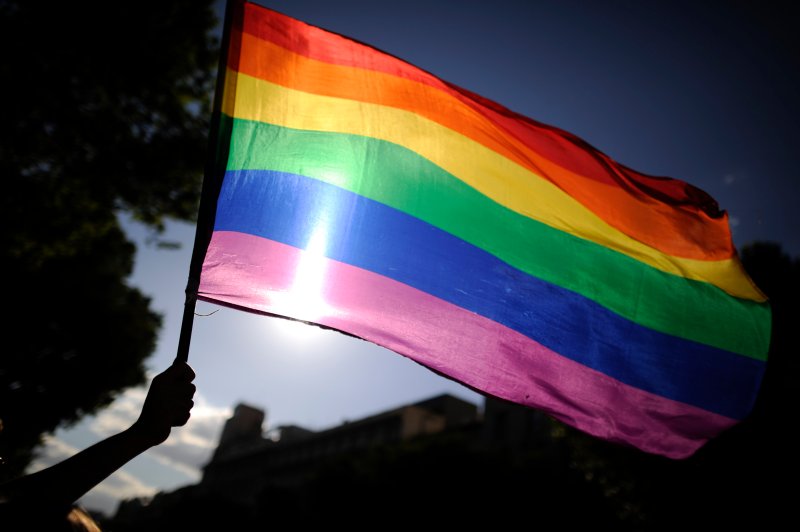
The National Post recently had an article titled, Christian school expels student who posed with rainbow birthday cake outside class, which reported that Whitefield Academy in Louisville, Kentucky, a private school, revealed it would expel students for living a lifestyle that does not align with Christian beliefs, and apparently that is exactly what they did. This Kentucky Christian school expelled a student after officials found a picture of her posing with a rainbow birthday cake. In the photo, the student of the Academy wears a long-sleeve sweater, with a rainbow on it, and she is sitting in front of a rainbow-coloured cake. For those who may not know, the rainbow is associated with LGBTQ pride. The Academy sent an email to the family outlining that the offending student, their child, showed “a posture of morality and cultural acceptance contrary to that of Whitefield Academy’s beliefs,” and the photo was the last straw in a series of “lifestyle violations.” Some Christian groups reject people who identify as LGBTQ. The mother of the student says that her daughter is not gay, not that it matters.

Rainbow flag  (Photo credit PEDRO ARMESTRE/AFP/GettyImages)

Stories like these infuriate me! Why? Because this student attending Whitefield Academy is a victim of bullying.  Legal Match defines bullying as “the use of intimidation to achieve a state of dominance over another person. Bullying can involve conduct such as, threats, force, coercion, aggressive or offensive behaviour.” The Kentucky student is being forced to change her ways, or risk being expelled from the school she chose to attend. That means the student was bullied! This is the use of coercion, or intimidation, so the school can achieve dominance over their students; to force students to comply with their belief system. That means they are bulling. Let’s call this what it is. This is religious bullying. The W. Y. Alice Chan website says “religious bullying occurs when a religious…person chooses to intentionally or unintentionally degrade another person emotionally, mentally, or physically based on: the bullied individual’s actual or perceived religious…identity, or the doctrines or practices of their belief.” In short, degrading another because someone’s religious beliefs do not align with theirs.

What is this type of behaviour really about? This is yet another story about intolerance, cold-heartedness, and exclusiveness of another.  American political activist, Rabbi Lerner, calls this ‘desanctification’, which is not being able to see the divine in the other. French philosopher, Pierre Teilhard de Chardin called it “dehumanization,” which is not being able to see the humanity in the other.

Barbara Coloroso  is an international bestselling author and is an internationally recognized speaker and consultant on parenting, teaching, school discipline, positive school climate, bullying, cyber bullying, grieving, nonviolent conflict resolution and restorative justice. I’ve never had the honour of hearing her speak, but some of my colleagues have. In her book, The Bully, The Bullied, and the Bystander, she says,

 Bullying is not about anger, it’s about contempt, a powerful feeling of dislike toward somebody considered to be worthless, inferior, and undeserving of respect. Contempt comes with three apparent psychological advantages that allow kids [or adults] to harm others without feeling empathy, compassion or shame. These are: a sense of entitlement, that they have the right to hurt or control others, an intolerance towards difference, and a freedom to exclude, bar, isolate and segregate others.

I like the way Ms. Coloroso defines bullying, and it applies to this story. The private Christian school is showing a powerful dislike toward the LGBTQ community and this student because she is perceived as being connected to the community. The community seems to be “considered to be worthless, inferior, and undeserving of respect.” The school appears to think it has the right “to harm others without feeling empathy, compassion or shame.”  It appears the school has “a sense of entitlement, that they have the right to hurt or control others, an intolerance towards difference, and a freedom to exclude, bar, isolate and segregate others.”  By all definitions, the school is bullying. Just because someone has different beliefs, or disagrees with your beliefs, doesn’t make their victims any less human. Every human deserves respect, regardless of what they may believe.

In fact, this is the stand of the United Nations (UN). In the UN’s Universal Declaration of Human Rights, it says in Article 1:

 All human beings are born free and equal in dignity and rights. They are endowed with reason and conscience and should act towards one another in a spirit of brotherhood.

Article 2 states,

Everyone is entitled to all the rights and freedoms set forth in this Declaration, without distinction of any kind, such as race, colour, sex, language, religion, political or other opinion, national or social origin, property, birth or other status…

As I said in my last post, there is a very simple solution to bullying, and that is the Golden Rule, which says, “Do unto others as you would have them do unto you.” Ironically, there are 6 scripture texts in Christian scripture that say this in one way or another. They are Matthew 7:12, Luke 6:31, Matthew 22:39-40, Mark 12:31, Romans 13:8-9, and Galatians 5:24. In my view, the behaviour of the Academy is unchristian, and hypocritical, since Christians are supposed to emulate Jesus Christ. Jesus was one of the most tolerant, understanding and accepting people ever, as Christian scripture says Jesus ate with many tax collectors and sinners (Mark 2:15). Tax collectors in biblical times were Jews who worked for the hated Romans. They were seen as traitors who enriched themselves at the expense of their fellow Jews. So, for Jesus to eat with them was a big deal. If every person lived by this simple rule, bullying would stop. It would make for a better world.

Bullying is Epidemic!

From CBC News

Earlier this month, I read a news article which I found quite disturbing, although this story not entirely surprising considering the current climate we live in. On October 7, a 14-year-old student, while his mother was with him, was fatally stabbed outside a Hamilton, Ontario, Canada High School. According to CBC News, four  teens were arrested; a 16-year-old male and a female, an 18-year-old male and a 14-year-old male, all charged with first-degree murder. Sadly, this is not the first teen killed by bullies, and then there is the problem of bullied teens committing suicide.

Global News says the family of the teen victim alleges that bullying was a persistent problem in the boy’s life and that the school never addressed the concerns. Canada News says, all five of those investigated are current or former students of the Hamilton high school. The victim’s mother claims the school and board knew about her son’s bullying, but little was done to stop it. “For a month, we’ve been trying to get this dealt with,” she said in tears. Both the school board and Hamilton police have confirmed they were notified of bullying incidents. Investigators were initially hesitant to comment on whether or not bullying and the attack were directly connected.

The Global News article, Experts say zero-tolerance policies aimed at stopping bullying aren’t working, quotes Carol Todd, an educator with a Vancouver-area school board, and whose 15-year-old daughter took her own life in response to violent bullying, said:

“We talk about bullying and we talk about how we can combat it, how can we end it. Are we doing enough to talk about the aspects of compassion, empathy, kindness and respect? Are we teaching our young people how to be respectful to other people and what to do?”

Ms. Todd is right. I’ve worked in the school system for 35 years, and I have never seen a curriculum that focuses on the aspects of compassion, empathy, kindness and respect. I taught Religious Studies in the Catholic School system, but even in the Religious Studies curriculum there was very little focus on those aspects, at least at the high school level. As Todd says,  curriculum focuses on preparing students for university and not on teaching young people about healthy human interaction.

Todd went on to say a common approach involves anti-bullying advocates making a one-time appearance in schools and delivering a lecture to students. She says, “In the school system, when you bring in an anti-bullying advocate now, kids are turning off their ears,” she said. “They’re tired of the conversation. We have to figure out different ways.” That has been my experience. Students listen to a speaker, then forget about it. I have observed little change in their attitudes or behaviour after a talk.

Debra Pepler, a psychology professor who’s done extensive research on aggression in children says,

“Schools are measured on how well they teach literacy and numeracy and science but … social emotional development should be included and it should start in…kindergarten.”

from http://www.dailymail.co.uk

She said the “zero tolerance” approach popular among many school boards involving punitive strategies do nothing to address the root causes of bullying and wind up reinforcing the kinds of behaviour they’re meant to eliminate.

I have to agree with Ms. Pepler. Every school I have taught in has had a “zero tolerance” policy regarding bullying, yet bullying was a big problem in every school I worked in. These policies are great, but virtually impossible to enforce. In my experience, bullying occurs subtly, occurring in locations teachers are rarely in—such as washrooms—or carried out discretely as to not be noticed by teachers. “Zero tolerance” policy is great, but it doesn’t work!

What is the answer then? In my opinion, there needs to be more focus on teaching students about healthy human interactions. Psych Central’s article, Bullying: A Problem That Starts and Ends at Home, says

Research shows that a harsh or negative parenting style is more likely to produce children who are bullies and victims of bullying than an emotionally warm environment with clear rules and supervision. Negative parenting includes obvious offenses like abuse and neglect, but also subtler forms of negative role modeling such as name-calling, threatening, manipulating and persistent teasing. Children learn from the way they’re treated, as well as the way their parents treat each other and the way their parents talk about other people.

Home is where empathy is learned or not learned, and school is where the lessons learned at home get played out. If relationships at home are based on fear and intimidation, children are more likely to use the same tactics with their peers. School bullies and victims are significantly more likely to report being physically hurt by a family member or witnessing violence at home than children who had not been bullied. Kids who are involved in bullying are also more likely to abuse drugs or alcohol and are at higher risk for depression and suicide.

Bullying is a learned behaviour, mostly learned at home, and therefore bullying can be unlearned. The ideal solution is to educate parents on bullying, but that is easier said than done. If empathy is not learned at home, then we as educators have a duty to teach it. The reality is, bullies are hurting people who need to be taught that taking their hurt out on other people is unacceptable.

STOP A BULLY  is a registered national charity in Canada, and has an anti-bullying program. Their website shows a study done by the University of British Columbia, based on 490 students (half female, half male) in Grades 8-10 in a British Columbia city in 1999, that reveals
64% of kids had been bullied at school, and that 64% of students considered bullying a normal part of school life. What I found particularly disturbing is that 61-80% said bullies are often popular and enjoy high status among their peers. I have personally seen this to be true. Regarding the ‘on-line’ world, 1 in 5 Canadian Teens have witnessed online Bullying, so it is clearly a huge problem in our world, and teen bullies typically become adult bullies. There is no shortage of bullies in governments and in our work environments. It is time to do something to address the bullying problem our world has.

Dan Pearce,  American author and blogger, says “People who love themselves, don’t hurt other people. The more we hate ourselves, the more we want others to suffer.” How true that is!

Young People Who Inspire Me (Part Two)

A commentary on social activism.

In my last post, Young People Who Inspire Me (Part One), I talked about Greta Thunberg, Áine Peterson, and Malala Yousafzai, three young people who inspire because they are making an impact in our world. I would like to continue with that same theme.

Greta Thunberg

First, an update on 16-year-old Greta Thunberg from Sweden. She is participating in the first ever Youth Climate Action Summit which brings youth climate campaigners together from more than 140 countries and territories to share their solutions to climate change on the global stage, and deliver a message to world leaders that we need to act now.

In her address to the UN Youth Climate Summit, she said, “Yesterday, millions of people across the globe marched and demanded real climate action, especially young people. We showed that we are united and that we, young people, are unstoppable.” (see Greta delivers message). Her phrase, “young people are unstoppable,” caught my attention and I hope she is right since it is the youth that have  the most to lose.

CBC’s article, Protest for Climate Action, reported that millions of youth were taking to the streets in roughly 150 countries around the world on September 20,  as part of a global strike demanding world leaders gathering at a UN climate summit to adopt urgent measures to avert an environmental catastrophe. This worldwide strike was inspired by Greta, and these were her words to the demonstrators in New York:

“Right now, we are the ones who are making a difference. If no one else will take action, then we will…We demand a safe future. Is that really too much to ask?”

I am excited about what is happening, as it gives me hope for change. I believe the world must change and UN Secretary-General António Guterres who spoke at the UN Youth Climate Summit said it best when he said,

“I have granddaughters. I want them to live in a livable planet. My generation has a huge responsibility. It is your generation that must hold us accountable to make sure we don’t betray the future of humankind.”

I don’t have grandchildren yet, but I want my children and future grandchildren “to live in a livable planet.” I’ve seen many science fiction movies that portrayed an uninhabitable world because we humans left the planet in ruins. The UN Secretary-General is right. The youth must hold my generation accountable. Let’s be honest; my, and previous generations, have exploited planet Earth for profits. American politician, Bernie Sanders, said, “What a disgrace that it takes a 16 year-old to tell world leaders what they won’t acknowledge.” He is right! So, I say, bravo, to Greta. I support your cause and wish you success.

Craig Kielburger, age 12

Craig Kielburger, a Canadian human rights activist and social entrepreneur, is another young person who inspires me. I used him as an example  of how one person can make a difference when I taught high school Social Studies. He is the co-founder, with his brother Marc Kielburger, of WE Charity, as well as WE Day.  In 2008, Kielburger was named a Member of the Order of Canada.

Craig Kielburger’s story starts in 1995, when at age 12 years old, he saw the headline, Battled child labour, boy, 12, murdered, in the Toronto Star newspaper. This was a story about a young Pakistani boy, a child labourer, turned child-rights activist who was killed for speaking out against the carpet industry. Kielburger did research on child labour and asked his grade seven teacher to speak to his classmates on the topic. Several students wanted to help, and the group of pre-teens started “Kids Can Free the Children” (later named WE Charity).

In December that same year, Kielburger travelled to Asia to see for himself the conditions of child labourers. While there, he learnt that then Canadian Prime Minister, Jean Chrétien, was travelling to India. He requested to meet with Mr. Chrétien, and was initially denied.  Kielburger was granted 15 minutes with Chretien, and he advocated for Canadian action on the issue of child labour, making headlines across Canada and internationally.  Kielburger attracted international media attention with features on 60 Minutes and the Oprah Winfrey Show.

Remember, this young man was 12 years old when he was inspired to act against injustice. I have taught many 12 year-olds, and don’t recall any of them being that aware of injustice in the world.

Time Magazine’s article, The School Shooting Generation Has Had Enough, tells the story of the Never again MSD movement. The days after the Parkland shooting—On February 14, 2018, a gunman opened fire with a AR-15 style semi-automatic rifle at Marjory Stoneman Douglas High School in Parkland, Florida, killing 17 people and injuring 17 others—Parkland kids publicly called out the NRA’s influence on national politics, and shamed the leaders they considered responsible for the nation’s slack gun laws.

Cameron Kasky in centre

The Never Again MSD group was co-formed by Cameron Kasky and his high school friends in the first four days after the shooting.  After a vigil, Kasky invited Wind and Whitney (the other cofounders) to his house, and they came up with the name “Never Again.” The next three days after the shooting, the group gained over 35,000 followers on Facebook. The group organized a nationwide protest on March 24, 2018, where nearly a million kids across the country left class for the National School Walkout to protest the school-shooting epidemic.

The Never Again group has lost the attention of the media and is no longer making headlines. Since the groups inception, many attempts to discredit the Never Again movement have been attempted in the form of verbal attacks and misinformation by right-wing Republican leaders. Wikipedia provides specifics.

Many have spoken out about school shootings. Here are some of the most noteworthy in my opinion. Richard Patrick, an American musician, singer and songwriter, said:

“We live in a crazy time. Every other week, there’s a school shooting. There’s always some nutty thing and I’ve always wanted to kind of understand the crazy.”

Florence Yared, a Parkland school shooting survivor, spoke in Tallahassee, Florida. This was where five people were shot and wounded at the University Village Shopping Center. She passionately said:

“The right to bear arms … does not and never will overpower the individual’s right to life, liberty and the pursuit of happiness…We cannot protect our guns before we protect our children.”

Brandon Wolf, Pulse nightclub shooting survivor, also spoke in Tallahassee. He said:

“After first graders were gunned down at Sandy Hook, what did you do? Not a damn thing. After 49 people, including my two brothers, were murdered at Pulse, what did you do? Not a damn thing. You plugged your ears and turned your eyes and hoped that we would stop talking. Now we’re here again. 17 people are dead. 14 of them are children. And what did you do yesterday when given the chance to do something about it? Not a damn thing.”

According to Wikipedia, there have been 28 school shootings in 2019, and that doesn’t include the many that have been thwarted. The young people behind the Never Again MSD movement have just cause.

Young people—high school aged when they started—are leading the way for change and speaking out against injustice. Why? Because they have Didaskaleinophobia, the fear of school or fear of going to school. An American High School student, Jillian French, said, “We shouldn’t have to be scared (when we leave for school) that we are not going back home.” Like Greta Thunberg, high school aged youth have to tell leaders in the U.S. what they won’t acknowledge.

I applaud these young people, support their cause, and wish them success! Thank God for youth! They just might save the world.

Is Hate the New Norm?

A commentary on the increase of hate crimes.

Lately I’ve been seeing a lot of news reports about hate crimes; reports that I find both disturbing and alarming. Here are a few examples.

I recently read about a homophobic attack on a lesbian couple in London, England. The couple were travelling on a city bus where they were assaulted by a group of teens after they allegedly refused to kiss each other on demand (see Homophobic Attack).

The New York Times reported that in “Staten Island, the phrase ‘Synagogue of Satan’ was spray painted on a wall outside of a Jewish school. In Brooklyn, a pro-Hitler message was scrawled on a poster outside a Jewish children’s museum whose mission is to fight anti-Semitism. In Manhattan, two rainbow pride flags were set on fire outside of a gay bar.” (see Swastikas and Burning Pride Flags).  Another New York Times article reports “The number of reported murders, rapes and robberies in New York is lower now [2019] than it was a year ago…These recent figures show that the drop in crime that began in the mid-1990s has largely continued…Reported hate crimes are up 64 percent compared with this time a year ago. A majority of those incidents were targeted at Jews, officials said” (see Hate Crimes Up).

In my country, Canada, CBC News reports that “the number of police-reported hate crimes reached an all-time high in 2017, largely driven by incidents targeting Muslim, Jewish and black people, according to Statistics Canada data… [saying] hate crimes have been steadily climbing since 2014, but shot up by some 47 per cent 2017, the last year for which data was collected” (see Hate crimes reach all time high).

This is just a small sampling of articles I’ve seen about hate crimes. Not only was I alarmed and disturbed, but began to wonder if hate was the new norm. One of last times hate was so prevalent on our planet was pre WWII, during a time when Hitler set out to eliminate Jews, LTQB, and other undesirables. It was also the time of the Nanking massacre in China by the Japanese. The last time the world went down a path of hate; a path lead by Hitler and other extremist leaders, WWII occurred.

I used to naively think that the human race had learned from WWI and WWII and would never make that mistake again. Now I am not so sure. One thing that strikes me, is many of those who are perpetrating hate claim to be Christians. THEY ARE NOT TRUE CHRISTIANS.

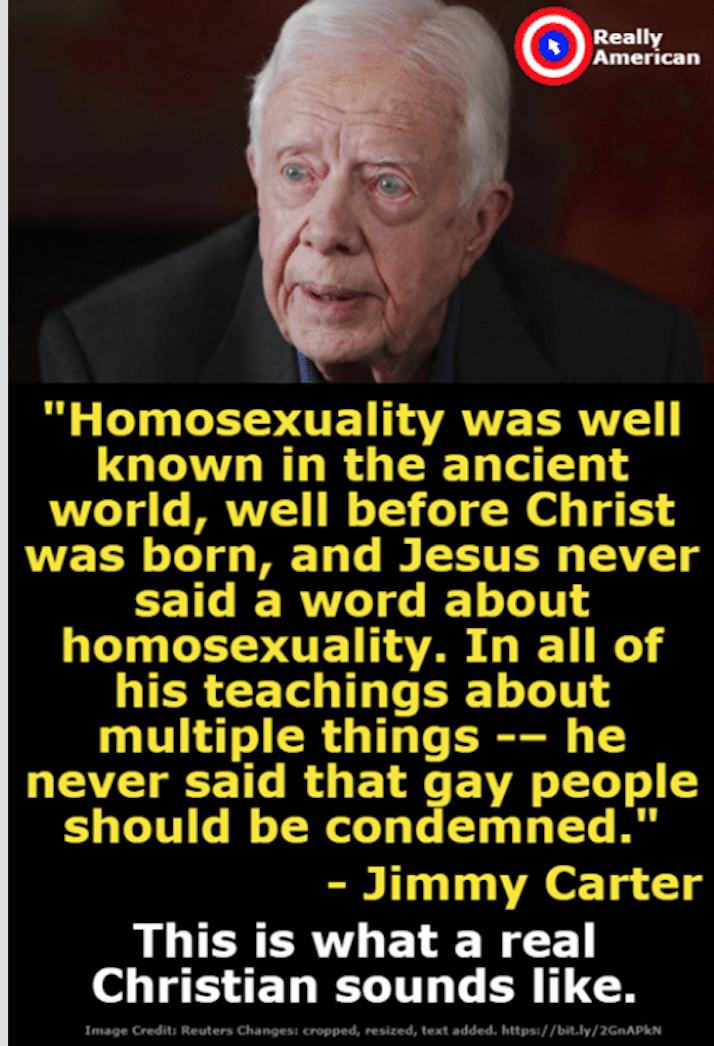
A meme recently went across my Facebook feed which is a quote from Jimmy Carter, the 39th president of the United States.

I agree with the former US president. Homophobes are not real Christians! I saw another meme on my Facebook feed.

That sums it up. Hate is the choice. We cannot choose homosexuality no more than we can choose to be heterosexual. It wasn’t a choice for me. I was just attracted to the opposite sex. I did not choose to be Caucasian. I did not choose to be born in Canada, although I am grateful I was. I did not choose to  come from European heritage. I can, however, choose to hate because I fear someone different than me. I can also choose to include and love those different from me.

Pope Francis is quoted as saying: “A person once asked me, in a provocative manner, if I approved of homosexuality. I replied with another question: ‘Tell me: when God looks at a gay person, does he endorse the existence of this person with love, or reject and condemn this person? We must always consider the person” (see  America Magazine in 2013). Pope Francis also said, “It is deplorable that homosexual persons have been and are the object of violent malice in speech or in action. Such treatment deserves the condemnation from the church’s pastors wherever it occurs.”

Where is all this hate coming from. One word answers that. FEAR. Much of that fear is propagated by extremist leaders.

Kevyn Aucoin, American makeup artist, photographer, and author, once said:

Fear is the most debilitating emotion in the world, and it can keep you from ever truly knowing yourself and others – its adverse effects can no longer be overlooked or underestimated. Fear breeds hatred, and hatred has the power to destroy everything in its path.

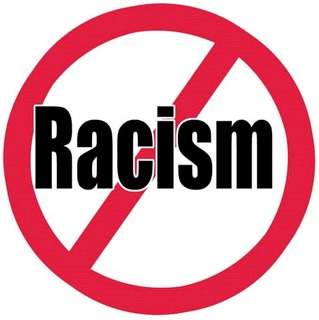
How true that is. Angela Merkel, former Chancellor of Germany, once said, “Hatred, racism, and extremism have no place in this country.” I agree with Ms. Merkel wholeheartedly. Hatred, racism, misogynism, anti-immigration, or anti-tolerance of any kind has no place in any country, especially my country.

The bottom line is unless humanity makes the choice to love one another, humanity is headed down perhaps another dark path like those that caused WWI and WWII.  After all,  Jesus commanded in John 13:34 of the Christian scriptures,

“I give you a new commandment, that you love one another. Just as I have loved you, you also should love one another.”

This is what a true Christian does!

These Pathogens Have Not Been Eradicated?

A commentary on the state of our world.

A Pow Wow my wife and I attended two years ago.

Last week my wife, a friend, and I attended an event called, “Meet the Inuit.” It was a series of talks by Inuit, Metis and Indigenous speakers, along with cultural performances. Many speakers said things that caught my attention. One Indigenous speaker talked about the clash of two cultures; Indigenous, Inuit, and Metis cultures verses European culture.

This made sense to me. Indigenous culture is present orientated—time conscious without clocks—whereas European Canadians are future oriented—time conscious with clocks. Indigenous Canadians (likely all Indigenous peoples) share their possessions freely—at least traditionally,  cooperate, are spiritual, and live in harmony with nature whereas European Canadians are savers and hoarders, compete for goods, driven by capitalism, and try to conquer nature. The world views of these two groups are vastly different.

Some of the speakers shared their experiences in the Residential Schools. It always strikes me when a Residential School survivor speaks of being taken away from their parents at ages 4 or 5, given haircuts and new clothes, told never to speak their native tongue, kept from their siblings who were attending the same school, and forced to stay several years in an unwelcoming large building. One speaker even told us how his brother literally was taken off the street by government agents without his parents being informed. His parents thought his brother had gone  missing.

CBC News has an article titled, Genocide against Indigenous Peoples, reports that the Canadian Museum for Human Rights in Winnipeg, Manitoba, now deems the treatment of Indigenous Peoples in Canada a genocide. Previously, the museum had said Indigenous Peoples faced cultural genocide rather than genocide.

The United Nations’ convention on Genocide (1948) says a genocide is:

  1. causing serious bodily or mental harm to members of the group
  2. deliberately inflicting on the group conditions of life calculated to bring about its physical destruction in whole or in part
  3. forcibly transferring children of the group to another group.

As The Star’s article, Cultural genocide?  says;

Canada did not pack Indigenous people onto train cars and send them to be gassed, or march them into fields and execute them with machine-gun fire. However, our country committed not “cultural” genocide, but just regular genocide.

We forcibly took children from families — sometimes at gunpoint — and flew them to remote locations they could not escape — sometimes in tiny handcuffs — where they were submitted to a program of forced labour and “education” designed to destroy their cultures and civilizations. This desire to destroy cultures seems to be the reasoning for various public figures’ use of the adjective “cultural” before genocide. The other reason, I presume, is that some cling tightly — and childishly — to the idea that Canada has always been on the side of goodness and justice, and they find it very hard to accept, admit, and announce that we are a country that committed a program of genocide that lasted for many decades.

Results of Rwandan Genocide

Let’s call “a spade a spade.” Canada committed genocide against our Indigenous, Inuit and Metis people; a genocide no different than the ones committed by Nazi Germany during WWII, or Rwanda in 1990s.  I must confess, I was one of those Canadians that held to the idea that Canada has always been on the side of goodness and justice. I no longer think that, and I now recognize that Canada has a dark past. Let us not forget the Japanese Internment during WWII; another dark part of our history.

One of the Indigenous speakers talked about how our greatest hurdles come from within. He spoke about what he called, The Six Social Pathogens.

Merriam-Webster defines a pathogen as a specific causative agent of disease. It typically refers to a bacterium or virus, but in the context of the speaker, a pathogen is a causative agent of the disease of racism. The six pathogens are: assumptions, presumptions, stereotyping, profiling, bias (for, or against), and misappropriation of feelings. This speaker says everyone—whether we’re aware of it or not—has some or all of the for mentioned pathogens working within us.

Before I go any further, let’s define the six pathogens. An assumption refers to something that is accepted as true without proof, whereas a presumption refers to an idea that is considered to be true on the basis of probability. Stereotyping is a set idea that people have about what a person, or group of people, are like. Profiling is the act of suspecting or targeting a person on the basis of observed characteristics or behaviour. A bias is a particular tendency, trend, inclination, feeling, or opinion, especially one that is preconceived or unreasoned.  Misappropriation means to put to a wrong use, so misappropriation of feelings is putting our feelings to a wrong use.

These six pathogens don’t just apply to attitudes towards the Indigenous, Metis, and Inuit people. They can apply to any group. As I observe what is happening in my country and the world, I would argue that these pathogens are presently very active. A Statistics Canada report in 2016 (the latest statistics I could find), revealed that the number of violent hate crimes rose 16% from the previous year, driven by increases in common assault, criminal harassment and uttering threats.” A 2014 Statistics Canada report found that, in two-thirds of cases, victims of crimes don’t report these hate crimes to the police.

As long as these six pathogens are alive and active, and there is a “us verses them” attitude, racism, prejudices, hate crimes, and so on, will continue. As long as we identify with a tribe instead of the human race, there will be conflict. As long as Christians, or Jews, or Hindus, or Muslims, or Buddhists think their faith is the right faith, there will be religious conflict. As long as there is masculism, there will be feminism. As long as feminist seeks to promote the rights and equality of women—which they should—and see themselves as equal with men, there will be misogyny, which is the disrespect and oppression of women.

As long as conservatives, as opposed to liberals, think their philosophy is best, there will be political tensions. As long as there are people who believe in “White Supremacy,” there will be racism and hate crimes. As long as there is ethnocentrism—The Cultural Superiority Complex, there will be anti-immigration. I could go on and on. Neale Donald Walsch, in one of his Conversations With God books, said, “Your way is not the only way. It’s just a way.”  We humans need to integrate that. Unless humans are willing to understand and accept differences, our planet is headed down a dark path.

Now, I had to ask myself: Do I have these pathogens? When I thought about it, and was completely honest with myself, the answer is yes. Have I made assumptions, or presumptions? Yes. I once believed Christianity was the superior religion. Did I stereotype? Yes. I once thought that people living on the streets were just too lazy to get a job. Did I profile? Yes. I targeted “unique” individuals in high school. Did I have biases. Yes. I had preconceived ideas about Indigenous people—they were lazy, drunks, etc.—until I educated myself. Were my feelings misappropriated? Yes.  I had my opinions about the LGBT community until I got to know some of their members. I would judge people based on first impressions, when I knew nothing about them, or knew anything about their story. In other words, I didn’t follow the Muslim proverb:  To understand a man, you’ve got to walk a mile in his shoes, whether they fit or not. Other variations of this proverb are: walk a mile in someone else’s moccasins, put oneself in another’s shoes, put oneself in another’s place, walk a mile in someone else’s shoes, and see the world through someone else’s eyes. Now, I try to do this; I try and  understand others and avoid judging them. I’m not saying I’m always successful, but I try.  If humanity did the same, perhaps our planet would be in a better place.

Oh, Those Stereotypes.

A commentary on stereotyping.

A stereotype is an over-generalized belief about a particular group of people. Business Insider’s article, 5 mistaken ideas about Americans, says a common stereotype of Americans throughout the world, is Americans are loud, arrogant, and entitled. That is certainly a stereotype that many Canadians hold.

The Globe and Mail’s article, These days, Canadians aren’t big fans of the U.S, published in October 2018, says,

In its report, the Pew Research Center found that “just” 39 per cent of Canadians had a favourable opinion of the U.S., the lowest percentage in polling since 2002. Two years ago, during the final stretch of Barack Obama’s presidency, 65 per cent of Canadians expressed a favourable opinion of their southern neighbour.

The drop was even more dramatic for Mr. Trump himself. “Only” 25 per cent of Canadians have confidence in Mr. Trump, the report said – a slight uptick from 2017, but plummeting from 83 per cent in the final year of Mr. Obama’s tenure.

Now that is striking, and in my experience accurate as pretty much anyone I talk to, has a negative view of Americans. The reality is, America gets a bad rap because of the current resident of the White House.  He certainly fits the American stereotype of being loud, arrogant, and entitled. News reports that us Canadians hear about white supremacy and the anti-immigration rhetoric coming from the United States doesn’t help either.

The Globe and Mail article goes on to say,

The trends in Canada – a two-year erosion of U.S. favourability and presidential ratings – were pervasive among America’s allies and neighbours, the survey suggests. In Mexico, positive views of the U.S. have decreased by an even greater percentage than in Canada since the end of the Obama presidency.

The negative view of the United States is prevalent throughout the world.

I believe regular, everyday Americans are getting a bad rap. Let me tell you why, based on my experience.  My wife and I just returned two weeks ago from a vacation in Maui, Hawaii. It was a wonderful trip of sun and beaches after a winter from hell. But this is not my point. Being we were in one of the American states, as expected, we met American citizens from all over. We met people from California, Tennessee, Kentucky, Oregon, Montana, New York, Washington, Arizona—I’m sure I’m missing some—and Hawaii.  I can honestly tell you that not a single one of them were loud, arrogant, or acted entitled. In fact, the only loud, arrogant person we met, ironically, was a Canadian.

An interesting side note, the vast majority of Americans that we met never spoke of their president or talked politics. I may be wrong, but Americans almost seemed embarrassed by their politics. We did meet a few people who made of point of telling us that their country was a mess because of Trump.

So, the question is: Is the stereotype wrong? No.  The article, All Stereotypes Are True, Except, by Psychology Today,  says,

Many stereotypes are empirical generalizations with a statistical basis and thus on average tend to be true. If they are not true, they wouldn’t be stereotypes. The only problem with stereotypes and empirical generalizations is that they are not always true for all individual cases. They are generalizations, not invariant laws.

There are plenty of Americans who are loud, arrogant, and entitled, but as far as that goes, there are plenty of Canadians who are as well. I’ve met many of them. I’m sure there are in every country.

Is there a danger with Stereotyping?  Yes. Stereotypes encourage prejudice.  How?  Another Psychology Today article, The Psychology of Prejudice and Racism, says,

By definition, stereotypes are limiting and disregard people’s individuality. They also lend themselves to negative and derogatory assumptions. When that happens the stereotype blends into prejudice.

As I mentioned earlier, not a single American that we met in Maui was loud, arrogant, or acted entitled. How does one explain that? Well, I can only speculate, but of all the Americans we met, they all were willing to travel and try new experiences, even if it was only in their own country. Many mentioned that they’ve been to Europe or other places, though. Those that travel meet people of other races and cultures, and become more tolerant of difference.

Intolerance can also be built by meeting and getting to know immigrants. If people—Muslims, Christians, Blacks, White, Indigenous, and so on—get to know one another, prejudices and racism would decrease. The reality is, we are all human beings with the same pains, desires, struggles, etc. This is what William Shakespeare is saying in the play, The Merchant of Venice.

In Act 3, scene 1 of the play, Shylock confronts two provoking Christians saying, “I am a Jew. Hath not a Jew eyes? Hath not a Jew hands, organs, dimensions, senses, affections, passions… warm’d and cool’d by the same winter and summer, as a Christian is? If you prick us, do we not bleed? If you tickle us, do we not laugh? If you poison us, do we not die…”

It seems this struggle has gone on for centuries.

Does creating friendships with individuals from other cultures and races reduce prejudice? Absolutely!  The Psychology Today article mentioned earlier says,

Positive emotional experiences with members of different groups [people from other cultures or races] can also reduce negative stereotypes. Having close friends from different groups is especially effective in this regard.

I would encourage everyone to put away their fear of other cultures and races, and instead ,talk to them, whether that be through travelling or meeting new immigrants. The world will be a better place because of it.

We Canadians Have Something to be Proud of.

A commentary on the Canadian Spirit

Every day I thank the Universe/God that I live in Canada. I am a proud Canadian. Let me tell you why.

The article, 7 Stereotypes About Canadians That Are Too Real, says that:

Canadians are notorious for their politeness and niceness. If you find yourself in a grocery store in Canada, the classic line you’ll hear from Canadians when they want to move through a tight aisle is “just gonna sneak past you there.” Sometimes, there’ll be enough room to fit two trucks, yet Canadians will still say “excuse me” to avoid alarming their neighbour casually looking at the canned goods section.

In fact, most Canucks are so polite that if you bump into one, they will probably apologize for standing in your walking space. When in doubt, Canadians err on the side of apologizing rather to avoid conflict.

In a BBC travel article entitled, Can Canada teach the Rest of us to be Nicer? it says,

We experience Canadian nice as soon as we reach customs. The US border guards are gruff and all business. The Canadians, by contrast, are unfailingly polite, even as they grill us about the number of wine bottles we’re bringing into the country…The niceness continues for our entire trip, as we encounter nice waiters, nice hotel clerks, nice strangers.

Canadian niceness is pure, and untainted by the passive-aggressive undertones found in American niceness (have a good day, or else!). It’s also abundant. Canada is to niceness as Saudi Arabia is to oil. It’s awash in the stuff, and it’s about time, I say, the rest of the world imported some.

In one recent list of rude countries as perceived by travellers, France, Russia and the UK were voted the rudest countries in the world, according to this list. The United States came in seventh place and Canada, I’m proud to say, came in 27th place out of 34 countries listed. The least rude countries on this list is Brazil and Caribbean. We’re not the nicest nation, but we’re rated pretty good.

There were two stories in the news this week that illustrated the truth behind the ‘Canadians are nice’ stereotype. Now, let’s be realistic. It’s a stereotype. Simply Psychology defines stereotype as “a fixed, over generalized belief about a particular group or class of people.” Not all Canadians are nice. I’ve met many unfriendly Canadians. Having said that, I believe most Canadians have integrity, are benevolent, and are altruistic. Here are two examples.

The CTV News article, Closed Kingston grocery store left unlocked, reports that shoppers walked into the downtown Kingston Food Basics store on Family Day—a statutory holiday in some Canadian provinces–when the store was closed, but the front doors were accidentally left unlocked. When a store manager arrived at the store, they found everything still in place. The manager was quoted saying, “Nobody took anything out of the store.” He also said some customers left money on the counter and notes; informing the manager of what they took. Police praised customers for doing the right thing. “It’s rare anywhere. We’re pretty impressed with our citizens that they’d be so honourable, honest to leave a bunch of money for the groceries they were taking.” said a Kingston Police officer. It is fair to say that Canadians value integrity and community. If that doesn’t illustrate integrity and ‘niceness’, I don’t know what does.

The news report, ‘They’re Heroes!’ reports of another example of the “Canadians are  nice’ stereotype. At Grouse Mountain Ski Resort near Vancouver, British Columbia, a group of quick-thinking thirteen year old youths cooperated to rescue an 8-year-old boy who was dangling from a ski lift. The group of teens heard the boy’s cries for help as a man who was on the lift with him—presumably his father—held onto him, unable to pull him back up. As the young boy dangled more than 6 metres (20 feet) above the ground, the group of five 13-year-old friends raced to grab nearby fencing, which they used as an improvised safety net. You can watch the video of the event in the news report.

Youth are often criticized as being trouble makers. The Seventeen Magazine’s article, 11 Ridiculous Stereotypes About Teens That Need To Go Away, list stereotypes such as,

  • Youth are addicted to social media.
  • Teens are all lazy.
  • Youth only care about themselves, and are unwilling to help others.

The ski lift story certainly counters the last stereotype. I know from working with youth for 35 plus years that most youth are compassionate, caring people.

Stereotypes come from some sort of truth. I like to think that we Canadians are friendly people. That is why I am proud to be Canadian. Canadians—for the most part—are nice, kind, , compassionate people with integrity, and community minded citizens. That is why Canada has social programs like universal health care and low-income support. Perhaps that’s why Jane Fonda, an American actress, writer, and activist, said, “When I’m in Canada, I feel this is what the world should be like.” Or, Bono, Irish musician, and philanthropist, said, “I believe the world needs more Canada.”  Bill Clinton, 42nd president of the United States, once said, “In a world darkened by ethnic conflicts that tear nations apart, Canada stands as a model of how people of different cultures can live and work together in peace, prosperity, and mutual respect.”

There must be some reason these people hold Canada up as a model country. Are we (Canadians) perfect? Hardly! Can we do better? You bet. The list of rude countries as perceived by travellers I mentioned earlier listed Canada as the  27th ‘nicest’ country out of 34, so yes we can do better. Does Canada have problems? Of course.  Nonetheless, I think we have something to be proud of.

CNBC gives a list of the 10 top countries to live in. In its article, These are the 10 best countries in the world in 2019, Canada is listed in 3rd place, with Switzerland and Japan listed in 1st and 2nd respectively.  The United States is listed as 8th place.  Business Insider’s article, The 19 best countries to live in if you’re a woman, also lists Canada in 3rd place, with Sweden and Denmark in listed in 1st and 2nd respectively. The United States is listed as 16th place for 2019.  I for one won’t be happy until Canada is number one in both. Still, 3rd place is pretty good.

I say to all Canadians: Well done fellow Canadians, but we can do better. Let’s be a world leader in niceness. Nelson Mandela,  South African anti-apartheid  revolutionary, said, “It is in your hands to create a better world for all who live in it.” Let us make the world a better place as examples of the world’s friendliest people.