
In late September I saw this video in a news report.
Now I had seen many news reports about Aleppo before but this video really got to me. This video touched me on a deep level. The Canadian band, Nickelback, has a song called, “When We Stand Together”. The beginning lyrics are,
One more depending on a prayer
And we all look away
People pretending everywhere
It’s just another day
There’s bullets flying through the air
And they still carry on
We watch it happen over there
And then just turn it off
The song portrays exactly what I have typically done and likely most people in the world do. We see what is happening in Aleppo, and other conflicts on the news and at the end of the news broadcast, we “just turn it [the TV] off”. Our mindset is, “it doesn’t really affect me. It’s happening far away from me.” But this time was different. This video got to me. It showed the human toll of this tragic conflict. The video showed how innocent people are being harmed by a senseless civil war and the emotional cost to its first responders. We’re told that 250 000 innocent civilians are trapped in this city that is without clean water, functioning hospitals, and no aid. BBC News reports at least 18 people were killed earlier this month when trucks unloading at a Syrian Arab Red Crescent near Aleppo was attacked by fighter jets. The aid convoy was the result of a long process of obtaining permission and making preparations to assist isolated civilians after a ceasefire was negotiated. The attack occurred when the ceasefire failed.
I wondered what I could do. Donating for aid seemed to be pointless since aid was not reaching Aleppo, so I thought educating people. As a retired teacher that made sense. Maybe if there is enough of an outcry from the world’s people, the international community would do more. Maybe if enough of the world community said to the Syrian and Russian governments, “stop the bombing or else” things might change. I know it’s not as simple as this but peer pressure works.
So you, like I was, might be wondering what this conflict in Syria is all about. Here is some history based on information from Wikipedia.
 The war in Syria stems from the 2011 Arab Spring, a revolutionary upsurge of demonstrations and protests in the Arab world. The revolution started in December 2010 in Tunisia and spread. Major insurgencies occurred in Syria, Libya and Yemen. Civil rebellions occurred in Egypt and Bahrain. Large street demonstrations happened in Algeria, Iraq, Jordan, Kuwait, Morocco, and Oman, and some minor protests in Saudi Arabia. In Syria , the revolution escalated to an armed conflict after the government of President Bashar al-Assad violently suppressed protests that were screaming for Assad’s removal. The war is now being fought among several factions which include the Syrian Government, a loose alliance of Syrian Arab rebel groups, the Syrian Democratic Forces, Salafi jihadist groups, and the Islamic State of Iraq and the Levant (ISIL). Many of these factions receive substantial support from foreign governments.
The Battle of Aleppo began in July of 2012. Aleppo is the largest city in Syria with the Old City of Aleppo being a UNESCO World Heritage site. The ongoing war is between the Free Syrian Army, Islamic Front and other Sunni militants and the armies of the Syrian Government who are also supported by Hezbollah and Shiite militants as well as Russia. The government forces and their allies are also attacking the Kurdish People’s Defence Units. The Kurdish people are an ethnic group located in northern Syria as well as in other Middle Eastern counties. Kurdish nationalists are pursuing greater autonomy and cultural rights.
The battle for Aleppo has been marked by the Syrian army’s indiscriminate use of barrel bombs dropped from helicopters, killing thousands of people, and intentionally targeting the civilian population. This includes hospitals and schools. Hundreds of thousands have been forced to evacuate. On October 6th, 2016 President Assad offered amnesty to militants in the city, offering to evacuate them and their families to safe areas but the militants refused this proposal.
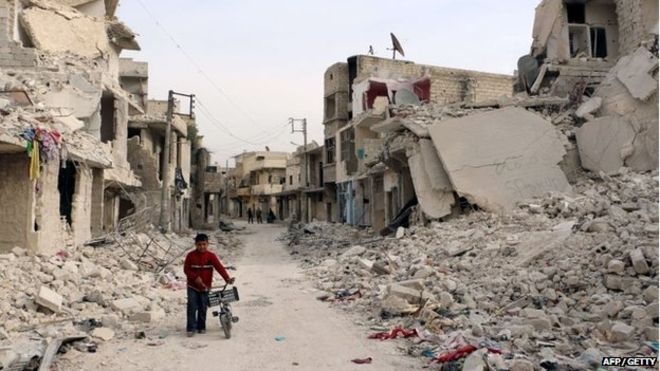
The battle has caused catastrophic destruction to the Old City of Aleppo, which I mentioned is a UNESCO World Heritage site. Here are some pictures taken by a drone showing the destruction of Aleppo.
In September 2012, Amnesty International, USA requested that the Geospatial Technologies and Human Rights Project of the American Association for the Advancement of Science (AAAS) to investigate human rights-related reports stemming from the escalating conflict in Aleppo. Their conclusions on the Conflict in Aleppo was,
Space-based monitoring of the conflict in Aleppo has revealed a steady and continuous trend of degradation to the city’s buildings and infrastructure, including residential, religious, commercial, and industrial facilities. Roadblocks and other makeshift fortifications have continued to proliferate, with over a thousand visible in the latest imagery. Other signs of military activity, such as shell craters, armoured vehicle tracks, and evidence of aircraft deployments are likewise visible, and are consistent with reports of ongoing combat involving heavy weaponry in civilian areas. Damage resulting from fighting has resulted in severe losses to the city’s cultural heritage, both in the city as a whole as well as the area designated as a UNESCO World Heritage site.
It saddens me to see a UNESCO World Heritage site destroyed. In case you didn’t know, a World Heritage Site is a place that is listed by the United Nations Educational, Scientific and Cultural Organization (UNESCO) as being of exceptional cultural or physical significance to humanity.
It saddens me even more to hear of the human suffering. The New York Times in its report, Why so many Children are Killed in Aleppo, tell us that roughly 250,000 people trapped in this Syrian city and about 100,000 are children. Children are the most vulnerable victims of the intensified bombings by Syrian forces and their Russian allies.
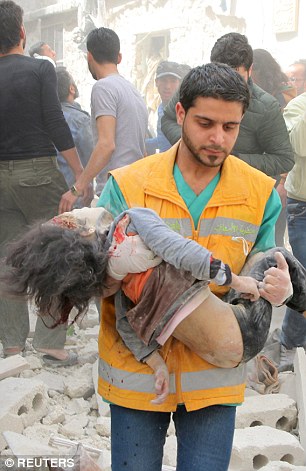 The Times article goes on to report that children in Aleppo face dire food and medicine shortages. Surgery and blood transfusions required for treating bomb wounds are practically impossible now. Medical workers have left children to die on hospital floors due to lack of supplies. Aid groups estimate that there are only 35 doctors remaining in East Aleppo, that is one for every 7,143 people, assuming a population of 250,000 people.
The reality is no one knows for sure how many people are trapped in Aleppo and how many are being killed. One person suffering, especially a child, is one too many. It all seems so senseless to see a world heritage site destroyed and learn of innocent people killed all because one man, Bashar al-Assad, a selfish leader who won’t give up his control of power. If the international community banded together to put serious pressure on the Assad government, maybe this nonsense would stop.
US Secretary of State, John Kerry, recently called for Syria and Russia to be investigated for war crimes since they keep hitting hospitals, medical facilities, children, and women (see The Guardian). I agree with Mr. Kerry as it appears to me that war crimes are occurring. War crimes are actions carried out during the conduct of a war that violates accepted international rules of war. There are 11 crimes which constitute grave breaches of the Geneva Conventions and applicable only to international armed conflict. These include willful killing and inhumane treatment, both of which have been violated. This would mean, in my view, Vladimir Putin and Bashar al-Assad are guilty of such crimes. It is time for the world to wake up and stop this senseless suffering, especially of innocent children.

 Sommer Season all year